
When breeding horses, a breeder must understand the basics of mating, as well as the breeds, seasons, and proper selection of horse pairs. Otherwise, the breed's purity may be compromised and the potential for population growth reduced. All these aspects are covered in detail later in the article.
How do horses reproduce in the wild?
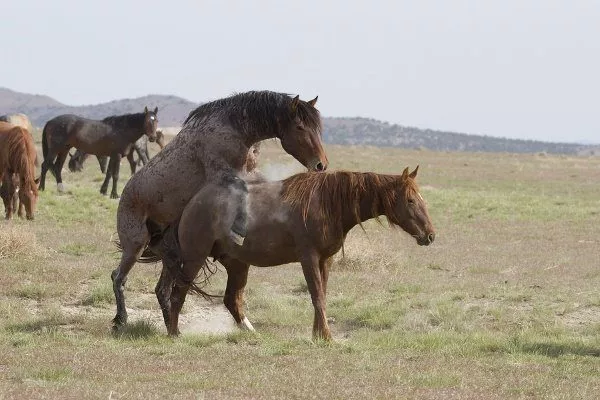
In the wild, horses live in herds in the same territory and under identical conditions. Nature itself regulates the size of a horse family. Mating occurs only for procreation, from spring to mid-summer.
A herd consists of a maximum of 12 mares, one of which is the so-called alpha female, and one stallion. The alpha mare leads the entire herd, chooses grazing areas, and, during breeding season, exercises absolute authority.
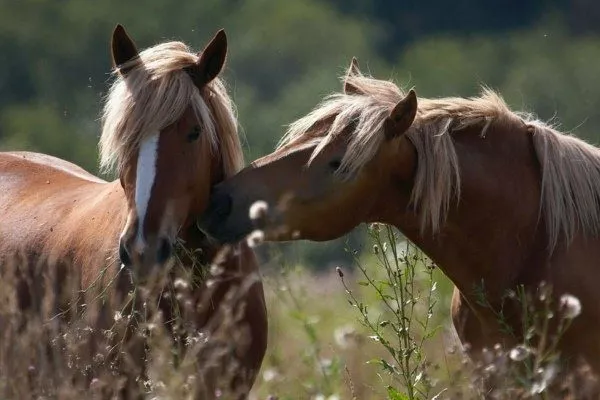
The stallion plays a protective role in the herd, leading the entire herd and mating with the other horses. He is ready to mate at any time, so he often mates with horses that have not yet entered heat. In this case, conception is impossible, but the mare may go into heat early.
During the heat, the horse changes its behavior towards the horse:
- her tail is slightly raised;
- head slightly tilted towards the ground;
- the hind legs are spread a short distance apart;
- makes sounds similar to a quiet squeal.
The stallion shows interest in her, bites her neck, sniffs her, etc.
The mating process can be repeated several times, increasing the chances of fertilization. A horse's pregnancy lasts on average 342-345 days. However, this period can occur earlier (prematurely) or later (post-term).
The process of natural horse breeding has its advantages and disadvantages. The advantages include:
- everything happens naturally;
- fertilization occurs at the peak of ovulation;
- the mare allows only strong, healthy stallions to approach her;
- the offspring are distinguished by robust health and increased chances of survival;
- mass insemination of mares in a herd.
The disadvantages of natural fertilization in the wild include:
- a young stallion may move away from the mare at the peak of the process, thus ejaculation will not bring a positive result;
- high probability of crossing of closely related individuals;
- the purity of the breed is lost.
Which is better: free mating or controlled mating?
On horse breeding farms, things are different. Breeders are interested in maintaining the breed's purity, increasing the herd's size, and improving the breed's qualities, so they carefully monitor and control the breeding process at all stages, selecting mating pairs and the mating method.
The controlled method of insemination of horses has its advantages:
- conception occurs in 95% of cases;
- the possibility of preserving and restoring the breed;
- a stud stallion does not need to be kept in a herd with all the other horses at all times;
- the possibility of forming breeds and tribes with desired characteristics.
Preparing for mating
The mother's condition determines how the process and subsequent development will proceed if conception occurs. The fetus's condition is directly related to the mother's well-being.
Preparing for mating involves creating comfortable conditions for the mare, ensuring calm and adequate nutrition. Therefore, prepare a warm, dry, and clean stable, brush and groom the animal's coat frequently, and ensure the horse receives an increased supply of a full range of nutrients, vitamins, and minerals.
Nutrition plays a major role in preparing for mating. Be sure to feed them oats, legumes, and vegetables.
Shortly before insemination, the prospective couple must be examined by a veterinarian. Semen samples are taken from the horse to check its quality, and the female is tested for any contraindications to pregnancy and other abnormalities.
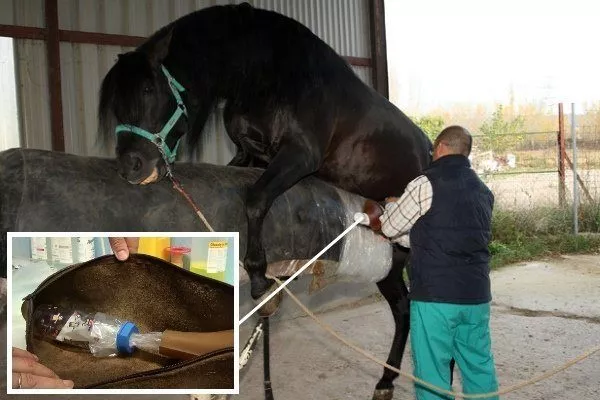
Collection of stallion semen
Selection of horses for mating
The stallion's characteristics are more important than the mare's. It's important to pay attention not only to health and pedigree, but also to the behavior and character of the individual.
- ✓ The stallion’s pedigree must include at least three generations with high reproductive rates.
- ✓ The stallion has no history of refusing to mate or showing low activity during it.
Selecting individuals for mating is a crucial step. The selection of a pair is based on several principles:
- the couple must be of the same height, or the mare must be slightly taller than the horse, otherwise insemination may not take place;
- a foal gets a large part of its physical characteristics from its father, so a healthy, hardy, and physically developed stallion is chosen for mating;
- The health of animals must be excellent, and their behavior, appearance, and purity must comply with norms and standards.
Age
A mare reaches physiological sexual maturity at 1.5 years of age. However, don't rush into mating her with a stallion. The resulting pregnancy will likely be abnormal, and the offspring will be weak and have low viability. This is due to the immaturity of her reproductive system and the unpreparedness of her young body for the intense stress associated with pregnancy. Allow the mare to gain strength and allow her systems to fully mature.
The optimal age for mating and producing healthy offspring for a mare is three years old. Waiting longer can lead to hormonal imbalances, which can lead to various reproductive system problems, including tumors and cysts.
Young stallions are also not recommended. At such a crucial moment, occurring for the first time, they tend to mount the female from the side or make many awkward movements during the process. However, they gain experience after only two or three matings.
Breed
To maintain purity during mating, the pair must be of the same breed. It is preferable for the animals to be elite, or close to it. Mating a thoroughbred horse with a common mare is possible, but the horses resulting from such a conception do not participate in the reproduction of the species.
How do you know if a mare is in heat?
Heat is the horse's ovulation period, so mating occurs only during this time. The female's cycle resumes after parturition within 8-14 days. The first heat lasts 4 days, and subsequent heats last 5-7 days.
The onset of estrus in a mare can be determined by the following signs:
- blood circulation in the vulva improves and it swells;
- the muscles of the vulva are in constant motion, causing the genital slit to sometimes narrow, sometimes widen;
- secretion of large amounts of mucus;
- the horse loses its composure, becomes disobedient, and starts to neigh;
- at the beginning of the heat, the female is calm about the male being nearby;
- When a stallion approaches, she assumes a position similar to that of defecating and may release a small amount of urine.
Methods of mating horses
Various mating methods are used in horse breeding. These depend on the desired end result, the size of the herd on the farm, the condition of the horses, and other factors.
Manual
Manual mating is identical to natural mating. The only difference is that the female cannot reject the stallion. During heat, the horse is restrained, and the stallion can inseminate her freely.
The breeder selects the horses themselves, notices the onset of estrus, and allows the stallion to approach. Before this, the animals are prepared and provided with a quiet, peaceful location. This could be a paddock, a barn, or another secluded area.
Stages of manual mating:
- the mare is placed in the stall so that her rear is in a slightly raised position;
- the tail is wrapped with bandages and tied up;
- remove the horseshoes from the mare's hind legs and the stallion's front legs;
- they put on a harness so that the horse cannot hit the stallion;
- They bring the male to perform fertilization.
Before mating, it is essential to let the animals sniff each other, get to know each other, and accept each other.
Mating can be repeated after a few days to increase the chance of conception. Mating can also be done several times a day. If the horse does not come into heat during the next cycle, she is pregnant.
Brewed
Warm mating is used when managing a herd. Several mares are placed in a corral (warm mating), where a stallion gradually mounts them, independently detecting their heat. Once completed, the animals are returned to the herd.
With this mating method, it is important to feed the stallion adequately so that his strength is restored and exhaustion does not occur.
Jamb
The herd method of insemination is very similar to the slaughter method, but in this case, the number of horses per stallion reaches 30. They are separated from the general herd, forming a herd, and grazed in a separate pasture until the mares' heat period ends and all are bred.
Thus, the stallion himself selects the female, determines her readiness, and mates with her. By the end of the breeding season, almost the entire herd is fertilized.
Artificial insemination of mares
Artificial insemination of mares is considered the most effective method, delivering a 100% success rate, but it requires considerable additional costs. This method is used at large stud farms and stud farms.
This method involves collecting the stallion's semen, testing its quality, and freezing it. A veterinarian then injects the semen into the mare's uterus using specialized instruments.
The video below shows how artificial insemination of a mare is performed:
Inspection of the stallion
During artificial insemination, the stallion's condition is crucial. He is examined by specialized veterinarians. They check not only his appearance but also the condition of his skin. Blood samples are taken, and his behavior is observed. Following the examination, a decision is made on his use in artificial insemination and the timing of semen collection.
Collection of seminal fluid
Semen collection is performed using a dummy, which the male "fertilizes." A sterile, disposable collection device is installed inside it. Alternatively, a special container—an artificial vagina—is used. All reusable instruments and materials are disinfected before the procedure, and the collection devices are replaced with disposable ones.
Before collection, the dummies are heated to a comfortable temperature of 40 degrees, and the cavity is lubricated with sterile petroleum jelly to avoid injury to the stallion.
The amount of semen from a single collection is sufficient to inseminate 150-200 mares. Such economical use of material cannot be achieved by any other mating method.
Artificial insemination is possible with seminal fluid in various states:
- Fresh. The biomaterial in this condition is of the highest quality, but insemination is only possible when the pair is in the same area.
- Chilled. The sperm is stored in special containers for 24 hours.
- Frozen.In liquid nitrogen, the biomaterial retains its properties for many years.
Advantages of the method
The positive aspects of artificial insemination of horses include:
- With this method of insemination, horses are injected with diluted semen. This allows for the conservation of valuable horse semen. The semen is treated with liquid nitrogen, creating a sperm bank to preserve the genetics of purebred studs.
- the method completely eliminates exhaustion and injury to animals;
- achieving insemination in almost 100% of cases;
- obtaining offspring from a male in his absence;
- it is impossible to infect a mare with an infection;
- there is a possibility of forming a tribe with the desired characteristics;
- there is no need to spend money on purchasing stallions for insemination.
When breeding horses, every breeder has the right to choose the breeding methods for their horses. By varying and combining these methods, it's possible to find the ideal method that brings maximum benefit at minimum cost. This process must be approached responsibly, armed with knowledge and the assistance of specialists.