
A horse's birth is a complex process that primarily involves the mare, but there are nuances that require human participation. Otherwise, labor can be detrimental to the health of both the mother and the foal. To properly manage the process, it's important to understand the physiological characteristics of horses.
Anatomical structure of the birth canal in mares
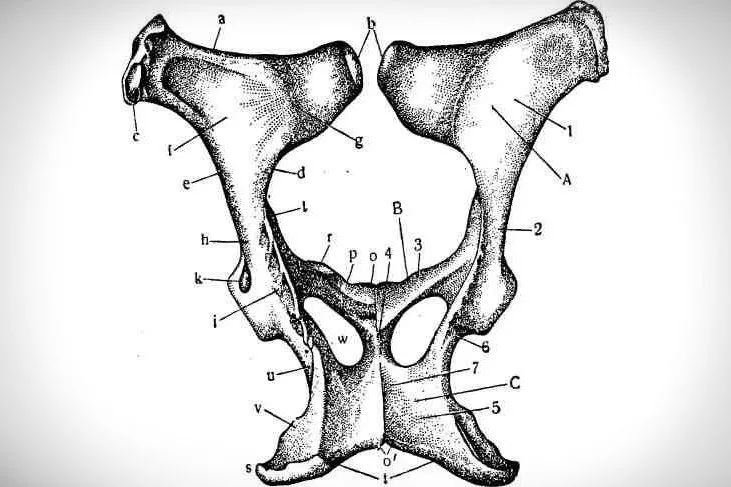
The foaling duct is the organ through which the embryo exits the horse's uterine cavity. It consists of the pelvis, sacrum, soft tissues, and various ligaments that form the cervix, vulva, and vagina.
Before labor begins, the amniotic sac compresses the urogenital organs, causing the cervix to shorten and dilate. This creates a birth "tunnel" through which the foal is released. However, delivery can be difficult due to poor elasticity of the vulva, especially in primiparous mares.
For the fetus to pass easily, a normal vaginal lumen and a sufficient pelvic cavity size are necessary. Otherwise, labor can be delayed, and ruptures and injuries can occur. Veterinarians note that the pelvis is particularly important.
What does it consist of and what does it look like:
- Entrance. It has an oval-round shape and communicates with the abdominal cavity, but is bounded by the sacrum, ilium, and pubic bones. The angle of the fundus relative to the iliac bones is 50 to 60°, so the entrance is oblique.
- Exit. The upper part has mobile caudal vertebrae, the lower part has ischial bones with tubercles and a notch. The sacral and sciatic ligaments are located on the sides.
- Pelvic cavity. It is a space with a vault that contains the bottom, side walls and top wall.
- Vault. It contains the first vertebrae of the tail and the sacral bones.
- Side walls. They are formed by a broad ligament and bone tissue, due to which they protrude strongly, which facilitates the easy release of the foal.
- Bottom. It combines the branches of the ischial-pubic bones and cartilages that fuse at the pelvic fusion.
- Bones without names. All elements have pubic, ischial and ilium bones, which in turn consist of segments and fuse on the surface of the articulations of the pelvic and hip joints.
Harbingers of labor
The first thing farmers notice is the behavior of a pregnant mare. As labor approaches, she refuses feed, becomes restless, circling around the stall, digging her bedding with her hooves, and frequently getting up and lying down and urinating.
If you examine the udder, you'll notice swelling, as it's filled with colostrum. When you press on the teats, milk drips.
But these aren't the only indicators to pay attention to. Experienced farmers examine mares before foaling, as physiological changes occur in their bodies:
- The pelvic ligament apparatus relaxes, causing the ligaments to lengthen by 1/3.
- When pressing on the sacrosciatic ligaments, a feeling of density is felt, and the sacrum itself “sinks” (a depression appears), an increase in the size of the labia, straightening of their folds (against the background of swelling and the skin becomes very smooth).
This happens within 5-36 hours, but there are cases when the pelvis changes up to 3 weeks before pregnancy. - Liquefaction of vaginal mucus, which is usually sticky and thick, and the presence of stringy, transparent threads due to the dissolution of the mucus plug. Symptoms are noticeable within 24-48 hours.
- A decrease in body temperature by 0.4 to 1.2°C over a period of 12 to 48 hours.
- Shortening of the uterus during the day before labor. This is checked rectally.
Farmers don't recommend relying solely on one of the precursors. To accurately determine the pre-labor stage, consider the combination of signs.
Preparing for pregnancy
To avoid panic during labor, prepare all materials, instruments, and the room in advance. Be sure to clear the rectum of stool, as the risk of injury increases during the delivery of the fetus.
- ✓ Room preparation level: the temperature must be at least 10°C, no drafts.
- ✓ Having all the necessary materials at hand: sterile gloves, antiseptic, scissors.
Premises
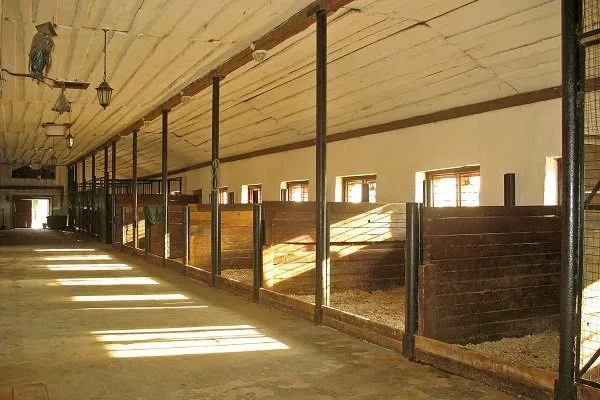
Cleanliness is key during a horse's labor, so be sure to disinfect the area with special disinfectants, iodine solution, a quartz lamp, or smoke. But before you do, do the following:
- Take the horses outside or to another area.
- Remove all contents from the stall, including hay, sawdust, etc.
- Treat walls, partitions, bird feeders, and windows.
- Bring the mares back no earlier than 24 hours later.
Next, carry out the following preparatory activities:
- Place fresh and dry straw on the floor.
- Place a rough cloth on the place where the woman in labor is standing to protect the floor from blood.
- Dim the lighting as bright light will act as an irritant.
Materials
Pregnancy can occur suddenly, so prepare the necessary materials in advance:
- diapers/sheets – to wipe the foal;
- antiseptic or alcohol-based iodine - draw 10 ml into a syringe in advance;
- scalpel/knife – if it is necessary to cut the umbilical cord;
- a sterile bottle and nipple for colostrum;
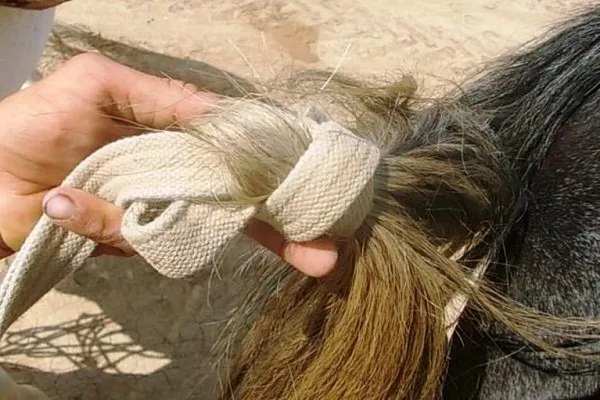
- tail bandage;
- Vaseline oil, Esmarch's mug, "bulb" - for an enema.
How does labor proceed in a horse?
During pregnancy, the foal is expelled from the abdominal part of the uterus by contractions (muscular contractions) and pushing (tension of the muscles in the abdominal cavity).
The first are characterized by a wave-like nature - contraction and relaxation occur, but in both cases the nerve endings of the animal's genitourinary system are irritated.
Dilation of the uterus
During contractions, only the muscles in the uterus contract, and it's impossible to recognize the very beginning of pregnancy, as the mare shows few signs of it. The moment can be recognized by the mare's timidity and glances at her own belly.
The contractions that are opening up also occur in stages:
- First stage. Contractions last about a second, and relaxation lasts up to 25-30 minutes. During this time, the cervix dilates and the fetus moves closer to the pelvic outlet.
This puts pressure on the unborn foal and the waters, causing them to move to the side with less resistance. - Second stage. Characterized by increased and longer duration of contractions: cramping spasms - up to 3-5 seconds, pause - up to 4-5 minutes.
At this point, the fetal membranes with the amniotic fluid move towards the open uterine canal, pressing on the walls, which leads to smoothing of the contours of the cervix and merging with the vagina. - The third stage. The duration of contractions increases to 1-2 minutes, and the duration of relaxations decreases to 30-60 seconds, as a result of which elements of the fetal membranes penetrate into the vagina and behind the vulva.
The fruiting parts begin to protrude outward in the form of a semi-oval, fluctuating bladder.
Labor and afterbirth contractions
After the bladder forms, labor begins, with contractions of both the uterus and the abdominal cavity. Contractions last 4-5 minutes, with relaxations lasting up to 3 seconds. Strong contractions push the fetus out, rupturing the membranes under the pressure and opening the uterus completely. This is the first water to break.
What happens next:
- after some of the water has been released, the fetus enters the pelvic canal, which leads to irritation of the receptors in the birth canal and further movement of the embryo;

- the pressure becomes so strong that the fetus pops out, completely rupturing the remains of the shell;
- When falling, the umbilical cord breaks.
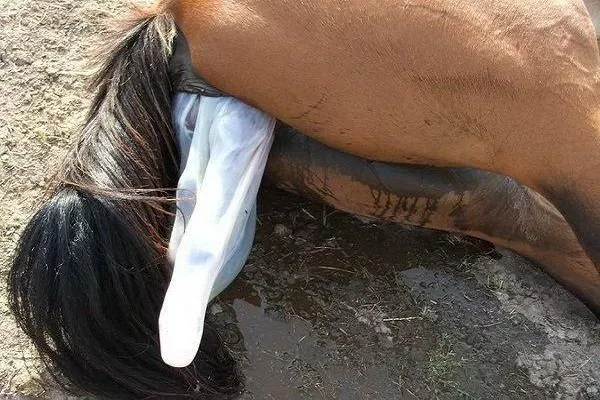


After the initial contractions, labor typically takes between 5 and 40 minutes. She then calms down for 5 to 10 minutes. After the foal is born, the mare still has some fetal membranes, causing her to exhibit aggressive behavior, which manifests itself in the following ways:
- wags its tail;
- shows anxiety;
- looks around (usually towards the stomach);
- stomps his hooves;
- jumps up abruptly and lies down;
- arches his back;
- sweats;
- groans.
How to deliver a baby
When a horse is pregnant, it will lie down on one side and begin straining vigorously. It may also flick its tail, kick its hooves, and move around the floor. However, some mares give birth standing up. This also shows restlessness.
Rules for accepting a foal:
- Prepare your materials – place them next to you.
- Stay close to the animal, but do not distract the female or make any loud or sudden sounds.
- Don't do anything if the horse is standing still. If it starts kicking, hold its legs, but do so carefully, otherwise it will become frightened.
- If the mare is giving birth standing up, place your hands under the foal to prevent it from hitting the floor. If the mare is giving birth lying down, do nothing.
- Watch for the membrane to rupture. If it doesn't, lightly cut the membrane with a knife.
- Wait 5-6 minutes if the umbilical cord hasn't severed—the mother will eventually do so on her own. If not, take a scalpel and cut the umbilical cord approximately 9-11 cm from the belly.
- If the rupture occurs further than this distance, take strong threads and tie them at a distance of 3-4 cm from the abdomen.
- Take the foal and wrap it in a blanket.
- Wipe your nostrils of mucus.
Assistance with normal childbirth
Even if labor is proceeding normally, the stud farm owner is obligated to monitor all processes and assist the horse if necessary. This will prevent complications and preserve the health of both mother and foal.
What you need to do:
- When any part of the fetus is cut through the membrane, pay attention to the mare's perineum - if it is excessively stretched, hold the opening with your hands, which will eliminate the risk of rupture;
- If the fetus is retained in the birth canal, but the body parts have already emerged, pull gently with your hands or make loops from the rope - if this is not done, asphyxia is possible, since the umbilical cord is pinched.
Possible complications
During pregnancy, unexpected situations can arise that can lead to illness and death, so it's important to know what complications can occur and what to do in a particular situation:
- If a mare or foal stops breathing and has a heartbeat, immediately perform cardiac massage and artificial respiration;
- the placenta is detached (signs - the amniotic sac turns red) - resuscitation measures are needed to save the baby's life;
- meconium is retained, which manifests itself in intestinal spasms - use drugs to cleanse the intestines and antispasmodics;
- green blister, yellow skin – consult a veterinarian, these may be serious diseases that require complex and highly specialized treatment;
- pathogenic bacteria enter the foal's body;
- limb deformation.
- ✓ No movement of the foal within 30 minutes after birth.
- ✓ Unnatural color of discharge in a mare after giving birth.
When to call a veterinarian?
If a horse breeder is inexperienced in handling pregnant mares, experienced farmers recommend calling a veterinarian immediately before the birth. This will increase the chances of a successful birth and the survival of the animals.
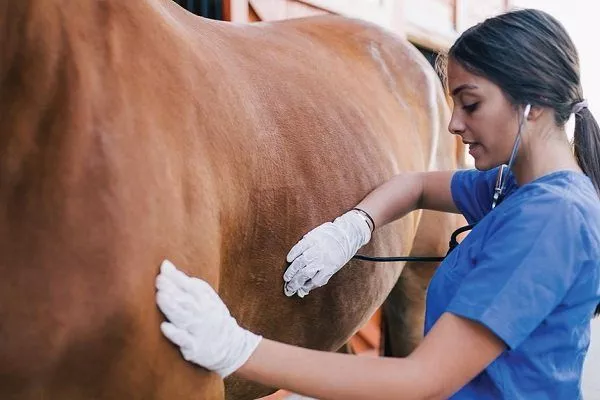
But there are situations that even experienced horse breeders cannot handle on their own:
- too long labor after the initial contractions;
- the embryo is in an incorrect position - with its hind limbs forward, sideways, in an inverted state (hooves up);
- only one leg protrudes from the vagina;
- absence of head during birth (only front legs);
- the foal is limited in movement, its actions are slow;
- multiple tears in the female's perineum;
- absence of placenta 2 hours after the birth of the baby (the remnants of the fetal membrane have not come out);
- high body temperature;
- convulsions.
Postpartum period
The postpartum period is considered to be the period of time from the delivery of the placenta until the mare's full health recovery (when the involution of the genitourinary system is complete, etc.). The duration depends on feeding conditions, housing, etc., but it lasts exactly until the onset of a subsequent pregnancy.
Features of the first days of the postpartum period:
- it takes 30-40 minutes to recover;
- after 60 minutes the placenta comes out;
- the body will require drinking within 1.5-2 hours;
- postpartum discharge occurs for 7-8 days;
- On the 18th-20th day the uterus is fully restored.
Caring for a horse after foaling
Immediately after the birth of her foal, the mare needs special care, as she has lost a lot of strength. Here's what to do:
- Once the horse has rested, bring warm water and a rag and wash its body.
- After water treatments, replace the bedding with dry one.
- If the baby hasn't been able to get milk, be sure to milk the mother. This should be done every hour and a half (this is the infant feeding schedule).
- Give cool (not cold) water with sugar (200 g per 10 l).
- Feed after 4-6 hours. Give fresh hay, bran, or mash.
Caring for a newborn foal
Care for a newborn foal begins the moment the umbilical cord is tied. What the newborn needs – horse owner's actions:
- Treat the cut area of the umbilical cord with iodine using cotton swabs;
- wipe with a towel:
- Dry it with hay, which will improve blood circulation, open the airways, and start the intestines functioning;
- place it next to the mother and her nipples;
- If the baby does not show sucking reflexes, give him milk from a nipple - poke into the mouth opening, giving drops of milk;
Make sure your baby has a bowel movement within 2 hours. If this doesn't happen, call your veterinarian immediately.
Helpful tips
Experienced farmers are happy to offer advice to newcomers planning to assist a horse in calving. Here are some guidelines to follow:
- apply to the stallion's udder every 1.5-2 hours;
- change the bedding daily;
- twice a day, while the discharge is ongoing, wash the perineum;
- check your body temperature;
- Do not give large portions of food the first 2-3 times;
- If you are not confident in your own abilities, call a veterinarian;
- It is better to have two people assist in the birth, especially if the fetus is retained after the amniotic sac has ruptured;
- Do not disturb the mare for 2 weeks after giving birth – do not force her to work or run.
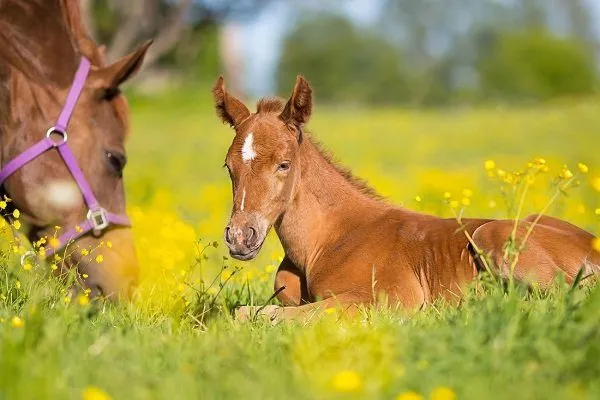
Helping a horse give birth for the first time is always scary, but experience comes with time, so at first, take an assistant with you, carefully study the rules, prepare the mare/materials/room in a timely manner, and consult with a veterinarian.