
Horse slaughter is a labor-intensive task that requires knowledge, experience, and both physical and mental strength. The process is divided into several stages, the proper execution of which determines the taste of the meat and the quality of the skin.
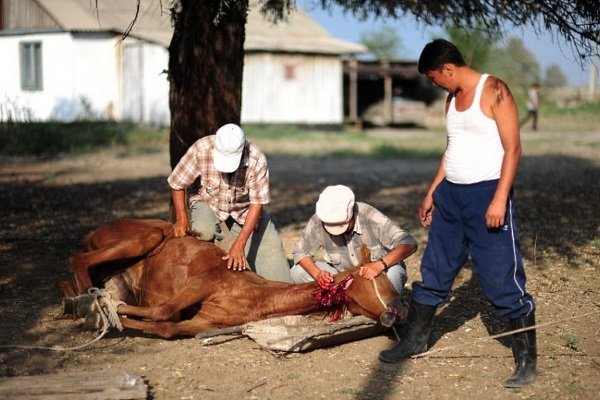
When are horses sent to slaughter?
Most often, horses are slaughtered out of necessity, after culling or because they are no longer needed—they don't want to waste the meat. Horses raised specifically for meat are slaughtered no later than two years of age.
The process of slaughtering and butchering horses is almost identical to that of cattle. The main difference is the moral aspect. While bulls are primarily associated with meat, horses are associated with loyalty, hard work, beauty, and speed. Horse slaughter is best left to professionals, but if a professional slaughterer is unavailable, the farmer must slaughter and butcher the animal himself.
The best time for slaughter is mid-autumn. In regions where temperatures do not rise above 10°C, horses and other livestock can be slaughtered year-round.
Preparation for slaughter
Horses are recommended to be fasted for two days before slaughter to allow their gastrointestinal tract to clear. Water should be stopped three hours before death.
At specialized plants, slaughter is streamlined and equipped with all the necessary equipment to simplify the process. Private farms, however, require slaughter and butchering of animals in a more primitive manner—on the ground. This reduces the value and flavor of the meat.
What else needs to be done before slaughter:
- Prepare a special area for butchering the horse. This could be a barn or an open-air location.
- Place the necessary equipment on the site: a large table, tethering posts, and a container to collect the blood. It's helpful to have a special stool or a post with a hook to hang the animal on—then all the work can be done with the carcass upright.
- Before slaughter, familiarize yourself with horse anatomy, the basics of butchering, and hygiene standards.
- During the preparatory period, provide the animal with plenty of water. This thins the blood, making it easier for the carcass to lose it. Plentiful water also makes the skinning process easier.
The better the animal is bled, the better the meat will be stored.
If pre-slaughter holding is neglected, there is a high probability of problems during skinning and butchering.
The slaughter process
Slaughtering a horse consists of two consecutive operations: stunning and bleeding.
If the animal is stunned correctly, its heart continues to beat.
Stunning is carried out in one of the following ways:
- Mechanical slaughter – using a hammer, stiletto or shooting apparatus.
- Using electric current.
- Chemical method.
Bleeding is an important procedure that determines the quality of meat—both marketable and sanitary—as well as its shelf life. To bleed an animal, major vessels—the carotid arteries and jugular veins—must be severed.
A special hollow knife designed by V. Yu. Wolferts is used for bleeding. It has a rubber hose at the end through which blood flows into a vessel. With proper blood flow, its mass accounts for 4.5-5% of the carcass's weight.
At home
Unlike a meat processing plant, a private farm doesn't have the necessary equipment to perfect the slaughter, cutting, and evisceration process. Here, everything is simplified to the extreme, and the only tools and equipment used are sharp knives, ropes, and a blunt, heavy object for stunning.
Slaughtering is rarely done without an assistant. It's difficult work, requiring physical strength and time.
- ✓ The ambient temperature should not exceed +10°C to prevent rapid spoilage of meat.
- ✓ Having assistants makes the slaughter and cutting process much easier.
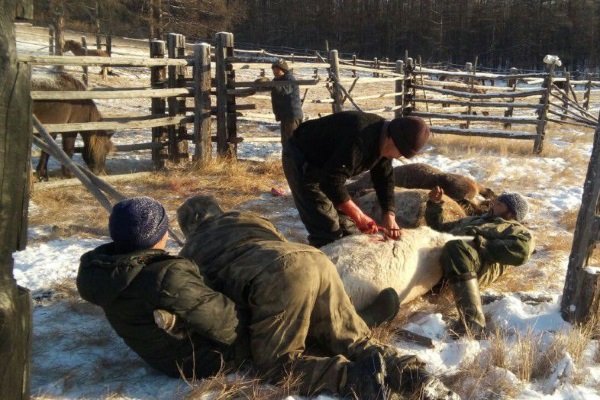
Stages of horse slaughter on a farm:
- Drive to the slaughterhouse. Tie the animal and use ropes to lay it on the ground. Assistants usually assist the slaughterer with this task, so select your helpers in advance.
- Stun. Stun the animal by hitting it hard on the head. It's important to knock the horse unconscious immediately, so hit it as hard as possible.
- Exsanguination. A stunned animal needs its throat cut as quickly as possible—in case it comes to. Follow a clear algorithm:
- Make an incision across the throat—it's the most effective way to draw blood. To do this correctly, study the location of the veins and arteries beforehand. Make the incision transversely, as carefully as possible. It's best to cut the throat on the first try, or at least on the second. Choose a large, wide knife.
- Once you've opened the vessels, leave the carcass upside down for 10-15 minutes to allow the blood to drain. Don't throw it away—it's a useful supplement for feeding pigs and poultry.
- Drag the drained carcass to the cutting area.
- Flaying. Once the blood has been drained, proceed to skinning. The skinning process:
- Cut off the ears completely. Make circular cuts in the skin around the nostrils and mouth.
- Make an incision from the nose through the eye on the corresponding side. Then across the forehead to the ear. Now you can remove the skin from the scalp.
- Make an incision from the slaughter wound, from the neck to the lower lip. Now remove all the skin from the head.
- Making an incision between the upper vertebrae and the occipital bone, separate the head from the carcass.
- To make it easier to remove the skin from the carcass, turn it belly up.
- Starting from the slaughter cut, move the knife towards the anus.
- Make ring-shaped cuts on the limbs – above the knees.
- After separating the skin from the breastbone and the lower neck, cut the skin along the hocks—the inside of the legs. Proceed carefully—a carcass with damaged tendons is difficult to hang.
- Remove all easily removable skin, and remove the remaining skin by hand, making cuts from the inside. To remove the skin from the rump and back, pull it simultaneously with both hands from both sides.
- Make a circular cut around the tail and remove the remaining skin.
- Gutting. Once the skin has been removed from the front and sides, split the rib cage with an axe. Remove the esophagus and trachea. If necessary, tie it to prevent the stomach contents from leaking. Now remove the internal organs, being careful not to damage the carcass. Gutting procedure:
- After cutting the peritoneum, remove the stomach and intestines.
- Remove the heart and lungs.
- Next, remove the liver and gall bladder.
- Folding the skinFold the hide along the spine, with the fur facing outward. Let it sit and cool—this takes 2-3 hours. While the hide is cooling, begin butchering the carcass. The hide can then be preserved by salting. Salted hides are stored at a temperature of approximately 8 degrees Celsius.
- Carcass processing.
- Cut the carcass in half, along an imaginary line running between the 13th and 14th vertebrae. Transverse cuts are most convenient for home slaughter. The carcass can be cut into halves or quarters.
- Remove the bones from each half or quarter. Trim the meat of fat, fibers, and tendons.
- Remove the neck from the bone. Clean, chop, and cut into pieces. Repeat the same process for the neck. Remove the shoulder blade.
- Trim the ribs. Boning the pelvic bones and lower spine, removing all bones.
- Separate the upper legs into pieces and remove bones and tendons. Do the same with the brisket and drumsticks.
- All that remains is to debone the lower part of the legs and trim the meat off the shoulder bone.
The process ends with salting the cooled skin and washing the carcass, which is then kept in a cool room in a suspended state - this is why the integrity of the tendons is so important.
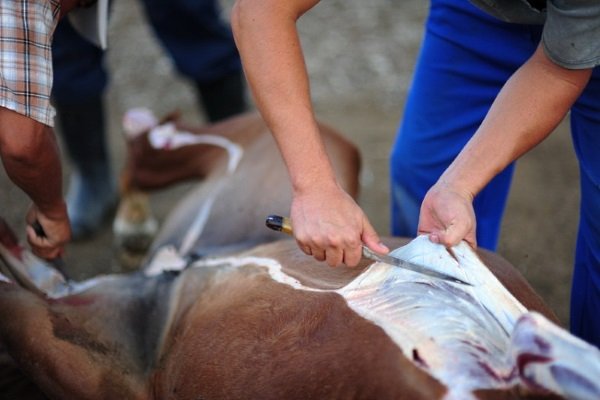
At the slaughterhouse
Each meat processing plant uses its own method of slaughtering and cutting carcasses. A major advantage of meat processing plants is the sterility of the process. Slaughter procedure:
- Stunning and immobilizing an animal. Most often, an electric shock is used for this purpose.
- In mechanized slaughterhouses and meat processing plants, bleeding is performed with the carcass suspended vertically. The stunned animal's skin and tissue are incised longitudinally along the midline of the neck. After ligating the esophagus, the major vessels are severed where they exit the chest cavity. The blood drains in approximately 6-8 minutes—the bleeding is completed while the carcass is moving along the conveyor. In processing plants, carcasses move at a rate of 3-5 per minute.
- The bloodless carcass is skinned, opened, and butchered according to state standards. The resulting pieces of meat are also hung vertically.
How to properly butcher horse meat?
At home, horses are slaughtered using the traditional farmyard method. Butchering is done in a primitive manner, violating sanitary regulations. To properly butcher a horse, appropriate standards are used, in particular GOST 32226-2013 "Meat. Cutting Horse and Foal Meat into Cuts."
Different parts of the carcass vary in fat content, bone content, and muscle fiber content. Consequently, their edible uses vary. When properly cut, the different parts are roughly equivalent in both flavor and appearance.
There are “folk” methods of cutting up carcasses, for example, the Kazakh one:
- The animal is butchered directly at the slaughter site.
- All bones are immediately separated at the joints. An axe is not used – everything is done with a sharp knife.
- They cut off the head, then cut off the fat on the neck, and then cut the neck into pieces.
- They cut off the legs with a knife, also at the joints.
- The ribs are cut from the spine and sternum.
- The spinal vertebrae are identified and divided individually.
- Moving on to the pelvic part, the carcass is also cut along the joints.
This method is convenient if the meat is shared between families, dried, or smoked. The lack of an axe allows for clean meat—free from dirt and bone fragments. This method is suitable for private households, but not for industrial use.
Meat processing plants strictly adhere to state standards, dividing the carcass into the required number of cuts. After cutting, the following parts are obtained:
- first hind quarter;
- second forequarter;
- third hind quarter (pistol cut);
- fourth forequarter.
In turn, each quarter consists of several parts, each of which has its own name - front or back shank, neck cut, shoulder part, etc.
Using skin and bones
Don't throw away horsehide—it's a valuable raw material. Incredibly durable. Horsehide is used to make elite footwear, which boasts a unique shine and durability. Horsehide is also used to make:
- bags;
- belts;
- key holders and business card holders;
- headwear – caps, berets, etc.
Horse bones aren't available in sufficient quantities to be processed on a large scale. However, they can be used in the same way as cattle bones—to produce bone meal. This is used as livestock and poultry feed, as well as fertilizer.
How to store horse meat?
Horse meat is perishable and should be stored immediately after cutting.
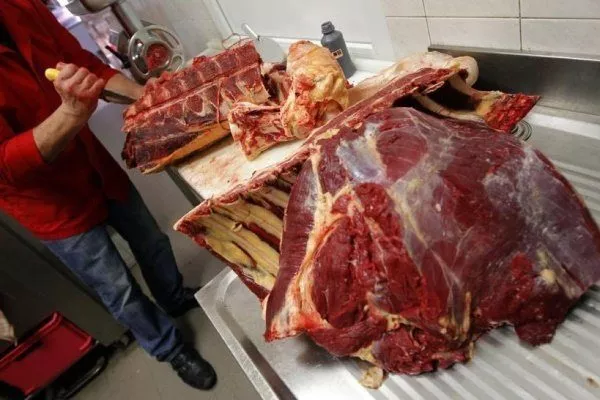
The methods for storing horse meat are as follows:
- Freeze. Frozen horse meat has a shelf life of approximately six months. If stored longer, its flavor and texture change. Small pieces are stored wrapped in foil. Larger pieces should be stored in vacuum-sealed containers. Refreezing horse meat is prohibited. Do not wash the meat before freezing.
- Cool. Chilled horse meat has a shelf life of only three days. It's stored in the refrigerator in airtight containers or enameled dishes. Coarsely chopped meat keeps better and longer.
- Dry. Dried horse meat has a shelf life of two years. To prevent spoilage, store the dried meat in a cool, dark place. The drying process begins with rubbing the meat with salt. It is then dried in an oven at 50°C. The dried horse meat is then used in cooking—it can be boiled or fried.
Horse meat can also be prepared for future use by smoking and drying.
Horse breeds for slaughter
Not all horse breeds produce tasty meat. All horse meat is generally edible, but most breeds produce tasteless meat. However, some breeds, such as the Kazakh, Yakut, and Novoaltaisk, have very pleasant, juicy, and marbled meat. A single horse produces 220-240 kg of meat with a live weight of 400 kg.
There are two types of horse meat: dietary and marbled, obtained respectively from young animals and adult animals no older than 2 years.
If a farmer wants to breed horses for meat, they need to select a breed suitable for their area. Furthermore, horses whose meat will be used for culinary purposes must meet the following requirements:
- It is desirable that animals lead a herd lifestyle.
- The breed must be adapted to local climatic conditions.
- If horses are to be bred in a stable, preference is given to heavy breeds.
- Meat breed horses usually have an elongated, strong body, short, stocky legs, and a wide back.
Meat horse breeds:
| Breed | Brief description |
| Yakut | The most frost-resistant breed. They can withstand temperatures down to -60 degrees Celsius. The breed is used for transport, as well as for meat and milk. An adult horse can weigh up to 500 kg. |
| Kushumskaya | This breed was previously supplied to cavalry regiments. Today, it is used for meat and dairy production. The meat is very tasty. Of the several subspecies of the breed, the main and heavy subspecies are most often bred for meat. |
| Bashkir | Hardy horses that can withstand temperatures as low as -40°C. This breed is a meat and dairy breed. Mares weigh 415 kg, stallions 470 kg. Slaughter yield is 51-55%. |
| Kazakh | A hardy breed with a very strong immune system. Maximum slaughter yield is 60%. Animals reach 1 m 35 cm in height and weigh 330-360 kg. |
| Novo-Kirghiz | They are a dairy and beef breed. Mares weigh up to 500 kg. |
| Adaevskaya | The breed is known for its good nature and loyalty. Weight: 420-450 kg. |
| Altai | Large horses obtained by crossing local horses with heavy trucksWeight – 460-490 kg. |
The slaughter process is one of the most complex and challenging events in a farmer's life. To do the job well, you need strong nerves, a wealth of specialized knowledge, and a firm conviction in the necessity of the undertaking. And then everything will work out.