
In the late 19th century, Russian specialists began developing local heavy draft horses. The Vladimir Heavy Draft is considered one of the first and most successful breeds in this regard. Thanks to its unique qualities and beauty, the breed has gained immense popularity among both professional breeders and hobby farmers.
The origin of the Vladimir heavy draft horse
The Vladimir region has always been renowned for its hardy and strong horses, supplying animals to major cities. It was in this region, in Gavrilov Posad, that the stud farm was located, where breeders set out to create a locally produced heavy draft breed.
Since there were no domestic specimens of this category, future parents had to be purchased abroad. Percherons were imported from France, Suffolk horses from England, and Ardennes from Belgium. Later, Clydesdales imported from Scotland and Shires from England began to be actively used in breeding efforts.
The specialists were faced with the task of developing a powerful and beautiful breed, the genes of which had to be passed on from imported parents, but on the other hand, the new representatives had to be strong, hardy, and easily adaptable to various conditions.
It wasn't until 1936, when various crossbreeds began to be systematically studied, that the Vladimir Heavy Draft was discovered. It took another 10 years to refine it and officially register it as a new breed. Thus, in 1946, the Vladimir Heavy Draft was added to the registry.
Characteristic
This is one of the largest heavy draft horses in Russia. Upon first meeting him, his size is striking. He can reach a height of 175 cm at the withers, and his maximum weight can reach 1,200 kg. Males are larger than females. A stallion averages about 760 kg, with a chest girth of 207 cm. A mare, correspondingly, weighs about 690 kg, with a chest girth of just under 2 meters, measuring 196 cm.
The pastern is quite long for a heavy draft horse, reaching up to 30 cm in length and 23.5 cm in circumference. Experienced horse breeders judge the development of the skeleton and the strength of the constitution by the thickness of the pastern.
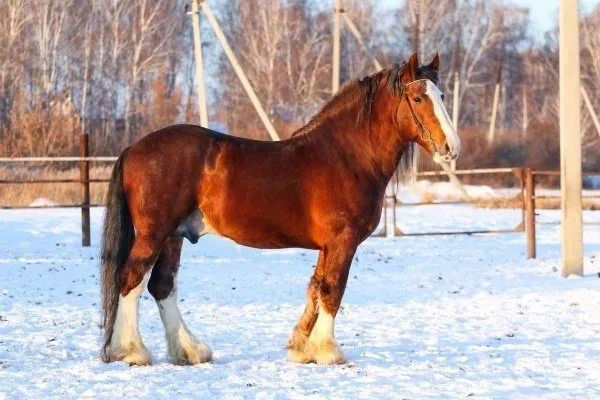
Speaking of color, the lion's share is bay and chestnut, while black and brown horses are less common.
Appearance
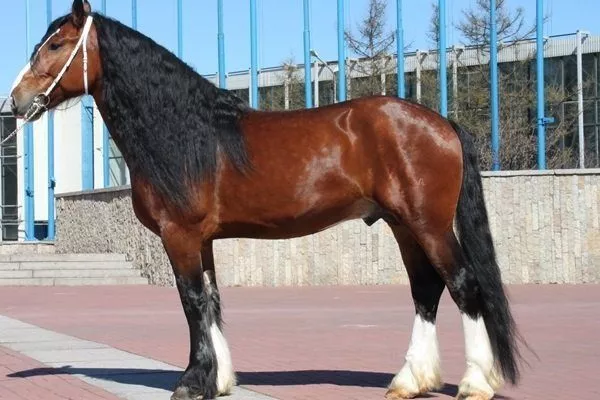
This giant is hard to confuse with other breeds. This tall, stocky beauty with a thick mane and tail immediately catches the eye.
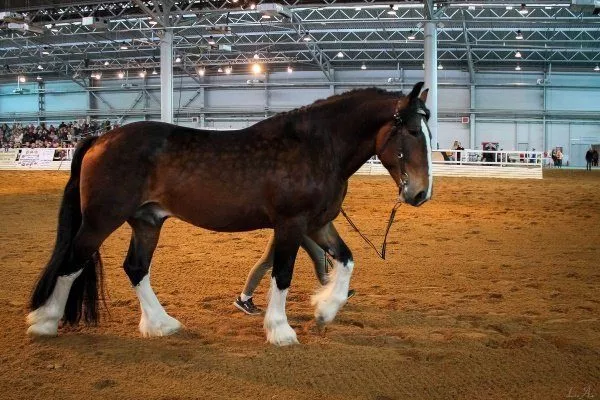
The animal's head is large, the skull is massive, and when viewed from profile, a prominent hump is noticeable. The neck is long and full with a pronounced nape, and the shoulder blades are strong and sloping. The chest is broad. The animal's shoulders are muscular, the back is long and broad, and the croup—the rear part of the body—is slightly sloping. The hooves are wide, and the horn is hard and strong.
The lower legs are covered in thickly furred white "socks." The fur is very thick and short, giving the animal the appearance of a giant plush toy. White spots can often be seen on the animal's head and belly.
Character
Despite their large size, these horses are very active and energetic. Most have a balanced, good-natured, and friendly disposition. They move freely, with good range of motion. They thrive in both the bustle of the city and the open countryside.
This is an easy-going animal. They get along well with children, listen to and obey people, and are therefore often used for horseback riding, with beginners being introduced to the saddle, for tourism, and for hunting.
Advantages of the breed
The main advantages of the breed include:
- Versatility - horses are used not only for their intended purpose - carrying heavy loads, working on the ground, but due to their gracefulness, they are perfect for riding and sports competitions.
- They are distinguished by maximum endurance and strength.
- The working experience of horses is 20 years or more.
- The animals' performance is unaffected by adverse weather conditions and is very high. They will work in heat, rain, and cold.
- Easy-going and calm, quickly adapts to work and a new place of residence.
- Early puberty, high fertility.
- This is a prestigious and valuable breed for breeding—it is suitable for breeders, as it can be used to develop new breeds that will be in demand among horse breeders.
Flaws
The Vladimir heavy draft horse also has some disadvantages, but they are significantly fewer:
- A long, soft back, coupled with flat ribs, makes the horse physically inferior to Suffolk horses. It seemed that these "deficiencies" in its structure would make the horse clumsy and prevent it from running fast, but practice has proven otherwise: a horse carrying a 1,500 kg load can cover a distance equal to 2 km in 5 minutes.
- Slow movement speed due to its heavy weight when compared to other heavy draft breeds.
Content
One of the reasons why the Russian Empire developed its own heavy draft horses rather than importing them was the need to adapt them to minimal, simple conditions and a low-quality feed base. This is precisely what was done. However, the Vladimir Heavy Draft still requires a balanced diet and standards, and should be provided with a more or less comfortable environment to ensure the animal remains healthy and in good working condition.
Horses can live in a stall—an isolated room or stall. When kept in a stall, an animal can suffer without social contact with other horses. As a result, the horse becomes aggressive and refuses to eat.
Stalls are generally easy to socialize with, but they are difficult to clean and maintain during the winter. At low temperatures, ventilation is limited, making horses susceptible to airborne illnesses. Furthermore, a sick horse can spread the disease and infect other animals. To reduce the risk of illness, the stall should be disinfected weekly.
Whatever housing option you choose, the ceiling height should be 3 meters—this allows for better ventilation. Ventilation in the stable is necessary, but it shouldn't create drafts. Installing vents under the roof is the best option.
The stable should be illuminated by sunlight for most of the day, as darkness negatively impacts a horse's vision. Large windows are needed to allow ample light into the room.
The floor is made of wood or concrete. The latter option is more durable, and drainage channels are installed to drain excess water. Sawdust or straw are used for the flooring.
In winter, the stable temperature is maintained between 8°C and 11°C, with a minimum of -3°C. Raising the temperature higher is not advisable, as sudden temperature differences between the outside and the stable can lead to illness. During warmer months, the stable is ventilated and regularly cleaned of manure. In hot weather, curtains are placed over the windows to control the temperature rise, as overheating is very dangerous for horses.
Care and feeding
Bringing a Vladimir Heavy Draft Horse into your stable won't require any additional investment, either physically or financially. Like any horse, it requires regular daily care:
- A draft horse is designed for heavy work, so its routine should include exercise. If the animal is used for its intended purpose, veterinary checkups should be regular, at least five times a year. Outdoor exercise is also a must.
- At the end of the day, if the weather is warm, the horse is bathed and doused with warm water from a bucket or hose. In cold weather, only dry brushing is permitted; water treatments are prohibited.
- The tail and mane are combed daily with a plastic comb to prevent the hair from becoming too tangled and are treated with special sprays.
- Hoof care is essential. They should be cleaned and regularly checked for cracks, injuries, and dermatitis. If any damage is detected, consult a veterinarian promptly and treatment should begin.
- A dental examination is no less important. Oral diseases significantly affect the overall well-being of an animal.
- A horse's diet should be balanced, complete, and varied. They are fed three times a day. A horse that works all day is fed every two hours. Grass and hay are a given, but a draft horse requires a lot of energy for physical work. Grain is a good source of this energy, but overfeeding it is also not recommended, as it can cause stomach problems.
Vitamin requirements are also higher than for other breeds. To replenish vitamins and minerals, the animal is given fresh vegetables and fruits. Salt is an important supplement, given to each individual daily. - Hay and water should be freely available to the animal. A horse drinks 80 liters of clean water per day. During the winter, when the diet consists primarily of dry feed, the amount of liquid consumed increases.
- Since animals constantly secrete gastric juices, they must constantly chew something. Hay must be constantly available in the feeder, otherwise serious digestive problems can occur.
- ✓ The hay to grain ratio should be at least 70:30 to prevent stomach problems.
- ✓ Daily salt intake should be 30-50 grams to maintain electrolyte balance.
Breeding and offspring
Only healthy, purebred animals with no behavioral issues are selected for breeding. Individuals must be at least three years old. It's preferable for the mare to be larger than the stallion.
Mating can be done naturally or artificially. The optimal time is mid-March to July. The foal will be born during the warmer months, when fresh grass is abundant. The mare is a good milk producer, as the foal requires a large amount of milk.
Prospects for breeding the Vladimir breed
The days of heavy draft horses are over; machines have replaced horses, and few villagers keep this giant for work. Today, the breed's population is declining significantly, and this beauty is in danger of extinction. Although breeders still work with them, the breeding stock doesn't even number a hundred animals.
But the Vladimir Heavy Draft still has a bright future. Its magnificent appearance and calm and docile nature make it suitable for tourism, equestrian competitions, and sport hunting.
There is both supply and demand for this breed. The price for a stallion can reach up to 500,000 rubles. The average price for a yearling stallion ranges from 200,000 to 250,000 rubles. The price depends on the animal's region of origin, pedigree, age, sex, and vaccination status. A Vladimir Heavy Draft stallion is usually more expensive than a mare.
Interesting facts about horses
True horse lovers will be interested to know a few interesting facts about this breed:
- The ancestors of the heavy draft horse are knightly horses, images of which can still be found in medieval paintings;
- The largest heavy draft horse was a horse named Mammoth, he was more than 2 meters tall and weighed 1.5 tons;
- These large animals can take low obstacles and jump over small barriers;
- a stable nervous system allows the horse to work in any noise, rumble and shouting;
- The endurance of Vladimir heavy draft horses has been proven; they were used to make the journey from Vladivostok to Moscow.
The Vladimir Heavy Draft is a unique breed that combines power and grace, energy and calm, and its striking exterior captivates at first sight. It requires no special care and becomes a loyal companion to its owner.