
The Trakehner horse breed has been around for a very long time. Thanks to the meticulous breeding process, these animals have many advantages and few disadvantages. Breeding Trakehner horses is a profitable business if approached responsibly and seriously. This article discusses horse feeding and care guidelines.
History of the breed
Trakehner horses appeared in 1232 in a village in Prussia. The Knights of the Order wanted a new, hardy breed for their troops, one that would make their work easier during offensives. They brought back Eastern stallions from the Crusades, which they later crossed with Samogitian mares.
In 1732, a stud farm was established. At the same time, this year was officially recognized as the birth of the Trakehner breed. To begin their work, breeders used over 1,000 horses of various breeds, including Danish, English, and Oriental. Forest mares were crossed with Lithuanian, Polish, Tatar, and Oriental stallions. The animals were bred for several purposes: as draft animals to assist in agriculture and pull carriages, and as riding horses for the army.
The Trakehner breed in Russia
Horses of this breed appeared in Russia even before the Great Patriotic War. A large number of them were brought in 1925. The stallions were sent to the cavalry, and the best mares were bred with purebred stallions. However, the offspring were practically never preserved due to differences in housing.
The mare appeared in the country for the second time in 1945, where scientists at the Kirov Stud Farm in the Rostov Region began breeding them. This large stud farm continues to breed Russian Trakehners to this day. Many of the horses have excelled in equestrian sports.
Exterior features
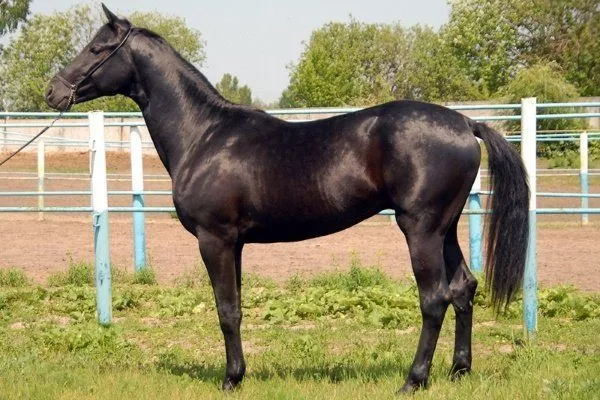
Horses of this breed have a well-shaped head, slightly dry, with graceful lines. The eyes are large, bright, and deep, the forehead is broad, and the profile is slightly concave or straight. The head is set on a short, slender neck, which is cone-shaped.
These horses have a broad and deep chest, a powerful body, and long shoulder blades. A distinctive feature is their high, muscular withers and well-developed musculature. Their croup is oval, and their legs are firmly planted on the ground, offering an attractive, correct stance.
Many believe that Trakehners are predominantly black, but in fact, red, gray, and bay specimens are also found. Roan horses are occasionally seen. Due to the presence of the piebald gene in the breed, piebald Trakehners are also found today. Previously, such horses were culled from breeding.
Trakehner horses are distinguished by their large size and tall stature. Stallions stand approximately 166 centimeters at the withers, but taller specimens, reaching 174 centimeters, are occasionally encountered. Mares range in height from 164 centimeters. Trakehner horses weigh between 460 and 550 kilograms.
Personality traits
Horses of this breed have a mixed personality: some are hardworking, while others are completely unwilling to work. Some are friendly, while others are aggressive.
At the same time, the breed is gentle and docile, courageous and determined. If there are kind Trakehners in a herd, they will happily help an inexperienced rider reach the pinnacle of equestrian sport. These horses are known for their work ethic and their dedication to following any command, which will especially appeal to those who enjoy dressage.
Performance
The horses' movement and jumping abilities are important criteria for evaluating the breed. Trakehners are characterized by a light gait, especially under saddle. A combined training system is used to develop both working and athletic skills. This includes dressage trials, cross-country racing, and jumping.
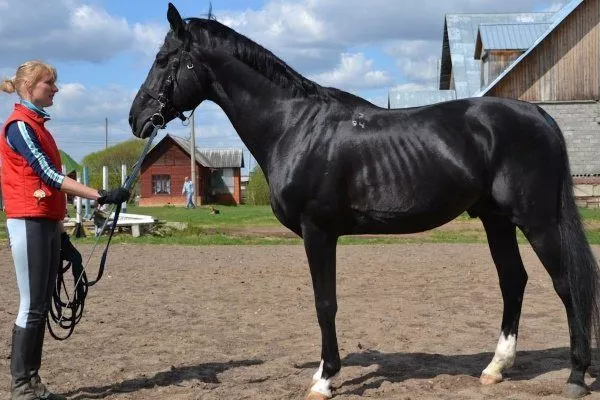
Due to the fact that the animals are trainable and have a balanced character, they are suitable for any type of equestrian sport.
Advantages and disadvantages
The Trakehner breed has both advantages and disadvantages. Positive qualities include:
- ease of training;
- versatility (they are used in different directions);
- courage, endurance, risk-taking;
- excellent performance indicators;
- tirelessness;
- peaceful and friendly character;
- ease and smoothness of movements;
- attractive appearance;
- the ability to jump high.
The following points are considered negative traits of horses:
- Animals often suffer from joint diseases and hernias.
- The survival rate is 85%, due to weak immunity and low viability.
- Horses are difficult to breed in a herd because, compared to other breeds, they are not known for their robust health and are prone to infectious diseases and colds. It's best to breed them in separate stables with access to summer grazing.
- A distinctive trait is capriciousness and pampering. This applies largely to the care and upkeep of the horses. During breeding, the animals were kept in clean stables and received the highest level of care. However, scientists paid little attention to training and physical exercise.
Care instructions
To ensure that Trakehner horses thrive, are strong, powerful, and healthy, and show high results in competitions, they require proper care:
- Clean the stables and stalls. Cleaning is carried out regularly. Once a month, the premises are treated with antiseptics to control pests and parasites.
- Make sure there are no drafts in the room. Horses do not tolerate excessive dryness, high humidity and windiness - this can lead to illness.
- Equip feeders and waterers. They should always have clean drinking water and fresh food.
- Provide long walks. Because Trakehners are active animals, they require long walks, which are done in large pastures so that the horses have the opportunity to frolic to their heart's content.
- Brush and bathe horses regularly. These procedures help maintain an attractive appearance. Horses should be washed once a week with special coat and mane care products. In the summer, this should be done more frequently.
- ✓ Regularly check hooves for cracks and infections, especially after exercise.
- ✓ Use only specialized shampoos for bathing, so as not to disturb the pH of the skin.
Horses participating in competitions require daily training and exercise. Inconsistent training can result in horses lacking sufficient strength and endurance.
Feeding the breed
Feeding Trakehner horses is a separate topic. It's important to follow these basic guidelines:
- Despite their large size, horses of this breed have small stomachs. Therefore, they require frequent, but small meals.
- Animals must be regularly provided with clean water and drinking bowls, which must be washed after each meal.
- To satisfy the chewing abilities of racehorses and ensure proper functioning of the gastrointestinal tract, it is essential to include forage in the diet.
- New foods should be introduced into a horse's diet gradually. This allows the stomach to get used to the unfamiliar food.
- Feed animals only high-quality feed. Avoid feeding horses moldy foods, as this can lead to infectious diseases.
- The diet is compiled based on his physical activity.
- After eating, horses need rest to facilitate better digestion. Avoid putting them under heavy physical strain immediately.
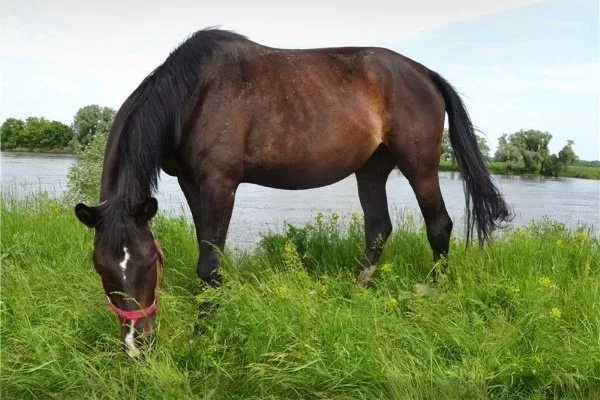
To maintain the health of Trakehner horses, regular checkups are essential, with particular attention to the genital area. The farmer will need to brush the horses' teeth, trim any sharp teeth, and administer deworming and other parasitic medications. Consult a veterinarian if you notice any significant changes in the horse's behavior or deterioration in health.
- ✓ Bright, shiny eyes without discharge.
- ✓ Even breathing without wheezing even after intense workouts.
Reproduction and lifespan
Trakehners live for approximately 30-35 years. They reach sexual maturity at two years of age. However, breeders recommend waiting until they are three or four years old to fully mature.
The breed is usually bred artificially during the females' heat season. The gestation period for a stallion lasts from 320 days to 1 year. During this time, the mare is cautious and calm, and her belly becomes rounded in the second half of pregnancy. During pregnancy, it is especially important to let the mare out for walks.
When the foal is about to be born, the mare begins to become restless, constantly lying down and getting up. The birth process lasts no more than 20 minutes. The foal is born wet, and the mother begins to lick it. The very next day, it can walk with the mare in the yard. After a month, the foal is fed vegetables in addition to milk. After six months, the foal is moved to its own stall.
Sports achievements and awards
Trakehner horses have a very attractive appearance, but they also perform at a high level. They make excellent companions and friends for riders of any level. Recently, Trakehner horses have become a common sight in competitions around the world, and they typically emerge victorious rather than defeated.
The Trakehner breed excels in many equestrian disciplines. Their excellent jumping ability and energy are particularly evident in competitions and dressage events. Trakehner horses also frequently win eventing competitions.
In 1972, a horse of Russian descent named Pepel made a particularly memorable appearance at a national equestrian competition. His rider, E. Petushkova, won the top prize in the team competition and became the world champion in dressage.
The American Trakehner Abdullah is no less memorable – he won gold at the 1984 Olympics. Horses of German and Russian origin are considered the best representatives of this breed – they have repeatedly demonstrated excellent results.
The cost of a horse
Purchasing a Trakehner will cost a farmer between $2,000 and $10,000. This is because it's an elite breed. The animal's price depends directly on its age, sex, health, athletic achievements, and pedigree. For example, sick or older specimens will cost less – around $1,000. Young horses without pedigree or athletic training sell for between $3,000 and $6,000.
The most expensive horses are considered to be young, strong, and healthy, with athletic training and a noble pedigree. The animal's value largely depends on its parents and their accomplishments.
Reviews
The Trakehner horse breed is generally praised for its endurance and performance:
There are some that I can safely place beginner riders on—the animals behave well. Their jumping abilities also vary significantly—some are foolproof, while others can be difficult to overcome obstacles.
Despite their temperamental nature, Trakehner horses are known for their endurance, good physical qualities, and attractive appearance. With serious training, they will achieve exceptional results. It's no wonder many of these horses become winners in equestrian competitions.