
Mouse-colored horses are strikingly colored animals whose striking appearance is irresistible. This coloring doesn't affect the horses' physical attributes or character, but it does make them recognizable. Many breeders prize breeds that feature this coloring.
The history of the suit's appearance
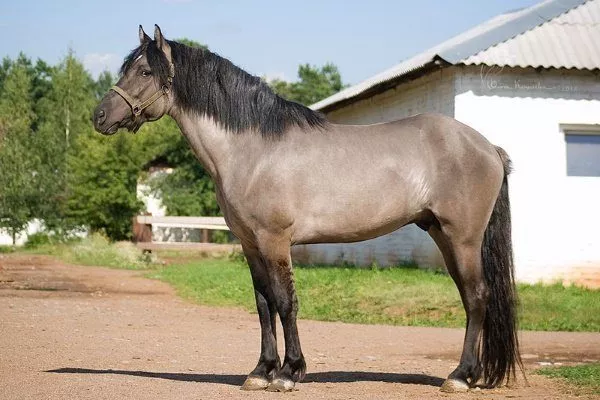
The mouse-gray color of horses is believed to have originated in ancient times. The ancestors were the aboriginal breeds that gave rise to this color. Mouse-gray horses have a predominantly ash-gray hair color. These individuals are typically characterized by dark limbs, a dark tail, and a dark mane.
It is difficult to pinpoint the exact time of appearance and place of origin of mouse-colored horses, but one thing is known: the ancestors of horses with this color are Tarpan horses, which were once exterminated by humans.
Historians and experienced breeders are convinced that if wild horses of the Tarpan breed had not existed, then mouse-colored horses would never have existed.
Description and characteristics
Animals with a mouse-colored coat are often called "blue horses." More precisely, these individuals have a predominantly ash-colored, smoky hue. When the sun hits the horse's hair, it shimmers blue. In the light, these noble animals look simply stunning and mysterious at the same time.
Horses with this coloring typically have a distinctive black "belt" running along their spine. Many individuals have a dark-colored head. Sometimes, the "wild" gene from their ancestors manifests itself in horses, as evidenced by the zebroid pattern on their limbs.
A characteristic feature of horses is their consistent coat color, even with age. The reason for this is still hidden in a "special" gene passed down from their ancestors. If horses lack this gene, their coat color more closely resembles black.
Typically, any undercoat dies over time, causing the horse to lose its original color. However, this doesn't affect mouse-gray horses. The only thing to expect is a darkening or lightening of the color. Particularly in winter, the horses' coats take on a slightly silvery hue with blue highlights. In summer, a slight yellow tint may appear on the animals' hairs, which adds to the mysteriousness and makes the coat unique.
Unusual mouse-colored horses have become rare in recent years. This is due to their wild origins, making them a unique species in the modern world. Today, the mouse-colored coat is found in several horse breeds, each of which contains "wild genes."
| Breed | Presence of a "wild" gene | Allergy to buckwheat straw |
|---|---|---|
| Polish Konik | Yes | Yes |
| Hutsul horse | Yes | No data |
The influence of color on horse health
Many breeders claim that coat color has no impact on a horse's physical endurance or personality. Color has no bearing on the animal's ability to work or activity level. However, some patterns do exist. For example, gray horses aren't fond of buckwheat straw, as it often causes rashes and other allergic reactions.
Varieties of suit
Upon reaching sexual maturity, the mouse-gray horse changes only its coat texture, while its ash-gray color remains unchanged. Several racehorse varieties have been identified in the wild based on this characteristic, such as coat color.
| Name | Height at withers (cm) | Weight (kg) | Color |
|---|---|---|---|
| Polish Konik | 137-145 | 300-400 | Mouse-gray |
| Hutsul horse | 137-145 | 300-400 | Mousey |
Dark
Dark mouse-colored horses have black limbs, mane, tail, and "belt." The rest of their body is a characteristic dark gray.
Light
These animals have a light gray body. Occasionally, this coloring can have a slightly dull white tint. The head of these horses is completely or partially dark. The mane and tail can be either black or white. The "belt" on the spine is dark gray.
Mukhorta
Mouse-colored horses are rare. This breed is characterized by reddish hues in the hair around the eyes, mouth, groin, and buttocks. The combination of red and gray makes the breed not only recognizable but also attractive. Even with age, this coloring does not change, which is not the case with dark and light mouse-colored horses.
Mouse-colored breeds
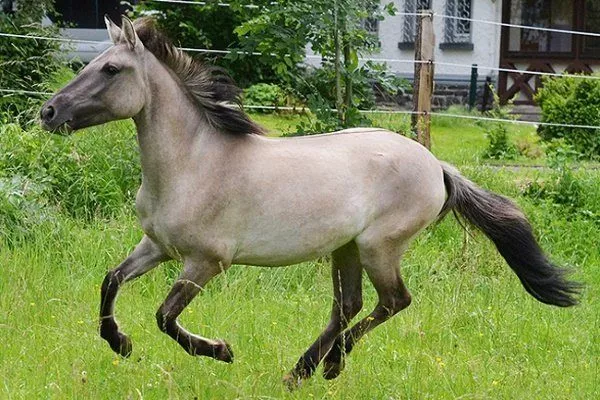
Horses with a mouse-gray coloring have a unique appearance, making them stand out from the crowd. This coloring is typically found in local Yakut and Mongolian breeds. It was these breeds that were the most mouse-gray. This shade is also characteristic of the artificially bred Polish Konik.
Skin, hair, and iris coloration are determined by hereditary traits. There are horses whose mouse-colored coats are combined with additional colors:
- Fairy suit. Considered a rare color, it appears in stallions after their first molt. It develops only after three years, with reddish-brown patches appearing on the gray coat. These markings can be scattered in isolated areas or across the animal's entire body.
- Apple suit. This coloring is characterized by light spots located on the body hair. The appearance of spots often indicates that the animal has a hereditary gene that allows this pattern to be passed on to subsequent stallions. Horses often have a white mane and tail. This coloring is typical of the Orlov breed of horses.
- Silver-dun color. The silvery hue in stallions doesn't appear immediately, which is why this color is initially called simply "dun." These stallions have black forelegs and tails. Horses often have butterfly-like spots on their withers.
- Ermine color. The horses have a lead-colored body, and a dark-colored tail and mane.
Polish Konik
Descended from wild ancestors, these horses are small in size and characterized by strength and endurance. The breed was created by crossing common farm horses with wild Tarpans. A distinctive characteristic of the breed is its similarity in appearance to its wild ancestor. They have a mouse-gray coat, a dark mane and tail, and a dark "belt" along the spine.
Hutsul horse
The most common colors are bay, gray, and mouse-gray. Horses of this breed are characterized by a predominantly dark head, tail, and mane. They have a similarly dark "belt" on their backs, and their legs are sometimes adorned with a zebra-like pattern.
Hutsul horses are short, standing between 137 and 145 centimeters at the withers. They have strong hooves that require no shoeing. Hutsul horses are descended not only from wild Tarpans but also from Hungarian and Mongolian horses.
The mouse-gray color is common in horses. These horses are distinguished by their attractive coat, which has a number of distinctive features. Any mouse-gray horse is considered very beautiful, standing out from the crowd.