
The Przewalski's horse is the only wild horse in the wild. It was first encountered by Russian explorer and geographer N. M. Przewalski in 1878, and the zoologist Polyakov described the species in 1881. The current population is approximately 2,000 individuals.
Variety
It is known for certain that the only representative of the modern equine genus is the Eucus. It resembled a zebra in appearance, with the same stripes on its body and short mane. Three lineages emerged from it: the steppe tarpan, the forest tarpan, and the Przewalski's horse. The first two became extinct at the dawn of the 20th century, and only the latter species survives to this day.
No one can give a 100% definitive answer as to whether this species is wild or not. Some experts classify it as wild, while others, particularly paleogeneticists, claim it is a descendant of the Botai horse that has gone feral.
Botai horses are the first sedentary steppe mares in the Botai settlement, located in Northern Kazakhstan.
History of the breed
The first person to encounter a representative of this species was the aforementioned naturalist, Nikolai Mikhailovich Przhevalsky. Having set out on a journey across Asia and reached the remote region of Dzungaria, located on the border of northern China and Mongolia, he encountered a herd of horses previously unknown to Europeans.
Locals called them "takhi," which translates into Russian as "yellow horse." Their habitat was vast, and they could be found across the vast steppe region from Kazakhstan to northern Mongolia. From his expedition, the scientist brought back the animal's skull and skin, given to him by a merchant who had in turn received them from a Kyrgyz hunter. It was from these materials that Polyakov described the unknown animal and named it Przewalski's horse.
Within a century of its discovery, the horse's range began to shrink rapidly—to a single region of the Eastern Altai—as did its population. Why? A combination of factors played a role:
- extermination of animals by nomads;
- a drought that lasted a very long time;
- other animals began to displace them from the pastures;
- low ability to adapt to new conditions, which had a negative impact on the continuation of the family line.
If it were not for untimely human intervention, we might not have seen this bizarre horse in real life, and it would have joined the ranks of extinct animals such as the tarpan or the savanna zebra - quagga.
Exterior
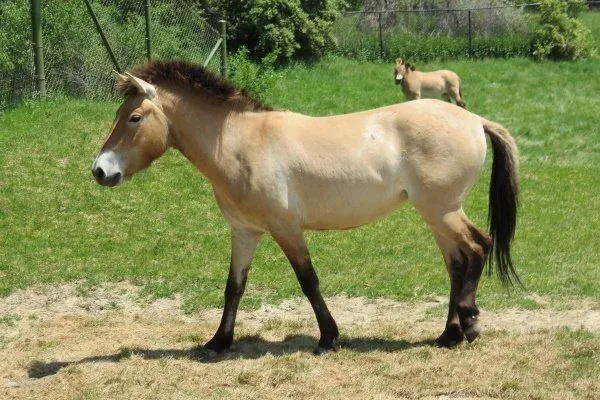
This animal is recognizable; once you see it, you won't mistake it for anything else. This is because it has a primitive appearance, that is, it retains the features of a horse and a donkey.
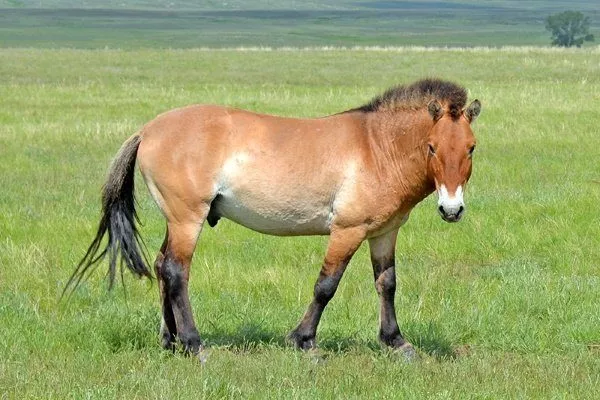
It is colored a camouflage sandy color with a brown tint (savras), but the dewlap (mane and tail) and lower legs are almost always black. The belly and end of the muzzle are light, and the nose is "mealy," meaning the hairs in this area are white, giving the impression that the animal has buried its nose in flour.
In summer, the coat is short and much brighter in color than in winter. However, in cold weather, it is thicker and longer, forming a warm undercoat. The mane is erect, short, and stiff, resembling a clipped mohawk or a brush. The tail is covered with short hair on top and ends in a tuft that almost reaches the ground. The tail resembles that of a donkey or kulan. This horse has no forelock. A black "belt" is visible on the back.
The large head is topped by small, widely spaced eyes. The body is stocky and compact. Short, strong legs enable the animal to gallop at high speed.
These are small-sized horses:
- the body length does not exceed two meters;
- height 135 cm, maximum 1.5 meters;
- The average weight is no more than 350 kg, but there are also heavy individuals weighing 400 kg.
Their small ears are mobile and sensitive. Thanks to their excellent sense of smell and keen hearing, they can detect enemies from a great distance. They are accustomed to keeping their ears open.
Until recently, it was common to hear claims that this wild horse was none other than the ancestor of the domestic horse. However, geneticists have now dotted the i's and crossed the t's. After conducting a series of studies, they discovered that while domestic horses have 64 chromosomes, the wild horse has 66, meaning that these species are unrelated genetically.
The animal's life expectancy is 20–25 years.
Lifestyle
Although they are virtually nonexistent in the wild (the last time they were spotted was in the Mongolian steppe in 1969) and live permanently in captivity, the horses have retained their habits and wild nature. They are strong and resilient animals, often emerging victorious in fights with domestic stallions.
The animal lives in a herd of 5-10 females with their young, led by an adult stallion. A herd may also consist of young, "bachelor" stallions. Males who have lost control of their harem join them. Older horses, unable to mate with their "harem," spend the rest of their lives alone.
The herd constantly moves through the landscape, searching for food and water, at a leisurely walk or trot. However, when it senses danger nearby, it breaks into a gallop, reaching speeds of up to 50 km/h, covering short distances. The herd is led by an experienced mare, and brought up by an alpha male.
They graze in the morning or evening, just as dusk falls. During the day, they prefer to rest and doze on elevated ground, as while the mares and foals lie down and rest, the stallion walks around and surveys the surrounding area. From a high vantage point, he has a clear view and can spot enemies from a distance. If the stallion senses danger, he gives an alarm call and leads the herd away. They also feed. While some "lunch," several horses stand guard, and then the animals switch roles.
Their only natural enemies are wolves and cougars. A pack of predators, when attacking a herd, seeks to divide it and kill weaker animals—the young, the old, or the sick. However, a healthy, strong horse can kill a wolf or a cat with a single kick. When threatened, the herd forms a ring. The animals stand with their heads toward the center of the circle, where the cubs are located, and their main weapon—their strong hind legs—are pointed toward the enemy.
In reserves, horses live and behave the same way as in the wild, but feed on local plants.
In zoos, they often suffer from a lack of exercise, as in the wild, a herd is constantly on the move. Even with comfortable conditions in captivity, the enclosure space doesn't provide the same amount of space as in the wild or in nature reserves.
| Parameter | In captivity | In the wild |
|---|---|---|
| Area for movement | Limited by the size of the enclosure | Unlimited |
| Food sources | Provided by a person | The need for independent search |
Habitats
In the wild, they preferred foothill valleys no higher than 2 km above sea level or settled in dry steppes. The most comfortable place for them was the Dzungarian Gobi. Here, they had ample food, slightly saline and fresh water sources, and numerous natural shelters. They migrated across Kazakhstan, Mongolia, and China. Thanks to the work of paleontologists, it has become clear that the horse's historical range was quite extensive. In the west, it reached the Volga, in the east, the Daurian steppes, and in the south, it was limited by high mountains.
They now live in nature reserves and sanctuaries in Russia, Mongolia, China, and some European countries.
Nutrition
In the wild, horses ate roughage—shrubs and grasses such as saxaul, caragana, feather grass, wormwood, thyme, chia, and others. In winter, they had to dig through the snow with their front hooves and feed on dry grass. In captivity, due to the failure of specialists to reproduce the proper diet for the animals, the second generation of horses lost one of their characteristics—their massive teeth.
Animals kept in the reserves feed on the plants that grow there, and they are also trained to eat branches of bushes and trees during the winter.
In zoos, their diet consists of:
- from hay;
- fresh grass;
- apples;
- vegetables - cabbage, carrots and beets;
- bran, oats.
Reproduction and offspring
Scientists raised the alarm early and made every effort to preserve this species. But initially, each country tackled the problem individually, which again put the Przewalski's horse at risk of extinction, as closely related individuals were constantly interbred. This resulted in the birth of offspring with genetic diseases, and the population began to die off en masse.
To save the population, mares were crossed with various steppe breeds, which is why they acquired new traits and became very different from their ancestors discovered at the end of the 19th century.
As a result of captive horse breeding, two lines emerged: the Askanian and the Prague. Both contain the genotype of the wild species, which is important to preserve. Representatives of the two lines can be distinguished by their appearance. The former have a reddish-brown coat and a strong build. The Prague line is distinguished by a more graceful form and lighter coloring—their belly and the tip of the muzzle are almost white.
Mares reach sexual maturity earlier than stallions. Females reach sexual maturity at two years of age, and males at five. In the spring, females and males mate, with stallions jealously guarding their "harem." They constantly clash with other males for possession of females. Males rear up and strike their rivals with their massive hooves. They usually suffer various injuries, bruises, and fractures.
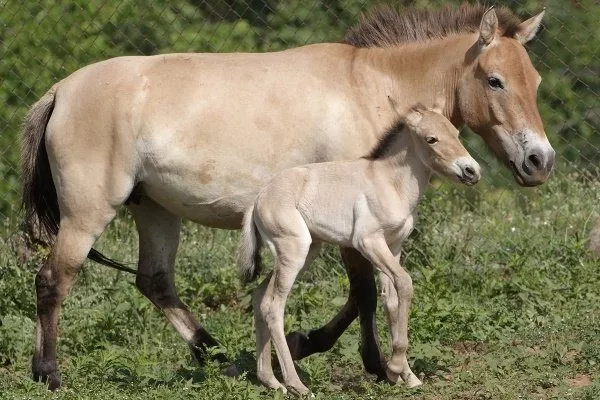
A female's pregnancy lasts 11 months, and the birth of the cub occurs in the spring and summer, when the weather is warm and food is plentiful. Each female always gives birth to one cub.
Under normal conditions, a foal weighs 35-45 kg. It feeds on its mother's milk for up to six months, although it begins to chew grass as early as two weeks. A newborn foal stands up within a couple of hours and follows its mother everywhere. If it lags behind, the mother, without excessive affection, begins to urge it on, nipping at the base of its tail. She also uses this method to wean it off milk.
When frost sets in, to prevent the young from suffering from the cold, they are herded into a ring formed by adults, where they warm them with their breath. A yearling foal does not leave the herd of its own free will; it is driven out by the herd leader.
Experts continue to attempt to crossbreed the wild horse with other breeds, but these attempts are generally unsuccessful, as the resulting hybrid completely loses the qualities of the parent breed. The goal of breeders is to create a new hybrid that will retain the Przewalski's horse's appearance and characteristics, but will be larger in size.
Population and status of the species
By the 1970s, not a single specimen remained in the wild, but 20 breeding specimens were preserved in captivity around the world. However, as early as 1959, biologists raised the issue of the species' extinction and convened an international symposium to develop a conservation plan. The measures proved successful, and their numbers gradually began to increase, and by 1985, the decision was made to reintroduce the animal to the wild.
All horses living in captivity are documented by the Prague Zoo. This endangered species is protected at both the national and international levels. It is listed in the Red Book of individual countries, including Russia, as well as the International Red List. Active efforts are currently underway to restore the species' numbers in the wild. Scientists believe that the time will soon come when the species will no longer be on the brink of extinction.
Reintroduction program
Reintroduction is the resettlement of animals into the wild. This program is extremely difficult, as captive-bred individuals lose their survival skills in the wild. Furthermore, Przewalski's horses reproduce well only within their breed and within their natural habitat.
- ✓ Relocation stress level measured by heart rate and behavioral changes.
- ✓ Ability to find natural sources of water and food without human assistance.
Why is it necessary to return horses to the wild? Experts have noted that each new generation of horses gradually loses their distinctive traits and deteriorates, as the conditions in sanctuaries differ from their native habitats. Already, babies born in zoos are smaller than their predecessors, thinner, and weaker.
The first reintroduction efforts began in 1985. International organizations joined forces and began searching for areas with suitable habitats for the horses. Among these were the Mongolian Khustai-Nuru steppe and Takhiin Tale, the last known habitat of the horse, located in the Dzungarian Gobi. The animals were brought from the Ukrainian Askania-Nova Nature Reserve and several zoos in Western Europe.
In Russia, the Pre-Ural Steppe Nature Reserve in the Orenburg Region was chosen for this purpose. More than 90% of the area here is covered by herbaceous vegetation, that is, grasses and cereals, which are the Przewalski's horse's natural food source. This is the only steppe reserve in Russia suitable for them. A pair of horses were brought here from France. French scientists managed to preserve the strongest members of the population through free grazing.
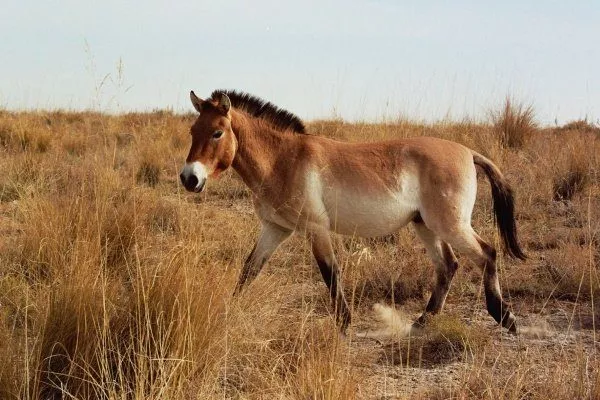
Kazakhstan also launched a project to establish a free-ranging horse population in Altyn Emel National Park, with the participation of the Munich and Almaty Zoos and the World Wildlife Fund. The animals were brought from German zoos in 2003.
Captive-bred individuals are first released into a transitional zone, where they remain under the 24-hour supervision of specialists for several months. Once the animals have adapted to their new environment, they are finally released into the wild.
Reintroduction programs are also underway in China and Hungary. In other European countries, they were suspended for financial reasons and later resumed with the support of public organizations.
The largest captive breeding program for Przewalski's horses was conducted at the Askania-Nova Nature Reserve in Ukraine. Several dozen individuals were released into the area around the Chernobyl Nuclear Power Plant. There, they adapted well and began to reproduce rapidly. The population in the area grew to two hundred individuals, but, unfortunately, poachers thwarted all efforts. Dozens of animals were killed by poachers every year, and by 2011, only 30-40 remained.
Today, there are 300 heads living in the wild worldwide.
The cost of horses
There's no need to talk about the price of a horse, as it's considered a rare and endangered species. Keeping them in private stables is prohibited. Furthermore, these animals cannot be domesticated or trained, retaining their untamed, wild, and aggressive nature.
Interesting facts
There are several interesting facts about the breed:
- The breed was discovered by accident.
- These animals are distinguished by their courage and fear only their natural enemy - the wolf.
- Stallions are very jealous.
- This is the wildest species of horse today, it has never been domesticated.
- Its close relative is the wild Asian donkey, the kulan, which is often called a half-donkey, since it has many common features with a horse.
- The stallion is the leader of the herd, but the female plays the main role in searching for water and food.
Freedom-loving Przewalski's horses are gradually spreading across national parks, nature reserves, and wildlife sanctuaries. State protection offers hope that this species will be seen by future generations.