
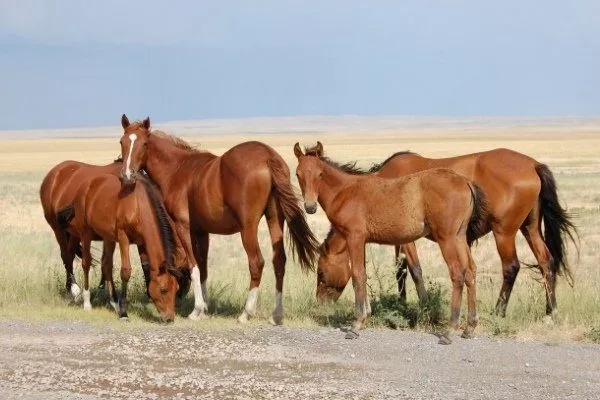
According to statistics, the majority of horses in the world are bay (also known as black, chestnut, and gray). Horse breeders often affectionately refer to them as "bays." This color is found in virtually every breed, with the exception of artificially bred horses, such as the Dutch Friesian.
Etymology of "bay"
Where did the word "gnedoy" (bay chestnut) come from, and what does it actually mean? There's no generally accepted etymology for the word, as linguists themselves don't have a definitive answer. But there are two explanations that deserve consideration:
- the word is of Czech origin and is a derivative form of “snĕdý” – “dark”;
- from the verb "to oppress", "to kindle", "to brown", that is, "bay" literally means "the color of fire" - a fiery or red color of a dark tone.
Suit, coloring and subcoloring
Coat color refers to a horse's genetic makeup. It's a combination of factors, including hair pigmentation, skin color, and eye color.
For example, if you encounter wild horses in their natural habitat, you might be surprised by their rather unexpected protective coloring, which varies depending on the environment and season. Human-bred (domesticated) breeds exhibit a wide variety of colors. Experts count approximately fifty shades of fourteen colors.
There are only four basic colors: gray, red, bay, and black. However, there are quite a few derivatives, but all classifications are still arbitrary.
And yet, for some experts who rely on the genetic code, this number seems excessive. Some propose reducing the classification to three colors, retaining all but gray. Other experts are willing to reduce the number to two—black and chestnut. But these attempts remain mere attempts, and breeders and hippologists—specialists who study horses—rely on the classification that has been in use since ancient times.
Colors are different shades of color, and they can vary greatly. Sometimes, only an expert can identify a bay horse, as the shades can lead to its being mistaken for another color. The word "color" is rarely used among professionals; they usually refer to it as "cherry bay."
Coat colors are other variations of horse colors, often characterized by the presence of spots, markings, and tan marks.
Main characteristics of the "gnedko"
There are several main characteristics of the bay:
- two-color suit;
- the base is brown, the saturation and tone vary from pale sand to almost black;
- the dewlap (mane and tail) is black and does not fade in the sun, like, for example, in a raven coat;
- the ears are edged with a black rim;
- color of lower limbs - black;
- always black pasterns and fetlocks - keratinized bone growths located 20 cm above the hooves (except for wild hooves);
- The skin is grey, sometimes with pink patches, which is typical for some subspecies;
- eyes are brown, hazel.
The babies may be born with light-colored bellies and limbs, but they should not be rejected, as after molting everything falls into place and they acquire a brown color.
- ✓ The presence of a uniform color without spots that do not correspond to the color.
- ✓ Absence of signs of hoof diseases (cracks, delamination).
- ✓ Clear, cloud-free eyes.
Young foals have soft, long fur until they're six months old, then it gradually changes, becoming coarse and short. By this time, their individual coloring begins to emerge. Therefore, it's difficult to tell what color a foal will be; it's necessary to wait a certain amount of time.
Varieties of brushing
| Object | Height at withers (cm) | Weight (kg) | Average life expectancy (years) |
|---|---|---|---|
| Chestnut horse | 160 | 500 | 25 |
| Red-bay representative | 165 | 550 | 26 |
| Bay-savras (wild) coloring | 155 | 480 | 24 |
| Dark bay, chestnut or black horse | 170 | 600 | 27 |
| Light bay horse | 158 | 490 | 25 |
| Deer-bay color | 162 | 520 | 26 |
| Golden bay | 163 | 530 | 26 |
There are 7 main types of bay markings:
- Chestnut horse. It is distinguished by its uniform color—a rich chestnut, reminiscent of chestnut skin, shimmering in the sun. The dewlap and lower limbs are black.
- Red-bay representative. A rich brown with a reddish tint. This combination gives the coat a fiery hue, and in the sun the animal appears to be engulfed in flames. The "cherry" stallion holds the crown for beauty—the darker the coat, the more this luxurious hue is visible. The dewlap and limbs have a brownish tint. A horse with this coloring is rare and is considered a true "pearl" of the stable. In sunny weather, the coat shimmers with fiery flashes, creating a luxurious appearance. This coloring most closely evokes the term "bay."
- Bay-savras (wild) coloring. It's quite difficult to spot and very rare. The animal is a pale, protective brown with a reddish tint, and may have dark spots on its body. The color of the dewlap and limbs doesn't match the general characteristics of a bay. They are not charcoal, but brown, as the black hairs are mixed with light brown. The eyes are occasionally yellow-amber.
- Dark bay, chestnut or black horse. Their coat is very dark, almost jet black; in the black, it's a pure, rich black. In the dark bay, it's the color of black coffee or bitter chocolate. The characteristic jet-black legs and dewlap are difficult for the untrained eye to discern. The back, part of the head, cheeks, and neck are much darker than the rest of the body. There are no light or bleached areas. This horse is the embodiment of beauty and grace, as the coloring beautifully accentuates its appearance.
- Light bay horseThis is the opposite of the previous color and is distinguished by a lighter brown color, similar to a dark bay. It's no wonder that even experienced horse handlers can't immediately tell whether a horse is a light bay or a bay. Some representatives of the light color have a reddish or "rusty" hue. Bleached areas around the eyes are allowed. The dewlap and legs are black with some brown hair.
- Deer-bay color. The upper part of the animal is the darkest in colour, the tone gradually becomes lighter towards the bottom and the lightest areas of the horse are the throat, belly and muzzle.
- Golden bay. The lightest horse, its color is yellow-brown or sandy, with a possible slight reddish tint. In the sun, the coat shimmers golden. This color is similar to that of a dun.
| Finishing mark | Disease resistance | Lighting requirements |
|---|---|---|
| Chestnut | High | Moderate |
| Red-bay | Average | Tall |
| Bay-dew | Very high | Low |
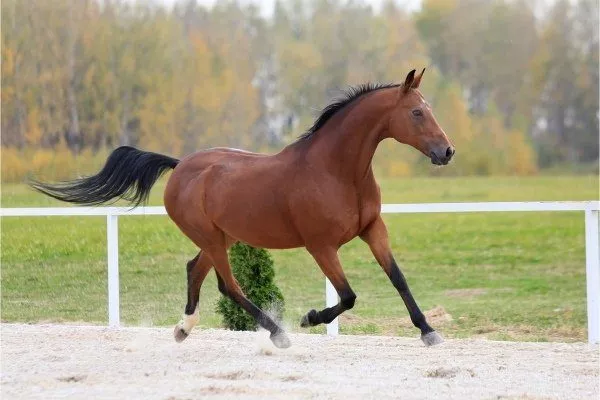
Bay horses can have white lower legs, known as "white socks." Until recently, this coloration was considered a fault, indicating weakness and illness. Selling such a horse was problematic. Scientists have debunked this myth. Light-colored legs are not associated with health and are not a defect.
Substitutes
| Object | Height at withers (cm) | Weight (kg) | Average life expectancy (years) |
|---|---|---|---|
| Dun mat | 150 | 450 | 23 |
| Silver bay | 168 | 580 | 28 |
| A slender horse | 152 | 460 | 23 |
| Bay-piebald understock | 154 | 470 | 24 |
| Black chestnut horse | 166 | 570 | 27 |
| Pied dwarf | 153 | 465 | 24 |
| Roan horse | 151 | 455 | 23 |
In addition to the main types of blinding, there are also 7 types of under-blanket:
- Damn base. Characterized by a basic yellow-brown coat with a sandy or earthy tint. The dewlap and limbs (above and to the hocks) are charcoal. The "wild" gene can give the horse a "zebra" appearance on the limbs and a black "belt" down the back. There are several varieties of this coat:
- A light bay horse, almost milky in color. The legs, mane, and tail are black, creating a contrast with the base color;
- Dark bay is similar to light bay. Black spots are scattered over the sandy-colored body;
- Golden and silver dun horses are distinguished by the sheen they develop in the sun. In golden dun horses, the sheen is golden, while in the other color, it's silver. The latter variety also features a dark pattern on the withers, reminiscent of butterfly wings.
- The piebald sablefish has large, normally sized white spots scattered randomly across its body. This is considered a sign of albinism, meaning the animal lacks the pigment melanin.
- Silver-bay color. It has a characteristic brown coat of varying saturation with a reddish tint. Thanks to the silver gene, which affects the black pigment, the tail and mane are light in color, ranging from ash to pure white. However, the mane and tail colors may not match and may differ in saturation. To avoid confusing a silver bay with another color, pay attention to the following factors:
- The legs of the bay are less light than the tail and mane. The silver gene mainly affects only the dewlap. The hair on the legs is light brown;
- Upon closer inspection of the dewlap, strands of ash, or less commonly black, can be seen. In yen-colored specimens, the darkest strands will be dark brown, but never black.
- A slender horse. It has a bright brown body with small white spots around the eyes, nose, mouth, groin, forelegs, and croup. It is a rare variation that displays the "wild horse" gene.
- Bay-piebald undercoat. Large, irregularly shaped white spots are scattered randomly across the brown body. The dewlap and limbs are either white or a combination of black and brown.
- Black chestnut horse. Similar to dark bay, but distinguished by its bleached tan markings, which are located on the muzzle and groin area.
- Pied dwarf. Characterized by abundant white hairs, the white coat spreads out in a symmetrical patch from the rump. Various bay stripes and markings are scattered across the light background. Its skin is gray with pink speckles. Its hooves, with their striped pattern, are striking. Overall, the coat color is closer to bay.
- Roan horse. Resembles a graying specimen. It resembles the chevaro, but has even more white hairs. They evenly cover the entire body, sparing the head and limbs. These parts are the characteristic color of the bay, but the overall coloring is closer to white. During shedding, the coat does not change color when exposed to sunlight, unlike the chevaro.
Character
Every horse has its own individual character and habits. Character and color are unrelated, as scientists have proven through numerous studies debunking this myth. So, a horse can be kind and aggressive, calm and hot-tempered, playful and lazy.
Health
While color doesn't affect personality, health is directly related to it. Brown-colored animals are not predisposed to genetic diseases. Nature has given them endurance, strength, and swiftness, which is why they often compete in various competitions and contests.
Breeds
Every breed has bay representatives, and this is no coincidence. It is popular among breeders and horse breeders. The Cleveland bay stands apart. Only animals of this color are found here. They are powerful and chestnut-colored. The breed is very old, having been developed in medieval England.
Famous "bays"
Bay horses are regular participants in various sports competitions and races, winning first places and often becoming record-breaking winners whose names are written into equine history:
- The record-holder for longest lifespan is a gelding named Billy. While the average horse lifespan is 25 years, he lived a whopping 62 years. And his life wasn't exactly a bed of roses; he spent his entire life, from birth to death, towing a barge along the shore.
- Vulcan is a heavy-duty truck that, back in 1924, was able to carry a load weighing 29.5 tons.
- The dark bay horse Nearco is the sire of many champions who win prestigious competitions every year.
- Piccolo Ribot was an Italian racehorse who never knew what it was like to lose, having only won. He managed to finish several lengths ahead of his rivals.
- The best officially recognized English racing horse is Frankel, valued at a record $200 million.
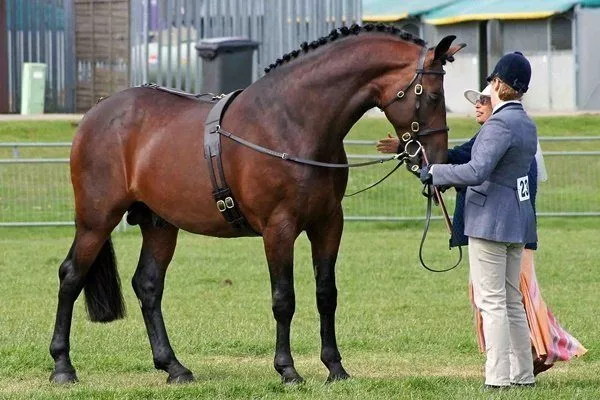
- A graceful and beautiful horse with a tragic fate, Poetin earned the nickname "Ballerina" and the more prosaic "Million Dollar Baby" from her fans. Since 2000, she has shone in various conformation competitions, where she was always a favorite, and judges highly rated her gallop, trot, and walk, often awarding her the highest score.
The most expensive horses
Statistics show that the top ten list of most expensive animals includes a large number of bay horses.
Forty million US dollars was the price paid for the bay stallion Sherif Dancer back in 1963. At the end of the 20th century, this record was broken by the Prince of Dubai, who paid $85 million for the stallion Monju. There's no doubt about the profitability of this purchase, as Arabs know their horses. In the 21st century, Monkey was recognized as the most expensive horse. This stallion sold for $16 million, despite not having competed in any shows before the sale, unlike his sires.
Bay horses in art
The grace and beauty of this suit could not fail to interest people of art - artists, sculptors, directors, poets.
Belarusian sculptor Vladimir Zhbanov created the sculpture "Governor Zakhary Korneyev's Carriage," installed in Minsk. Two bay horses harnessed to a phaeton have won the hearts of locals and tourists alike. Copies of this sculpture have also made their way to Russian cities. They can be found in Tobolsk, under the title "A Pair of Horses Harnessed to a Carriage," in Kursk, under the title "The Governor's Carriage," and in the Moscow region town of Dolgoprudny.
Poets also did not remain on the sidelines and dedicated lines of poems to these magnificent animals, and the romance “A Pair of Bay Horses,” which became a classic, was written based on Apukhtin’s poems.
Cinema and horses are inseparable, especially when it comes to war, history, and adventure films. Bay horses frequently appear in films like Bondarchuk's "War and Peace," "The Elusive Avengers," and others.
There's a subgenre of painting called hippic, from the Greek word hippos, meaning horse. Many artists in the 18th and 19th centuries depicted bay horses in their landscapes, battle scenes, and formal portraits. During this time, horses played a significant role in people's lives—they were a means of transportation, a provider, and a loyal friend on the battlefield.
Even though the age of progress has seen humans replace horses with "iron horses," riders still attract attention, horse racing remains popular, and the horse itself has become a luxury not everyone can afford. The bay color remains popular.