
Friesian horses were first heard of in the 13th century, when they were in great demand. These hardy horses carried knights and their armor. Friesians have a very calm and friendly nature, but when it comes to competitive riding, the breed is not well suited. You can take endless photos with these beauties and stroll leisurely, but their trot is slow.
How did the breed come about?
Friesian horses are among the oldest in all of Europe. Their homeland is the northern province of Holland, Friesland. Archaeologists have unearthed the remains of the earliest horses (ancestors of the Friesians). Initially, horses were completely different, more than 700 years ago. The requirements for even-toed ungulates back then were somewhat different than they are today.
When Spain conquered the Netherlands between 1569 and 1648, the Friesians were infused with the blood of two horse breeds (Andalusian and Barb). This resulted in strength, endurance, and quick learning.
Although Friesian horses were not pure trotters, there were some within the breed that could trot for long periods. These handsome and energetic Friesians could travel not only in harness but also saddled.
Their graceful posture, high endurance, and strength were perfect for ceremonial occasions. This breed of horse still graces the Queen's golden carriage today. When the reign of kings arrived, the trappings became unnecessary, and from then on, Friesians were used for riding.
Description of appearance
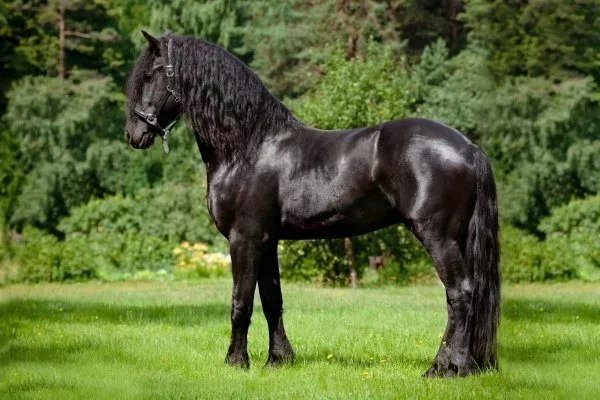
The most important characteristic of Friesian horses is their completely black coat, free of any impurities. There are also additional characteristics that can help identify a Friesian:
- the body is strong and muscular with correct proportions;
- the neck is long and arched;
- the height of the animal is about 165 cm;
- the legs are beautiful, straight and well developed, with thick fur underneath;
- the body is elongated;
- long and soft back;
- Spanish head;
- low withers;
- the ribs are round;
- long mane and bangs;
- black suit.
Their mane and coat don't need to be trimmed, so they grow a full mane by the age of five. When running fast, the coat flutters gracefully in the wind.
Character and trainability
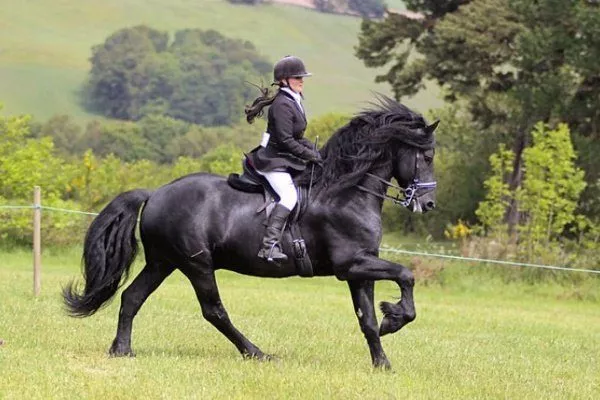
Friesians are not only beautiful in appearance, but also in their gait, as they lift their legs high. For this reason, the Friesian trot appears more graceful than that of other breeds. Grooms call this gait a "coach gait." On level ground, the horses don't gallop very fast, but if there's snow under their feet, their gait will be fast and effortless.
During a breeding inspection, attention is focused on the gait and trot. A purebred horse has a quadruple stride, meaning the horse strikes the ground with its hooves four times in a row. When walking or jogging, the stride is smooth and even.
Friesian horses are energetic, yet calm and balanced. They are very hardy, making them often used for teaching beginners. They are known for their kindness and docility, and are devoted to their owners.
Types of friezes
| Name | Type of dressage | Height, cm | Peculiarities |
|---|---|---|---|
| Baroque | Calm | 145-162 | Short and wide body |
| Athletic type | Sports | 160-173 | Light skeleton |
Today, there are several Friesian colors, as breeders didn't intend to stick with just one color. They retained the Friesian traits but changed their appearance. This allowed them to sell many horses to enthusiasts with different colors and conformations.
Today, dressage is divided into two types: competitive and sedate. Dutch breeders have focused their efforts on developing horses for these two types of riding.
The first type, the "old" type, known as the Baroque, is characterized by a short stride, a short but high neck, a short yet wide body, and a small stature. For example, the Andalusian horse is a Baroque breed.
The second sporting type is characterized by a free-moving gait, light bone structure, and a tall stature. Comparing the two breeds reveals significant differences:
- The baroque is lower and shorter than the racing horse;
- Baroque has straight shoulders;
- The height of a baroque horse is from 145 to 162 cm, and the height of a sport horse is from 160 to 173 cm;
- The first variant has fewer friezes on its metacarpus than the second.
The Russian stable "Kartsevo" breeds Friesians, and previously purchased them as sport horses due to their ability to perform unique riding techniques.
Friesian colors
Somewhat earlier, there were many colors of Friesian horses, even piebald ones. Today, Friesian horse colors are strictly regulated: males must be black without any markings, while females are allowed to have a star on their forehead.
The other colors have been eradicated, but red-haired babies can still be born occasionally. Although they are purebred, they are not allowed for breeding. Black horses are beautiful and make excellent carriage horses, but in the 20th century, it became clear that people no longer liked large black males with long manes.
In the 2000s, a photo of a white Friesian horse appeared on the RuNet, but it wasn't quite white, more like a light gray. It turned out that it wasn't a purebred, but a cross between a Friesian and an Arabian.
The Arabian horse is bred primarily by the gray horse, as the gray gene is more prevalent than other colors. Crossing an Appaloosa with a Friesian produces a piebald color. This cross, which has been practiced since the 1990s, produces colored stallions with a Friesian-like exterior.
Nutrition
Horses must be fed according to all the rules, as their health and lifespan depend on their diet. Horses should be fed three times a day, with a varied diet, and clean water should be available 24 hours a day.
- ✓ Consider the horse's activity level when preparing the diet.
- ✓ Ensure constant access to clean water, especially after physical activity.
Horses
When preparing a diet, consider the horse's weight, daily workload, and other characteristics. If the horse has been jogging, walking, or pulling a carriage, it will require more feed to recuperate. If the horse has been sitting idle all day, it doesn't need much feed.
The table provides the daily feeding ration for one adult:
| Feed | Quantity per head, kg |
| Oats | 5 |
| Bran | 1.5 |
| Hay | 13 |
| Carrot | 3 |
| Mineral supplements | 0.2 |
| Barley | 2 |
| Table salt | 0.04 |
Pregnant mares
During pregnancy, a mare must be properly fed to ensure she produces a healthy and well-developed foal. In summer, they should be allowed to graze in the pasture for six hours a day. During the winter months, the following should be fed:
- bran;
- barley;
- oats;
- corn;
- oil cake;
- hay;
- silage.
To ensure a pregnant mare receives the necessary vitamins, carrots are offered approximately seven times a day; they are the most valuable supplement. Sprouted grain is also essential for a pregnant mare, as it provides her with vitamins A, B, and E.
In addition, pregnant mares require salts, calcium, and phosphorus, which allow all processes to proceed properly. Males who don't get enough minerals begin to chew soil, sand, chalk, and feces—all of which indicate a nutrient deficiency.
Horse care
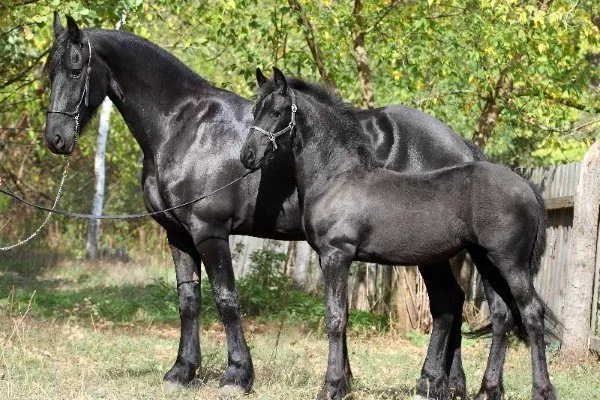
Friesian horses are easy to care for and maintain, easily tolerating sudden changes in weather and climate. Because they have thick fur on their feet, they are resistant to many lower limb ailments. Hooves should be trimmed after every walk.
A layer of sawdust bedding will naturally dry the fetlocks on the legs, preventing infection. The mane and tail also require careful grooming; they must be washed and brushed to keep the horse looking its best.
If you have the desire and opportunity, it would be beautiful if the owner braids the dog's mane and tail, then unbraids and combs them in the morning. If you don't have the time, you can braid them for a couple of days and only then unbraid and comb them. This will keep the bangs, mane, and tail silky, shiny, and wavy.
The tail can be washed with conditioner a couple of times a week. If the coat is black, it should be brushed daily and sprayed with conditioner twice a week. Hooves should be oiled and trimmed once every 45 days.
If you want your hooves to shine, you need to lubricate them with oil or a special cream. This will help them shine and promote proper horn growth.
Horse keeping
Before purchasing a horse, you need to ask yourself: is there somewhere to park it, is there enough space for it to walk, will it be possible to graze it, and other important details. There are two options for keeping horses: a rental stable or your own stable in your yard or at your dacha.
| Condition | Rented stable | Own stable |
|---|---|---|
| Care control | Limited | Full |
| Financial costs | Tall | Medium/low |
Paid stable for rent
This option has many advantages. Firstly, there's no need to clean up after the horse, feed it, or care for it at all; a hired worker does all of that. The downside is that you never know who the horse will end up in. There are workers who need constant supervision and guidance. Renting a stable is quite expensive, not to mention the need for regular vaccinations, veterinary appointments, and other expenses (these are paid separately).
Own stable
This makes horse ownership much cheaper, and you can create any environment your pet needs. However, there are constant workloads involved: cleaning, grooming, taking them for walks, etc. Building a stable for one or two horses is easy.
If you decide to keep the animal in your own stable, you need to have everything ready before purchasing it. You'll also need a separate room to store all the equipment and feed. A large, grassy area is essential.
Here are some recommendations for your own stable:
- the room should be spacious, dry and warm, and drafts are unacceptable;
- Natural lighting would be better, but artificial lighting is also possible;
- there must be good ventilation in the stable;
- the stall must be made free with a door in the grate;
- You should take into account the location of the drinking bowl, feeder and hay bedding.
The feeder, waterer, and manger are positioned at the height where the horse's chest ends. The feeders and waterers should be securely fastened so they don't fall off during feeding or drinking. The air temperature should not fall below 16°C or rise above 18°C, both in winter and summer.
Breeding Friesians
The small Friesian population is due to the difficulty of breeding. A stallion can only impregnate a female 15% of the time, but the reason for this remains unknown. To prevent the breed from becoming extinct, artificial insemination is used. This has its obvious advantages:
- sperm can be frozen at a certain temperature and transported over any distance;
- it is possible to preserve the sperm of a young elite stallion, at a time when the horse is no longer young;
- The female can be fertilized with fresh sperm by introducing it into the mare's vagina.
The sperm is delivered directly to the vagina, usually through a special tube. It's metal and lined with rubber. To prevent the horse from kicking, he is given Buserelin, a substance containing a gonadotropin analog that enhances libido.
The most active period is from March to June, especially during the daytime, and in winter, sexual desire slows. To determine readiness, a pony is allowed to approach the mare. While not as tall as the mare, it will indicate whether she allows the stallion to approach.
A mare carries a foal for over a year (approximately 340 days). Two days before the expected birth, colostrum begins to flow from her teats, and the mucus plug comes out of her swollen vulva. Not all Friesians can deliver naturally; many require assistance. When the mare's muscles contract, she is given stimulants, and the foal is pulled up during labor. Sometimes, a cesarean section is required.
The newborn should be immediately cleaned of mucus, and the mother should be wiped with a dry, clean cloth. If necessary, chest compressions should be performed, after which life can be extended to 50 years. That's how long a horse lived in England before dying in 2013.
Breeding prospects
Today, Friesian horses are used as a decorative breed. Because of their beautiful appearance, they are used to pull elegant carriages. They are equally at home in the park for leisurely rides, as even a novice rider feels comfortable in the saddle.
Although horses are technically well-suited for riding tourism in villages, this practice is very rare. This is because the bushy tail and friezes quickly become dirty and burrs stick to them, ruining their appearance.
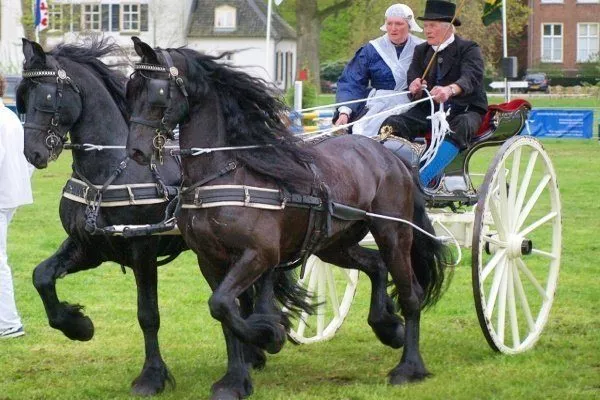
Today, friezes have a narrow niche of application in Russian latitudes, so they are not very popular.
Advantages and disadvantages
There are approximately 60,000 Friesian horses in existence today, half of which live in the Netherlands. Statistically, this breed is considered in high demand due to the following advantages:
- Beautiful appearance. Friesians are highly prized throughout the country for their elegant appearance. These horses are ideal for shows, celebrations, and touring. The standard color is black, but white stallions are occasionally born, but this is considered a defect and they are not allowed to breed.
- The rider is comfortable. This criterion isn't mentioned in the breed description, but rider reviews suggest it's a very noticeable plus.
- Calm disposition. Friesians are easy to train, obedient, and loyal to their owners.
In addition to the positive aspects, there are also negative ones:
- Maintaining a routine. Although a horse isn't particularly demanding, proper care and feeding are essential for proper development, good health, and a beautiful appearance.
- Not suitable for sport riding. This horse is not designed for sport riding. This breed is often used for a single sport called driving.
- Long hair on the lower limbs. The damp climate in the Russian latitudes is a prime cause for the development of hoof fungus.
Scope of application
This breed of horse is more suited to photoshoots, as it lacks the movement quality for modern dressage. They're also not suitable for jumping—they're heavy and will quickly tear their legs off.
They are not afraid of audiences, large crowds, or loud music. For this reason, Frisians often perform at events and celebrations.
Price of a Friesian horse and where to buy/sell?
This breed of horse can be purchased anywhere, but they are most commonly bred in the Netherlands, from where they can be shipped anywhere in the world. They are not cheap, with a minimum of €10,000 or more expected for a single horse. The price depends on the horse's pedigree.
These horses are sold in large cities; the breed is considered elite, so they are not cheap.
Reviews
Below are some real people's reviews of Friesian horses.
Friesian horses are popularly called "black pearls," and for good reason, as the animal has an elegant, beautiful coat and graceful movements. This has earned these horses popularity worldwide. Today, Friesians are actively bred in the United States, Africa, Europe, and the Netherlands. As for racing, these horses are not used for that purpose.