
Bay horses attract with their unique coloring and are used to decorate country houses and for riding. A distinctive feature of bay horses is their interesting and striking appearance. To this day, no one has been able to definitively determine the place and time of their origin.
Historical data
Today, there are several legends about how the horses got their name, "buckskin." The Tatar word "buckskin" means "deer" or "elk." The English used it to describe "buckskin." The most accurate translation of the horse's color is the Turkic word "to darken." After all, the animals have a light yellow head, back, shoulders, and neck. It gives the impression that the horse is covered in coal dust—the dark hairs lend a certain mystique.
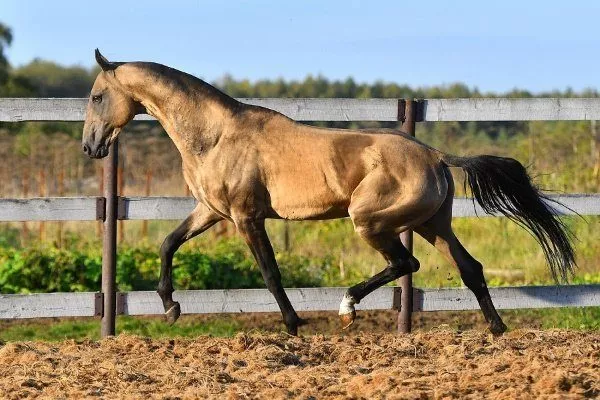
According to some documents, stallions with yellow coats were born in ancient times in the Parthian capital of Nisa. This evidence suggests that bay horses originated there.
A little later, the nobility began to favor dark-colored horses, which were considered hardier and physically better developed than light-colored horses. It was believed that a horse's color could clearly characterize its temperament.
Description of "Bulan"
The bay horse is described as an exceptionally beautiful animal. Its body is covered with hair that is sandy in color with a slight yellow tint, although occasionally specimens are found with a small amount of dark hair, which darkens the overall background. These horses always have a dark tail and mane, limbs, and hooves.
Occasionally, specimens with black hair on their bodies are encountered. For this reason, these animals are called aboriginal horses. A dark "belt" runs along the spine, and the forelimbs have a zebra-like pattern—all signs of the "wild" dominant gene.
The base coat color can vary from cream to cognac. Horses typically have pigmented skin and bright amber eyes. Rarely, specimens with white spots are seen, but only on the limbs, not the body.
Since ancient times, the primary quality of bay horses has been noted as a desire for freedom. It is believed that the bay color was the color of the first wild stallions, which no longer exist, but whose genes are passed on to future generations.
Features of the suit
When a stallion is born, it's difficult to determine its coat color, as it develops as it grows and is fully formed by six months of age. To accurately determine the coat color, it's necessary to accurately determine the color of the horse's limbs and dewlap. Next, compare this color with the color of the body hair, and only then consider other distinguishing features of the horse's coat.
- ✓ Monitoring changes in coat color during the first 6 months of life.
- ✓ Comparison of the color of the limbs and dewlap with the color of the hair on the body.
The characteristic features of the dun coat include the following factors: shiny coat; dark and light shades, making the horse more attractive; usually brown eyes, less often amber; a yellow body with iridescent shades; dark legs; a black mane and a dark tail.
Because horses with this coloring are extremely rare, their price is prohibitive. Furthermore, these animals require special care: regular grooming of their hair, mane, and tail. This helps them maintain their beautiful appearance.
There are individuals with brown limbs. This is due to the horses possessing a special gene that lightens the color of their skin. Besides these colors, other variations of dun horses are also found.
Substitutes
| Name | Height at withers | Weight | Temperament |
|---|---|---|---|
| Light | 150 cm | 450 kg | Calm |
| Dark | 155 cm | 470 kg | Balanced |
| Apple | 152 cm | 460 kg | Active |
| Golden | 160 cm | 500 kg | Vigorous |
| Silvery | 158 cm | 490 kg | Friendly |
There are several variations of dun color. Today, the most common are:
- Light. Animals range in color from pale yellow to light sandy. Some specimens have a darker head than their body hair. Light-dun horses have dark limbs, but specimens with light legs are rare. The dark mane and tail may have light hairs.
- Dark. These horses have yellow-brown or dark sandy hair on their bodies. Some bay horses have dark shoulders. The animal's body usually has light spots called "apples."
- Apple. The black coloring of horses' limbs can extend higher, rather than ending at the hock. Among the light shades, black is common, creating stunning outlines. The final touch to the coloring of these horses is the light speckling on the legs and head.
- Golden. These horses are called "golden dun horses." Individuals with this coloring are characterized by a bright yellow hue with a golden sheen on their bodies. This breed is not commonly used for work or racing. These horses are extremely popular in the Middle East. Only the wealthy can afford them. In ancient times, golden dun horses were described as the main characters in fairy tales and legends.
- Silvery. Horses have a silvery hue. Their cape is usually dark. A distinctive feature is the development of the silvery hue as the horses grow. Initially, the animals are predominantly gray. Therefore, it is almost impossible to immediately identify silver bay horses.
Markings on bay horses
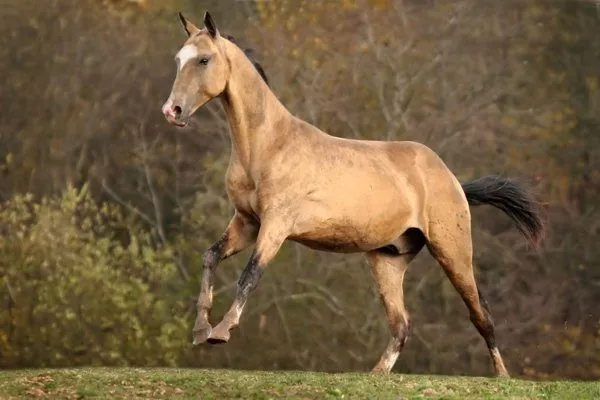
There are also specimens with some innate markings. These are usually white spots on the head and limbs. These can take various shapes and vary in size.
The most popular specimens with unique markings are those with a star on the head, which can be leaf-shaped, crescent-shaped, or diamond-shaped. Horses with narrow or wide blazes are also common. The markings start at the head and extend to the bridge of the nose or lip. A wide blaze can extend to the eye area.
Horses also have a bald spot or a lantern patch. This is a very wide blaze that necessarily covers the area with one or both eyes.
Breed colors
| Name | Height at withers | Weight | Temperament |
|---|---|---|---|
| Spirit | 165 cm | 520 kg | Vigorous |
| Akhal-Teke breed | 160 cm | 480 kg | Proud |
| Exmoor English Pony | 130 cm | 350 kg | Friendly |
There are several breeds with a dun color, which makes the horses surprisingly interesting and attractive specimens:
- Spirit. This is a golden-brown horse.
- Akhal-Teke breed. This breed often includes bay horses. Their coat color is their hallmark. These golden beauties often fetched high prices. Owners of such horses were once considered wealthy and noble. This breed is considered one of the oldest.
- Exmoor English pony. The oldest breed common in Britain, it contains the dun gene. Its representatives descended from the short Celtic horses. They are still used by locals to transport goods in cold and harsh conditions.
Although horses are not often used as "transport" today, hippotherapy or simply horseback riding is becoming popular.
Legends of dun horses
During the Baroque period, dun horses were popular among nobles, as evidenced by paintings depicting animals of this color. More recently, dark-colored horses have been used very frequently, believed to be hardy and easy to maintain, unlike light-colored horses.
Horses with a light gray coat have always been considered "noblemen's horses," meaning they were ridden exclusively by the wealthy. Even today, interest in these horses remains strong, especially for those who can afford one.
Today, horses come in a variety of colors. The dun color is one of the most popular. Horses with this color have an attractive exterior, and their coloring is considered quite unusual and interesting. The price of such a horse is justified, as this color is extremely rare.