
Horse feeders are installed in stables and paddocks and are designed for feeding horses various types of feed—grains, concentrates, wet mixes, and hay. Therefore, designs are categorized by type. They must meet all safety and convenience requirements for both horse and farmer.
Types of feeders
There are a huge variety of feeders – they are made from different materials, have different volumes, differ in design features and purpose.
For individual and group maintenance
Individual feeders are typically installed in stalls, which is why they are often called stall feeders. Their capacity ranges from 5 to 40 liters. Their shape can be triangular, rectangular, round, or polygonal, depending on the model.
If the size is maximum, then crossbars are installed across the inside of the structure, thanks to which the horse will not be able to pull out all the hay at once.
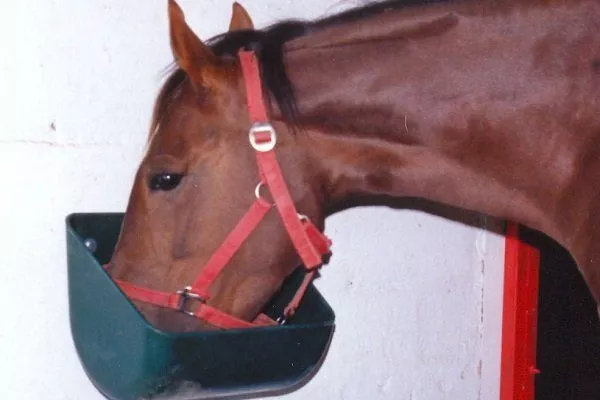
For group housing of horses, large-capacity feeders are used – 50-300 liters. They are designed for 2-12 horses.
Peculiarities:
- installed in one line along walls or stalls;
- The crossbars divide them into sections;
- The models are divided into mangers for hay, grain feed and wet mixtures, but there is a universal option - a feeding table, which combines 2-3 options at once;
- They are used in large farms, where feeders with automatic feeding are most often installed, which simplifies the process of caring for horses for the horse owner;
- preferred material – wood, galvanized steel, less often – plastic;
- shape – rectangular, round or oval – the last two types are used in pastures, as horses can approach the feeder from all sides when free-ranging.
Some models are equipped with protective roofs in case of rain.
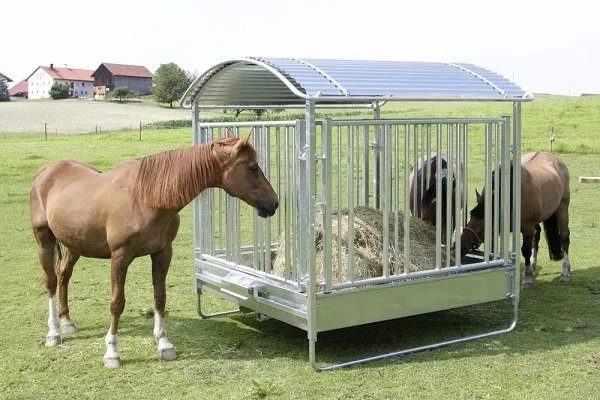
For hay and grain
Specific models are designed for specific types of feed. For example, if you pour grain into an open slatted manger, it will spill onto the floor.
The main categories of horse feeders:
- For hay. These are typically open or closed mangers, but with free access to the feed. They are most often suspended structures, as a large tray is installed underneath them (to prevent hay from spilling onto the floor).
Some models feature a grain trough at the bottom and a slatted top section for straw. Dimensions: length – 1 to 1.2 m, spacing between slats – 8 to 10 cm.

- For bulk feed (grains, compound feed, concentrates). These are small containers that hold grain for a single meal. They are hung on the wall. Hopper models are also available that dispense feed in measured doses.
- For fresh grass. Floor-mounted structures. The main requirement is secure fixation to prevent the crèche from tipping over. This can be either a standard large trough or a version with crossbars, which is much more convenient and cost-effective (no loss).
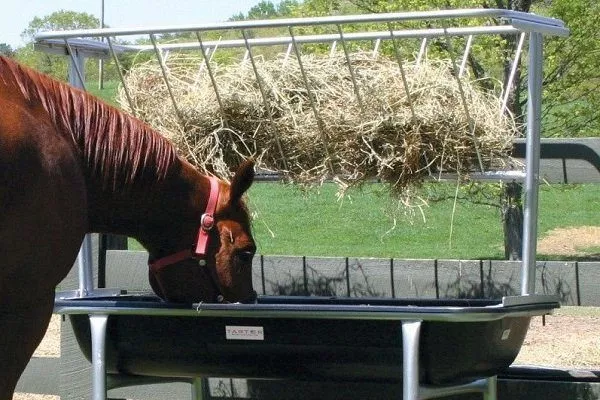
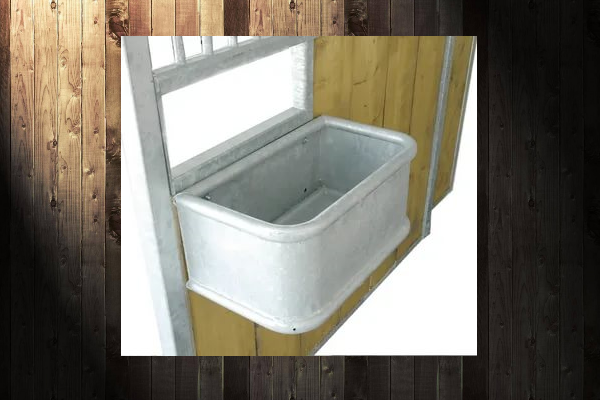
Design features
There are only 3 types of feeders. Namely:
- stationary – they do not move from their place, as they are built into the floor or wall;
- mobile (portable) – easy to move around the stable or transport to pastures;
- folding – are usually attached to the wall, but they can be folded back or fastened at any time.
Requirements for feeders
The most important rule for a horse is the convenience of the feeder. It should be easy to reach the feed. There's an unspoken rule: when the horse lowers its head into the bowl, its jaw should be able to open freely. This is only possible if the distance from the front to the back wall is 32-35 cm (for a standard-sized adult horse).
It is important that the feeder meets the main criteria:
- reducing feed costs, namely, preventing food waste from falling;
- keeping food fresh - if you stack hay or grass in a solid structure, there will be no air circulation, which will lead to the feed becoming stale;
- protection from any pollution, precipitation – you need to make a roof;
- saving space, which is especially important in stables with large livestock.
If a horse feeder is designed correctly, it creates comfort not only for the animal, but also for the person caring for the horses.
Please pay attention to the following parameters:
- Location height. Many beginners believe that the manger should be hung almost at head level (this will help the horse learn to hold it upright). This is incorrect, as swallowing food becomes difficult due to strained neck and throat muscles.
When a horse puts food in its mouth, it inevitably pulls its head out, causing feed to scatter (which is wasteful). The optimal height for hanging the feeder varies from 90 to 110 cm, depending on the horse's height.
The rule is that the edge at the top should be level with the horse's elbow. - Material. It shouldn't contain toxic substances. Horses shouldn't be able to chew the feeder easily. Easy cleaning and washing are important.
- Purpose. Since horses eat a variety of dry, wet, and hay feeds, the manger should be designed for the purpose. Each type of food requires its own type of manger. If space is limited, purchase or make a combination manger.
- Food preservation. The feed should not spill out of the container, as any leftovers are considered unfit for consumption. Consequently, the farmer would have to rake them up along with the manure and dispose of them, resulting in financial losses.
If a horse eats from the floor in the absence of food, the risk of infection increases. To ensure proper feed retention, the sides of the feed trough should be solid and the hay slats should be positioned at an angle. - Design features. The simpler the feeder's design, the easier it will be to maintain and operate in the future. Furthermore, simplified models can be made at home and are much cheaper in stores.
- Safety. There should be no splinters, sharp corners or anything else that could injure the horse.
Which material to choose?
The materials used for horse mangers must be durable to ensure maximum longevity. There are several options for manger materials, including wood, stainless steel, plastic, glazed clay, and concrete. Each type has its own advantages and disadvantages.
- ✓ Consider the material’s resistance to saliva and feed acids.
- ✓ Pay attention to the material’s ability to withstand mechanical damage from horses’ teeth.
Wooden structures
Wood is considered the most natural material, but only if it's not coated with paint or varnish. This is an important criterion for making horse feeders. Wooden structures for horse feeders have few advantages:
- the cost is low, and if the farm has extra boards, the manger will be free;
- ease of manufacture – just nail a few parts together and the feeder is ready;
- the ability to make any size, which is convenient for both single and group keeping;
- environmental safety.
Wood has many more disadvantages when it comes to horse feeders:
- the tree contains starch, which is converted into sugar when in contact with the salivary biological fluid of an animal that licks and chews on the manger (sugar in this form is harmful to horses);
- the bite is disturbed, as small feed gets stuck in the cracks that form during use (the horses try to grab it, but only get empty gulps of air);
- lack of practicality and durability - animals chew on it, damaging the structure, untreated wood is prone to drying out or rotting;
- there is no safety - the tree contains sharp splinters, which can injure the animal's teeth, mouth, and nose.
Cemented feeders
Concrete structures were used in the last century. They are characterized by a smooth surface, relatively inexpensive cost, and ease of home construction. They are easy to clean with water, can be used with household chemicals, and are safe for animals.
Despite so many advantages, there are many disadvantages:
- When in contact with acids contained in wet and other feeds, the cement is destroyed, so there is no talk of durability;
- takes up a lot of space;
- It must be installed only on the floor, the weight of the material does not allow hanging it on the wall;
- It is impossible to additionally securely equip it with crossbars.
Metal
Only stainless steel options are used for manufacturing. Feeders for all types of feed are made of metal: solid models for wet and grain feeders, and models with crossbars for hay feeders.
Advantages of metal structures:
- strength and durability – the metal lasts for decades;
- stability – if you make a floor model from heavy types of iron;
- lightness of the material - for example, steel or aluminum, from which suspended options are made;
- weather resistance – can be easily installed in a pasture during rainy weather;
- not susceptible to horse teeth;
- safety;
- Ease of manufacture – you can create absolutely any model.
But there are also significant disadvantages:
- It is not advisable to leave it in the open sun in very hot weather, as the bars will heat up and burn the animal’s skin (you can make a canopy or roof);
- For independent production, experience with a welding machine is required.
Glazed clay
This is the most optimal material for making bird feeders, as glazed clay has the most advantages. Among them:
- durability and reliability;
- resistance to food acids and any chemical compounds;
- surface smoothness;
- naturalness.
Horses can't chew through this material, making it safe. Disadvantages: it's impossible to make without some experience working with glazed clay, and the raw materials are difficult to find.
Plastic
A cutting-edge material that's easy to maintain, chemically resistant, doesn't oxidize, and has an attractive appearance. This lightweight raw material is used exclusively for hanging horse feeders.
It's impossible to make one yourself, so plastic models are purchased from specialty stores. Small plastic feeders are used for individually feeding horses wet food and grain.
Making structures with your own hands
Building a horse feeder yourself doesn't require extensive experience—there are simple options that even a woman can handle. All you need to do is decide on the type of feeder, gather the necessary materials and tools, and have a positive attitude.
From a volleyball net
The most basic design for hay and grass. It's hung on the wall, but with larger mesh, it can be used to cover hay in the pasture. This type of feeder is slow (the horse won't be able to consume the feed quickly) and is also known as a "reptuh" (a "reptuh" in common parlance).
Advantages of the design:
- low cost (any network can be used);
- feed saving;
- proper nutrition for horses (they should eat slowly, in small doses);
- safety;
- possibility of movement.
There is only one drawback: it is difficult to fill the inside with hay or grass.
What you will need:
- volleyball or other net with cells of 5 cm maximum diameter (any size);
- piping or tape for edging;
- thread with a needle;
- rope.
How to make it yourself:
- Measure the net to the required size and cut off a piece.
- Fold in half and sew the sides.
- Sew a border onto the top of the resulting bag so that you can thread a string inside.
- Pull the rope in.
- Fill with hay, tighten the top, hang it in the stall.
If you don't have a ready-made net on hand, make one from baling ropes, as shown in our video:
Made of metal elements
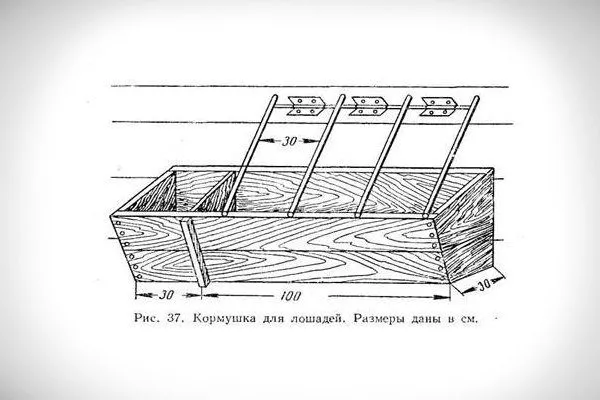
This model is designed for hay or grass, as it consists of a base and a grid. It can be configured to any size—for one head or several. This model is considered a simplified version and is hung on the wall of the stall.
- Prepare a drawing with dimensions, taking into account the height of the horses.
- Choose stainless steel that is at least 2mm thick for durability.
- Ensure the safety of the structure by rounding off all sharp corners.
Materials needed:
- galvanized sheets (thickness about 2-3 mm) – 5 pcs.;
- metal rods with a diameter of 8-12 mm - the quantity depends on the size of the feeder;
- welding machine;
- hacksaw for metal.
Procedure:
- Make a frame from 4 sheets of iron - weld them together to form a box with a bottom.
- Weld the rods at a distance of 32 cm from each other at an angle of 45°.
- Drill holes in the wall so that the tops of the grates fit into them.
- Insert.
- Attach the back wall of the base to the wooden wall of the stall with bolts.
Made of wood
Wooden planks can be used to construct a simple structure for storing grain or concentrated feed. They can also be used for hay if needed, but are not suitable for wet food, as the wood will become soggy in high humidity.
For a feeder measuring 600x45x45 (length/width/height), take the following materials and tools:
- boards 6 m long, 15 cm wide, 2 cm thick – 7 pcs. (3 will go to the bottom, 3 to the back and front walls, 1 to the side plugs);
- wooden slats – 3-4 pcs.;
- hammer and nails;
- carpenter's corner;
- circular saw;
- marker or felt-tip pen.
How to make – step-by-step instructions:
- Knock 3 boards for the bottom together using slats and nails into one piece.
- In the same way, connect 2 more boards for the sides, which will not be located on the horse’s side.
- Nail sides made from 1 board and 2 knocked-down ones to the bottom on both sides (along).
- Cut the side caps to the same width as the feeder. Nail them to the main frame. You'll end up with something like a box, with the sides higher on one side and lower on the other.
- Trim rough edges with a circular saw (45° angle).
- Place on a support according to the height of the horses.
Helpful tips
To ensure that your feeder meets your requirements and avoids difficulties and errors during production, follow the recommendations of experienced horse breeders.
What experts advise:
- When eating food, especially hay, horses can turn their heads in different directions, causing food to fly off the sides - to prevent this from happening, make the shape of the manger oblong (rectangular);
- Always make the outer sides higher than the inner ones to prevent the horse from throwing feed towards the path in the stable;
- carefully process all materials - sand them so that there are no protruding splinters;
- Place the feeder at a height of at least 70-75 cm from the ground for foals, 100 cm for adults - this is the most comfortable position for horses to eat;
- for one animal the length of the container is 120-150 cm;
- for large livestock, install stationary feeders with automatic feed supply;
- For wet food, it is better to use plastic models;
- Install heavy metal structures of round, oval or oblong shape in the pasture so that all horses have free access to feed;
- Never use varnish or paint to treat the surfaces of feeders.
If you already have a wooden structure and can't afford a new one, experts recommend extending the life of the manger to prevent horses from chewing on the wooden parts. To do this, nail galvanized sheets to the inside of the manger. Make sure the metal is positioned on the curved edges.
Before choosing horse feeders, consider the different models, calculate the cost of each, and decide whether purchasing a manger is more cost-effective or easier to make your own. Be sure to consider all requirements, especially those related to the comfort and safety of your animals.
Very useful information, thank you.