
A horse stall is the most suitable place for animals to live. It is also known by other names, such as a stall or a stall. Its main purpose is to create the most comfortable and safe conditions for horses and their owners. It also helps train them, developing attentiveness and observation skills.
Types of horse stalls
| Name | Type of construction | Material | Mobility |
|---|---|---|---|
| Stationary | Constant | Wood, brick, metal | No |
| Mobile | Temporary | Plastic, lightweight metal structures | Yes |
| Transformer | Difficult | Metal, plastic and wood materials | Partially |
You can commission a professional to build a stall or build one yourself. But first, decide on the type of stall you'd like:
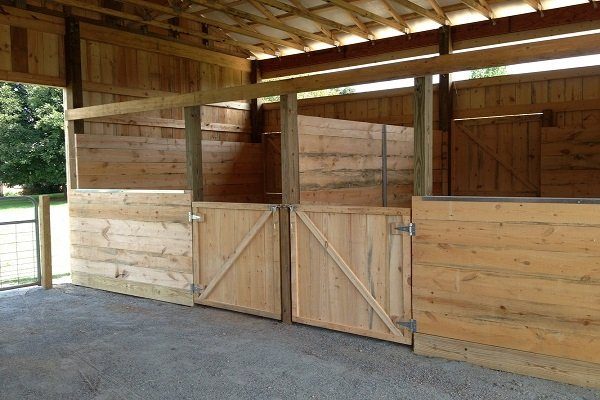
- Stationary. This is considered the most common type installed in stables. The stall walls are made of wood, brick, or metal, and the front section is equipped with a door. The structure is not portable.

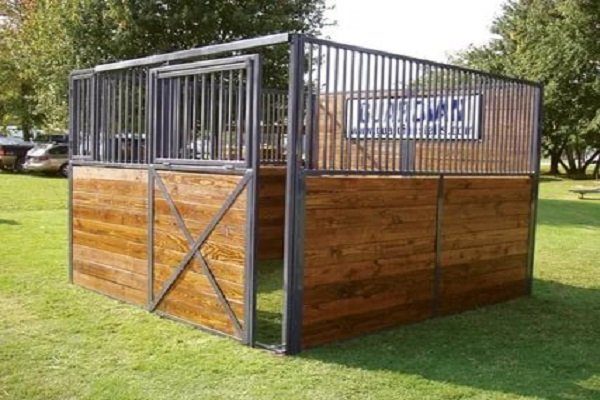
- Mobile. This is a portable model that can be easily assembled and disassembled. Its primary purpose is to temporarily house horses away from the home stud (during competitions, etc.). It is made of plastic or lightweight metal structures.
- Transformer. These are complex structures consisting of hinged elements in the walls, allowing them to be extended. They are particularly useful when there is a need to connect two or more machines.
This category also includes telescopic partitions, which allow for increased space for a single horse. These partitions are made from metal, plastic, and wood.

Horse Stall Requirements
The most important thing when housing a horse is to create a comfortable, dry, and warm space, which is especially important when breeding thoroughbreds and housing mares with foals. The size and materials used to construct the stall are also important.
Main parameters
Since horses spend most of their time in stalls (except in the summer, when they're taken out to the paddock), stables and stalls should be located on a slight elevation to avoid excessive dampness. If the common area is built in a low-lying area, the stall floor will need to be raised.
There are rules for creating stalls that cannot be ignored:
- The standard size for an average horse is 3x3 m, which is 9 sq. m, which reduces the risk of tipping over the feeders, restricting movement and making it difficult to eat, so it is optimal to make a stall measuring 4x4 m (14 sq. m);
- To accurately determine the parameters of the stall, take into account the weight and length of the horse - the stall should be 1.5-2 times larger than the horse itself, which will allow it to turn around freely;
- for a mare with a foal the minimum size is 5x5 m, for heavyweights – 4x4.5 m;
- Since horses love free space, create ceilings at least 3 m high, but 4 m is better (this will also prevent them from hitting their heads when rearing and will allow fresh air to circulate normally);
- make the passage between the stalls 1.8-2 m wide;
- a mandatory requirement is the installation of drains for the drainage of feces and urine;
- the material must be environmentally friendly, without the use of harmful paints and varnishes, and durable - keep in mind that horses can chew on feeders and walls;
- When installing the restraining elements, pay attention to the fact that the leash should not interfere with the horse’s ability to tilt its head toward the feeder or waterer, lie down, or move.
When building a stall, make sure there is adequate staffing available to ensure that the stall is accessible to all staff (for cleaning, grooming, etc.).
Walls
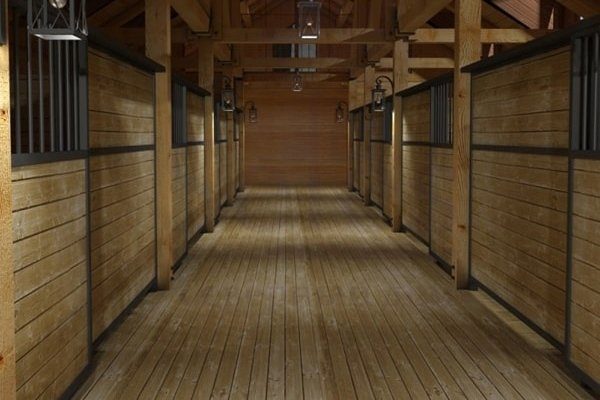
One of the stall walls must be shared, as the stall is built within the entire stable. Sometimes a stall consists of two such walls, for example, when it's located in a corner area, or three or four, which completely separates the animals between stalls (to limit the mare's access to the horse, etc.). Everything else is just partitions.
- ✓ Consider the sound insulation properties of the material to reduce stress in horses.
- ✓ Pay attention to the material’s resistance to mechanical damage, especially in the horse access area.
Features of walls and materials:
- the general, that is, the back one – made of brick, which will eliminate drafts and the penetration of cold air in winter;
- dividing partitions - can be made of wood or durable metal (to prevent the horse from breaking the structure with its hooves), but in the second case, treatment with non-toxic anti-corrosion agents is required;
- Make partitions so high that they are halfway up the ceiling;
- If the walls are made of brick, metal or wood and are too high, be sure to make holes in them for ventilation;
- build the walls in such a way that broken elements can be replaced if necessary;
- Do not leave gaps between the boards, which will make it difficult for the horse to start gnawing on the wood;
- Choose materials that are easy to disinfect and will not be damaged by disinfectants;
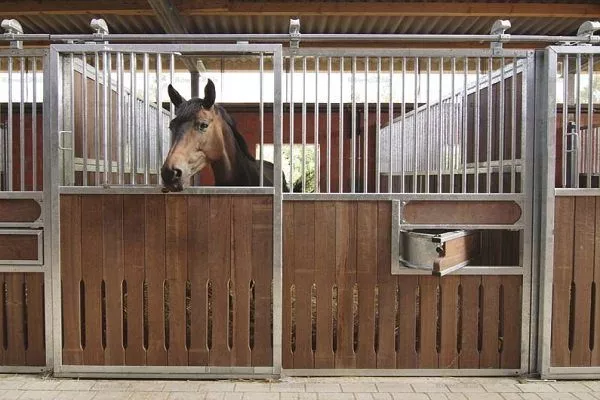
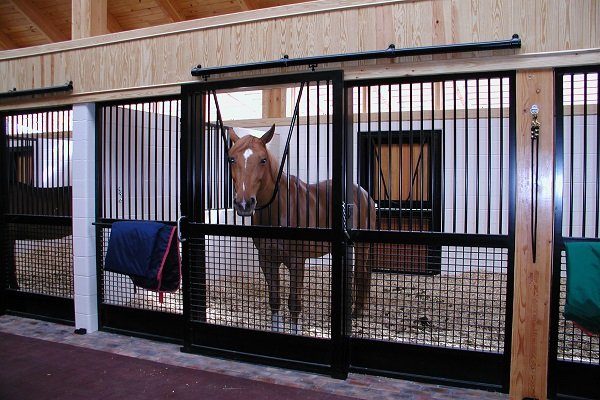
- Partitions can be made from a metal grid, which will allow the animals to communicate with each other (it is important for them to see their fellow animals, as they are herd animals).
The front wall deserves special attention. The main requirement is open visibility, as a horse can't sit in a completely enclosed space all the time. The entrance door to the stall is also installed here, as are the water bowl and feeder.
Types of front wall:
- From the lattice. A convenient option for stables with regular visitors—it prevents the horse from reaching strangers and biting them. The grate can be installed at the full height of the stall or halfway up.
- Made of wood. Such a wall shouldn't be too high; ideally, it should reach the horse's shoulder level, allowing it to easily stick its head out. Another option is to install a grate in the center of the partition to provide a clear view.
- Made of brick. This is used when the other three walls are made of the same material. The requirements are identical to the previous ones.

Floors
The flooring in a horse stall must meet certain requirements that affect the animal's health and overall well-being. Easier cleaning by staff is also important. Therefore, a gentle slope and the provision of a drainage channel are considered the most important guidelines.
This will prevent stagnation of the horse's excrement and, accordingly, reduce the risk of intoxication from processed products and infection.
Particular attention is paid to the material. There are many options, each with its own advantages and disadvantages:
- Peat. A simplified design that involves excavating the top layer of soil and then filling it with peat. It's simple, easy, and quick to make, and after replacing it with new material, the old one can be used as a natural fertilizer in the garden.
There is a significant drawback: when urine and feces come into contact with organic matter, pathogenic microorganisms develop, which become the main cause of horse diseases.
- Clay. Clay floors were used in the old days, but many farmers still use them today. There's one condition for this: the presence of clay quarries in the region. Otherwise, such flooring would be prohibitively expensive.
The main advantages are constant warmth, non-slip properties, which eliminates injury to animals, and water-repellent properties (urine and feces are not absorbed, so there is no persistent unpleasant odor).
Among the disadvantages, they note the need and importance of knocking down the clay layer three times a year, which is very problematic. New material requires financial investment.
- Wood. The material is more commonly used in small stables, especially if the property has scrap lumber, but experts consider it impractical, as wood quickly absorbs moisture and odors, causing it to swell and stink. Because wood becomes slippery when in contact with manure, horses often get injured.
- Concrete. This is the optimal option for all types of horse farms, as concrete does not absorb liquids or unpleasant urinary/fecal odors, is non-slip, does not rot, and is considered the most durable. Additionally, concrete flooring reliably protects the stall from rodents such as rats, mice, and the like.
The first drawback is that cement isn't considered expensive, but considering the area it needs to cover, it becomes quite expensive. The second drawback is that in winter, concrete only transmits cold, so the farmer will have to stock up on huge quantities of hay and straw to create several layers of bedding.
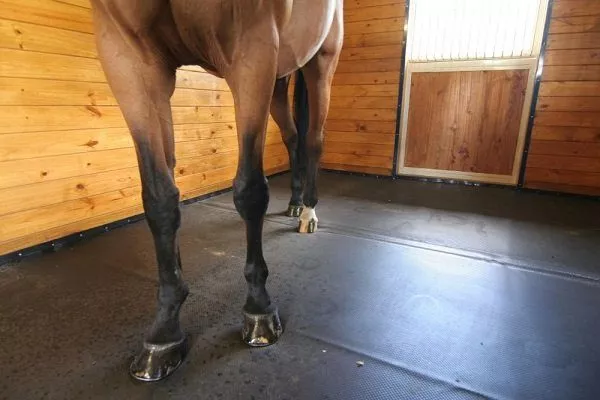
- Rubber. This is a modern option, most often used on private horse farms. The flooring is a rubberized mat, sold in two variations: one-piece and a multi-piece mat that fits together like a puzzle. Models with an antifungal coating are also available.
Among the advantages, they note ease of cleaning, lack of odor and slipperiness, compatibility with all disinfectants, and durability. The only drawback is the high cost.


Doors
The type of stall door installed determines animal safety, ease of entry for staff, and the availability of space. The main requirements are a width of 1.2 m and a height of 2.4-2.8 m. These parameters will prevent injury to the horse's shoulders and hips.
Classification of stall doors based on opening method:
- Outside or inside the stall. The first option is used when stall space is limited, while the second is used when the aisle between stalls is insufficient. Both options are considered inconvenient, as the door design requires space equal to the door's opening.
- Sliding. They are made in a "coupe" style and are considered optimal - they do not take up space and do not injure horses, but they are expensive.
The device is secured to trough guides with special roller mechanisms at the top and bottom, which allows it to move to one of the sides.
According to the type of construction, day doors are of the following types:
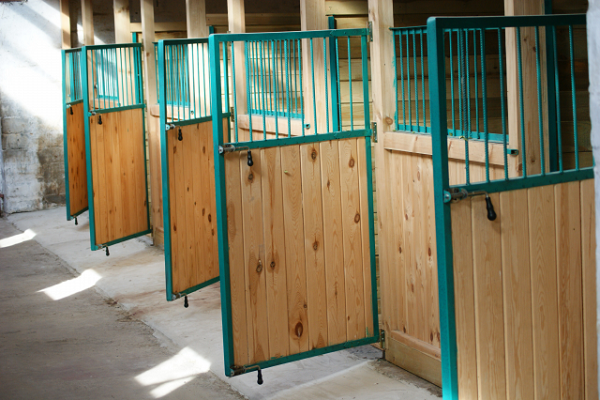
- Solid. This isn't a very convenient option, as visibility is blocked and there's no ventilation, but waste from the stall doesn't escape into the aisle. Galvanized metal and wood are used for construction.
- Lattice. It consists of a single metal grate, which is convenient for the horse, as it can see who's in front of it (either fellow horsemates or visitors). Another advantage is that it allows ample fresh air into the stall.
The downside is that when the horse paws, straw and other debris fly out. The same thing happens during feeding.
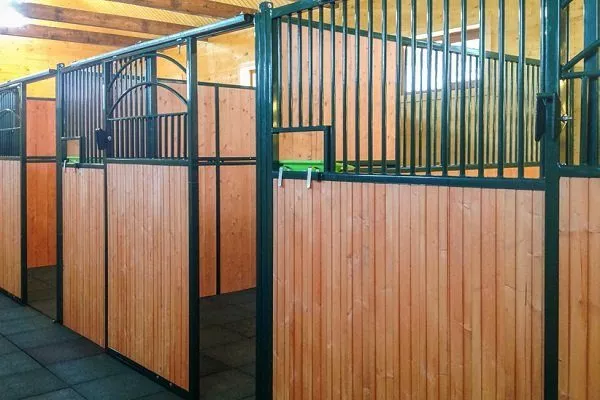
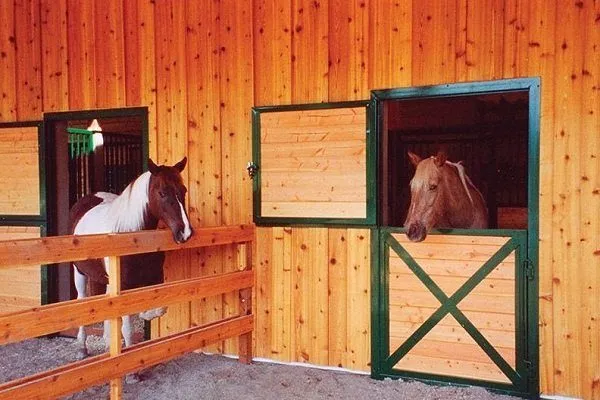
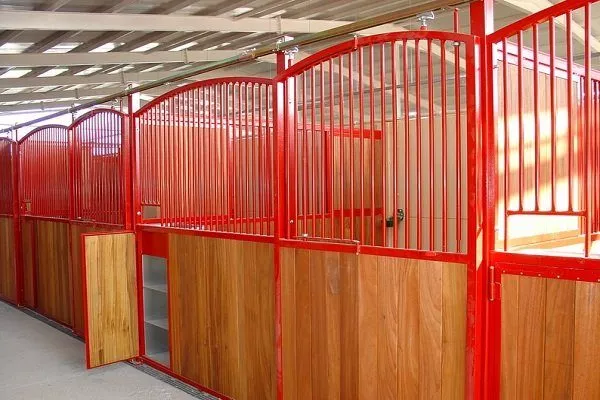
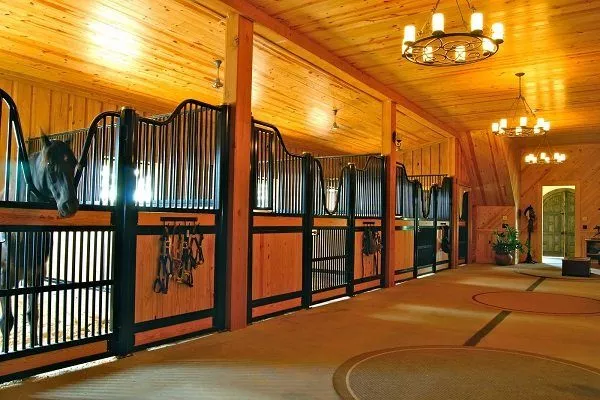
- Combined. This combination door combines all the advantages of the two previous types. It's made of half solid material (the lower part) and half metal mesh.
Arranging a stall
The main components of a stall's interior are a feeder, a waterer, and bedding. No other elements are required. Some horse farmers, with smaller stalls, forgo a manger and instead scatter hay directly on the floor, but this option is considered impractical, as horses trample most of the dry feed.
Feeders and drinkers
Both types of products have the same requirements. They are as follows:
- installation height – from 60 to 70 cm above floor level;
- depth – from 25 to 35 cm, depending on the size of the horse;
- all edges must be rounded - no sharp corners;
- the surface must not contain any wood chips or other elements that could injure horses;
- the absence of cracks to prevent water leakage and spillage of loose feed and against the proliferation of pathogenic microbes (feed gets stuck in the cracks);
- the material is as natural as possible, not treated with toxic agents (paint, varnish, etc.);
- ease of maintenance and disinfection, so choose simplified designs;
- suitability for the intended purpose - if it is hay, then the manger must be air-permeable; if it is loose feed, then the feeder must be solid.
Materials for feeders and drinkers:
- high-strength plastic;
- galvanized and stainless steel metal;
- baked clay.
Stall feeders, or individual feeders, are used in stalls. They can be rectangular, square, triangular, round, etc.
Types of feeders based on their purpose:
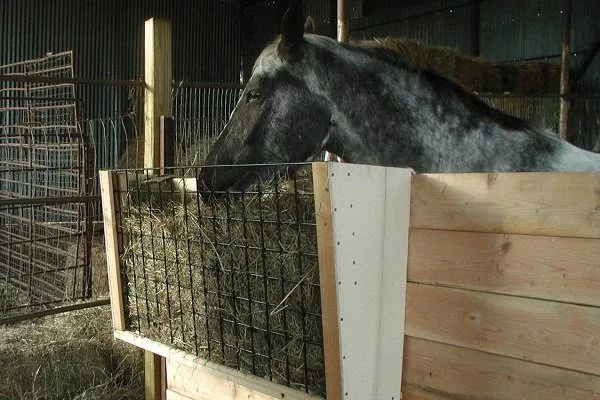
- For hay and fresh grass. Commonly known as a "manger." Typically, they are constructed as suspended lattice structures, with trays installed underneath to prevent spills.
If the manger is solid, slats are installed inside to ensure the feed is dispensed in measured doses (the horse won't be able to get a large amount of hay at once). The distance between the slats should be at least 8 cm, maximum 12 cm.
- For oats, grains, compound feed, concentrates and granulated feed. These feeders should be small enough to dispense a single serving. Solid structures are the only option. For convenience, hopper systems are used on larger horse farms.
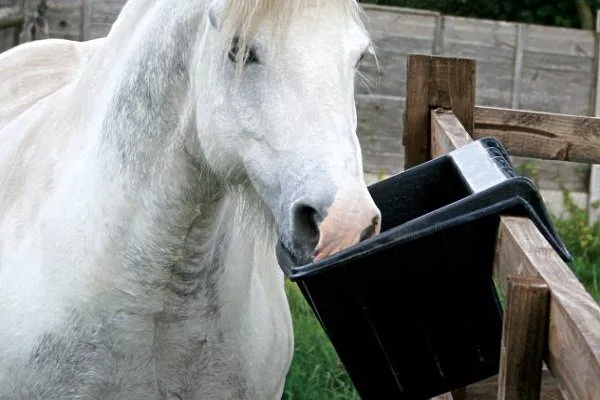
In the stall, drinkers are installed that do not tip over, so this can be a container fixed to the floor or suspended from one of the walls (usually the front one).
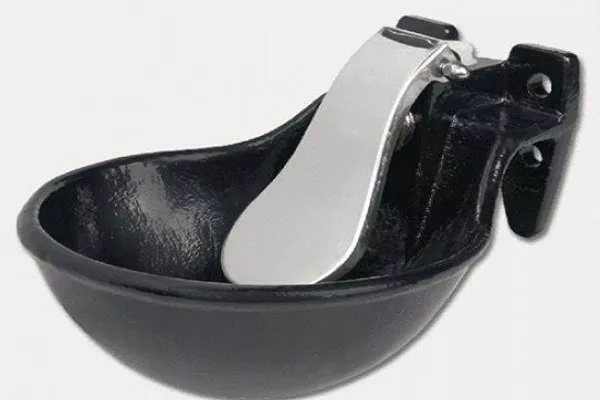
Today, automatic cup models equipped with tongue valves are most commonly used. The design is connected to a water pipe, and when the horse places its head in the trough, the valve is pressed, releasing water in metered doses.
- ✓ Check the system for the ability to adjust the water flow to avoid overflow.
- ✓ Ensure that there is protection against freezing during the winter period.
Bedding
Many infections are transmitted through bedding, causing animals to become sick and die. Therefore, it must meet the most important requirement: it must absorb moisture well, which will prevent urine puddles from stagnating and the release of harmful ammonia.
There are other nuances:
- comfortable to lie on;
- the ability to dig with hooves;
- eco-friendliness of the material;
- creation of warmth, which is important for the winter period;
- absence of sharp elements (bites, thorns, etc.).
The following types of bedding are available for horse stalls:
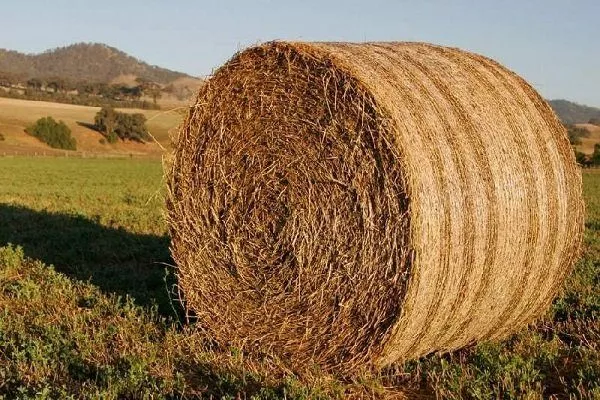
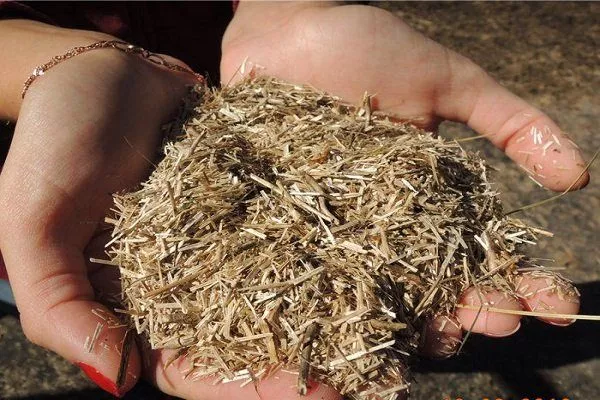
- Straw. The most common type, as the raw material is considered warm, soft, and permeable to moisture. Straw is also inexpensive. Disadvantages include the presence of fungal spores and dust, requiring treatment.
For horses, choose wheat straw, as it doesn't contain any sharp elements. Oat and barley straw are not very suitable.
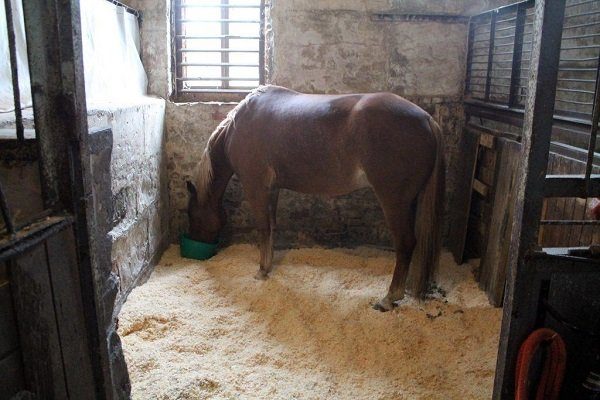
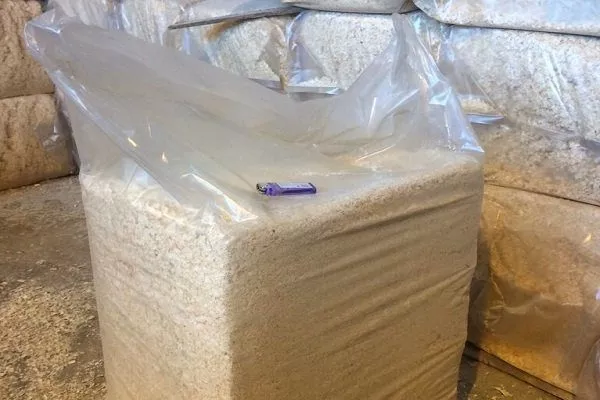
- Wood sawdust. They differ from straw in that they are free of pathogenic fungi and dust. They are a complete substitute for straw. The downside is that they cannot be used as organic matter after stables; they become heavy, making cleaning difficult.
If you buy sawdust from unscrupulous sellers, there's a risk that the raw material may contain nails, glass, large sharp splinters, and chemicals from paints and varnishes. Because it's pressed quickly, the material doesn't generate heat well.
- Hemp chops. It has high hygroscopic properties, making it considered the best modern raw material. Another advantage is its low consumption, as the entire layer does not need to be replaced, only topped up. The used material is used as a plant fertilizer.
Disadvantages: high cost and turnover rate.
- Paper. It's spread in a crushed state. It's inexpensive, but the consumption is high.
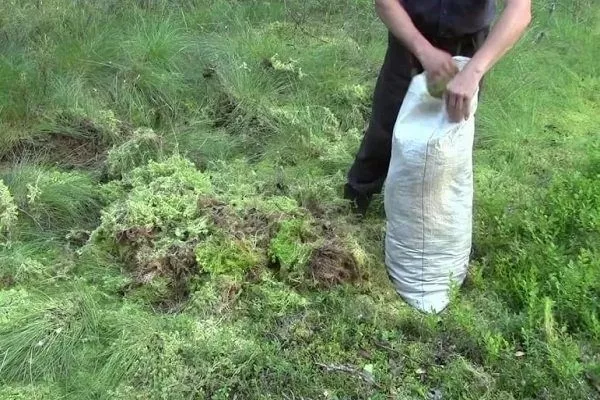
- Peat moss. It is soft, non-flammable, but gets wet quickly, is heavy in weight and expensive.

Rubber mats can be used, but they should only be laid on a concrete floor, as there is a risk of leaks, which a wooden flooring will not withstand.
Stall safety
A high level of security is an important requirement for a horse stall. Horses are quite large and strong animals, so they can wreck a structure, break through a partition, or push down a door at any moment, especially if the horse has a domineering nature.
Other safety precautions to take:
- Hide all wires and other electrical components - mask them with special devices, place them in a partition, run the electrical system under the ceiling, otherwise the horse may be electrocuted;
- Before letting the animal into the stall, carefully inspect all the walls, floor, feeders, etc. for cracks, protruding sharp objects from the materials or fasteners from the structures - carry out such actions periodically, as horses can get injured;
- To avoid diseases, insulate the premises in the fall with building insulation or connect heating systems;
- Always tie up horses, for which purpose equip the stall with strong elements.
To ensure a comfortable stay in a horse stall, follow basic requirements for materials, safety, the size of the stall, and the animal's size. If you decide to breed horses, choose the most durable structures, but remember that horses need to be able to see each other.