
Horses' hooves have a unique structure, so proper care is essential to prevent diseases and other problems. Hooves support the horse's body weight, provide shock absorption during gallops and gaits, protect joints, and improve blood circulation during exercise.
Functions and structure of the horse's hoof
The general term for hoof tissue is hoof horn, which is characterized by a base and superficial cells. The latter (composed of papillary and lamellar cells) provide adhesion between the capsule and the base. The tissues are renewed annually.
- ✓ Regularly check hooves for cracks and damage, especially after long walks on hard surfaces.
- ✓ Use of special ointments to moisturize the hoof horn in dry weather.
The hoof itself is a hard, horny structure that surrounds the coffin bones and the digital phalanges. Many compare it to a human organ, claiming that a horse's hoof is like a human nail. In infancy, the hooves are soft, but over time, the modified skin becomes keratinized, causing the structure to become so hard.
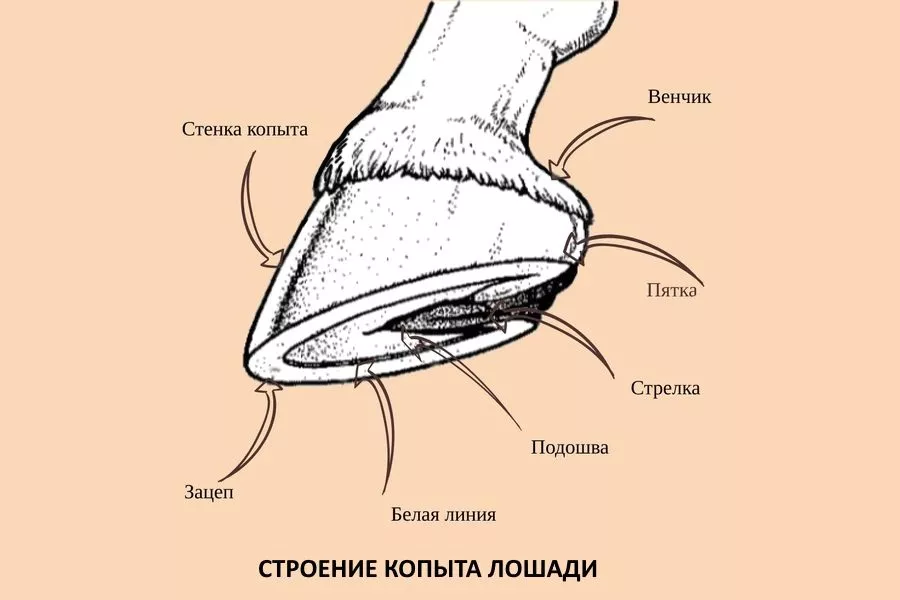
Hooves consist of an outer and an inner part. The outer part, called the shoe, is a horny sheath and consists of the following elements:
- Border. It is a narrow strip about 5 mm wide. It is located between the shoe and the hairy skin. It consists of an elastic and soft tubular horn, a papillary layer, and sebaceous glands. The latter produce a special glaze that swells when exposed to water.
The main property of the border is to reduce the pressure on the hairy area from the horny capsule. - Whisk. It connects the walls to the rim and appears as a semicircular band containing numerous nerve endings and blood vessels. These enable the horse to sense all the unevenness of the ground.
- Wall. It is a membrane that covers the lateral walls of the bone. It is the largest part of the hoof, providing protection for all its elements. It connects the horny layer to the inner part. It is composed of smooth, tubular tissue that prevents moisture from penetrating.
They also distribute loads and make the shoe durable. This is achieved through the presence of a large number of leaf-shaped cells. - Sole. This part prevents hooves from becoming deformed. The sole lines the supporting surfaces, is indented, and has a cutout for the frog. The sole is self-healing. It contains a 4 mm thick strip—the white line.
- Arrow. This is the digital cushion, characterized by its wedge-shaped form and longitudinal groove. Composed of soft cells, it acts as a connecting element between the sole and the ground, as well as a shock absorber to soften the impact of running.
Based on research data, in ancient times, horses had five toes on their hooves, but only the middle one performed its functions, so during the course of evolution, only it remained.
Anatomical features of the horse's hoof
Hoof anatomy involves its internal structure. The foundation is the joints:
- Putovye. They are designed to fix the metatarsus and pasterns and consist of multiple ligaments—collateral, osseous, intersesamoid, rectus, and sesamoid. Joint movement—flexion and extension
- Coronary. They include the lateral and medial volar ligaments, so movement occurs only in one plane.
- UngulatesIt consists of the coronoid, sesamoid, and coffin bones; the joint is located in a capsule and has limited lateral movement.
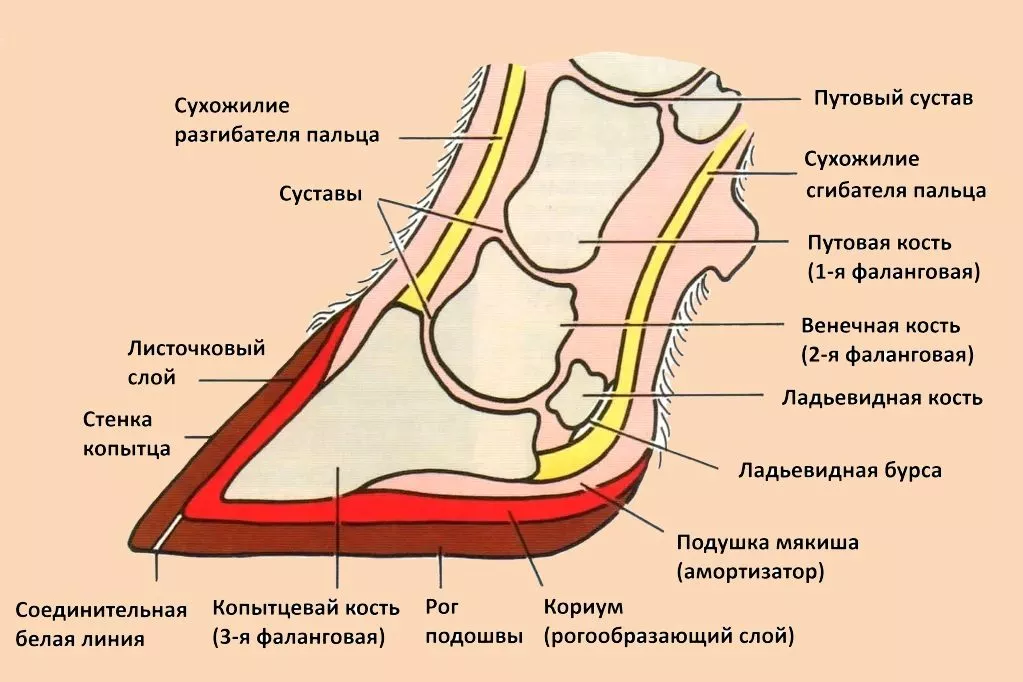
In addition to the joints, the inner hoof consists of:
- pterygoid cartilages - similar to flower petals, connect the bones to the hooves;
- sensitive sole - nourishes the bones, appears as a layer;
- sensitive arrow - has a wedge-shaped form, is intended for cushioning and nutrition of the crumb;
- coronary ring - necessary for feeding the border;
- digital artery - provides blood supply.
Features of hooves:
- Mechanism of operation. Contact with the ground alters the circulatory system, preventing stagnation. Hoof function is based on the following:
- When the limbs are lowered, a load is placed on the distal phalanx, which presses on the digital cushions and frogs, causing the hoof to be pressed against the surface;
- the sole flattens and the height becomes smaller, the heels widen and the bulbs become smaller;
- the lateral cartilages diverge, the coronary band becomes narrow and shifted backwards;
- This results in cushioning and reduced impact loads.
- Shapes and sizes. These parameters are influenced by several factors—heredity, breed, body weight, and living conditions (the type of terrain the horse moves on, the type of gait used, etc.). For example, heavyweights have massive and wide hooves, while thoroughbreds have narrow and elongated ones.
If a horse walks on dry ground, the sole area becomes smaller, while if it frequently walks on wet ground, it becomes larger. Therefore, the shape and size can change throughout its life. - Front hoof. Characterized by the following indicators (average):
- the inclined angle of the front part relative to the ground varies from 45 to 50 degrees;
- sole thickness – 10 mm, almost no concavity;
- the width of the toe and heel sections have a ratio of 3:1;
- The edge of the sole is rounded and wide in the center.
- Hind hoof. Has the following characteristics (general):
- the angle of the hook is from 55 to 60 degrees;
- the border on the sole is narrow and elliptical;
- sole thickness: 11.5 mm at the front, 15 mm at the side;
- the sole is concave, therefore more stable than the front one;
- The width of the toe and heel sections have a ratio of 2:1.
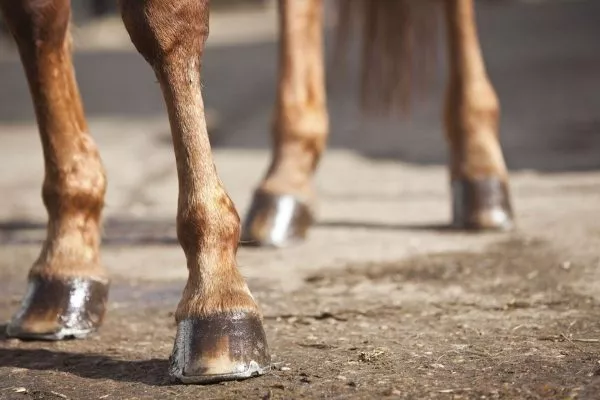
Hoof diseases
If hooves are not properly cared for and proper precautions are not taken, this area is susceptible to diseases and other problems. There are many, but a few are particularly common.
Wounds (notches) of the corolla
The main cause of a coronet nicked is mechanical damage. This occurs due to improper gait, improperly fitted shoes, neglected shoeing, walking on slippery ground, sharp turns, etc. The main symptoms of superficial wounds are:
- abrasions;
- swelling;
- light bleeding.
In deep wounds the following is noted:
- lameness;
- tissue crushing;
- pain;
- the presence of wounds with phlegmon.
Treatment begins with hair removal, then treating the affected areas with a 5% iodine solution and applying a bandage. For deep lesions, surgical debridement is performed, using iodoform and boric acid, penicillin, or streptocide.
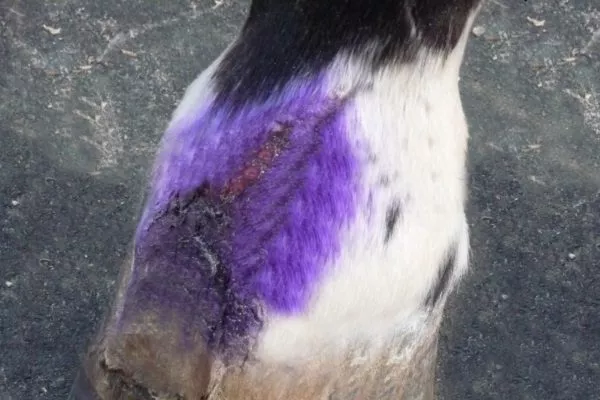
Corolla phlegmon
It occurs after deep incision and other inflammatory processes with infection, and is therefore considered a complication. It manifests itself as follows:
- swelling;
- pain and lameness;
- hoof tension;
- an increase in body temperature, first in the affected area, then throughout the entire body;
- loss of appetite;
- depression of the state.
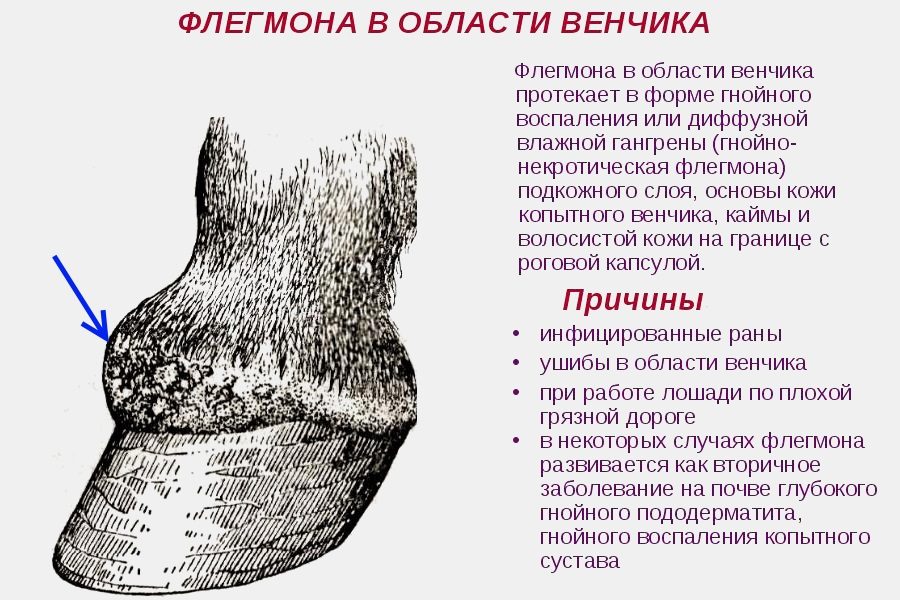
Treatment begins with thinning the horn walls at the site of swelling. The following medications are then prescribed:
- camphor alcohol (20%) for dressing;
- novocaine with penicillin - injected into the artery;
- hexamethylenetetramine, glucose, alcohol and other components (auxiliary) - intravenously;
- Novocaine-penicillin blockade – injected into the tissue.
Hoof cartilage necrosis
It is a complication of deep notches, direct nailing, frog injections, and other purulent pathologies. Symptoms:
- severe lameness;
- the presence of phlegmon;
- abscess and fistulas.
Treatment involves injecting zinc or copper sulfate at a 30% concentration into the fistula tract. The doctor then scrapes out the purulent exudate with a spoon. If necessary, an incision is made and suction dressings are applied.
Pododermatitis
Pododermatitis is an inflammatory process affecting the underlying skin of the hoof. It occurs in two forms:
- Aseptic pododermatitis. It occurs due to mechanical damage, excessively hard ground, improper shoeing, the presence of foreign hard objects, etc. It manifests itself as lameness and hemorrhages upon careful examination. Treatment involves applying a cold compress for three days, followed by heat. The final stage is shoeing for therapeutic purposes.
- Purulent pododermatitis. The main cause is purulent diseases. These can be superficial or deep. The horse tries to push the affected limb forward, constantly flexing it. The hooves become hot, and the digital arteries pulsate. Purulent exudate flows from the wounds.
For treatment, hot creolin is used for a foot bath, followed by spraying with hydrogen peroxide.

- Chronic warty pododermatitis. This form of pododermatitis occurs due to dirty housing and lack of exercise. Sometimes, it can be caused by impaired lymph flow, putrefactive processes, horn maceration, or an unbalanced diet. Symptoms:
- lameness when moving;
- destruction of the horn;
- the stench of pus;
- formation of warty skin of a grayish-red or blue-red hue;
- bleeding.
Treatment involves removing the overgrown frog and then cauterizing it with iodine. In advanced cases, novocaine blockades and penicillin injections are used. Birch tar dressings are recommended.
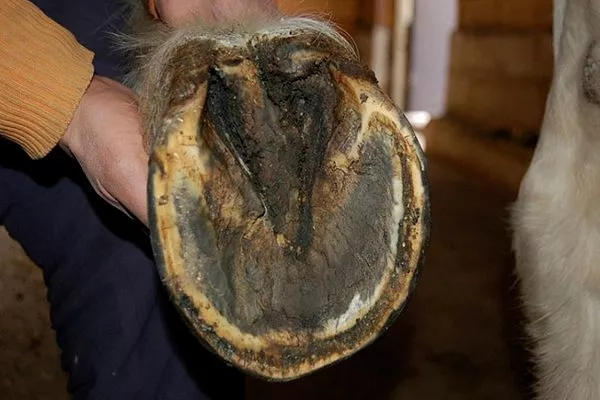
Puncture wounds of the frog and sole
The cause is sharp objects. Puncture wounds manifest as sudden lameness. If the sharp object breaks, it can be found in the sole of the hoof. If left untreated, purulent inflammation with bloody discharge develops. Body temperature rises to 40 degrees Celsius, and the horse refuses to eat or move due to severe pain.
The same remedies are used for treatment as for any purulent processes.
Laminitis is a rheumatic inflammation of the hooves of horses.
Laminitis (rheumatic inflammation of the equine hooves) is a chronic condition affecting the hoof walls and toe. The disease most often affects the forelimbs. There are several causes of rheumatic problems, including increased stress on the legs, infection, allergic reactions, and dousing a hot horse with cold water.
Signs:
- increased breathing and pulse rate;
- increase in body temperature;
- pain;
- lethargy;
- trembling;
- sweating;
- lameness.
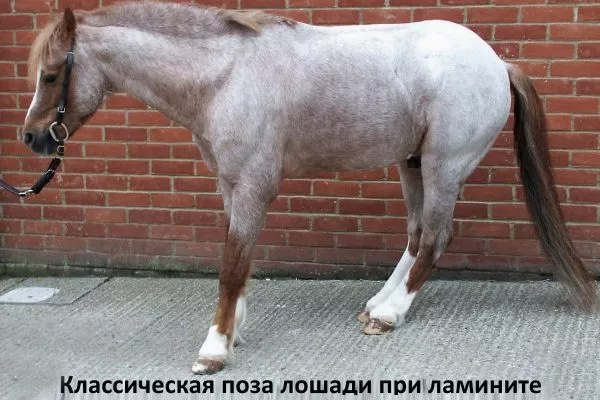
The first thing the veterinarian does is wash the hooves, then administer various medications and use solutions;
- calcium chloride;
- ketofen;
- hydrocortisone;
- adrenalin;
- novocaine;
- sodium salicylate;
- laxatives.
In case of rheumatism, it is advisable to feed the horse with special feed, for example, Equimins Laminator.
Wounds of the hoof joint
Joints are also susceptible to puncture wounds. The symptoms are identical to those of frog stab wounds, but with the difference that synovial fluid, initially clear and later cloudy, is released from within the joints. Symptoms include hot swelling, abscesses, pus, and phlegmon. Bone tissue destruction then develops.
Treatment involves trimming the hoof and removing any foreign object. The doctor widens the canal and places the hoof in a hot bath with creolin, applying an antiseptic dressing.
Hoof injury during shoeing
If forging is done incorrectly, a wound can occur. The main cause is the placement of the nail groove near the inner edge. Sometimes the blacksmith violates the rules, using excessively large nails or driving them incorrectly.
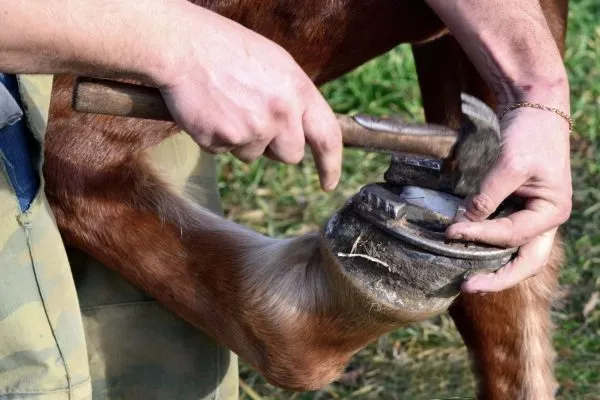
Signs:
- at the moment of shoeing the horse jerks the limb;
- lameness;
- After the onset of the inflammatory process, the temperature rises, pus, abscesses, and the like appear.
Treatment involves cleaning the wound with an iodine solution. A tampon is then soaked in tar and inserted. The horse should rest for a week.
Arrow rot
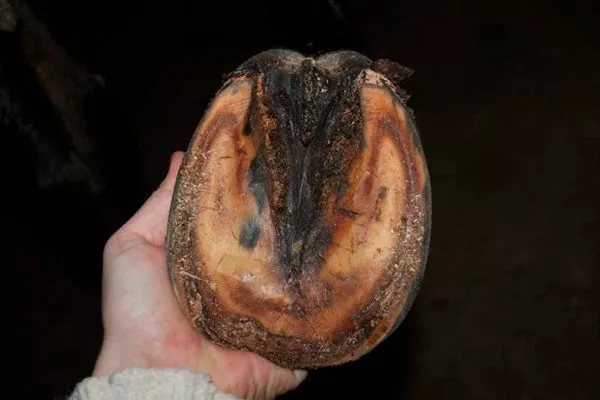
In this case, the underlying skin in the frog is damaged, resulting in horn disintegration. It occurs due to improper housing (dirty conditions) and inactivity. Symptoms include a strong purulent odor, lameness, and enlarged papillae.
During therapy, the exfoliating horn on the frog is removed and then treated with a copper sulfate solution. A swab is soaked in turpentine and inserted into the wound.
Fractures of the coffin and navicular bones
Fractures occur due to falls, jumping over rocks, fast gaits, punctures, pinched bones, illnesses, etc. Fractures are generally closed and can be intra-articular, oblique, sagittal, or multiple. The fractured bones include the coffin bones, extensor processes, rami, and navicular bones.
Fractures manifest themselves as follows:
- sudden onset of lameness;
- pushing the diseased hoof forward;
- support only on the heel or the hoof being in a bent position only;
- swelling;
- pain reaction.
Therapy includes the following actions:
- transferring a horse to a large stall;
- ensuring peace;
- wrapping the broken part with electrical insulating tape;
- improving diet;
- Physiotherapy – ultraviolet light, iontophoresis with calcium, massages, clay treatment.
Chronic podotrochleitis
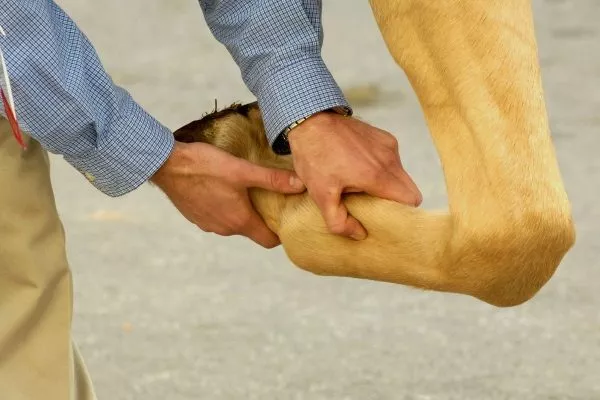
It most often occurs in horses subjected to fast gaits. The disease is characterized by an aseptic inflammatory process in the navicular bursae and bones, as well as the terminal areas of the flexor tendon. Factors influencing its development include osteoporosis, limb deformities in the hoof area, bone disease, and heavy work.
Signs:
- the horse puts the limb forward, bends it at the phalangeal and carpal joints;
- over time, the horse's stride shortens;
- movements are restricted;
- the horse stumbles and limps;
- compression develops.
Chronic podotrochleitis causes irreversible tissue changes, making it impossible to completely cure. To alleviate the horse's condition during an exacerbation, a novocaine block is used.
Hoof cracks
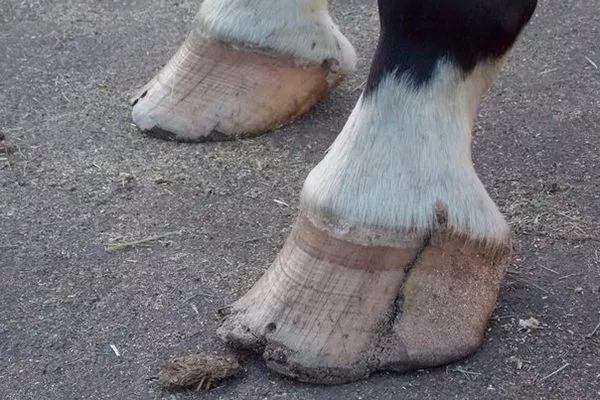
Cracks occur due to falls, mechanical impact, cuts, running fast, nails that are too thick, and the like. They are classified as lateral, heel, toe, superficial, deep, and plantar.
- Clean the hoof of dirt and debris.
- Treat the crack with an antiseptic solution.
- Apply a temporary bandage to prevent infection.
- Consult a specialist for further treatment.
Symptoms:
- pain syndrome when moving;
- inflammatory processes;
- bloody discharge (in case of deep lesions);
- lameness;
- placing the limb forward;
- When infected, a purulent abscess occurs.
To prevent the crack from widening, its edges are secured with plates, tape, or forging nails. To prevent pinching, horn removal is performed.
Deformed hooves
Hooves become deformed due to fractures, bruises, and a variety of diseases. This deformity limits the horse's range of activity, impairs its functionality, and contributes to strain in the tendon-ligament system.
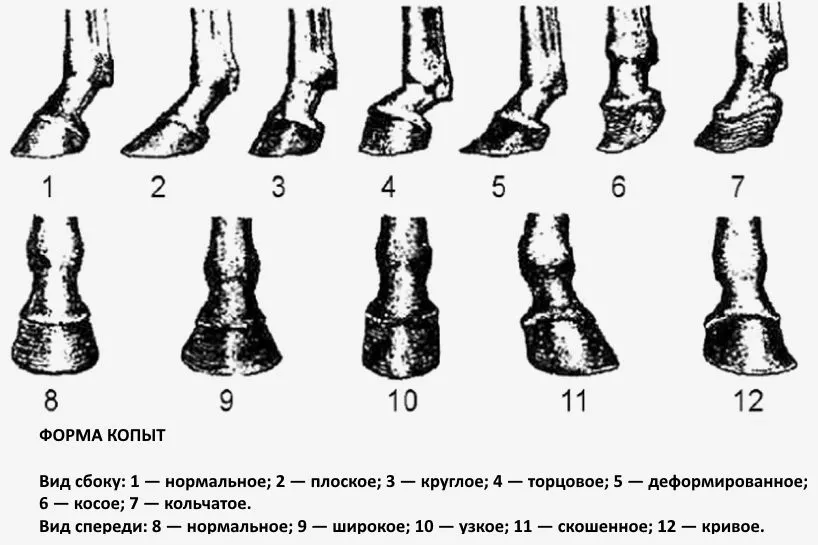
Deformed hooves are divided into types:
- The hoof is flat. The cause is chronic inflammation of the hoof skin. Flat feet are normal in heavyweight horses. The hoof structure is such that the sole and the edge of the horn wall are level, the heel walls are weak and low, and the horn breaks easily due to its fragility. However, the frog is well developed.
To ease the horse's condition, it is shod with a special horseshoe - with a cove, smooth, rounded. - The hoof is full. It is characterized by a protrusion beyond the plantar edges, therefore a horseshoe is used as in the previous case, but with lapels and a felt lining.
- The hoof is crooked. It is distinguished by different sidewalls, one of which is compressed, shortened, and steep, while the other is sloping and long. The cause is improper shoeing and trimming errors. This type of hoof is shod with a three-quarter base and a horseshoe with a single thin branch or an outward bevel.
- The hoof is crooked. Characterized by different walls—convex and concave. The cause is uneven distribution of loads and horn breakage. This contributes to pinching of the underlying skin and stretching of ligaments, leading to persistent lameness. Shoeing is performed on one wall with the wide side of the horseshoe, and on the other with the straight side.
- The hoof is cool. It has a steep toe wall, high heel walls, and concave soles. The cause is tendon contracture, improper trimming, and improper foot placement. A crescent-shaped shoe is used.
- The hoof is compressed. It is characterized by converging heel walls and a small, painful frog. The horn is hardened and dry. The causes of any type of compression (heel, plantar, or coronary) include a sedentary lifestyle, excessive trimming of the frog, or constriction of the hooves by horseshoes.
It's advisable not to shoe such horses and only let them ride on soft ground. Alternatively, horseshoes with soft pads soaked in birch tar are recommended.
Understanding the structure of horses' hooves makes it easier to care for them, preventing various diseases and deformities. Mandatory care includes hoof trimming, clipping, and re-shoeing, which is performed every six weeks. Keep in mind that it is not recommended to shoe foals until they are 4-5 years old.