
Cows' hooves must be trimmed regularly to prevent deformities and the development of various pathologies, including infectious diseases of the epidermis and dermis. Cows kept tethered in stalls should have their hooves trimmed at least three times a year. In loose-stall housing, this frequency can be reduced to twice a year. Why hoof trimming is important and how it's performed is discussed below.
Anatomical and physiological characteristics of hooves
The hoof is a horny layer that grows like human nails. It consists of a pair of digits, called phalanges of the third and fourth toes. They face each other and are separated at the distal end by a small gap. At the base of the hoof (the coronet), there is an arch and a common sheath of skin.
On the 5th and 2nd toes, additional hooves are formed, which are rudimentary organs, so cows do not rely on them.
The anatomical structure of the hooves is as follows:
- keratinized skin epithelium;
- superficial connective tissue membrane;
- deep fascia;
- blood and lymphatic vessels;
- nerve endings;
- tendons;
- skeletal apparatus.
Overall, hooves are quite complex, as they can perform a variety of motor functions. For example, through the action of tendons and joints, an animal can bend, extend, and rotate them. Therefore, hoof health is crucial for an animal's movement and activity!
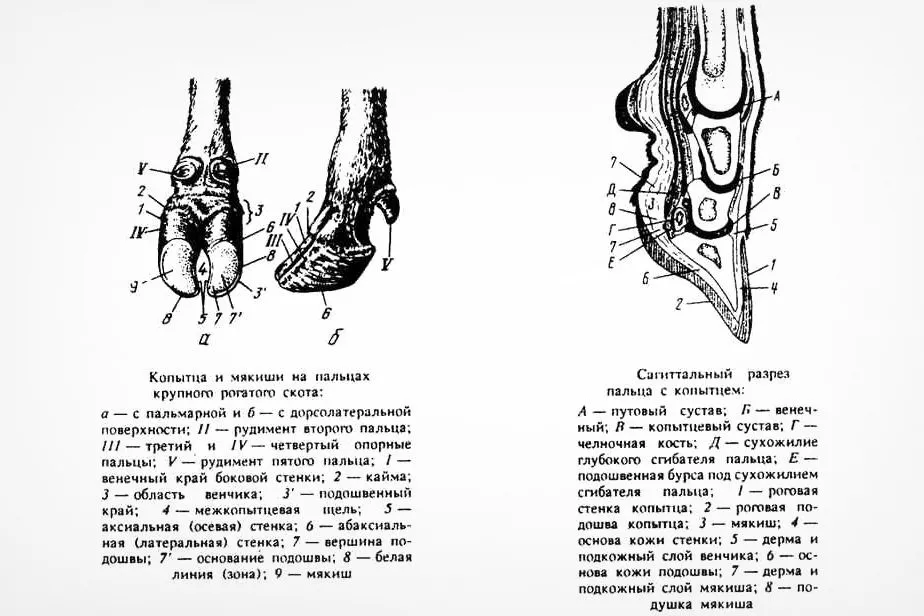
The horn layer should wear away as cows move naturally. However, modern livestock management limits their mobility, so their hooves don't wear away, necessitating trimming.
Why is pruning necessary?
This procedure should never be neglected, as it can prevent a number of negative consequences. These include:
- Hoof injuryWhen animals graze on pasture, they move around a lot, causing a natural wear-down of the dead, hard epidermis. The stratum corneum (the stratum corneum) constantly grows (approximately 7-8 mm per month) and replaces the worn-down layer. When animals are confined to stalls and move little, this stratum corneum grows much faster than it wears away. Its most intense growth period typically occurs in the fall and winter. This causes the hooves to crack, bend, and become deformed.
Dangerous microorganisms can enter the resulting wounds, causing inflammation and decay.
- Sprain of the ligamentous apparatusIf the keratinized layer is not removed for a long time, the ligamentous apparatus will stretch greatly, so animals will be more susceptible than usual hoof diseasesHowever, correcting the situation will be quite difficult, since the ligamentous apparatus is practically beyond restoration.
- LamenessHoof horn damage and hoof damage due to untimely trimming lead to various diseases that cause lameness in horses. These diseases include:
- sole ulcer;
- footrot;
- digital dermatitis;
- white line disease.
- InfectionWhen the hoof horn grows, the cow's weight shifts from the toe to the sole. As a result, the horny layer grows and forms a bulge on the sole of the foot. This, in turn, leads to pododermatitis (inflammation of the underlying skin) and trauma to the hoof tissue, which can lead to infection. Due to infection, cows may experience the following pathologies:
- dermatitis of fingers;
- footrot.
- Decreased productivityThe cow, bearing all her weight on untrimmed hooves, experiences pain. She begins to eat poorly and limps slightly when moving. All this negatively impacts milk production. Milk production often decreases by a quarter, but in severe cases, the cow may stop producing milk altogether.
Thus, if you trim the hooves in a timely manner, you can completely eliminate various cow diseases, as well as achieve the following goals:
- improve the condition of the herd;
- increase milk yield;
- ensure ease of movement for the cows.
Who should I trust to do the pruning?
This work should only be entrusted to a well-trained specialist, since without the appropriate knowledge, animals can easily be injured, which will ultimately lead to a decrease in their milk yield.
So, if you lack the necessary experience, you should call a team of professionals. They will arrive with all the necessary equipment, so there's no need to purchase it. In a single day, the team can trim the hooves of 80 cows and perform a range of other ancillary tasks, including treating the feet for disease diagnosis.
Special workers can be invited once per season.
In the video below, you can see how a professional trims hooves:
Hoof trimming rules
This procedure is extremely important for the health of cows and their productivity, so when carrying it out, a number of rules must be taken into account:
- Determine the optimal number of trims depending on the cattle's housing conditions. If cows are kept indoors and rarely move, the procedure should be performed at least three times a year. If cows are taken out to pasture, it can be performed twice a year—in the spring and fall.
- If kinks or injuries develop, trim the hoof horn unscheduled. Ignoring this procedure will lead to reduced movement of cows due to the inability to take them to pasture. This will reduce blood circulation in the foot by 10-15 times, causing hooves to grow more slowly, with little or no replacement.
To ensure that trimming is beneficial, it must be done on time; otherwise, the hooves will not be restored even if all the rules for keeping livestock are followed.
- Before treating the hoof, carefully inspect it for fungal and infectious lesions that require immediate treatment.
- When trimming, proceed with caution. It's better to leave some of the old horn than to damage living tissue, causing pain and discomfort to the cow. Doing so can reduce milk yield by 20-25%.
- Check the quality of the work performed using a hoof horn tester, which will measure the angle between the sole and the front of the hoof. It will also help determine how well the hoof contacts the ground. If such a device is unavailable, the flatness of the surface can be checked by firmly pressing a knife against it.
It is important that the hoof surface is smooth, otherwise the animal's weight will not be distributed evenly, causing its gait to change.
Hoof trimming instructions using hand tools
To carry out the work, you need to prepare the following tools in advance:
- hoof nippers;
- hoof knife;
- rasp;
- pliers;
- hooks or special fasteners;
- electric cutters.
- ✓ Tools should be made of stainless steel to prevent corrosion and ensure durability.
- ✓ Hoof nippers should have adjustable compression force to adapt to different thicknesses of the horny layer.
Pruning is carried out in the following order:
- About a day before the procedure, keep the cow on damp sawdust to allow the hooves to become slightly damp and soft. This will make them much easier to trim.
- The cow's limbs must be securely restrained to keep her immobile. You can tie her horns with nose pincers or use a special chute. In extreme cases, you can roll the cow onto her side and tie her.
If a machine isn't available, about three strong men should be involved in trimming the hooves. If a machine is used, one operator can handle the job.
- Secure the limb to a stall or stable post. Start with the front legs and then move on to the hind legs.

- If the animal is violent, calm it down before the procedure. In severe cases, an antipsychotic drug, such as Rometar, may be administered.
- Clean the hoof of any dirt, then use the prepared tool to trim the sole, removing the gray, old layer until the elastic tissue is exposed. Work slowly and carefully. This layer is typically about 5 mm thick. It's best to start trimming from the highest claw, removing all imperfections down to the white line. Continue trimming the second claw in the same manner. The work is complete when the sole completely touches the surface of the hoof knife. At this point, the axis of the digital bones (an imaginary line running through the middle of the coffin, coronary, and pastern bones) will be perfectly straight. Unique features for determining pruning depth
- ✓ The elastic tissue under the stratum corneum has a pinkish tint, which serves as an indicator that trimming has stopped.
- ✓ The thickness of the removed layer should not exceed 5 mm to prevent damage to living tissue.
To remove the old, hardened layer, instead of a hoof knife, you can use a grinder with discs attached to it.
- Use pliers to smooth the hoof wall, positioning the teeth 2-3 mm below the sole. Use a rasp to smooth the edges. Do the same with the sidewalls if they have any protrusions.
- If wounds or abrasions appear, treat them with iodine.
- Place the cow on a level surface to assess the correct position of the hooves and limbs.
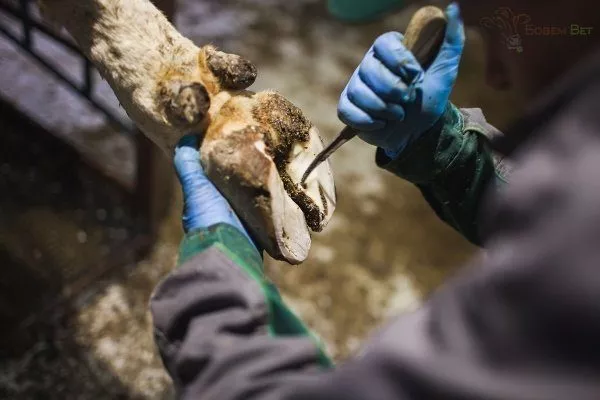
The plane of the trimmed hoof should be perpendicular to the axis of the leg to ensure the cow has a normal gait and an even distribution of weight on all limbs.
Features of using machines
While hoof trimming with a knife can damage a cow's legs, using a hoof trimmer can virtually eliminate this risk. It allows the cow to be securely restrained horizontally with straps. This prevents her from being confined, so she will remain relatively calm. The hoof trimmer also includes electrical drives and leg-lifting and restraining devices, such as special clamps or ropes.
Machines come in different types, but they can be roughly divided into two groups:
- MobileThis equipment is portable. It's typically lightweight and has removable wheels. The frame is made of lightweight material, and the floor is made of ribbed metal.
- StationaryThis sled is placed on a concrete floor and is not portable. It is made of tubing and stainless steel. The machine operates silently, without disturbing the cow. Attaching the legs takes 1-2 minutes.
Regardless of the type, the machine is controlled via a remote control. Besides its ease of use, it offers a number of other advantages:
- allows you to easily fix the cow in a comfortable and natural horizontal position;
- provides a hydraulic hoof trimming process;
- involves reliable energy saving technology;
- has high technical skills;
- completely reliable (made of a durable frame and high-quality materials).
Therefore, when keeping a large number of cows in a stall, an experienced farmer should acquire special equipment to significantly facilitate hoof trimming.
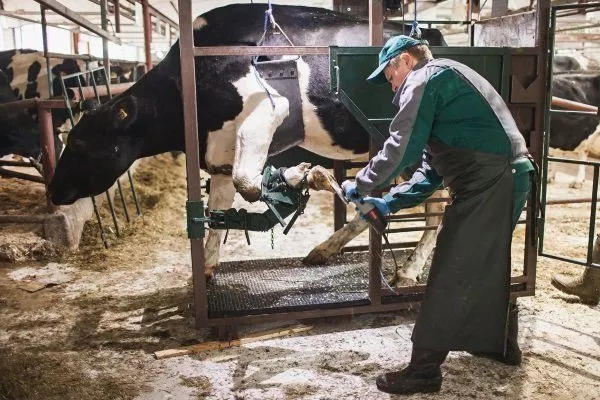
Hoof trimming on a stationary machine
Trimming in the stall
On small farms, trimming is often done directly in the stall. In this case, the most important thing is to securely restrain the cow, especially her head. It must be completely still. Various crossbars are used for this purpose. The legs are tied together and also to the supports in the stall. However, working in these conditions requires an assistant: one person holds the animal's legs while the other trims.
This type of hoof trimming is also performed using improvised tools. These include:
- electric cutters;
- nippers;
- scissors;
- hooks;
- clamps.
To make trimming easier, soften the hooves with copper sulfate. Then, easily remove any dirt from the work surface and treat it with an antiseptic. Wear rubber gloves when trimming.
When filing regularly, only the superficial thin layer should be removed so as not to damage living tissue and cause pain to the animal.
Hoof baths
After trimming, cows' hooves must be disinfected to prevent infection and spread to other animals on the farm. To do this, they must be passed through a bath prepared with one of the following substances:
- FormalinThis is an aqueous formaldehyde solution. It is very popular. The optimal dosage in the solution is 3% to 5%. For hoof treatment to be effective, the air temperature must be above 13°C.
When working with formalin, you must be extremely careful, as it has a strong odor and can cause allergies in the form of reddening of the skin, inflammation of the mucous membranes, and irritation of the respiratory tract, including an asthma attack.
- Copper sulfate or copper sulfateIt's a less effective product, so its dosage should be increased to 6-10%. This powder is difficult to dissolve in water, which is a significant drawback. It loses its effectiveness when exposed to manure and dirt, requiring frequent re-mixing, which requires considerable effort. All of this makes its use less appealing.
In addition to formaldehyde and copper sulfate, some farms have begun to frequently use a new product called "Four Hooves." It contains organic acids and ammonium. Even if the bath is 20% contaminated, the product retains its antiseptic properties.
Regardless of the chosen product, the following rules for treating hooves after trimming must be taken into account:
- Build a bath that can hold up to 200 liters of solution for approximately 200 head of cattle. Its dimensions will be as follows:
- length - 3 m;
- width - 1 m;
- depth - 15 cm.
- After 200 cows have passed through, the solution in the bath should be replaced with fresh one, as re-transmission of infection is possible.
- Before refilling the bathtub, rinse it thoroughly with clean water.
- Run cows through the bath twice a month. If an infection is detected, this procedure will need to be repeated daily.
To maintain hygiene after such baths, cows must return to clean sections.
In the video below, you can see how a hoof bath works in an industrial setting:
Preventive measures
To prevent animals from suffering from hoof diseases, it is necessary to take preventative measures:
- Provide cows with a balanced diet, providing them with fiber, trace elements, and vitamins. It's important to feed concentrated feeds in the morning, afternoon, and evening. If animals don't receive enough, the quality of the stratum corneum will deteriorate, leading to cracks.
Cows' diets should be high in fiber rather than starch.
- Maintain cleanliness in the area where cattle are kept. Poor hygiene, the presence of manure, poor ventilation, or high humidity will lead to hoof deterioration.
- Provide conditions for animals to rest in the stall for 12-14 hours. This should be especially important during the period leading up to calving. During this time, hoof horn grows more slowly but wears out more quickly. This often leads to hoof problems and lameness. After calving, hoof flexibility and navicular mobility will improve, especially with proper care.
- Pay attention to the floor of the barn. It should be level, durable, and not sag. It's a good idea to have gaps in the floor for draining slurry so it doesn't accumulate and flows directly into the manure storage area. Hooves are especially vulnerable to wear and tear when animals are kept in stalls with concrete floors. To preserve their integrity, the floor should be covered with a thick layer of bedding.
- Maintain bedding. It should be kept dry and clean at all times, as dry hooves are much firmer and healthier than those that are constantly wet. To prevent the development of ulcers, digital dermatitis, and other conditions, remove manure and change the bedding twice a day.
- Trim hooves 2-3 times a year and also arrange for them to be run through disinfectant baths.
Hoof trimming is a mandatory procedure for caring farmers, but if you lack experience, it should be entrusted to a trained professional. After trimming, the hooves should be straight and fully in contact with the ground. This will ensure the animal's weight is evenly distributed, ensuring comfort. After trimming, it's important to bathe them with antiseptic solutions. By following all these rules, you can prevent hoof diseases in cows.