
Slaughtering cattle requires proper preparation and a thorough understanding of slaughter techniques. Below are step-by-step instructions for each method, the necessary tools, and recommendations for further processing of the carcass.
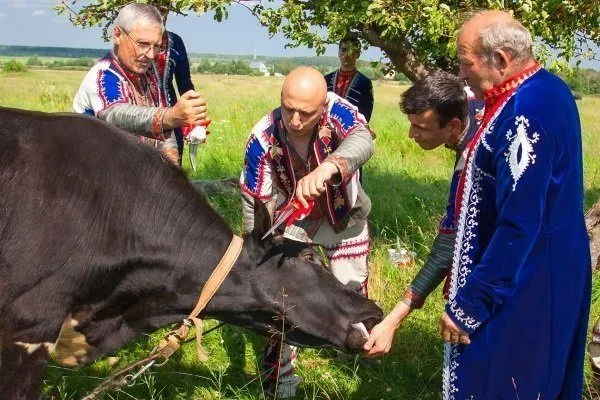
What cattle are subject to slaughter?
Sanitary regulations prohibit the slaughter of cattle without a veterinarian's inspection prior to the procedure. This ensures that diseases dangerous to humans and other animals are not spread. Raising cattle at home does not eliminate the risk of infection from pastures, water from reservoirs, or from other cows.
Slaughtering a cow for meat is strictly prohibited if the following diseases are present:
- malignant tumors;
- rabies;
- catarrhal fever;
- emkar;
- tetanus;
- anthrax;
- plague.
If symptoms of one of the listed diseases appear, the animal undergoes treatment. If the disease is advanced, the only cure is forced slaughter. The entire process takes place in a sanitary slaughterhouse under the supervision of a veterinarian; after slaughter, the carcass is completely disposed of.
Reasons why slaughter is temporarily postponed:
- when receiving a foot-and-mouth disease vaccination - on the 21st day;
- in case of vaccination against anthrax - for a period of 14 days;
- after treatment with antibiotics - until the drug is completely eliminated from the body;
- in case of non-communicable diseases and elevated body temperature - until the condition stabilizes;
- prevention and treatment of parasites - month;
- Newborn calves up to 14 days old.
Optimal time for slaughter
The optimal age for slaughter is one year. This is because animals actively gain weight before one year of age, and after this age, weight gain in cattle is only possible through fattening, i.e., a significant increase in feeding rates.
- ✓ The ambient temperature should not exceed +10°C to prevent rapid spoilage of meat.
- ✓ Air humidity should not exceed 70% to ensure high-quality bleeding.
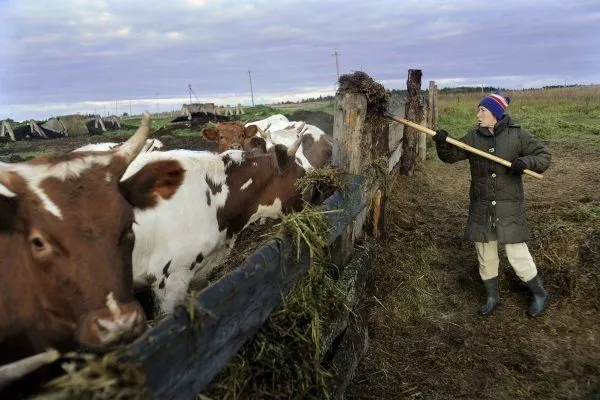
When raising a bull for meat, avoid castrating it, as this slows growth and development. Meat yield and quality will be significantly reduced.
Autumn is considered the most suitable time of year for slaughter. The procedure is preferably performed in the morning, when the ambient temperature is at its lowest.
Preparation for slaughter
Before slaughtering a cow, it's essential to take preparatory measures to prevent the risk of infecting people and other animals with dangerous diseases. It's important to ensure the animal itself and the slaughter area are properly prepared.
Veterinarian's permission
Before slaughtering a bull, the animal should be examined by a veterinarian. The specialist will determine any contraindications to the consumption of this beef and, if necessary, prescribe treatment or extreme measures, including forced slaughter and disposal of the carcass.
During a veterinary examination, the cow's body temperature is always measured.
Upon completion of the examination, the veterinarian issues a document on the basis of which further work is carried out.
Preparing the cow
Once a cow has received permission from a veterinarian to slaughter, all feed is removed from its diet, and water is provided in sufficient quantities. This will cleanse the animal's intestines, which will significantly facilitate the butchering process. Cattle should not be restricted for more than 24 hours, otherwise meat yield will decrease.
Immediately before slaughter, the cow is washed, cleaning its fur and hooves to prevent dirt and pathogens from getting into the meat during butchering.
Avoid frightening or hitting the animal. Under stress, when lactic acid levels in the body decrease, the meat's quality, color, and shelf life are adversely affected. Bruises interfere with bleeding the carcass and must be removed during butchering.
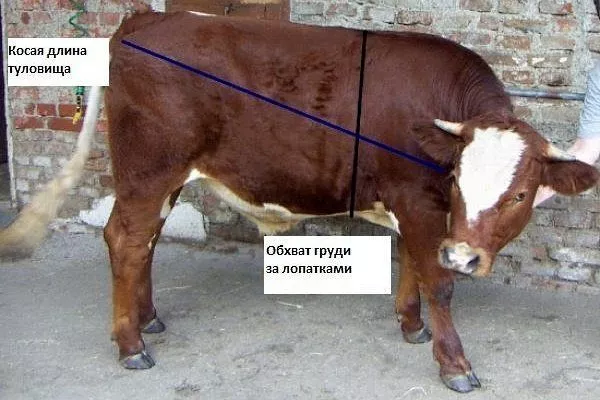
An important point in preparation for slaughter is measuring the animal to calculate live weight or weighing it.
What will you need?
Cattle are strong animals, and it's unlikely they can be killed instantly, so stunning is necessary. When slaughtering, it's important that the cow feels no pain as it dies.
For home slaughter of cattle you will need:
- sledgehammer;
- rope or cable;
- winch;
- slaughter knives;
- axe;
- containers for blood, meat and organs;
- rags;
- clean water.
For industrial slaughter, the type and quantity of necessary tools depends on the slaughter method and scale. However, the list remains fundamentally the same.
Slaughter methods
The method of slaughtering a cow depends on the animal's weight, the slaughterer's skill level, and the chosen location. If you lack experience, it's best to contact a slaughterhouse to let experts handle the job.
Slaughtering of cattle involves several stages:
- stunning;
- slaughter;
- bleeding;
- skinning;
- removal of entrails;
- cutting up a carcass;
- Sanitation (toilet).
Stun with bleeding
This method is most often used in private farms. It involves rendering the cow unconscious and then bleeding it. To do this:
- Place a rope over the animal's horns and tie it securely to a support, securing the head.
- Hit the cow on the forehead with a wooden hammer, stunning it.
- If the animal loses consciousness, cut the skin on the neck, exposing the carotid artery and jugular veins.
- Cut large blood vessels.
- Ensure the carcass is suspended to allow the blood to drain.
Stunning and bleeding has been used since ancient times. It is believed that repeatedly striking a cow on the forehead will cause it to lose consciousness due to a concussion. Experiments have shown that this method does not produce these brain injuries. Consequently, this method of slaughter is considered particularly cruel.
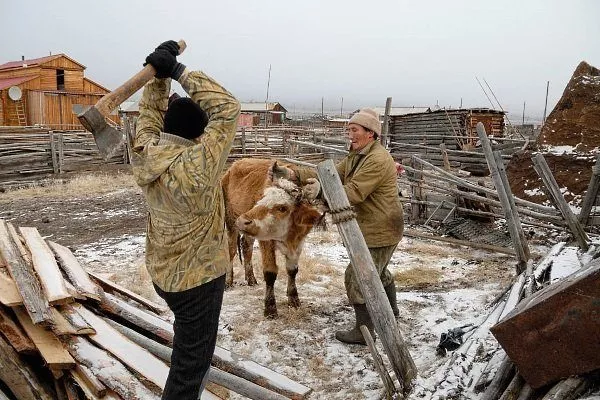
A wooden mallet must be used to strike the same spot up to 15 times, which is why metal sledgehammers are often used.
The agony that often occurs during slaughter reduces the quality of meat; bleeding is minimal, and any remaining blood leads to accelerated spoilage of the meat during the warm season.
You can determine whether bleeding has been performed correctly by collecting the blood in a container and measuring its final volume. In cattle, the blood level in the body is approximately 7-8% of the total body weight. If the collected amount is at least half of this value, the slaughter has been performed correctly.
An animal's behavior during its death throes is unpredictable. Extreme care and caution are essential to ensure the cow doesn't harm the butchers.
Slow bloodletting
The method of slow bleeding is used by northern European nomadic peoples and Siberian nomads. One of the most brutal methods involves the following actions:
- A long knife is thrust into the bull's neck, moving toward the heart, while it stands still. This severs the arteries and veins around the heart.
- The animal falls into an uncontrollable state, struggling and twitching. Blood flows rapidly from the wound.
- From loss of blood the bull weakens and gradually calms down, and soon dies.
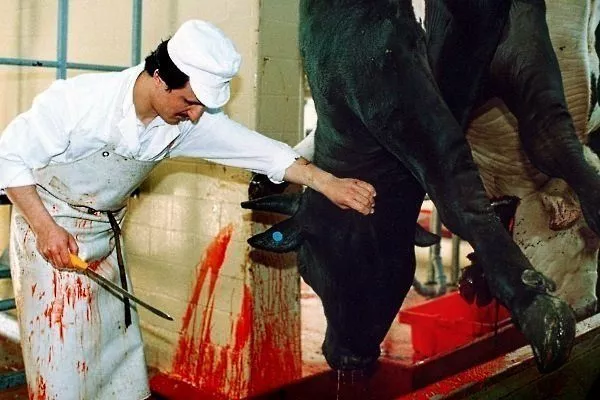
Using a buterol with a cutter
The butcher's sledgehammer with a chisel is a specialized butcher's sledgehammer. It weighs 2,300 g, and the handle is 90 cm long. One side of the hammer consists of a conical chisel, while the other side has a hook. The method involves several steps:
- Hit the bull in the forehead with the buterol so that the incisor breaks the skull, creating a hole.
- Insert a willow rod into the resulting tunnel.
- Destroy the medulla oblongata.
- Bleed the carcass.
A butcher must be skilled in the use of a butcher's knife and strong enough to deliver a good blow. Otherwise, the animal may suffer agony, causing additional problems during slaughter.
Slaughter with a mask
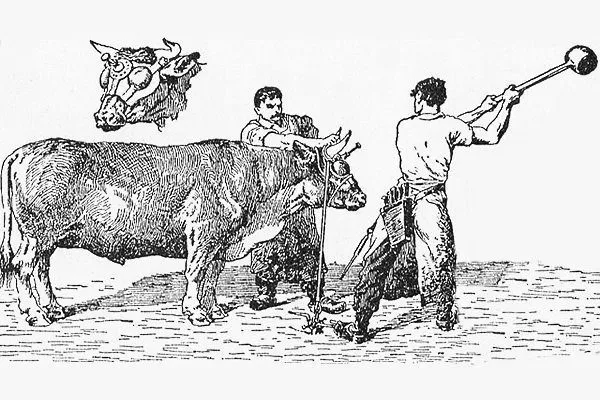
A head covering for a cow or bull, made of copper and leather, is called a "killer muzzle" or "buterol with mask."
- Secure the mask with straps so that the cylindrical hole in the metal plate is exactly in the middle of the animal's forehead.
- Insert a chisel into it, ending in a round, flat tip.
- Hit the chisel with a wooden hammer with considerable force. This will drive it into the head up to 25 cm deep.
- Insert a hard probe or willow rod into the resulting hole to completely kill the brain.
- Perform bleeding.
This method of slaughtering cattle cannot be considered rational, as there are numerous known cases where brain damage does not result in loss of consciousness. Furthermore, the brains become unfit for sale, and meat that is not completely bled loses its quality.
Bruno's method only caught on in France, although it was also tried in Europe and Russia. Slaughterhouse workers in St. Petersburg found it slow and laborious.
Skull fracture
The method can only be used in facilities with automated slaughterhouses. The process itself is presented in a sequence of steps:
- Several animals are placed in a narrow corridor-passage.
- The first bull stands on a movable platform, where its movements are limited by front and rear supports.
- The head is securely fixed between two vertical metal guides.
- The rail platform moves down a ramp with an iron crossbar installed at the end.
- The animal hits it with its head, crushing its skull.
- The dead bull's carotid artery and jugular veins are cut.
- The platform goes back for the next animal.
This method renders the bull's head and brains unfit for sale. The animals become frightened and stressed. This prevents complete bleeding, altering the color and flavor of the meat.
Sigmund's method (mask with shooting)
The Sigmund method for slaughtering cattle is very similar to the Bruno method. To implement it, follow these steps:
- Place a special mask on the animal's head and secure it tightly. It has a large, solid metal plate on the forehead.
- Screw the pistol barrel into the metal part.
- Fire a shot from the pistol.
- Cut large blood vessels in the neck to exsanguinate.
This method is quick to execute and doesn't require specialized knowledge or extensive experience from the butcher. However, a significant drawback is that the sound of the gunshot frightens the cattle, leading to stress and a decrease in meat quality.
The English way
The method was patented in England and is used to produce meat filled with blood, which is very popular with the English.
- The cow is stunned by a strong blow to the forehead area.
- They pierce the chest between the 4th and 5th ribs.
- Air is pumped through the hole using a special furry instrument, compressing the lungs. The animal dies of asphyxiation.
The slaughter method used in England is extremely cruel. Meat obtained through English slaughter contains a lot of blood, which significantly reduces its shelf life.
Kalmyk method of slaughter
The method of slaughter used by the Kalmyks is characterized by the following actions:
- The cow is secured by tying it by the horns with a rope.
- One butcher holds the animal, and the second stuns the cow with a precise blow to the forehead with the butt of a sledgehammer or an axe.
- When the animal has settled sufficiently, one sits on its head, while the other butcher cuts the sternum or under the shoulder blade between the 4th and 5th ribs on the left side.
- The heart is removed through the incision and the vessels on it are tied off.
The meat is infused with blood. Nomadic peoples highly value this product, serving it raw and warm immediately after the cow is slaughtered.
This method is even more cruel than the English method of slaughtering cattle. It requires specialized butchering skills throughout the entire slaughter process.
The Russian way
To slaughter a cow the Russian way, follow the algorithm:
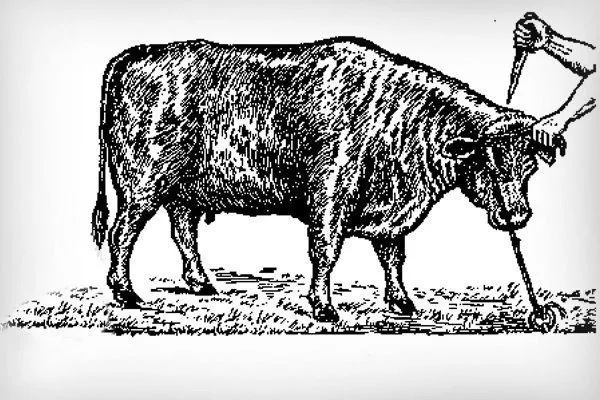
- Tie a rope to the horns and, passing it between the animal's legs, pull its head toward the floor. This will expose the oval ring, covered by skin and ligaments, between the occipital bone and the first vertebra.
- The butcher, standing in front of the animal, strikes this spot with a long dagger from front to back. The bull, losing consciousness, will fall onto its side, preferably the left.
- The second blow plunges the knife into the lower third of the neck towards the heart to reach and damage the pericardial blood vessels.
- The blood is collected in containers and disposed of.
The humaneness of the method depends on the time interval between the first and second knife strikes. It's best to perform them simultaneously. The method is quick and doesn't require stunning, as the first knife strike is used instead. Furthermore, the Russian method is considered safe. A single person can handle the slaughter of even the fiercest bull.
The meat is tasty and keeps well due to the high-quality bleeding of the carcass.
The Jewish Method
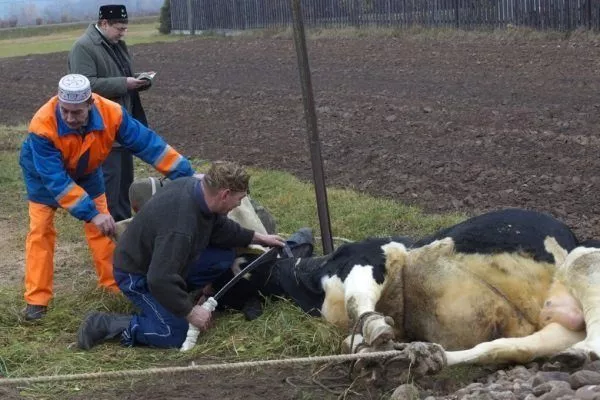
Since time immemorial, Jews have used their own method of slaughtering cattle, not only in their own communities but also in Christian territories, taking over the slaughter industry. The Jewish method, prescribed by religion, involves the following steps when slaughtering a cow:
- The animal's legs are tied and it is thrown over, dropped on its side so that its ribs hit the ground hard.
- The assistant—always a Christian—tilts the cow's head back so that the neck is taut. Most often, the horns are pulled back toward the back.
- With one stroke of the sharpest long knife, the incisor cuts through the skin and all the components of the neck down to the spinal cord. The incision is made between the first and second vertebrae.
- The animal shakes its head, scattering streams of blood, convulsions appear, wheezing is heard, and death occurs.
Special attention is paid to the knife used in this slaughter method. Its blade must be at least 50 mm wide and at least 350 mm long. A special sharpening is essential, ensuring that the hair is cut as soon as it touches the blade. Jews are prohibited from consuming the meat of the slaughtered animal unless these conditions are met.
In support of their method of slaughter, Jews argue that such a rapid neck dissection instantly kills the brain without hemorrhaging. The blood vessels and capillaries don't have time to adjust to the sudden drop in blood pressure, and death occurs instantly. This could provide grounds for considering the Jewish method the most humane of all.
Opponents of the method believe that when a knife is slashed through the animal's neck, it experiences intense agony for at least 15-20 seconds. They argue that this causes head shaking, while both the spinal cord and the central nervous system remain intact.
With the help of electricity
The electrical slaughter method for cattle was first used by Americans. It gained widespread acceptance in America, Italy, and England. The following procedures are used to implement this method:
- A pair of bare electrodes is placed near the animal's head, close to the ear. The electric current stuns the cow.
- If consciousness is lost, an incision is made on the neck, dissecting the jugular veins and carotid artery.
With this method, it's crucial to set the current correctly, as excessively high currents will kill the animal and cause the blood to clot inside the carcass. This renders the meat unfit for human consumption.
Approximate standards for current voltage and duration of its impact on livestock:
- animals under one year old - 70-90 V for 3-5 seconds;
- animals under 3 years old - 90-100 V for 10-12 seconds;
- over 3 years old - 100-120 V for 17-20 seconds;
- for large bulls - up to 200 V for 25-30 seconds.
The current in each case is maintained at 1 A. For safety, rubber mats under the fighters' feet and rubber boots are required.
This method is considered humane, as the animal loses consciousness and no longer feels any action. Meat slaughtered this way has a distinctive flavor, which is caused by the electric current.
Industrial slaughter
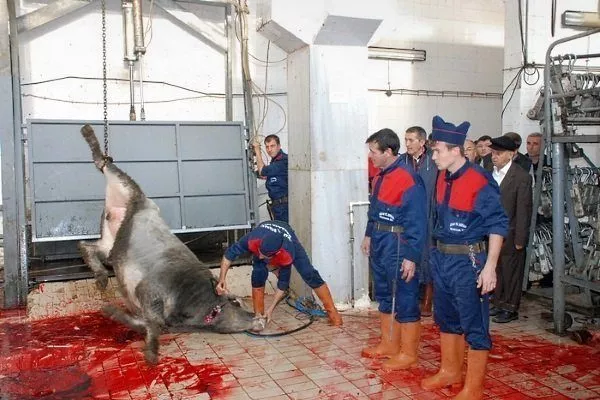
In industrial slaughterhouses, if a veterinarian approves, animals are placed on a mobile platform with high sides. Animal movement is restricted within a confined space.
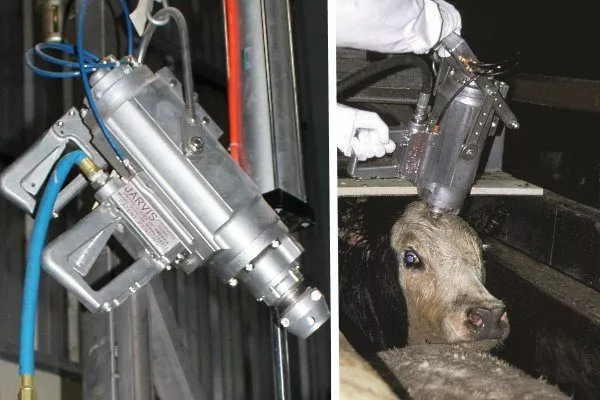
A pneumatic pistol powered by compressed air and a special cartridge is used for slaughter. With one movement, the device makes a hole in the center of the cow's forehead, into which a steel hook is driven to deactivate the brain.
The carcass is hung by the hind legs and the head is cut off.
Bloodletting is possible after the animal's heart has completely stopped; until this point, the blood nourishes the meat, impairing its quality.
Veterinary slaughter option
The veterinary method of slaughtering cattle is similar to the Russian method. The only difference is that the second strike is made with the knife still in the hole, reversing the direction of the blow. Thus, the first blade penetration is from front to back, and the second from back to front.
This method requires special skills and is best performed with the help of a veterinary specialist.
More modern methods of slaughtering cattle
Currently, stunning animals with carbon dioxide is often used on an industrial scale. This is done using a special, expensive gas chamber. The time required to render an animal unconscious varies from 3 to 7 minutes.
The taste of meat obtained using this method differs little from that obtained using other methods, since the animals are frightened and stressed in any case.
The advantages of this method include the purity of stunning and the ability to simultaneously affect animals of different age and weight categories with gas.
Carcass processing
Carcass processing is important to ensure the suitability of the meat for consumption, its sale, and the sale of the skin and internal organs.
Bleeding can be done horizontally or by hanging the carcass vertically, head down. The latter method is more efficient and convenient. The blood drains faster under the force of gravity, and the process is more thorough. Skinning and viscera removal are also more convenient when the animal is positioned vertically.
To prevent contamination, the slaughter area is lined with tarpaulins, planks, and film. Access to clean water is provided.
Skinning and dressing
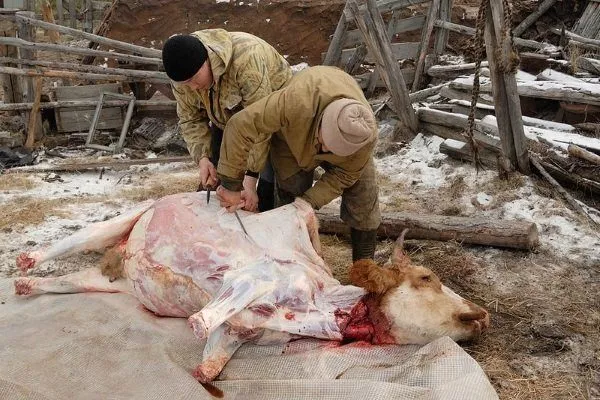
Removing the skin from a carcass is called skinning. Skinning a carcass is a simple process, but it requires care and attention. Rushing the process can damage the skin, ruining its marketable appearance, and contaminate the meat with microbes.
Skinning the head is a separate process. The ears are cut off, and the skin is removed through an incision in the forehead.
At home, the work is carried out with the animal positioned horizontally on a straw or wooden flooring:
- The carcass is placed on its back, with wooden blocks placed under its sides. The head is removed, and the remaining esophagus is tied off to prevent its contents from contaminating the meat during butchering.
- Using a carving knife, cut the skin lengthwise from the throat to the anus.
- A circular cut is made around the hooves of each leg.
- On the inside of the limbs, from the top to the hooves, the skin is cut.
- Using a knife and fingers to lift the skin, they remove it from the carcass. They begin with the front legs, then move on to the neck and chest, moving toward the hindquarters.
- The skin is removed from the sides down to the spine, and then pulled from the neck to the butt, trimming with a knife if necessary.
Watch the video below on how to skin cattle:
Removing the entrails
Removing the entrails after skinning is called evisceration. It must be performed no later than 1.5 hours after slaughter to prevent the spread of pathogenic microflora from the intestines into the meat. For horizontal evisceration, the procedure follows this procedure:
- Using careful movements to avoid puncturing the intestines, remove the genitals from the bull and the udder from the cow.
- Cut the sternum and esophagus lengthwise so as not to damage the insides with a careless movement.
- Chop the pubic and pelvic bones with a hatchet.
- Very carefully start removing the entrails from the top, cutting off the diaphragm near the ribs.
- Remove the spleen and liver, being careful not to damage the gallbladder.
- Remove the pancreas with the stomach, and then the intestines.
- Rinse the hollow carcass with cold water to remove any residual blood.
- Clean the bloody upper parts of the carcass and rinse with water.
To see how cattle are gutted, watch the video below:
Carcass cutting
Sawing is conveniently carried out on a large table or other flat, clean surface.
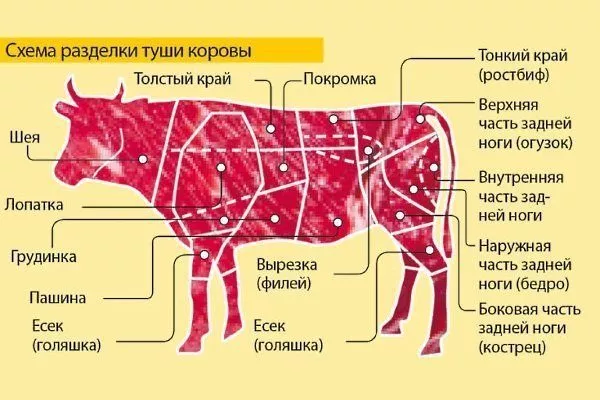
The cow's carcass is cut lengthwise into two halves. The muscles near the spine are dissected, and the cut is made slightly away from the spinal cord to ensure it remains intact. The carcass can also be divided into four halves. To do this, the halves are cut lengthwise between the 12th and 13th ribs.
The inside is rinsed with water and dried with a rag. Water is removed from the outside by scraping it down with the blunt side of a knife blade.
The finished carcass must be kept at a temperature of 0 to -4 degrees Celsius to allow a dry crust to form, which extends the shelf life of the meat.
Veterinarian's report
A veterinarian's pre-slaughter clearance does not guarantee that the meat is safe for consumption. A visual inspection of an animal cannot diagnose early-stage or latent diseases. Therefore, after slaughter, the meat must be submitted for examination.
Upon completion of the analysis and its favorable results, a veterinary and sanitary certificate is issued, permitting the sale and marketing of the skin, carcass and internal organs of the slaughtered animal, and the meat is branded.
Alternatively, if there are diseases, the animal is disposed of by burning or burial in a cattle burial ground, and the slaughter site and tools are subject to sanitary treatment.
Tips and Warnings
- Pay attention to the color and consistency of the meat and internal organs when cutting the carcass. There should be no inclusions, spots, or formations. If in doubt, have the carcass and the area inspected by a veterinarian.
- Don't undertake slaughter if you have little knowledge of the technique and no experience. Call in a specialist for assistance, and remain as an assistant yourself.
- Use only high-quality ropes for tying and restraining animals during slaughter. This is especially true for methods that may cause the cow to suffer death throes. In this state, the cow can cause injury and harm to humans.
- Pay special attention to the sharpening of your knives and their types. Long blades are often needed for slaughtering, while knives with medium or short blades are more convenient for butchering. For skinning, the blade should be less sharp.
Slaughtering is always physically and emotionally challenging. If you doubt your abilities, entrust the task to professional slaughterers. This will make the animal's life easier and save you some stress. A specialist will advise you on the most appropriate slaughter method and carry it out without any problems. This will preserve the quality of the meat, and proper processing and cutting will ensure the carcass remains marketable.