
Beef butchering rules are essential for farmers who raise livestock commercially and those who keep cows at home. If cattle are butchered incorrectly, it's unlikely the meat will be sold at a fair price or prepared properly.
Cow slaughter and initial cutting
Cows and bulls are slaughtered for meat no later than one year of age. For 24 hours before slaughter, the animals are deprived of food but given water to drink, preventing bacteria from entering the meat from the stomach. A few minutes before slaughter, the animals are washed and cleaned of any dirt.
It is strictly forbidden to frighten animals – not only because of aggression, but also because the level of lactic acid in the body drops sharply, which changes the color and texture of the meat.
There are many ways to slaughter cattle, but stunning is the preferred method at home. What you'll need:
- a strong sledgehammer and an axe;
- rope and winch;
- special knives;
- containers (to place meat, entrails, pour out blood);
- rags and water.
Stunning, bleeding and processing procedure:
- Place a rope over the cow's horns, tie it tightly and secure it to a support.
- With a sharp movement, hit the head (frontal part).
- When the animal loses consciousness, cut the neck with a knife along the carotid artery and jugular veins.
- Hang the cow upside down and place a basin underneath to collect the blood.
- Remove the skin (flaying method):
- Place the carcass on its back or side.
- Cut off the ears, make a cut in the forehead area, or simply cut off the head.
- Draw a line with a knife from the throat to the anus.
- Make circular cuts around the hooves, then cut the skin from the hooves to the top.
- Pull it off by prying it with a knife.
- Remove the insides:
- Dissect the sternum and esophagus.
- Cut the pelvic bones and pubic elements.
- Take out the liver, stomach, pancreas, spleen, etc.
- Rinse the carcass with clean water.
- Place in a room with an air temperature of 0 to -4°C for 2-3 hours.
- ✓ The temperature in the storage room must be strictly between 0 and -4°C.
- ✓ Air humidity should be maintained at 85-90% to prevent the meat from drying out.
- ✓ The meat should be hung on hooks to ensure free air circulation around the carcass.
To learn how to properly remove the skin, watch the following video:
Next, the farmer begins the primary cutting process, which includes two stages:
- Divide in half. The process involves the following steps:
- Make a cut along the flank line where the last rib is located.
- Cut the tissue until the tip of the blade touches the vertebrae.
- Cut into 2 parts (crosswise) between vertebrae 13 and 14.
- Quarter. Cut each half along the spine.
Stages and diagrams of cutting a beef carcass
The cutting of a cow is carried out in stages: first, it is divided into 2 and 4 parts, after which the following steps follow:
- Blending the front part.
- Cutting the back part.
- Boning.
- Cleanup.
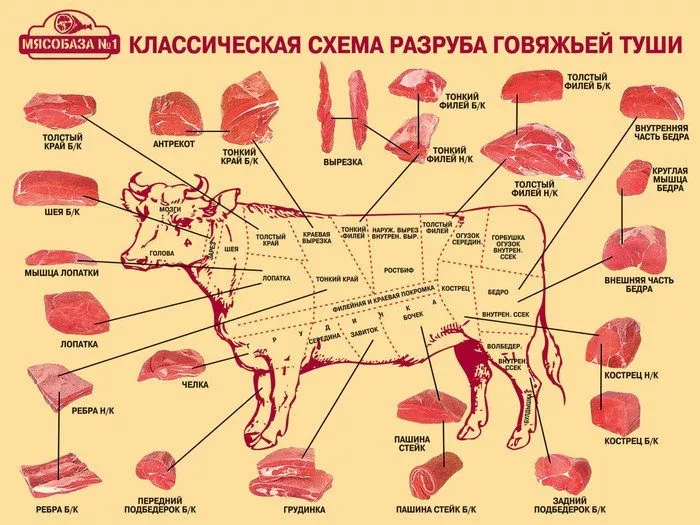
There are many different methods, and each country uses its own method and technology. In Russia, cattle carcasses are cut according to a standard method, which involves dividing them into 14 parts. These parts differ in name and other characteristics.
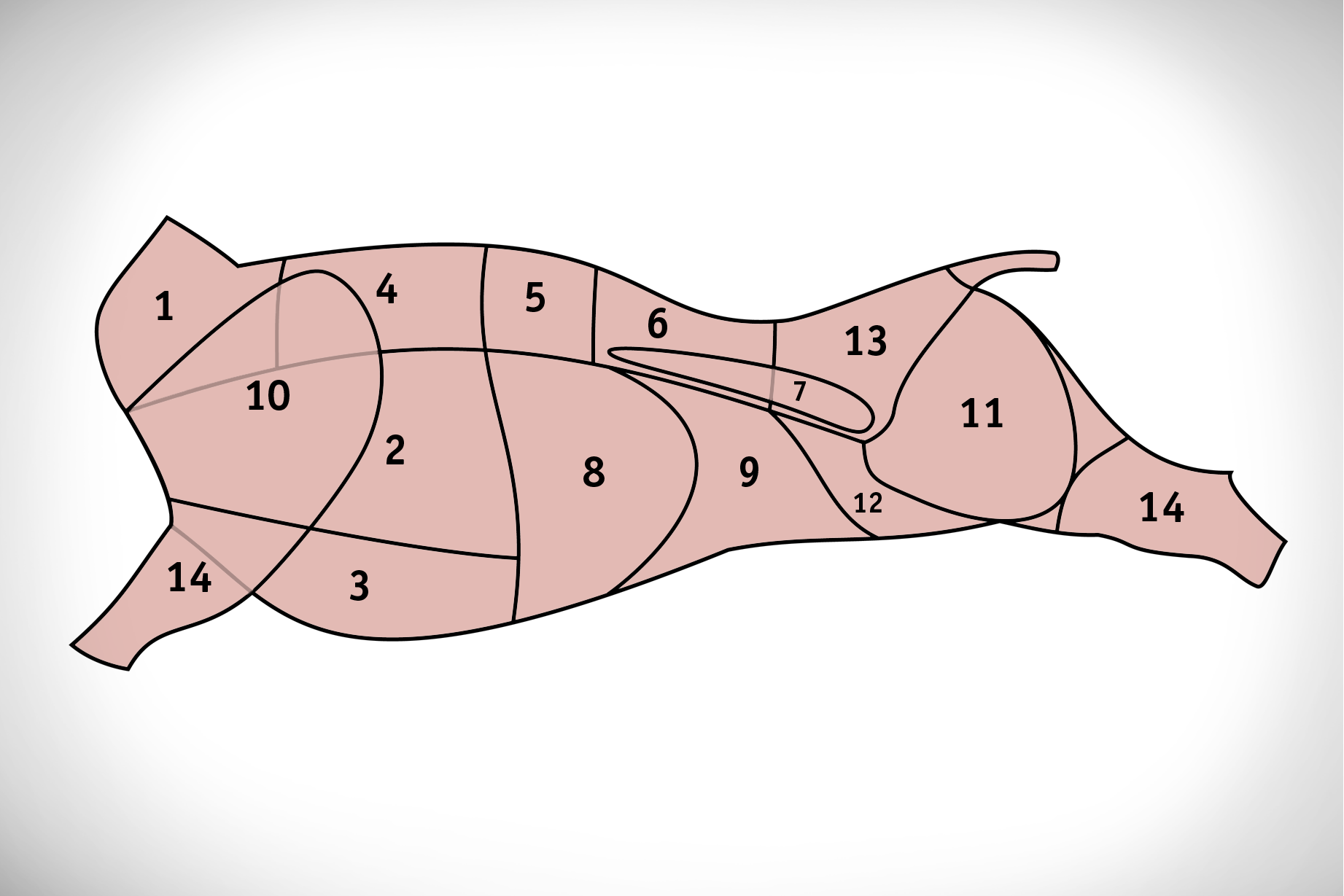
Other methods of cutting up cows:
- Russian No. 2. After cutting, there are 16 pieces.

- American. It is supposed to be divided into 13 parts.
- Dutch. This makes 12 pieces. The main difference is that a larger layer comes out from the sides and lower abdomen.
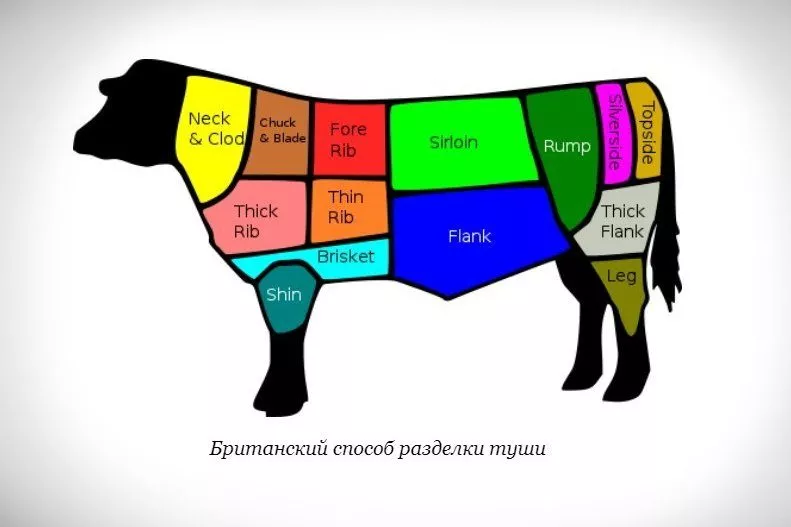
- British. Divide into 14 compact pieces.
- South American. Divide into 19 pieces.

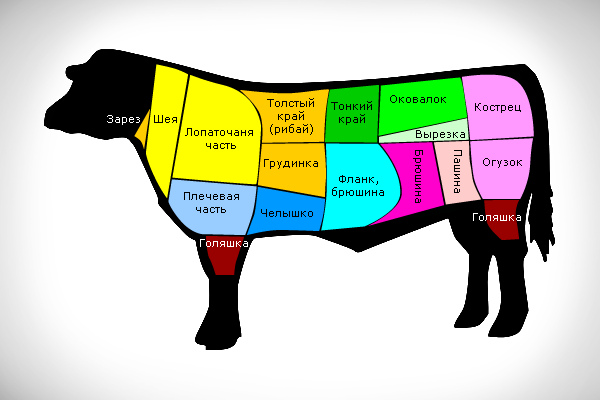
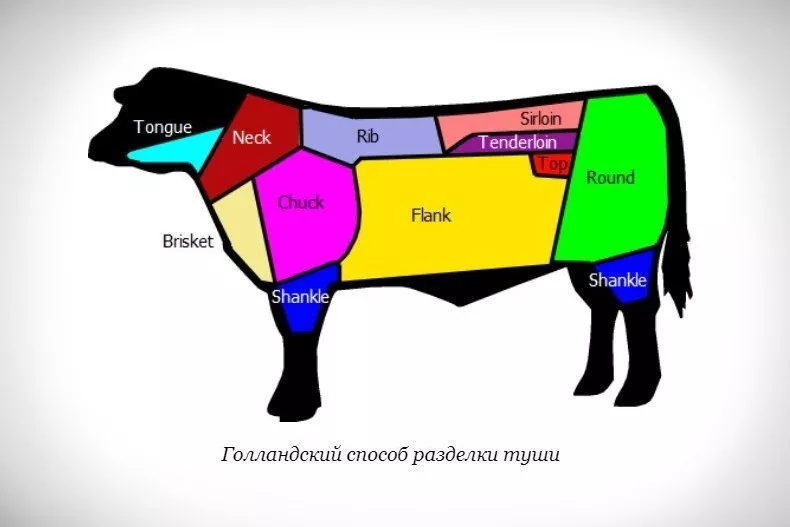
Cutting the front part
The front half of the cow's carcass contains the most valuable parts of beef (neck, shoulder blade, scapula, and rib). Perform this procedure with extreme care.
How to properly cut the front part of a beef carcass:
- Use a sharp knife to cut off the shoulder blade area so that no meat remains on the bones.
- Starting from the last cervical vertebra, separate the neck, but leave the back and chest sections intact.
- Divide the neck and shoulder blade sections into the shoulders and upper arms.
- Cut off the brisket, leaving a small amount of cartilage and ribs. Remove the outer layer of clean flesh from this brisket.
- In the area of the spine, where the thick edge is located, remove the shoulder meat. A small amount of flesh, called the rib edge, should remain on the ribs.
- Separate the breast cut.
How to cut the back part?
The rear half of the cow's carcass also contains valuable and tasty meat—the tenderloin. It's located in the posterior pelvic region, but there's also the hip and loin, which contain the flank (not valuable), the flank, and the sirloin.
Rules for cutting the hindquarters of a cow:
- Using a very sharp knife, remove the tenderloin along the remaining spine. Try not to leave any of it attached to the bones. To achieve this, start separating from the iliac bones, moving slowly and pulling the meat toward you. This will help it separate easily from the spine.
- Remove the pelvic bones. To do this, first split the backbone where the lumbar and sacral sections separate. Cut the flesh along the femur bones. The inner piece is easiest to remove.
- Remove the tibia and femur bones completely.
- Divide the resulting pulp into three parts: the side, the outer, and the top. This is easy to do thanks to the membranes that separate them.
- Cut the groin area along the contours of the hind legs.
- From the pelvis, separate the lumbar region with the hem (upper rib part) and flank.
Boning
Deboning is the process of separating the meat from the bone. A good indicator of the completion of the procedure is the absence of meat on the bones and no cuts in the meat.
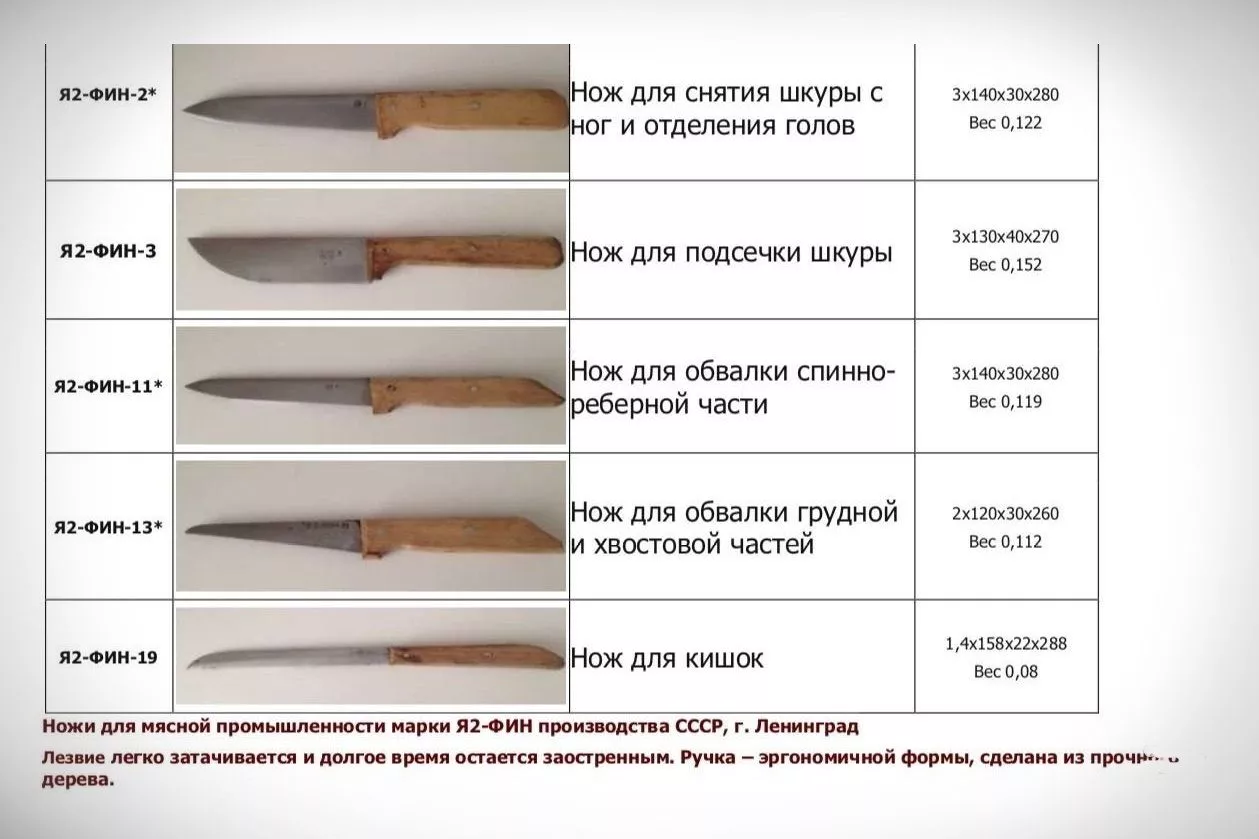
For boning, purchase special boning tools—sharp knives. They should have thin blades and pointed tips.
Features of boning all pieces:
- Shoulder blade. First, remove all tendons from the meat, then trim the muscles from the radius and ulna bones. Next, separate the meat from the shoulder and scapula along its entire length. Remove all sinew from the meat.
- Cervical part. There are attachment points on the vertebrae, from which you can remove the clean meat entirely, that is, in one piece.
- Brisket. Remove the flesh from the brisket where the ribs meet the sternum. Make sure to draw a straight line with the knife through the cartilage from the first to the thirteenth ribs.
- Thick edge. Starting at rib 13 and ending at rib 4, make a horizontal cut along the line that connects the thick edge to the under-rim. Finally, cut down 1/3 of the rib, then bring the knife horizontally again to rib 1.
- Subscapular region. The flesh is removed from the bone along with the thick edge, but then a square-shaped layer is cut off.
- Underhem. It's located on the ribs and is removed from them whole (not in small pieces, but in one large piece).
- Thin edge. Trim the flesh of this part along the spine, then carefully remove it from the other bones. At the same time, remove the flank.
- Postpelvic part. First, separate the tibia and femur. To do this correctly, find the joint, remove the tendons and meat, and then cut the joint with an axe. The next step is to separate the ilium. After this, make an incision along the femur and trim away the flesh.
Cleanup
After deboning, trimming is performed, which involves removing all unwanted elements from the meat that create toughness. These include:
- films;
- veins;
- cartilage;
- fat.
Cleaning features:
- absolutely all pieces of meat and bones are cleaned out;
- It is important to remove the periosteum elements from the neck first, and then the tendons;
- Be sure to cut off any films and fatty deposits from the shoulder blade;
- there is a lot of excess cartilage and fat on the sternum;
- from the thick edge, cut out not just the tendons, but also the edge pieces (otherwise it looks unsightly);
- There are too many tendons and the like in the posterior pelvic area.
Parts of the carcass and their uses
Regardless of the general cutting method used, the cattle carcass is ultimately divided into several main sections. Each section has its own distinctive characteristics in terms of taste, value (cost), tenderness, fat content, toughness, and usage.
After cutting up the cow carcass you get:
- up to 88% of grade 2 meat;
- up to 7% – 3 grades;
- up to 5% – 1st grade.
The animal's physical exertion determines the juiciness and tenderness of the future meat. Experts believe tenderness increases toward the tail and from the bottom to the top.
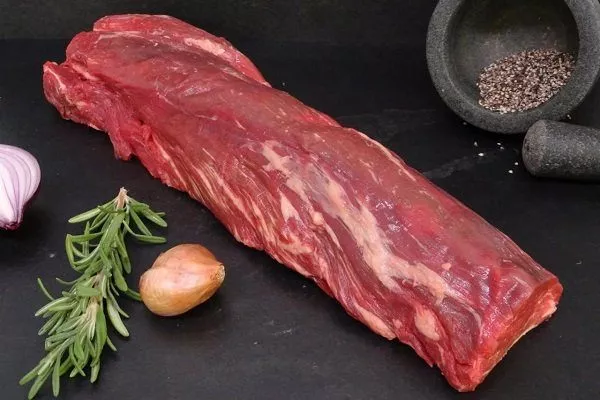
Fillet
This cut also has another, more common name: tenderloin. It's considered a first-grade cut and is characterized by its juiciness and tender texture.
Peculiarities:
- fat is almost absent;
- no veins;
- used for frying and baking whole;
- Steaks, beefsteaks, chops, roast beef, kebabs and the like are prepared from tenderloin.
The cost is the highest.
Pashina
This is a second-grade cut of beef, taken from the abdominal portion. It has a coarse texture. It contains sinew, membrane, fat, and some bone and cartilage. In cooking, it is used to make broths (which are very rich) and to make ground meat for cutlets, zrazy, meatballs, meatballs, and roulades.
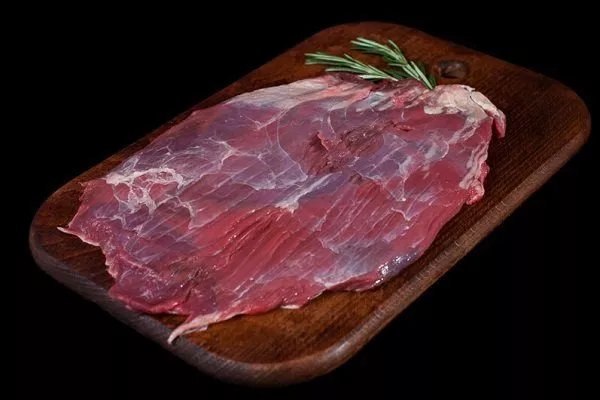
sirloin
Another name for this cut is thick sirloin, which is why it's considered a first-grade cut of beef. The flesh is tender and juicy.
Other characteristics:
- there are thin layers of fat;
- has bones - the last 3 ribs;
- the piece is divided into 3 parts of pulp;
- It is used in a variety of ways – for broth, beefsteak, cutlets, rib roasting, stewing, etc.
The boneless version is more expensive. You can save money by choosing the rib-eye version.
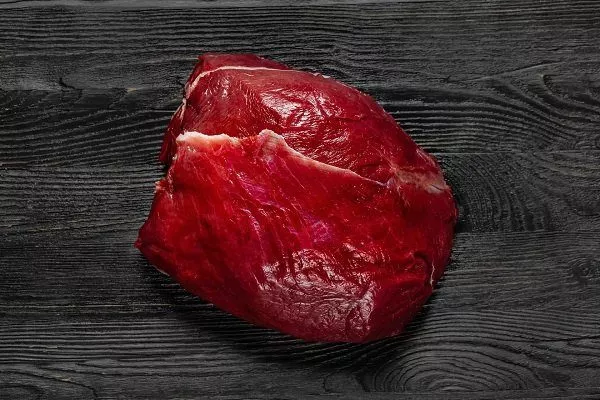
shoulder blade
This part is classified as grade 2 due to its fairly dense meat structure. The shoulder blade contains fat, but in small quantities. It is used for preparing steaks, cutlets, goulash, azu, and other dishes. It is not fried due to its coarse meat fibers and thick veins.
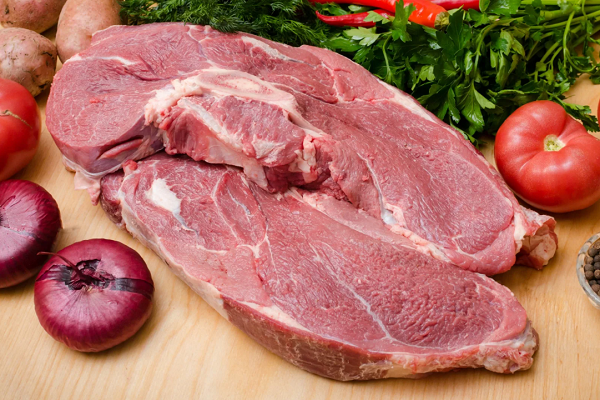
Neck, cut
Considered a third-grade raw material, it is distinguished by a small amount of sinew, but is particularly juicy and has excellent flavor. When boiled or stewed for a long time, the coarse fibers become tender. It contains a small amount of fat.
What is it used for in cooking:
- goulash;
- minced meat products;
- aspic;
- first courses.
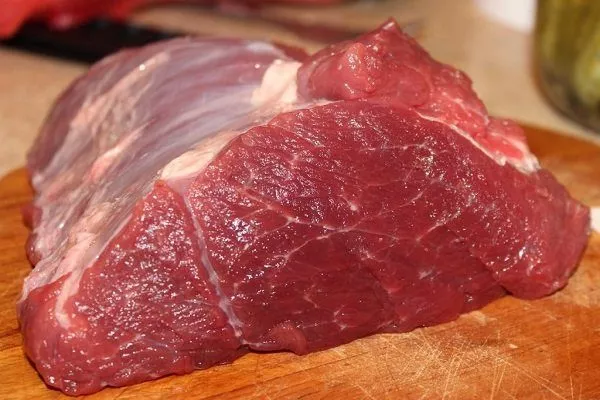
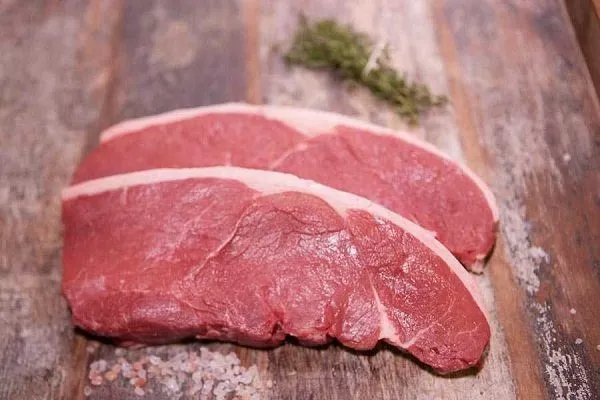
Rump
The rump is located at the top of the thigh. The meat is dark in color and firm in texture. It is sold boneless and always perfectly even in shape. It is classified as Grade 1.
Other features:
- there is some fat;
- there are veins with compaction at the ends of the muscles;
- structure – soft;
- Application: for baking, stewing, boiling and making minced meat.
Thick edge
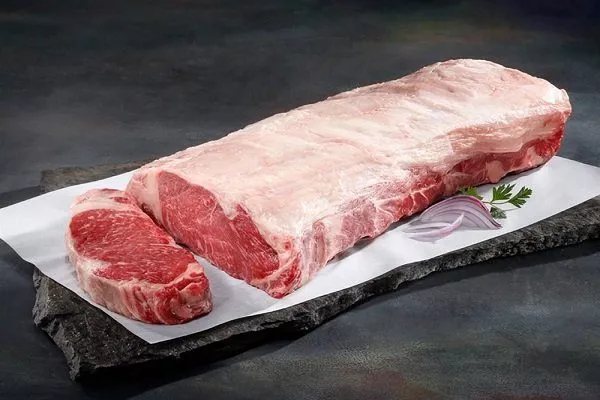
Another name is ribeye (due to the fact that this cut is used to make the most delicious steaks of the same name). Grade 1. Consists of the meat located on the ribs (4 to 5 pieces).
Characteristic:
- there are veins, but they are very thin and soft;
- there are many layers of fat;
- structure – juicy, tender;
- It is used for frying, baking, boiling and all other dishes, but its main purpose is steaks.
Thin edge
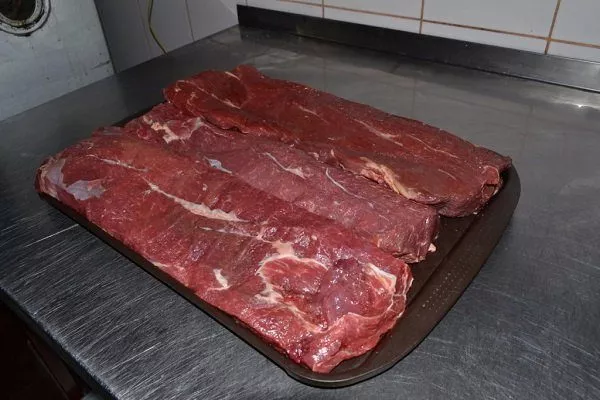
It's not much different from the chump steak, but it's slightly cheaper due to its denser texture. It's also known as striploin (also named after the steak). It's sold as a 4-5 rib steak or as a steak.
The fat content is negligible, but there are soft, fine veins. It's used identically to the thick edge, as the dish turns out tender and juicy. Grade: 1.
Knuckle and shank
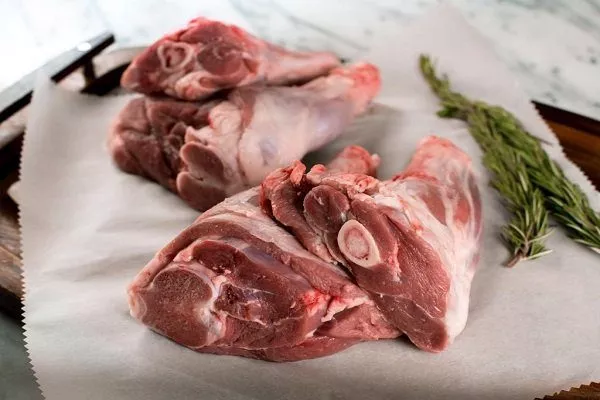
These two parts are completely similar in characteristics and both belong to the 3rd grade, but they are taken from different parts: the knuckle - from the front part of the leg, the shank - from the back.
Peculiarities:
- there is a lot of marrow bone and gelatin (that’s why the shank and knuckle make excellent natural jellied meat);
- after cooking there is a sticky feeling;
- there are a lot of veins, it takes a long time to cook and stew;
- the presence of a large bone;
- structure – dense;
- The color of the meat is dark red.
In cooking, they are used to make broths and ground into minced meat.
Falcon-cheeked chelya
A portion of the brisket (five ribs) is removed. This is considered a third-grade cut because it contains bone, sinew, and a high amount of fat. It is often used for fatty entrees.
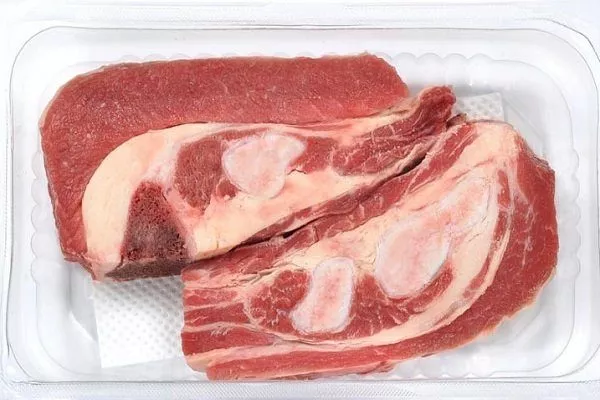
Brisket
The flesh of prime meat is located on tubular bones. Its texture is flaky, with a high fat content, yet soft and juicy. In cooking, brisket is baked under foil, boiled, and braised. In restaurants, it is used to prepare roasts.
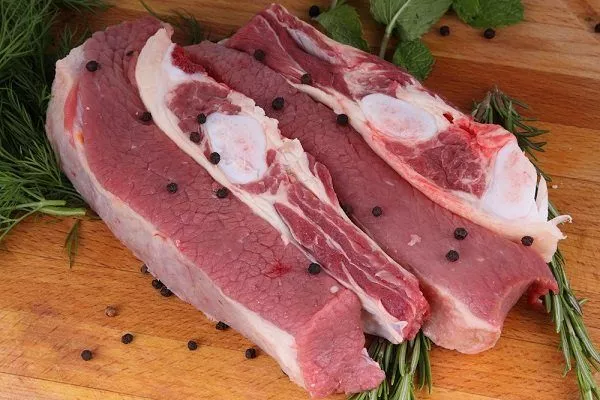
Rump
This part of the cow's body is characterized by tough meat, but the rump is an exception, as it is immobile. It is the middle part of the thigh. For these reasons, it is considered a premium raw material, used to make soups, cutlets, roast beef, and the like.
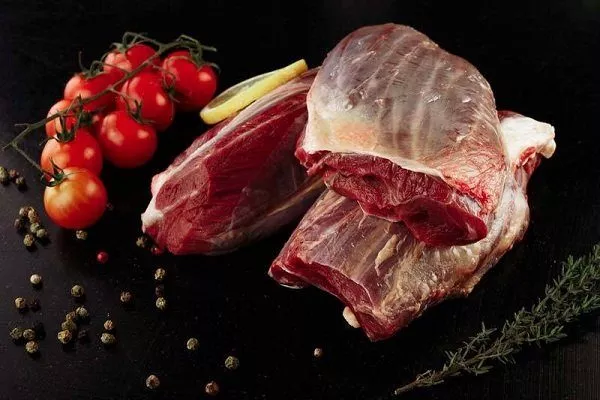
Sub-hip
It's classified as a third-grade meat due to its very coarse texture. Its flavor is appealing. This part contains gelatin, veins, and a small amount of fat. The pork thigh is commonly used to make seasoned soups, jellied meat, Tatar azu, goulash, and minced meat.
Beef butchering for sale should be done by a professional with extensive experience and a good reputation. If the animal is being slaughtered for personal use, it can be done independently. The main thing is to carefully study all the rules and requirements, stock up on the necessary tools, and have reliable assistants.