
Hereford cattle are renowned for their high meat yield and aromatic, delicate flavor. Although these cows cannot be milked, as all the milk goes to feeding the calf, farmers still recommend raising them for their meat. Furthermore, Herefords are capable of walking long distances, are easy to care for, and will eat any grass.
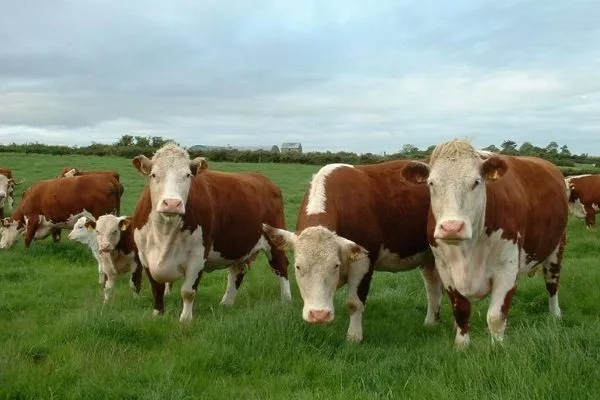
Description and characteristics of the Hereford cow
This breed was developed in the 18th century in Great Britain. Initially, they were ordinary red cows, but they failed to please farmers with either their productivity or their appearance. They began crossbreeding them until the first "excellent" Hereford calf was produced. The name comes from the English county of Herefordshire, where the first calf was born.
A century later, the herd was brought to Canada, then to the United States, where the breed's conformation and muscle mass continued to be improved. The cows have a strong, muscular build and adapt well to both northern and southern climates. They are particularly popular in the following countries:
- Africa;
- Australia;
- New Zealand;
- America (South and North).
The cows arrived in the USSR before World War II, where they were crossed with local cows to produce the white-headed Kazakh breed.
People are moving from cities to villages to raise cows, and farmers often choose breeds that adapt quickly to various climates and produce good milk and beef. Every farmer dreams of such a cow, as it has a strong constitution, can be used to graze the herd all day, and can withstand long journeys.
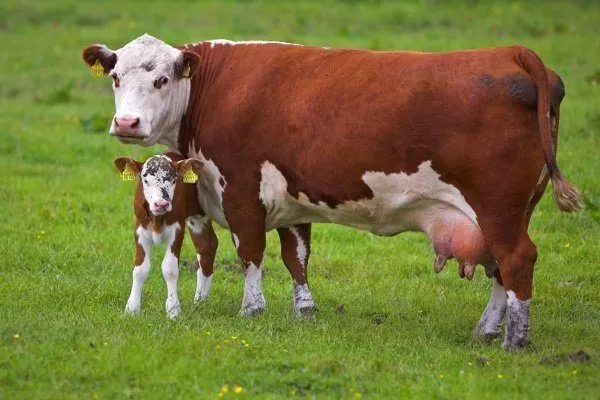
Externally, they look somewhat rough and differ from their counterparts in the following parameters:
- the neck is short;
- the head is white, broad and strong;
- color red-brown;
- white color of the following body parts: nose, lips, withers, mane, neck, belly and tip of the tail);
- horns are white, tips are dark;
- the sides are convex, the belly hangs down;
- thick skin;
- short but stable hooves;
- the mammary glands are poorly developed.
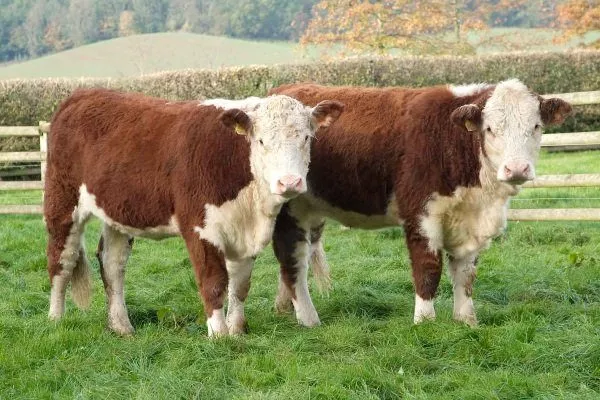
An adult animal reaches 130 centimeters in height, with a chest circumference of 195 centimeters. On Russian farms, an adult female weighs 600 kilograms live, while bulls reach 850 kilograms. In England, a cow can weigh 700 kilograms, and a bull 1 ton. By the age of two, a bull weighs around 800 kg, while a heifer weighs 600-650 kg.
Calves gain weight quickly, 900 grams per day, sometimes reaching 1.5 kilograms. At six months, heifers weigh 170 kilograms, and by one year, 300 kilograms.
| Age | Heifer weight (kg) | Bull weight (kg) |
|---|---|---|
| At birth | 28-35 | 28-35 |
| 6 months | 170 | 200 |
| 1 year | 300 | 350 |
| 2 years | 600-650 | 800 |
| Adult | 600 | 850-1000 |
Today, the Hereford cow is the most popular beef breed, as they do not require special care, are unpretentious in feeding and produce good products.
Nowadays, there are three types of constitution of Hereford cows:
- short;
- average;
- big tall.
The life expectancy of such cows and bulls reaches 18 years, and they maintain good productivity and nutritional status until their last day.
Productivity
Although breeders have been trying for many years to achieve early maturity in these cows, they have failed. The cow calves her first time at 36 months. This late-maturing breed is designed for meat production, so she can't boast of milk production, which is limited to 200 liters. These cows have a strong maternal instinct and are good mothers, but they are wary of other cows' babies. The slaughter yield is a whopping 70%. The meat is marbled, juicy, and nutritious, thanks to its high caloric content. The fibers are fine, and the fat layer is very thin.
Meat qualities are inherited when crossing with other breeds, a fact that breeders always keep in mind. The thickness and quality of the hide indicate its high value. After all, Hereford hides are used to make shoe frames, soles, and insoles. Bags, wallets, and other items made from the hides of these animals are also available in the market.
The maximum amount of milk that a Hereford cow can produce in a year is 1,200 kilograms, with a fat content of 4%.
Hereford intrabreed types
Cows were often crossbred to achieve good appearance and productivity. Herefords were crossed with Aberdeen Angus to produce even stronger calves. Herefords also differ in the climate in which they were bred and where they are kept.
Classic Hereford
This species is distinguished by its reddish-motley coat, with the main body being red. The head is white. The piebald patches on the lower body merge with the piebald patches on the head. This species has horns, which point either forward or downward.
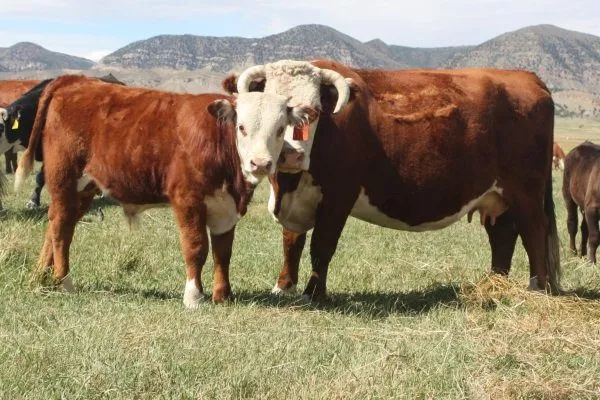
Polled Hereford
Polled Herefords are a mutation; they lack horns. Today, this variety is the most common because they are easy to care for and maintain. If a bull and a cow have a dispute, they will not cause significant harm to each other. Otherwise, they are no different from the classic type.
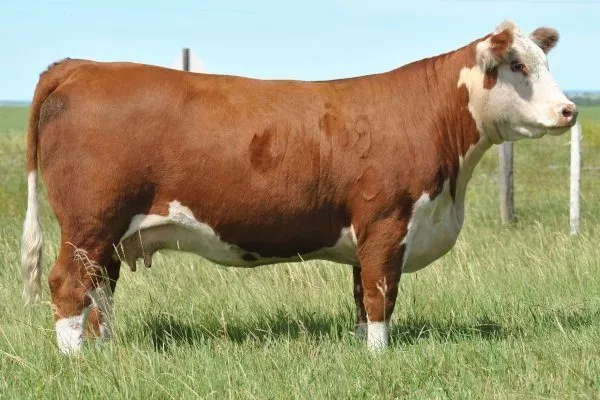
Black Hereford
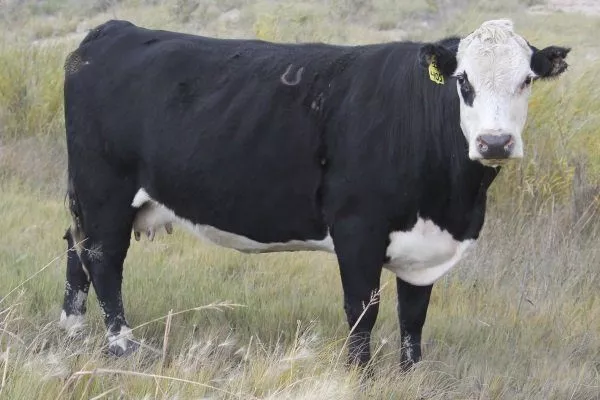
Since Hereford cattle are often crossed with other breeds, it's no surprise that a breed known as the Black Hereford has emerged. They have Aberdeen Angus and Holstein bloodlines. Their characteristics are identical to those of the Red Hereford, with the only difference being their coloring. Black Herefords are typically larger than their Red counterparts, so if the goal is to breed for beef, the Black Hereford is more suitable.
Care and maintenance of Hereford cows
Hereford cows are not dairy cows, so they are not milked at all. Their milk is used solely for feeding newborn calves. The calves receive additional feed while grazing with their mothers.
Adults are quite voracious eaters, as 15 head of cattle can consume 200 tons of hay in a single winter. Therefore, before raising such cows, it's necessary to purchase specialized equipment for mowing the grass and prepare the hay in advance.
Care
The cows' barn must be dry and absolutely clean. This breed quickly acclimates and adapts to any weather conditions; they can even withstand northern frosts. Drafts should be avoided; all cracks should be sealed and the barn ventilated several times.
- Move the cow to a separate room three days before the expected date of birth.
- Provide clean and dry bedding.
- Prepare the room for childbirth, eliminating drafts.
- Monitor the diet, including mineral supplements.
It's a good idea to set up a separate barn where cows and calves can be kept together. The barn should have a cow pen and calf stalls, with feeders and waterers in the center of the barn. The bedding should be kept dry at all times, and clean water should be available 24/7. Additionally, the barn should have a farrowing room, where the cow is moved three days before the expected due date and for seven days after.
- ✓ Daily cleaning of the skin with a soft brush to prevent ringworm.
- ✓ Ventilate the room several times a day without creating drafts.
- ✓ Providing 24-hour access to clean water.
Cows of this breed have elastic and delicate skin, so they need to be brushed daily with a soft brush and have dirt washed off, otherwise they will develop ringworm.
The best results in Hereford breeding are reported in Orenburg. These cows are also bred in Novosibirsk, Omsk, Perm, Rostov, and the Chelyabinsk and Tyumen regions.
Cows of this breed are responsive and quickly respond to changes in housing or feeding. Before autumn, the animals gain fat, which they use for energy during the winter. They also develop a thick coat in autumn, and shed their fur in the spring.
Herefords are generally non-confrontational, but to avoid conflict and stress, cows should be grazed according to age: young animals should be kept separately, adults should be kept separately, and calves should be kept separately. However, until calves finish suckling, they should be kept with their mothers.
Feeding
Hereford cows are easy to feed, which has a positive impact on cost savings. They are fed hay and crushed barley, lightly salted.
In order to feed a calf, the mother spends a lot of energy, for this reason it is necessary to add the following to her feed:
- silage;
- coarse concentrated feed;
- bone meal;
- mineral fertilizers.
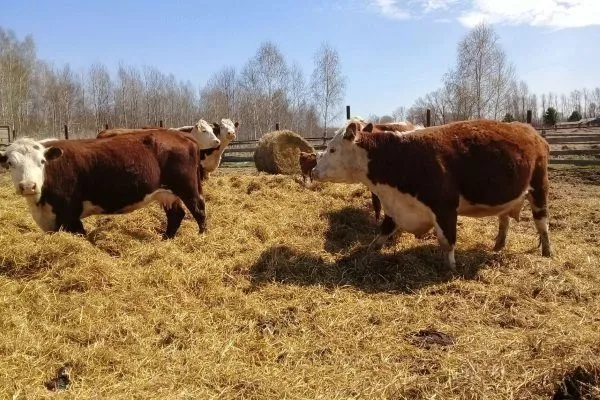
Animals can graze from morning until evening in the pasture, and there is no need to choose places with special grass; Herefords even eat weeds.
The best feeding method for Hereford cows is a combination diet. In summer, natural grass and artificial grassland are used, while in winter, concentrated supplements, hay, and silage are used. Supplementing with calcium, protein, and phosphorus is also important for the proper development of the young.
If the diet is properly formulated, daily weight gain will be 1 kilogram per day, and the cows will easily tolerate severe frosts. However, if the animals are not fed correctly, their weight gain will drop to 500 grams, and even the mildest cold snap will be difficult for them to cope with.
Feeding is selected depending on the animals' climate and whether the cow is pregnant. Feeding for pregnant cows during the dry period varies.
This is what the diet of pregnant cows should look like during the dry period:
| Product | Hay diet | Silage ration | ||
| Live weight of a cow | ||||
| 500 kg | 600 kg | 500 kg | 600 kg | |
| Cereal hay | 4 kg | 4 kg | 2 kg | 2 kg |
| Bean hay | 2.5 kg | 3 kg | 1.5 kg | 2 kg |
| Spring straw | 3.5 kg | 4 kg | 3.5 kg | 3.5 kg |
| Haylage | - | - | 9 kg | 10 kg |
| Corn silage | 9 kg | 12 kg | - | - |
| Concentrated feed | 1.4 kg | 1.5 kg | 1.4 kg | 1.5 kg |
| Salt | 54 g | 61 g | 51 g | 61 g |
| Diammonium phosphate | 5 g | 6 g | 3 g | 3 g |
If the goal is to raise a cow with a lower fat content, she is fattened for a slightly longer period, and low-calorie feed is selected. If pregnant cows are kept on a poor diet before calving, there is a high risk of miscarriage and the calf will die in the womb. Even if the cow does give birth, the calf may be weak or sick.
Diseases
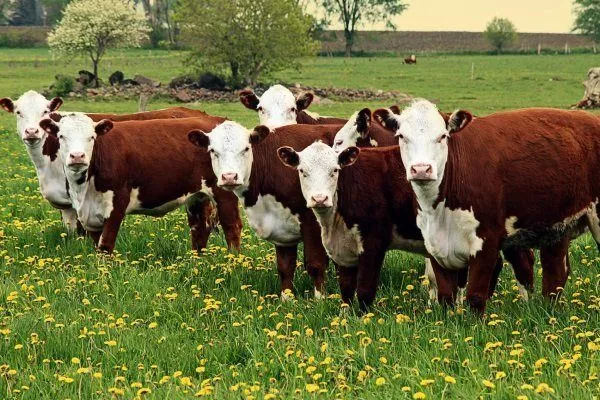
Herefords adapt quickly to any climate and can be kept outdoors even in winter. They are resistant to infectious and viral diseases. This breed is susceptible to serious hereditary diseases, but only in southern countries where the sun is scorching. In the North, cows are kept exclusively in barns, which must always be clean, dry, draft-free, and ventilated several times a day.
Hereford cattle can rarely develop a condition called eye cancer. This can also occur in areas with long days and constant sunshine. Cows with "black glasses" around their eyes are less likely to suffer from this condition.
Animals have fur on their faces that provides some protection from external influences, but their udders are hairless, so they often get udder burns from the hot sun. Foods that increase sensitivity to ultraviolet radiation can also cause burns.
Vaginal prolapse is a common hereditary condition, but it can also be caused by poor nutrition. On the other hand, if a cow is overfed during pregnancy, the calf will grow large, and under intense pressure, the uterus may prolapse during calving.
Breeding
One of the main goals in breeding Hereford cows is to produce delicious, marbled meat. Because the animals are free-range all day, they gain weight quickly, with a meat yield of 70%. Calves are small at birth, weighing around 25 kilograms, so birth is usually quick and uncomplicated. With proper management of calving cows, calf survival is 98%, and they almost never get sick.
Puberty occurs at approximately 30 months. The first calving occurs at 36 months. Good productivity is achieved by grazing, but unfortunately, this is not feasible in all regions of Russia. Therefore, it is recommended to modify the system, namely:
- create perennial cultural pastures;
- plant annual herbs and use them in autumn and winter;
- use concentrated additives 35%.
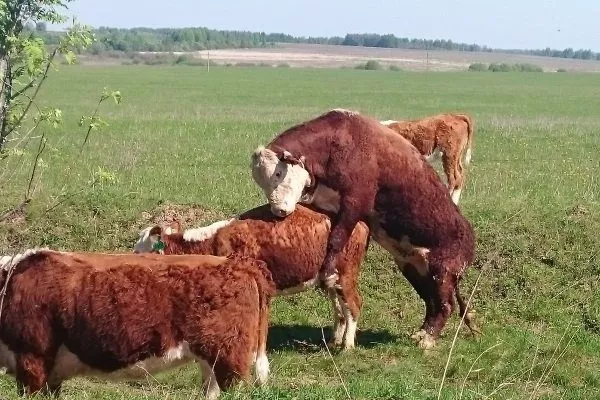
It is recommended to graze heads of the same age in one area, and it is better to keep calves that are suckling close to their mothers, thus achieving better growth.
Care and maintenance of Hereford calves
A newborn Hereford calf weighs between 28 and 35 kilograms. Because the cows have a strong constitution, they give birth naturally without complications, with a calf mortality rate of 3%. With proper care and feeding, calves gain weight very quickly and mature early. Calves' development depends on their initial body weight, the cow's milk production, and proper nutrition.
If the milk yield is 1,200 kg, the calf should weigh 220 kg at weaning. If the milk yield is higher, the calf will weigh 250 kg at the same age. The best time to give birth is March-April. During this period, the grass is lush, increasing the likelihood of increased milk yield, which in turn increases the calves' weight gain.
Within the first hour after birth, a calf should taste its first milk, called colostrum. It has a yellowish tint compared to milk and is much more filling. Until they reach three months of age, they feed primarily on their mother's milk.
From the 15th day, you can gradually introduce succulent feeds, followed by concentrated feeds. The hay must be tender, harvested before flowering, and dried in the shade. It's also helpful to give the calf a hay infusion. To do this, chop the hay (make sure it's clean) and pour boiling water over it at a rate of 1 kilogram per 6 liters. Cover with a warm towel, wrap the calf in a blanket, and wait 7 hours. Before feeding the calf, strain the infusion and give it warm. Add 1 gram of salt per liter of infusion. Do not leave the finished drink on the second day.
It's important to ensure the calf sucks colostrum and milk calmly, in small sips, so it's properly digested and absorbed. This isn't the case with bucket feedings, as the calf greedily gulps down large gulps, which disrupts the calf's immature digestive system, leading to gastrointestinal problems.
At six months, a calf reaches 200 kilograms of live weight. At this point, it's time to wean it from its mother's udder and transition it to independent feeding. This will allow it to gain weight and mature more quickly.
Until the calf reaches six months of age, the owner chooses one of three feeding options:
- Traditional.
- Bezvypasny.
- Regulated.
If the calf is born in the spring, then the traditional method is chosen, which is when the calf and its mother graze in an open pasture.
If the calf is born in the fall, the best option is free-range feeding. The young are fed artificial feed to maximize weight gain. This option is expensive and heavy.
Regarding regulated feeding, this is when the calf is brought to its mother about once a day, gradually reducing the number of feedings to 2 times a day.
Advantages and disadvantages
Hereford cows are considered unique because they:
- good producers;
- easily acclimatized;
- easy to maintain and care for;
- calve easily;
- high life expectancy – about 15 years;
- rapid weight gain;
- they feed on any grass, even weeds;
- not prone to infectious and viral diseases;
- high quality meat;
- have a calm character.
There are very few disadvantages and they are minor:
- In hot countries, Herefords can get udder burn;
- fear of drafts;
- voracity;
- timidity.
Farmers' reviews
Farmers who raise Hereford beef cattle have left their feedback:
Hereford cows are one of the best breeds for beef production. They cannot be milked; their milk yield is low, and all of it is given to newborn calves. They are easy to care for, with the key being a lack of drafts and a balanced diet. If all the rules are followed, these cows will delight you with their marbled, juicy, and delicious meat.
Great article!!!