
To make farm work easier, various automated and mechanized devices are used today. These include feed dispensers. They simplify animal care, improve their nutritional conditions, and increase business profitability.
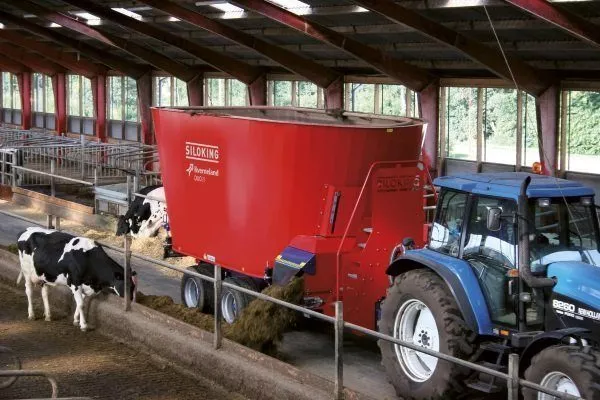
Purpose of the mechanism and operating principle
An animal feed dispenser is a specialized mechanism that receives, transports, and distributes a specified amount of feed or mixtures to livestock feeders. These devices can dispense roughage, green and plant-based feed, as well as various mixtures.
- ✓ Consider the type of food that will be used (dry, green, liquid).
- ✓ Pay attention to the size of the farm and the number of animals.
- ✓ Check compatibility with existing equipment (tractors, cars).
Such mechanisms should:
- adhere to the indicated doses with a small acceptable deviation;
- ensure timely, uniform and accurate supply of feed;
- be safe for people and animals;
- keep the feed clean and free from contamination;
- Do not allow separation of feed ingredients in mixtures.
Benefits of using technology
There's no point in buying expensive equipment for keeping a single goat or cow, but managing a larger herd manually will be difficult. Let's look at all the clear advantages of farm automation:
- the presence of dispensers that make it possible to control the amount of food given to animals;
- reduction of time and labor costs spent on feeding livestock;
- crushing and, if necessary, processing of feed before serving;
- transportation of feed to the feeding place;
- observing the cooking process;
- control of feed and mixture temperature;
- reduction of the cost of the resulting products.
All these advantages of automation help control feed consumption and significantly simplify the process of feeding livestock. Using such devices can increase farm income while reducing the cost of running a farm.
Classification of feed distributors
There are various models of feed dispensers, adapted to specific animal management and needs. The basic classification involves mechanisms that differ in their movement method, distribution method, and feed carrying capacity.
| Feed dispenser type | Average energy consumption (kWh) |
|---|---|
| Stationary | 5.5-9 |
| Mobile | 12.5 |
| Partially mobile | Depends on the model |
By mode of movement
The method of movement is the main characteristic by which feed dispensers are differentiated. Farm equipment is selected based on whether the device can be moved.
Distributors can be:
- StationaryThis type of equipment is installed above or near the feeders and cannot be moved. The unique feature of these mechanisms is that they deliver feed directly from the bins where the mixture is prepared for consumption.
- MobileThey look like carts with a feed container. These devices can pick up livestock feed from any designated location and transport it to the feeders, distributing it evenly. This equipment is primarily designed for dry and green feed. Transportation is accomplished using machinery such as a car or tractor.
- Partially mobile (dispensers-mixers). These are machines that transport liquid or semi-liquid feed. They move along special tracks on the building floor, so their movement is limited. However, their advantage is that they can mix the feed before feeding it into the trough, ensuring a uniform consistency.
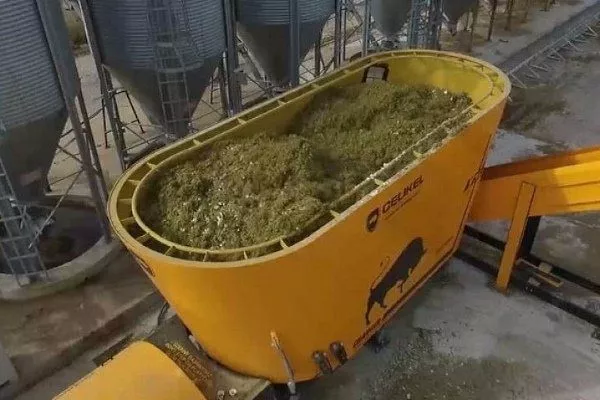
stationary dispenser
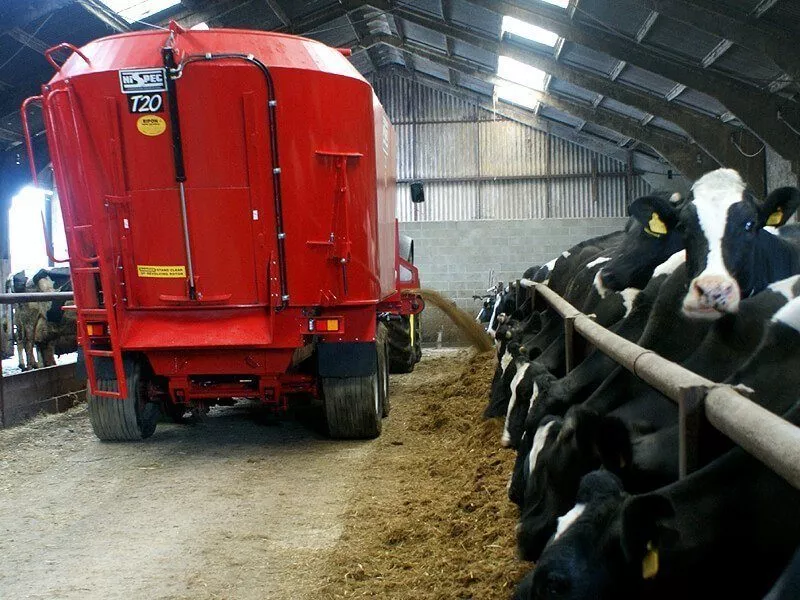
mobile distributor
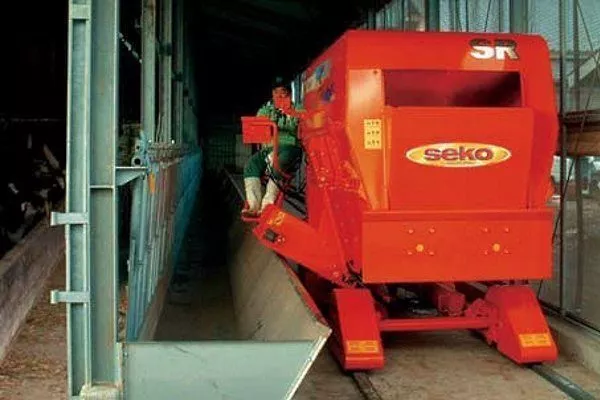
partially mobile (dispenser-mixer)
The advantage of stationary devices is their simple design and ease of installation. They are used primarily on small farms. Mobile devices offer the advantage of being able to deliver feed to any location and are easy to use.
Stationary devices for cattle can be:
- tape-type – have a special roller tape in their design;
- platform - a conveyor operates, dispensing feed in doses;
- scraper - chain-scraper conveyors move along a concrete chute;
- cable-washer - feed is delivered using a cable with fixed washers, moving inside the pipe.
Mobile dispensers are moved by tractors or vehicle frames, but there are also fully autonomous units powered by electricity. Mixer-dispensers are controlled by operators using levers and a remote control and are also powered by electricity.
By distribution type
Feeding mechanisms can also have different distribution types. Some dispense feed and mixtures from only one side, while others can do so from both sides of the animal's feeding container.
By load capacity
Differences in load capacity indicate the weight a dispenser can carry. This classification is specific to mobile devices. This figure depends on the number of axles on the tractor and the load capacity of the chassis of the vehicles on which the dispenser is installed.
The average lifting capacity of feed distributing devices can be as follows:
- for single-axle vehicles – 1.1-3.0 t;
- for mechanisms with two axles – 3.5-4.0 t.
Description and characteristics of the best feed dispensers
When deciding which feed dispenser is right for your farm, carefully consider the equipment's specifications. Feeding mechanism parameters can be general (e.g., operating speed, feed bin capacity, number of heads handled) or specific to a specific model.
For mobile equipment, the weight of the feed being transported, its speed and range of movement during operation, and dimensions are important. When purchasing a stationary model, consider its power and belt speed.
Stationary
Stationary equipment is most often installed on farms with large livestock herds. This helps make feeding the animals easier and more convenient. However, such dispensers can also be found on smaller farms (for example, if mobile devices are not suitable due to the size of the feeders or the building itself).
The most famous models:
- TVK-80B. This is a belt model suitable for all dry and hard foods. The device features a closed-loop belt approximately 0.5 m wide. Power is supplied by an electric motor, which moves the belt.
Feed from the hopper is distributed evenly along the feeding bin, and then the device is turned off. This dispenser allows for fully automated feeding of livestock. - RK-50A. A conveyor belt dispenser is located above the feeder and distributes small feeds. The mechanism consists of an inclined and transverse conveyor, one or two conveyor belt dispensers, and a control unit.
Each conveyor has its own electric drive. The feed travels through the following path: an inclined conveyor, then a transverse conveyor that directs the food to the dispensing conveyor, and then a feeding trough. - KRS-15. A type of scraper feed dispenser for animals. It is most often used for succulent, dry feed, and various mixtures. A conveyor consisting of two distribution channels runs along the bottom of the feeder.
The device is powered by an electric motor. Feed is fed into the enclosure and then distributed by scrapers. Once the scraper completes a full rotation, the drive disengages.
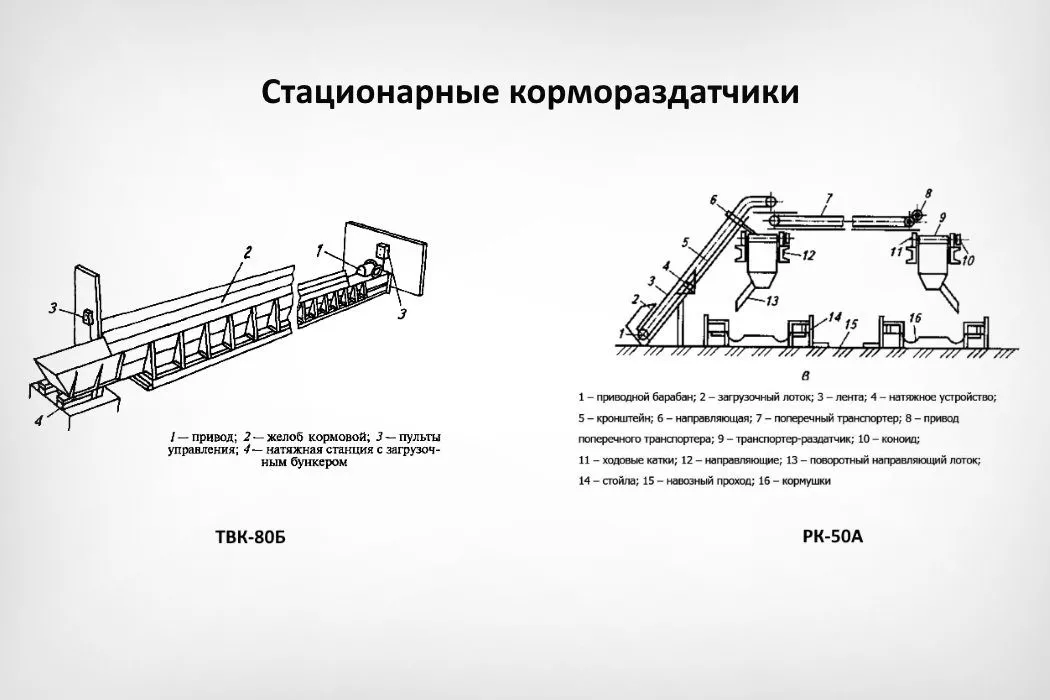
Comparative table of technical characteristics of stationary feed distributors:
| Model | Length of feeding area | Number of heads served | Engine power | Performance |
| TVK-80B | 74 m | 62 | 5.5 kW | 38 t/h |
| RK-50A | 75 m | 100 or 200 | 9 kW | 3-30 t/h |
| KRS-15 | 40 m | 180 | 5.5 kW | 15 t/h |
Mobile
Mobile feeders can be used on all farms where space permits. The advantage of these feeders is that they not only distribute feed to animals but also deliver it from storage or preparation areas. Mixer-type feeders also mix the feed before serving.
Common models of mobile feeding devices:
- KTU-10It travels on a tractor trailer and is suitable for working with various Belarus tractor models. The unit includes a cross and unloading conveyor, as well as several beaters.
The feed rate depends on the tractor's speed. Feed can be delivered from one direction or two. The dispenser's minimum turning area is 6.5 m, making it unsuitable for confined spaces. - AKM-9Essentially, it's a feed processing plant, capable of preparing and distributing feed mixtures from straw, haylage, food additives, and silage. It's quite maneuverable and designed for livestock sizes of 800 to 2,000 head. It can be used with TS class 1.4 tractors, including the MTZ-80 and MTZ-82.
- RMM-5.0A compact mechanism, similar in functionality to the KTU-10. Due to its compact size, this dispenser can operate even in tight spaces. It can be used with Belarus, T-25, and DT-20 tractors.
- KS-1.5. This feed mixer belongs to the feeder-mixer category. It moves along rails. After mixing, the feed is distributed into the feeders by auger devices. It is powered by an electric motor via a gearbox.
- KSP-0.8. This is also a mixing model, without a wheeled trolley. Its operating principle is largely similar to the KS-1.5 dispenser. It is controlled by an operator from the platform, who operates certain levers.
- RS-5A. Another type of mixing mechanism. Like the others, it is driven by an electric motor. The cart moves along special tracks in the floor. The controls also use levers, and the operator sits directly on the cart, on a seat.
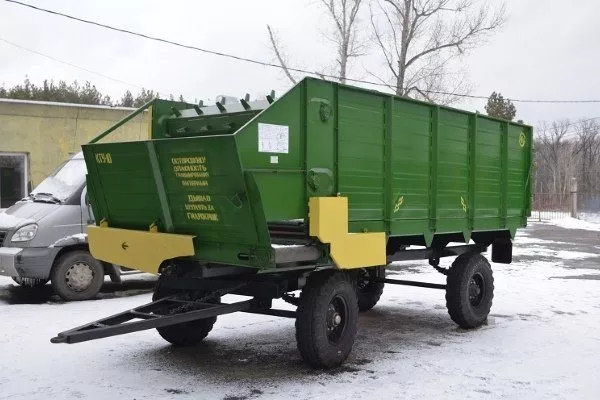
Mobile distributor KTU-10
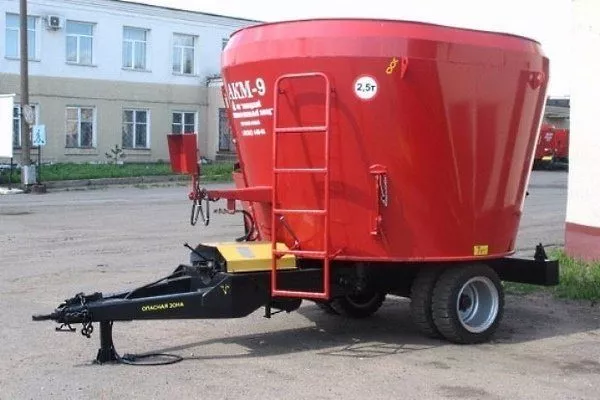
AKM-9 mobile dispenser
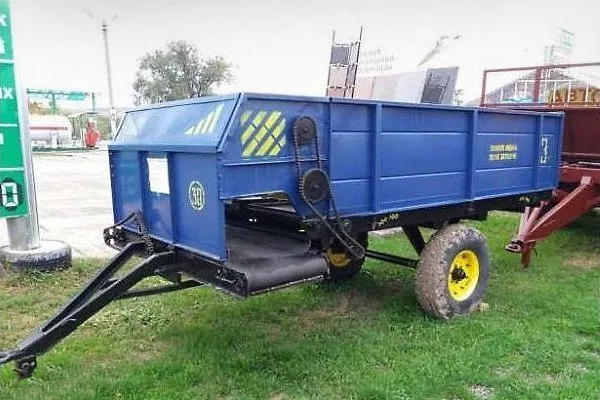
RMM-5.0 dispenser
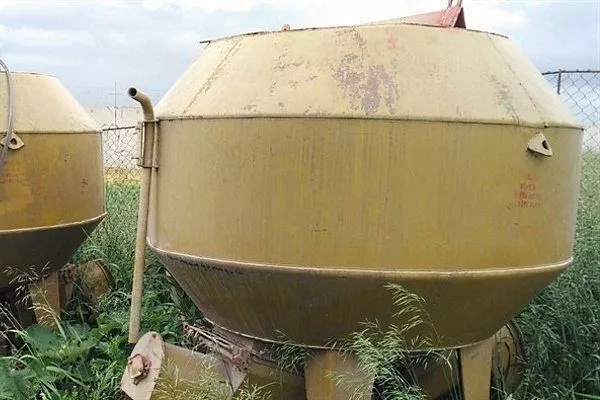
KS-1.5 dispenser
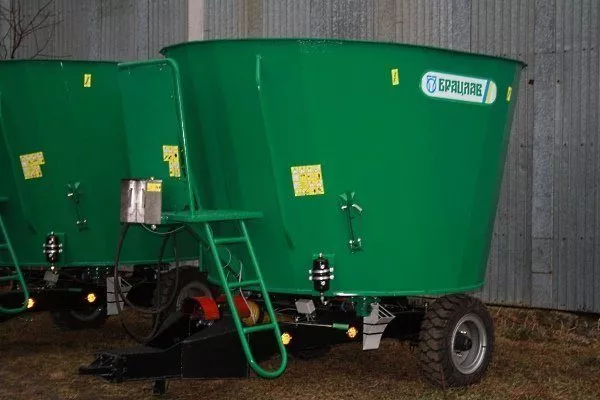
KSP-0.8 dispenser
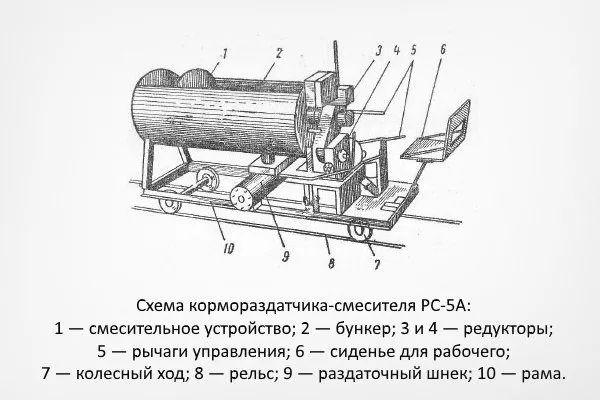
feed dispenser RS-5A
Comparative table of technical characteristics of mobile feed distributors:
| Model | KTU-10 | AKM-9 | RMM-5.0 | KS-1.5 | KSP-0.8 | RS-5A |
| Volume of the feed hopper | 10 m3 | 9 m3 | 5 m3 | 2 | 0.8 m3 | 0.8 m3 |
| Load capacity | 3.5 t | — | 1.75 t | — | — | — |
| Engine power | 12.5 hp | — | — | — | — | — |
| Time for preparing feed | — | up to 25 minutes | — | — | — | — |
| Performance | 50 t/h | 5-10 t/h | 3-38 t/h | 4.8 t/h | 1.6 t/h | 1.8 t/h |
| Feed rate | 3-25 kg/m | 0.8-16 kg/m | 0.8-16 kg/m | — | — | — |
| Track | 1.6 m | — | 1.6 m | — | — | — |
| Dimensions (L/W/H) | 6.175/2.3/2.44 m | 4.7/2.38/2.55 m | 5.26/1.87/1.92 m | — | — | — |
The process of preparing mixed feed mixtures
Often, animal feed is prepared at home rather than purchased. In this case, it's important to know the proper cooking procedures and adhere to certain requirements. For example, cattle feed should be:
- homogeneous;
- humid within 65-80%;
- free from mold and foreign impurities;
- maintaining a balance of biological additives, vitamins, and stimulants.
Having your own feed production facility allows you to reduce the cost of animal feed by utilizing your own resources (various waste materials, plant residues such as grass or branches).
Based on your cattle farm's needs, you can confidently choose the right feed dispenser. Consider the number of animals and the size of your farm. Based on these factors, purchase a dispenser with the appropriate speed, size, and capacity.