
Feed is the main cost item in raising and maintaining animals. Large farms typically try to reduce feed costs, for example, by producing it themselves. For this purpose, they purchase specialized equipment. One such device is a food extruder.
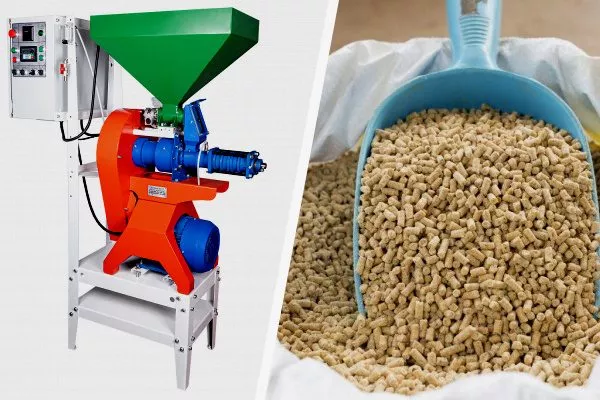
Who will benefit from the extruder?
A feed extruder is a machine that forces a finely ground mixture of ingredients through a die, creating a uniform product shape. The resulting product is compound feed. Depending on the components used, it can be used to produce feed for cattle, sheep, pigs, horses, and even pond fish.
Producing your own feed using an extruder allows you to customize the nutritional composition of your feed. For example, high levels of corn or other grains in commercial cow feed make their microbiome more acidic, weakening their immune system and making them more likely to transmit E. coli. This leads to additional costs for animal treatment or even losses. This can be avoided by purchasing high-quality feed or making it yourself.
- ✓ Calculate the payback period for the equipment, taking into account the cost of raw materials, electricity, and possible income from the sale of feed.
- ✓ Consider the costs of additional equipment and storage space for raw materials and finished products.
The feed extruder also allows for the mass production of commercial feed. Therefore, it is used not only by farm owners but also by private entrepreneurs.
Moreover, during dry seasons or when there are prolonged downpours and other unfavorable weather conditions, the demand and prices for compound feed increase.
Advantages and disadvantages of equipment
Extruders vary in productivity and capacity. Equipment with throughputs ranging from 90 kg of grain per hour to 2.5 tons per hour is available.
This type of equipment, such as an extruder, is valued for:
- mass production;
- continuity of work;
- homogeneity of the final product;
- cost-effectiveness in feed consumption (with this type of feed production, the digestibility of nutrients from raw materials is quite high (up to 95%), which means that the animal needs less feed to be satisfied);
- increasing feed efficiency (the feed composition can be changed according to the needs of animals, achieving the set goals in a short time (relevant for fattening, etc.)).
Flaws:
- It is necessary to strictly adhere to production technology, otherwise the equipment may quickly wear out or break.
- Feed components require preliminary preparation by hand (for small farms) or with the help of additional equipment.
- Space is required to accommodate equipment, store raw materials and finished feed, provide utilities (steam generator), and require additional equipment (mixer, storage bin, conveyor, etc. for large farms or for producing feed for sale).
- Hired employees are needed to service the device.
- The equipment is not durable; over time, worn-out parts will need to be replaced (the auger part has a limited lifespan, so check with the equipment manufacturer in advance and purchase consumables in a timely manner).
Many companies currently offer extruders for feed production. However, unscrupulous sellers, in an attempt to lower prices and attract more customers, use low-quality components (in particular, their augers break easily). Therefore, it is recommended to purchase such equipment only from reputable manufacturers!