
A milking machine is a specialized device designed to facilitate and speed up the milking process, essential on every cattle farm. These units not only allow for efficient milking of several cows at once but also protect their mammary glands from damage and infection. We'll explore the different types of milking machines and how they work below.
The device's structure
The classic milking machine has a simple design, which includes the following parts:
- the frame is on wheels, making the device mobile (there are large units without wheels, but they are rare);
- a pump from which vacuum hoses for supplying milk and air run (the pressure in them can be measured using a vacuum gauge);
- a pulsator or manifold where the vacuum line ends (in some models, the pulsator is absent, and its role is performed by a piston pump and valves that open and close in the direction of the piston’s movement);
Without a pulsator, the number of vacuum pulses cannot be measured, but it is indicated in the technical specifications of the device.
- 4 milking cups (according to the number of teats on a cow), the outer wall of which is metal (made of food grade steel or aluminum), and the inner wall is covered with rubber cuffs, one of which is connected to the sub-teat (inner) chamber for sucking out milk, and the other to the chamber between the walls to create a vacuum pulsation;
- receiver for stabilizing the vacuum in the line (not present in all models);
- milk and vacuum tubes coming out of the glasses and entering the manifold, on which there is a valve for supplying vacuum to the glasses;
- a milk main line that comes from the collector and leads to a common tank;
- a can with a capacity of 20 liters or more, which can be made of stainless steel, aluminum or plastic.
An aluminum tank is lightweight and flexible, so it can be damaged if accidentally knocked over, while a steel bucket is very heavy and awkward to use. Therefore, the best option is a plastic milking container with a transparent lid to make it easier to monitor the milk level.
Operating principle
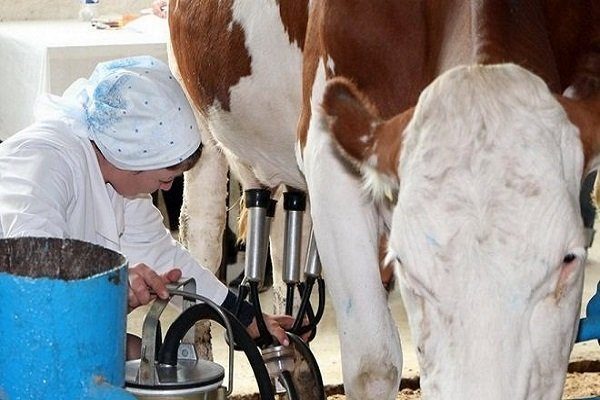
The milking machine operates using a vacuum pump. A cup is attached to each of the cow's teats. When the machine is powered, milk is drawn out and sent through hoses to a collection container—a bucket or can.
The technology of milk extraction is as follows:
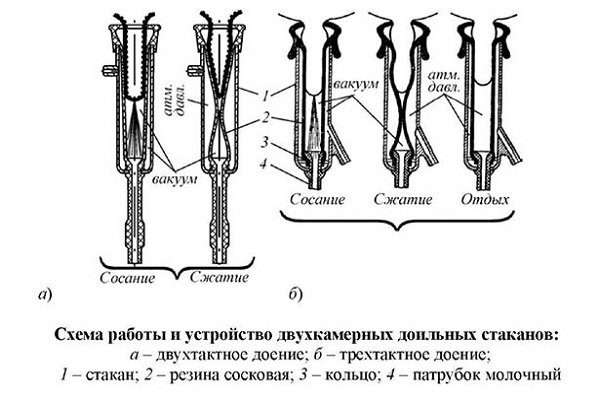
- A vacuum is created in the sub-teat chamber, which is always at low pressure.
- A pulsator mounted on the lid of the can emits vacuum pulses into the glasses.
The presence of a pulsator allows you to control the vacuum supply, making milking more comfortable for the cow.
- Under the pressure of the vacuum pulsation, the nipple is compressed in the inter-wall chamber.
- When low pressure is created in these two chambers, the milk flows first into the collector and then into the storage tank.
- The pressure in the inter-wall chamber rises to atmospheric pressure, at the same time the rubber tube contracts and squeezes the nipple, and the milk stops flowing.
This operating principle is typical for two-stroke milking machines, which perform two main functions: compressing the teat and pumping out the milk. Three-stroke machines also exist, which differ in that they alternately pump milk from each teat, squeezing them in sequence. Short breaks are allowed between pumping cycles to restore blood flow to the mammary glands, allowing the cow to become accustomed to the machine more quickly.
In a three-stroke engine there are 50 pulsations per minute, and in a two-stroke engine – 90.
The operating principle of two- and three-stroke devices is shown in the diagram:
Types of devices
Milking machines can vary in both technical specifications and operating methods. Let's take a closer look at popular classification criteria.
By engine and pump type
The cow milking machine can be equipped with the following engine:
- ButteryIts advantage is its quiet operation, which significantly improves cow comfort during milking. The disadvantages of an oil engine include:
- sensitivity to low temperatures (possible starting problems);
- the need for constant maintenance (you will have to regularly top up the fluid and monitor the oil level to avoid leaks).
In winter, the oil may solidify, making it difficult to start the machine.
- Dry actionThese engines are more forgiving, but they have a significant drawback: they produce a lot of noise during operation. To mitigate this, mufflers must be installed. Dry-running engines are also sensitive to air humidity, which causes them to overheat quickly.
When operating and storing dry-type devices, do not allow any liquid to enter the structure.
The pump in the milking machine also comes in three types:
- MembraneThe cheapest option and designed for minimal workloads—milking up to three cows at a time. Suitable only for small farms.
- PistonCompared to a membrane pump, it's more efficient, but it's noisy and overheats quickly. Units with a piston pump are larger.
- RotaryA reliable dry or oil-lubricated pump that takes up little space and produces no loud noise during operation.
Unique parameters for pump comparison- ✓ Maximum number of heads for milking without overheating: membrane - up to 3, piston - up to 10, rotary - more than 20.
- ✓ Noise level in decibels: membrane - 60 dB, piston - 85 dB, rotary - 50 dB.
By milking type
Depending on the milking method and connection of cups to the nipples, the device can be of two types:
- Simultaneous (normal)The cups are attached to 4 milking cups, so the machine simultaneously draws milk from all teats.
- Pairwise (asynchronous)In these models, the cups are installed in pairs. Milking is performed using two cups, each placed on the teats one at a time. This is the most gentle mode for the animal.
Machines with a paired milking method allow cows to be accustomed to machine milking more quickly and also completely eliminate problems with the udder.
By purpose of use
Machines for milking cows are conventionally divided into two more types:
- HouseholdThese are primarily chosen for small households. These units have a simple design and are equipped with removable parts that can be replaced with new ones after wear.
- IndustrialThese units are manufactured for industrial use and are designed for milking large numbers of cows. They are powerful and feature several automated systems, which can be selected depending on the type of cow to be milked.
Review of popular models
There is a wide variety of milking machines available on the market, but the following models are particularly popular:
- AID-1This machine operates on a two-stroke principle and does not require a pulsator. It is convenient for small farms, as it can handle up to 10 cows per hour. It has an oil pump that does not overheat and is quiet during operation. The pressure is 47 kPa, close to the optimal 50 kPa.
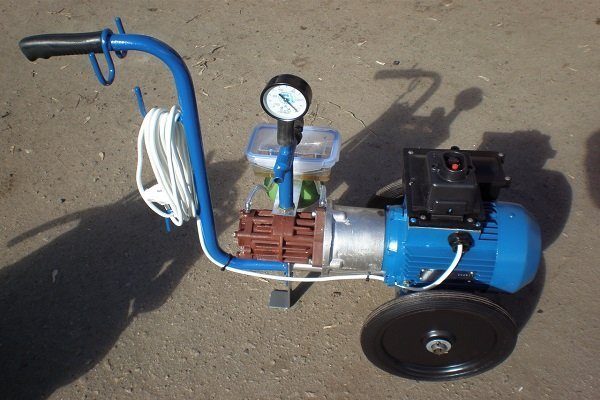
- AID DA-3M "Volga"A three-stroke universal machine with two-chamber stainless steel milking cups, a pulsator, a vacuum valve, and a main hose.
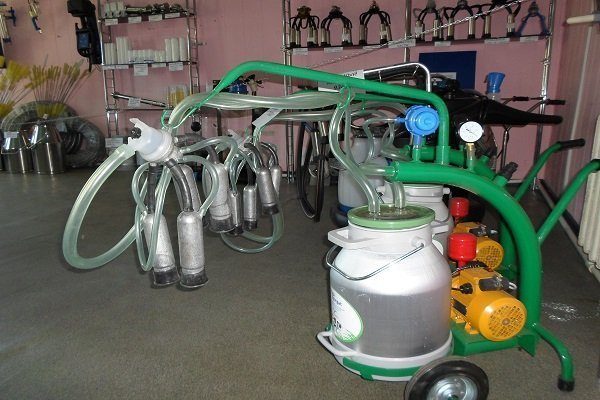
- Doyushka 1RThis compact, automated, and reliable machine is ideal for small farms—it can milk approximately 10 cows in an hour. The farmer doesn't need to adjust the number of strokes. The pulsation is controlled by a piston pump, which produces 64-70 strokes per minute.
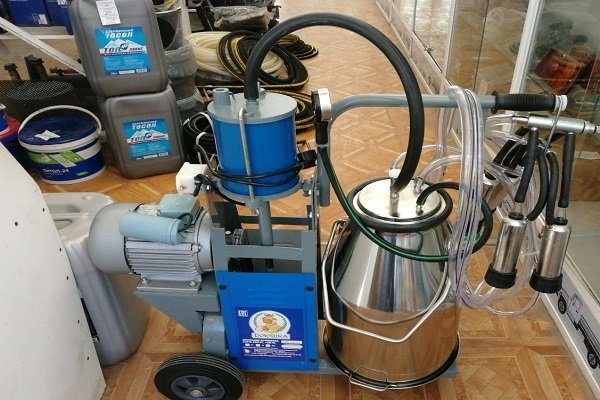
- MaigaThis two-stroke, easy-to-maintain unit comes with a bucket and handle attached, making milk easy to drain. It's highly portable.
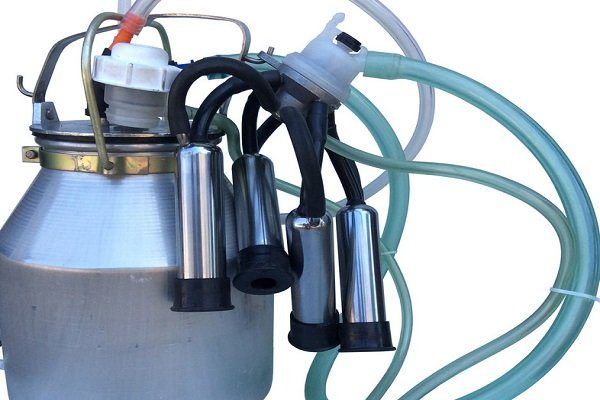
- My MilkaDry rotary milking units. Equipped with a powerful motor capable of 1,450 rpm. Four cups for paired milking are included. These models are designed to serve eight cows per hour.
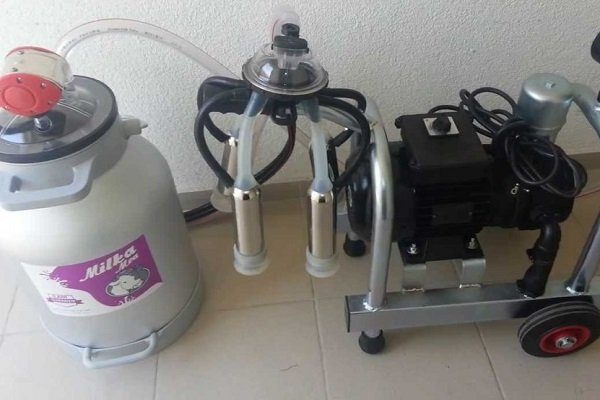
- Birch-1, Birch-2Mobile dry-type units. They can milk up to 24 cows in 30 minutes. They are equipped with a powerful, loud engine and operate at 1,500 rpm.

- Compact (1 STD, 2 STD) from MilklinePopular dry-type milking machines from a leading European manufacturer. One mobile unit can process up to 14 cows in one hour. Milk is collected in a transparent bucket with a measuring scale.
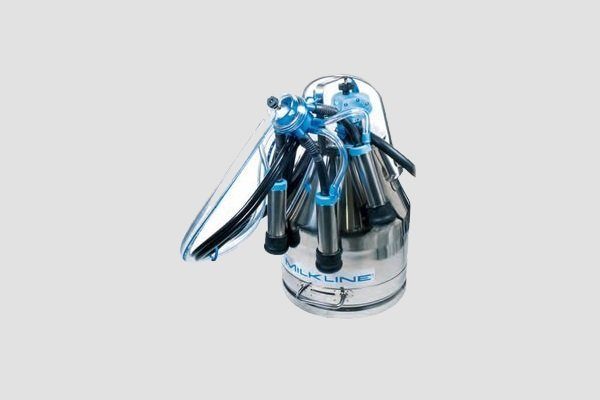
- DeLavalThese dry-running electric motor units from a Swedish manufacturer are silent during operation and are considered among the best, but are expensive.
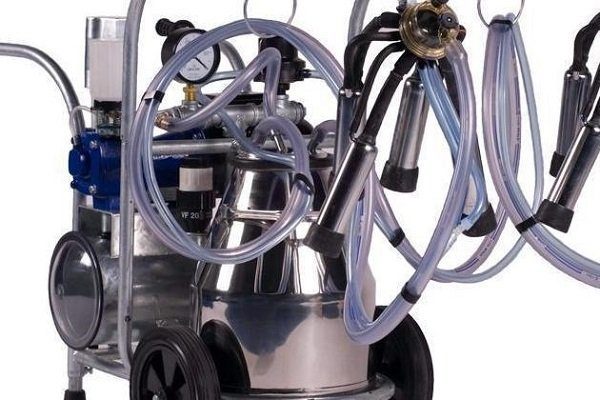
- BurenkaThe lightest unit, distinguished from other models by its separate milking bucket. Farmers recommend the Burenka Tandem for simultaneous double milking. Units are also available in Standard, Euro, Stainless Steel, and Maxi models. They can handle up to 20 cows per hour. Power ranges from 1,500 to 3,000 rpm.
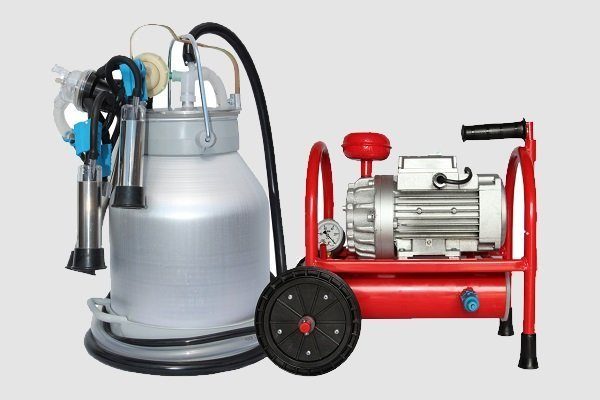
We also recommend watching a video review of the Burenka-1 device:
Tips for choosing a device
When purchasing a milking machine, you should consider a number of recommendations:
- If you have a large number of cows, it's best to choose a three-stroke milking machine. If you have two cows, a two-stroke machine is sufficient.
- For milking cows on pasture, choose a more mobile and lightweight unit. It's preferable to have the milk collection bucket or can mounted directly on the unit, otherwise it will be difficult to move.
- If the cows are kept in stalls, it is better to purchase a stationary device with which you can milk several animals at once.
When purchasing a device in a store, you need to check its operation, adjustments, and the tightness of all parts.
How to milk a cow with a machine?
Machine milking technology is simple, but requires following the correct procedure and a number of rules:
- Before milking, check the serviceability of the equipment, especially the operation of the pulsator, collector and vacuum unit.
- Examine the cow. If there is mastitis on the udder and teats, milk her by hand. Transfer the cow to machine milking only after she has fully recovered.
- An hour before milking, clean the stalls and wash the udders with warm water or a special solution. Avoid using cold or hot liquids, as this will slow milk flow. Remain calm around the cow, without raising your voice.
- After treatment, wipe the nipples dry with individual wipes and massage them in a circular motion, gently pushing up individual parts of the udder, repeating the actions of a calf when feeding.
- Manually milk a small portion of milk and check that it does not contain blood clots, lymph inclusions, etc. During this time, the animal's milk let-down reflex is activated.
- First, open the machine's vacuum valve and immediately after preparing the udder, attach the teat cups. To do this, grasp the milking cup from underneath with one hand and move it toward the udder, while with the other hand, attach the teat cups one by one, starting with the back ones. If the teat cup needs to be raised, it's best to clamp the milk tube first.
The cups must fit tightly to the nipples, otherwise hissing noises will occur when the machine is running.
- Only after milking begins should you move on to the next cow. If milk flow slows or stops, massage the cow's udder until it resumes. There's no need to remove the equipment.
- If the milking cups fall off, turn off the machine, rinse the cups with clean water, massage the udder, and restart milking. The machine itself should be positioned closer to the cow's front hooves to make it more difficult to tip over.
- After milking, remove the milk cups. To do this, grasp the milk collector or milk tubes with one hand and squeeze them, and close the valve on the milk collector or the clamp on the hose with the other. Next, squeeze the rubber suction cup on the milk cup to release the air, while simultaneously gently removing all the milk cups. Connect the milk collector to a vacuum and suck out any remaining milk in the milk cups.
- If there is milk left in the udder after milking with a machine, milk the cow manually to prevent her from developing mastitis.
- Finally, wipe the nipples with a dry towel and lubricate them with Vaseline or an emulsion with an antiseptic effect.
- Clean the milking machine using a vacuum. First, run warm water (32-35°C) through it, then apply disinfectant. It's a good idea to periodically disassemble the machine and remove any residue. Store the machine in a designated area.
The milking machine operating diagram looks like this:
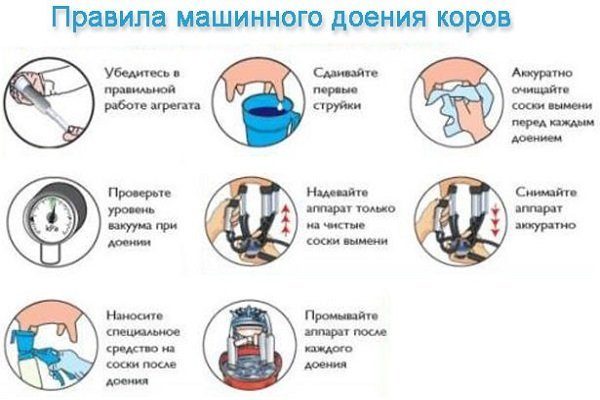
You can see how to milk a cow using a special machine in the following video:
Assembling the device yourself
If you have ready-made components and some materials on hand, you can assemble the unit yourself. We'll cover the steps below.
Preparation of components
To assemble the milking machine, you need to prepare the following components:
- an electric motor to operate the pump;
- pump – oil, dry or vacuum;
- belt that provides rotation from the pump to the engine;
- vacuum hoses for pumping out air;
- a vacuum cylinder that smooths out fluctuations caused by air pressure (in factory designs, this function is performed by a receiver);
- exhaust pipe for air discharge to the outside;
- a dielectric insert that prevents the spread of voltage throughout the device;
- vacuum gauge (to control the pressure created, milking is carried out only when the indicator is at 50 kPa);
- glasses, a collector and a pulsator are the components of the hanging part of the device, which must be purchased in a specialized store;
- silicone milk hoses;
- container for collecting milk (can or bucket);
- vacuum regulator for pressure correction;
- Air valve for introducing air into the can.
Assembly
Assembly of the suspension unit is of great importance. It is carried out in the following order:
- Connect the milk line ring to the lower end of the nipple rubber. Leave at least 5 mm between them.
- Insert the thin end of the milk tube into the rubber, pull it through it and place it in the milking cup.
- Place the rubber head on top of the cup. Be sure to ensure even tension, as this affects milking speed.
- Place the vacuum hose onto the side pipe located on the body.
After assembly, flush the system, which will also allow you to check for leaks. To do this, pour hot water into a bucket, immerse the milking cups in it, and plug in the machine. Rinse for 5 minutes. After this, place the cups on the teats and milk the cow for about 6 minutes.
Once a month, it is recommended to disassemble the device into its parts and thoroughly wash each of them in hot water.
Troubleshooting
After self-assembly of the milking machine, some malfunctions may occur that require timely elimination:
- Insufficient vacuum pressure due to extraneous air suctionThe cause is most likely a poorly sealed suspension system. This problem can also occur if the cups are not attached to the milking cups correctly.
- Extraneous sounds are being madeIf the device makes any unusual noises during operation, this indicates that the connecting elements are not securely fastened.
- The engine is slippingThe malfunction may be caused by a loose belt or oil getting on it.
Advantages and disadvantages of milking machines
- increases farm productivity;
A milking unit increases milking speed many times over: an experienced milker can milk 2-3 cows in half an hour, while a good machine can milk around 10-20.
- protects milk from contact with hands and air, so it comes out fresh and free of foreign odors;
- requires a minimum of time and effort;
- does not harm the health of the cow.
A milking machine is essential for almost every dairy farm. It allows you to milk 2-3 animals at once in a short time, significantly improving the quality of the milk. The key is to choose the right machine with the right power for the size of your dairy farm.