
Sometimes, newborn rabbits are left without their mother's milk and care. These responsibilities then fall to humans. Raising rabbits without a mother is a serious and responsible task, as the babies' lives depend on the speed of decision-making and subsequent actions.

Why are baby rabbits left without their mother's milk and care? What is the danger?
The decision in favor of artificial feeding is made by the farmer for one of the following reasons:
- Having barely given birth, the female refuses the rabbits and abandons them;
- the rabbit has no milk or has developed mastitis;
- the female is in a very serious condition after giving birth or she has died;
- another wet nurse does not accept the babies.
It's especially dangerous for the kittens when the mother dies before she can feed them their first valuable colostrum. Colostrum contains essential antibodies that help the babies develop their own immunity.
Human care and attention cannot replace a mother for cubs, and improper actions by breeders increase the mortality rate.
Decorative rabbits have a lower chance of survival, and meat breeds Even on artificial feeding they grow up to be healthy and strong individuals.
What to try before artificial feeding?
The goal of bottle-feeding is not just to keep the rabbits full, but to provide comprehensive care for their offspring. Before you begin, try the following alternatives:
- Find a wet nurse for the offspring.This scenario is possible if the breeder has multiple sows. Simply introducing the rabbits to another nursing sow is not an option. The chances that she will accept the offspring are virtually zero.
Therefore, remove the mother rabbit to another cage for half an hour, and wipe the babies with fluff and straw from her home. The nurse will return to the cage and will likely accept the new charges. - Awaken your parental instinct.Most often, it's after the first litter that the mother refuses to feed her babies. Try to solve this problem by simply holding the doe during a few feedings.
If all goes well, the kittens will quickly grow stronger and gain weight while nursing. However, sometimes these tips don't help.
How to properly feed rabbits for the first 30 days?
Baby rabbits are born completely blind, without a fur coat. The first downy fur begins to grow on their bodies on the sixth day, and their eyes open on the tenth day. Newborns weigh 60-90 g, but with comprehensive care and proper nutrition, they quickly gain weight and grow.
The farmer should prepare for artificial feeding of the offspring by mastering care skills and purchasing equipment.
Tools
To feed rabbits, nipples and containers are required.
Buy in storeanimal feeding kitIt includes a special syringe with rubber tips of various shapes and sizes. This kit is sold as a bottle with several special nipples.
You can make do with improvised means:
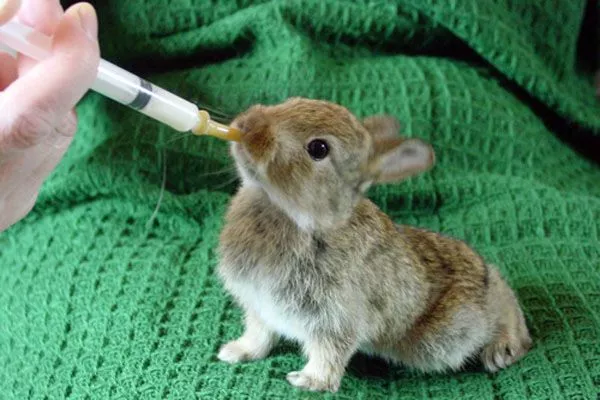
- Use for feedingsyringe and rubber tip from a pipette, making several small holes in it.
- Suitable for performing the procedureeye drop bottleFor convenience, use it with a pipette tip.
- Baby bottlesmall volume will be useful for older animals.
The process of artificial feeding should be as similar to natural feeding as possible.
Before their eyes open, baby rabbits' response to milk substitutes is weak. When pouring milk into their mouth, be careful and don't rush, otherwise the baby may choke or swallow.
Milk substitutes
Newborn rabbits require high-quality, complete nutrition. Rabbit milk substitutes include:
- Goat milk.The best option for bottle-feeding rabbits. No need to dilute or add anything, as the formula is similar to rabbit milk, only slightly lower in fat content.
- Cow's milk.The most affordable and common alternative to rabbit milk. It shouldn't be fed to babies in its pure form, as it lacks carbohydrates. Mix cow's milk with condensed milk in a 3:1 ratio. Heat the mixture for 40-60 minutes at 70°C. Cool to 37°C (99°F) before feeding.
- Special mixtures.A wide selection is available at pet stores and veterinary pharmacies. Look for milk replacers designed for rabbits or dogs. Cat food will also work as a last resort. Their ingredients are very similar to those of rabbit milk.
- Infant formulaThis type of food is suitable for rabbits if it contains a minimum of sugar and additives.
- ✓ The composition of the substitute should be as close as possible to the composition of rabbit milk in terms of fat content and protein content.
- ✓ The temperature of the feeding mixture must strictly correspond to 37°C to prevent burns or hypothermia.
In this video, you can see the principle of artificial feeding of rabbits:
Therefore, the most suitable food for newborn rabbits is special dry mixtures, and cow's milk is the least preferable option.
Feeding procedure
During the procedure, hold the animals upright, firmly, but without applying pressure. The kittens may not respond to the simulated nipples at first. Be patient.
Gently wet your baby's mouth with milk; he'll lick it off. Repeat several times. This will stimulate the sucking reflex.
When feeding, be careful not to allow liquid to enter the rabbit's respiratory tract. This could result in death.
Be careful not to let their tummies become overfull, as babies themselves are not yet able to determine their level of fullness. Overeating can cause stomach upset and related problems.
The feeding fluid should be at 37 degrees Celsius. Store milk in the refrigerator for up to 3 days, and always use freshly prepared formula.
Adjust the feeding schedule to the babies' needs. Well-fed babies sleep quietly, while hungry ones squeal and actively search for food.
Dosage and frequency
The amount of mixture and the frequency of feeding directly depend on the age of the rabbits.
The mother feeds her kittens 1-3 times a day. Her milk is highly nutritious, and this number of feedings is sufficient for the kittens to develop, grow, and gain weight properly.
But no formula can replace rabbit milk, so formula-fed babies are fed up to 6 times a day.
In the first 2 days, a few drops of food per feeding is enough for the rabbits; even 1 ml of the mixture is too much for them.
Gradually, the amount of milk needed for the development of the cubs increases, and the number of feedings decreases.
Artificial feeding according to age
Organizing artificial feeding is a responsible task. It's essential to be extremely careful when choosing a feeding regimen for rabbits, depending on their age and physical health. Inaccuracies in the quantity and quality of the diet can have a detrimental effect on the babies.
From birth to 5 days
A newborn rabbit requires only one drop of nutritional fluid. They are fed 5-6 times during the first 24 hours. Since babies have not yet learned to swallow on their own, caution is required.
On the second day, 4-5 feedings are sufficient. On the fifth day, 4 feedings are sufficient. The daily milk requirement is 5-6 ml. By the end of this period, the kittens, with normal development, double their weight.
From day 6 to day 14
As the animals grow, the amount of formula per feeding increases. They drink 7-10 ml of milk per day. The number of feedings remains the same or decreases to three. The baby rabbits weigh up to 250 g.
From day 15 to day 30
Starting at 15 days, the animals are transferred to two meals a day. For the first 2-3 days, observe the young animals' behavior and, if they show signs of hunger, supplement with a small amount of formula at the third feeding.
By the end of the month, the daily amount of formula reaches 60 ml. This is their main food for now. Weaning should be done around day 20-25.
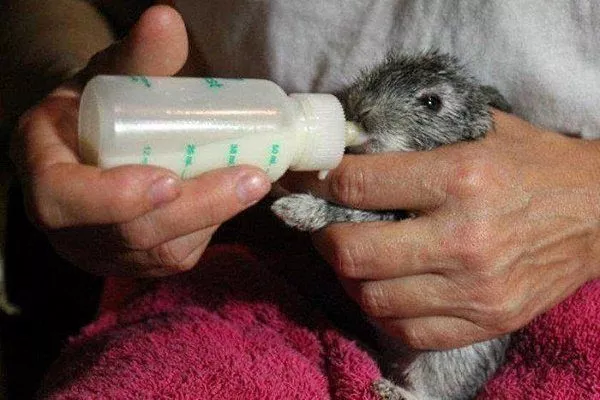
Readiness for introducing solid foods is determined by the condition of the teeth. If permanent teeth have replaced baby teeth, you can gradually introduce solid foods and teach them to drink from a saucer.
By the end of the period, the weight of animals reaches approximately 500 g.
| The period of development of rabbits | Number of feedings per day, times | Mixture norm per 1 feeding per 1 individual, ml |
| From birth to 5 days | 5 | 1 |
| From day 6 to day 14 | 3-4 | 7-10 |
| From day 15 to day 30 | 2-3 | 60 |
Introduction of fertilizers
Starting from the third week, place small piles of dry grass in the cage - this will prepare the rabbits for solid food.
During this time, it's important to monitor changes in the kittens' stool. If diarrhea occurs, immediately remove hay from the diet. If adaptation to the new food is unproblematic, add a small amount of mixed feed, grass, or carrots.
- Start with small amounts of dry grass in the third week of life.
- Gradually introduce compound feed and vegetables, observing the reaction of the digestive system.
- Completely switch to an adult diet by 45 days, if there is no weight loss.
Starting at 31 days, if they are not underweight, milk is gradually weaned from the kittens' diet. When the offspring reach 45 days of age, they are fully transitioned to an adult diet.
Vitamin A and vitamin D
In the wild, rabbits receive essential vitamins and minerals from their mother's milk and later from a varied adult diet. Artificially fed rabbits require greater vitamin supplementation.
If the body lacksvitamin A, rabbits suffer from runny noses and dry eyes. This vitamin is responsible for the desire to reproduce and have healthy offspring, as well as the healthy functioning of the nervous system. Sources of vitamin A include beet tops, carrots, cabbage leaves, young grass, and others.
Vitamin DVitamin D is responsible for bone formation. A deficiency can lead to growth retardation and various deformities of the limbs and spine. The body produces vitamin D naturally when exposed to sunlight. Bone meal, fish oil, and milk can help with this. Feed foods in areas away from sunlight, as exposure to sunlight destroys vitamin D.
Oat flour and oat sprouts
Oats are a fundamental grain in rabbit nutrition, containing a wealth of vitamins and microelements. Their caloric value is 336 kcal/100 g and can comprise up to 50% of the total feed weight. Rabbits gain weight well on this diet, but oats do not cause obesity.
This grain is introduced into the rabbits' diet as soon as they begin to feed independently. Initially, they are fed oatmeal or crushed grain, and then they are transitioned to whole grain.
Animals happily eat this food up to 5 times a day, and adults - 3 times a day.
Oat sprouts have a beneficial effect on the reproductive system of rabbits. They are included in the diet of both males and females during mating. Oats help lactating females recover after kindling and stimulate the production of nutritious milk.
The nutrients found in sprouted oats have a beneficial effect on the gastrointestinal tract of animals. Appetite increases, fur becomes beautiful and shiny, and body weight increases.
Be sure to put it in a cage drinking bowl, if the rabbits' diet is dominated by dry grain feed.
Bone meal and chalk
Bone meal is a powder made from animal and bird bones, a valuable source of calcium, phosphorus, fluorine, zinc, iron, protein and other micro- and macroelements.
Introducing it into rabbits' complementary feeding significantly reduces the risk of musculoskeletal disorders. Thanks to the protein, the animals' muscle mass grows faster.
The dosages indicated on the bone meal packaging must be strictly adhered to. Overdosing is even more dangerous than the problems associated with not having enough of this supplement:
- The rabbits' stomachs become clogged with a jelly-like mass, which often causes the animals to die.
- Females become aggressive and lose the ability to reproduce.
- Cases of cannibalism among individuals occur.
If you notice any signs of these problems, reduce your portion sizes or eliminate flour from your diet.
Chalk is a safe mineral supplement that provides calcium to the body. It can be used in powder form, in lumps, and in mineral briquettes. Chalk is useful for preventing bone diseases.
Branches and acorns
Tree and shrub branches are used not only for food. Some can be useful for disease prevention.
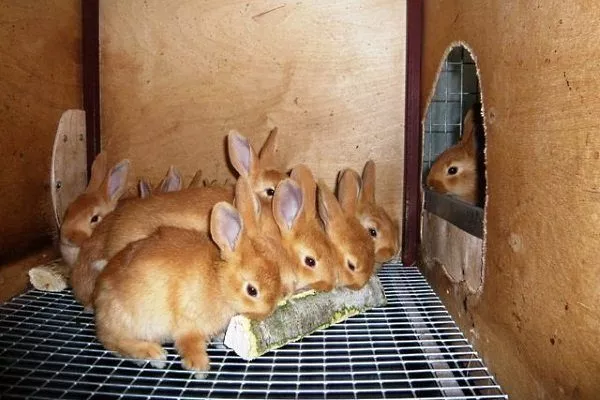
For example, walnut branches help flush out parasites, linden and willow branches act as a pain reliever, and birch branches act as a diuretic. They are given to rabbits infrequently, as needed.
To trees and shrubs whose branches can be used asconstant complementary feeding, include:
- Apple, acacia, poplar, hazel, ash, linden, maple, aspen, mulberry, etc.
- Raspberries, currants, grapes.
Trees whose branches can be given to rabbitsoccasionally:
- Pear, rowan, oak, chestnut.
- Pine, juniper.
You cannot use branches of bird cherry, lilac, elderberry, or wild rosemary in your diet.
Acorns are another nutritious food for rabbits. They can be fed both green and dried. The recommended daily intake of acorns for an adult rabbit is 50 g.
Introduce them gradually—first as flour, as a supplement to the main grain feed, and then as a separate food. Rabbits love to nibble on them.
For more information, read our article about it. How, when, and what to feed rabbits.
Table salt
Table salt is used for more than just seasoning. Chloride ions promote the production of hydrochloric acid in gastric juice, and sodium ions are responsible for transmitting nerve impulses.
Rabbits chew on wooden cage partitions due to a salt deficiency. This indicates the following problems:
- metabolic disorders;
- decreased productivity of offspring, increased number of miscarriages;
- slow growth of newborn animals;
- gastrointestinal diseases;
- water-salt imbalance and diseases associated with hematopoiesis.
It is customary to give table salt together with chalk. For this purpose, they preparemineral briquettesYou will need the following components:
- 500 g of feed chalk;
- 500 g red clay flour;
- 300 g of crushed deciduous charcoal flour;
- 5 tbsp. salt;
- 3 tbsp. feed sulfur.
Mix the ingredients with water to form a thick dough. Form it into matchbox-sized shapes. Thread them onto wire. Dry first in the shade, then in the sun. Bake like clay in an oven.
Place one in each rabbit cage. They will learn to chew on the pellets themselves, in the amount their bodies require.
Acidophilus
Rabbits aren't known for their robust health, and their gastrointestinal tract is their weak point. Gastrointestinal stasis is common in these animals, causing the stomach to stop working and the animal to die.
Acidophilus is a complex of beneficial lactobacilli. It helps digest food in the colon and protects against harmful bacteria, the growth of which leads to bloating, diarrhea, and other problems.
This drug will also help when taking antibiotics, when all intestinal microflora is destroyed.
What are cecotrophs, what are they for, and where can I get them?
Cecotrophs are the primary feces of a rabbit. They are oblong in shape, often resembling a bunch of grapes due to the clumped pellets. The color ranges from light green to black. They have an unpleasant, sour odor.
This feces is produced in a special compartment of the cecum, which is unique to lagomorphs. Therefore, don't confuse cecotrophs with regular feces.
Rabbits typically consume cecotrophs from the age of 20 days, immediately after they are excreted. This allows them to reabsorb vitamins and minerals. Without this, the animals would suffer from vitamin deficiency.
If there are too many cecotrophs and the rabbit isn't eating them, you're overfeeding it grains. Remove grains from the diet for a couple of days, leaving water, branches, and hay.
The second cause could be worms. Treat the parasites and everything will return to normal.
The advantages and disadvantages of human-rearing rabbits
Artificial feeding of rabbits has its positive and negative sides.
Benefits include:
- Once accustomed to milk substitutes, baby rabbits are unpretentious about food.
- A good appetite leads to increased weight and growth of individuals.
- The diet is adapted to the individual and their capabilities.
Disadvantages of artificial feeding:
- The nutritional value, vitamin and mineral content of milk replacers is significantly lower than that of natural rabbit milk.
- The inability to transmit antibodies, which means weakened immunity of the offspring.
- Difficulty of getting used to a pacifier.
- The baby rabbit may be injured while feeding.
- The constant presence of a person near the children for care and attention.
Caring for baby rabbits
The earlier the rabbits are separated from their mother, the more complex their care will be. The conditions and feeding schedule require a great deal of responsibility and dedication.
Lighting and heat
Newborn rabbits require special care, attention should be paid to lighting and warmth when raising the babies.
The cage must have a place out of direct sunlight. Direct sunlight is dangerous for the animals. Daytime lighting should be dim, and it is recommended to turn off the lights at night.
Baby rabbits need to be kept warm. To achieve this, build a nest from adult rabbit down or place a heating pad in the cage. The optimal temperature is considered to be comfortable, not hot, to a person's hand.
Hygiene
Cleanliness is essential when caring for baby rabbits, as without immunity they are more susceptible to germs and bacteria.
Boil utensils and nipples before use. Prepare formula before feeding, according to the instructions. Store milk in the refrigerator for no more than 3 days.
Before feeding, wash your hands with unscented soap and dry them thoroughly with a towel. After feeding, clean your baby's body of any food or feces.
Abdominal massage
Emptying the bowels and bladder requires special attention, as babies do not know how to cope with this.
Before feeding, the mother licks the baby rabbit, pressing her tongue against its belly, moving from the navel to the hind legs. This forces the intestines and bladder to empty.
The person who acts as a mother to the rabbits must not forget this procedure. Otherwise, the rabbit's bladder will burst.
Before each feeding, massage the baby rabbit's belly with a damp, soft cloth or a piece of cotton wool.
This manipulation is completed when the offspring is more than 14 days old.
Healthy rabbits have a firm, slightly convex abdomen. A sunken abdomen indicates gastrointestinal problems.
In the video below, the breeder demonstrates how to massage a rabbit's abdomen before feeding:
Caring for orphaned rabbits requires a great deal of effort, skill, and patience. This is the only way they will survive and grow into beautiful, healthy individuals.