
Before butchering a rabbit, carefully study the basic diagrams and rules—the quality and integrity of the pieces, as well as the taste (this applies more to the slaughtering process), depend on these. But overall, the technique is not much different from the methods for gutting a chicken.
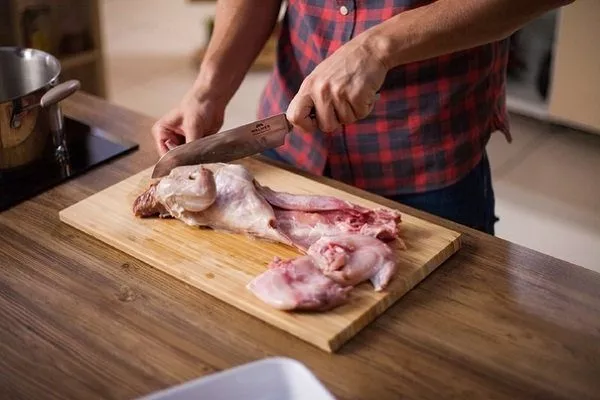
Slaughter and evisceration
To ensure the meat is tasty, juicy, and marketable, it's essential to slaughter the animal properly. Unlike chicken and other poultry, rabbits aren't killed by having their throats slit, but by blunt force. This method is called bloodless slaughter.
There are many other methods around the world. For example, in Muslim countries, rabbits are killed by slashing, in Europe by electrocution, and so on, but the bloodless method is considered the most optimal.
Step-by-step slaughter instructions:
- Carefully remove the animal from the cage, avoiding fright. Grasp its hind legs and lift it in front of you. Wait 1-2 minutes for the rabbit to calm down.
- Strike sharply at the occipital region—the junction of the back of the head and the base of the neck behind the ears. Measure the force carefully—if it's too light, the rabbit won't die immediately; if it's too strong, it will destroy the medulla oblongata and spinal cord, causing the meat to turn blue.

- Drain the carcass. To do this, wait until the convulsions stop and then hang the body over the pelvis. Blood will begin to flow from the nostrils upon impact, but to speed up this process, make additional incisions in the same area or sever the aorta in the pharynx.
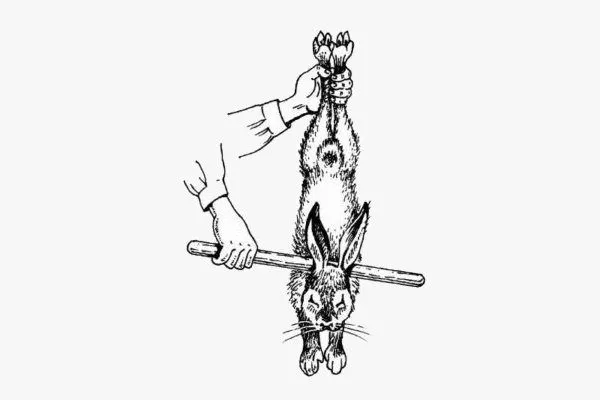
After this, you need to remove the skin without leaving it intact. There's a standard procedure for this:
- Starting from the hind legs, pull the skin off, holding it with one hand. First, make a circular cut in the fur to separate it from the carcass.
- Move to the groin area, grabbing with both hands.
- Continue this way to the forelimbs, pulling the skin away from the muscles. Make circular cuts again.
- Remove from the head, cutting the ears, mouth, and eyelids.
Watch our short video to learn how to properly skin a rabbit and set up a slaughterhouse:
After this, proceed to the gutting process:
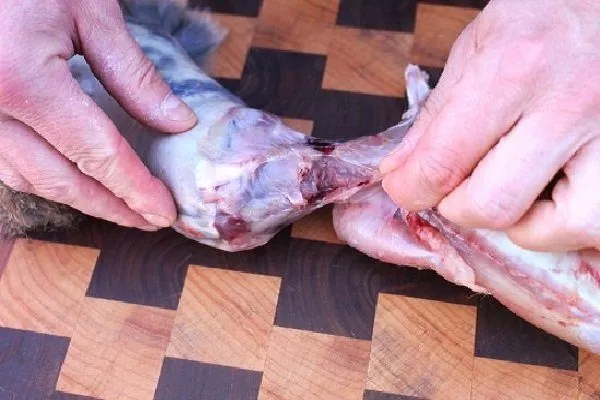
- Locate the ankle area and break the limbs apart to remove the furry portions of the paws.
- Cut through the tendon and muscle area and separate the legs.
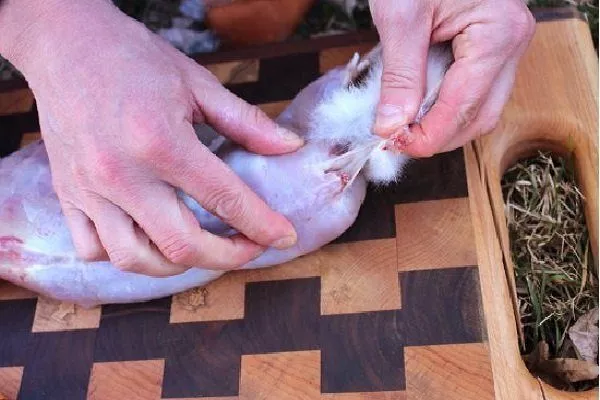
- Cut off the head at the first cervical vertebra.
- Tear off the tail with a sharp movement.
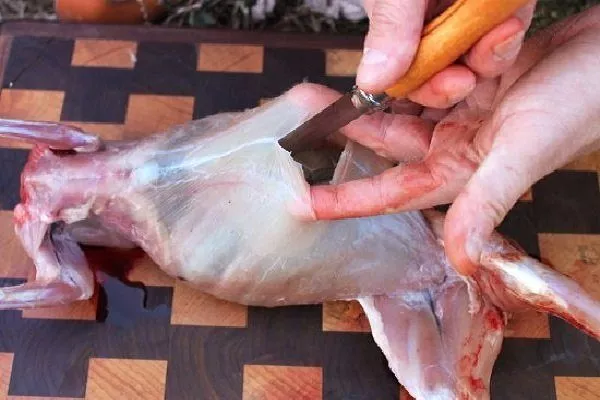
- Place the body on its spine. There's a white line down the center of the belly; cut along this line to the sternum.
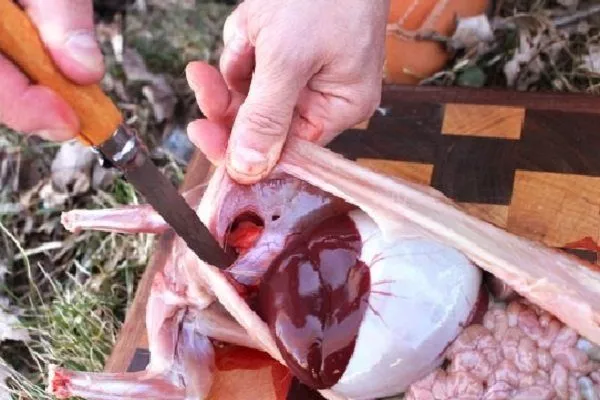
- Begin separating the entrails from the muscles. Do this carefully to avoid damaging the organs, especially the gallbladder (the meat will become bitter). Remove them.
- Now remove the liver and examine it. In a healthy rabbit, the organ has a dark red tint.
- Remove the lungs, heart, kidneys and stomach.
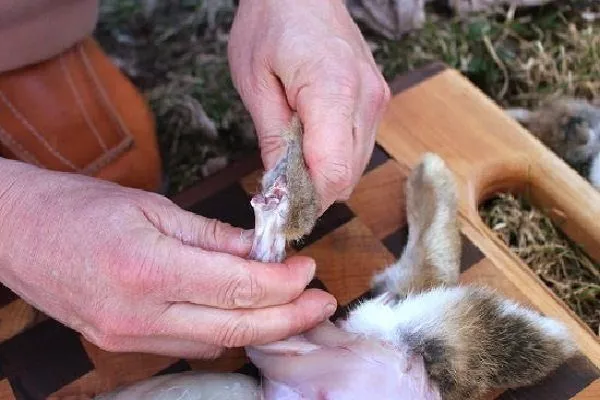
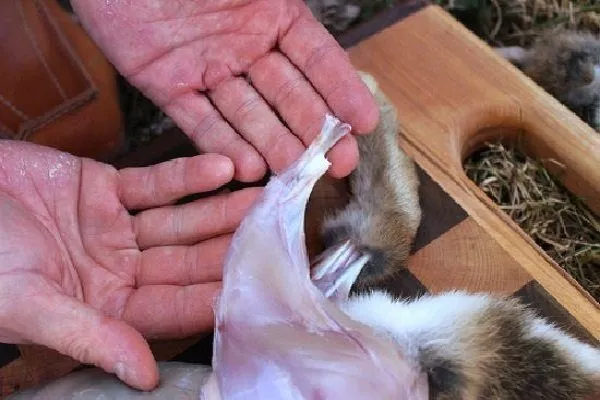
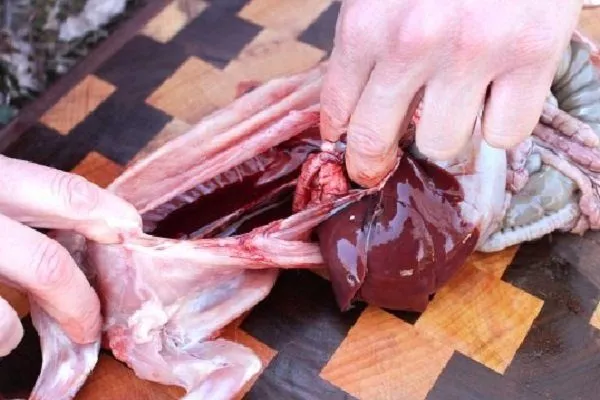
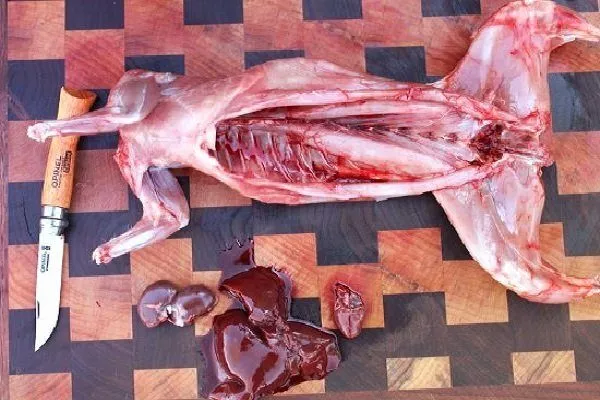
The carcass must be thoroughly washed, removing all impurities.
What equipment will be needed?
To quickly, easily, and efficiently butcher a rabbit, prepare the following tools in advance:
- sharpened knife;
- sharp kitchen scissors;
- a cutting board appropriate for the size of the rabbit.
- ✓ Tweezers for removing small bones.
- ✓ Brush for cleaning the carcass from residual hair.
Carcass cutting technology
Some beginners use kitchen cleavers to make the job easier, but experts do not recommend chopping the carcass, as the tubular bones will split into many small fragments.
Into portions
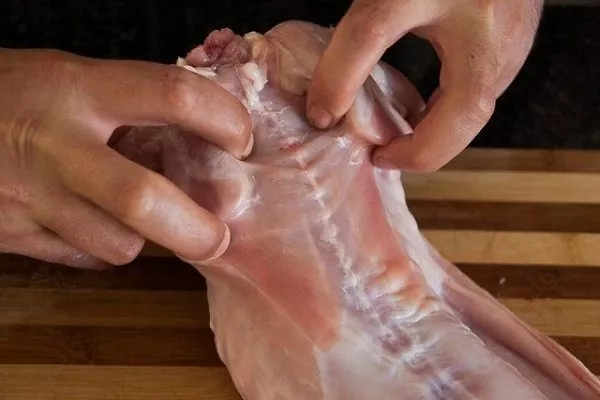
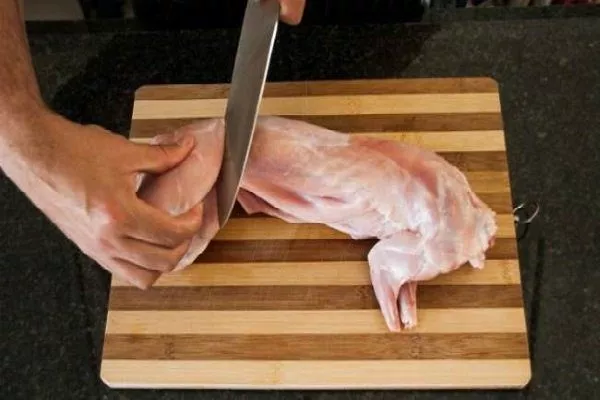
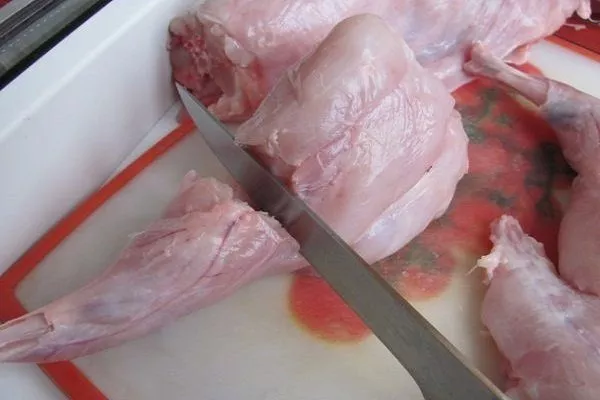
Most often, rabbit is prepared in portioned pieces. There are two universal techniques. The first involves the following steps:
- Place the carcass on its back, spreading the legs apart. Trim the fatty parts from the sides.
- Now cut off the front legs. Unlike chicken, the front legs are not firmly attached to the body, so they can be easily pulled aside and removed.
- Turn the chicken over onto its belly, then remove the fillet along the spine and cut into pieces. If you want to leave all the meat on the bones, don't do this.
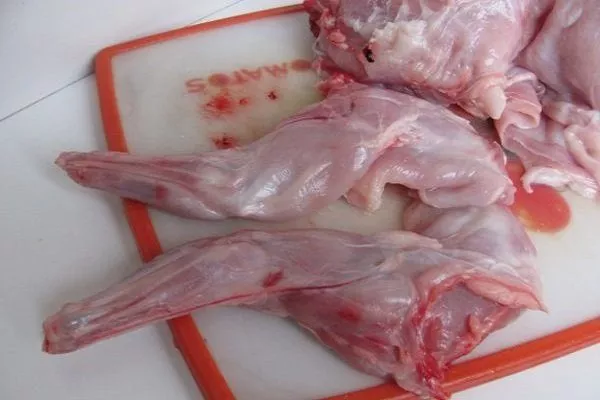
- Lay the body on its side and insert a knife into the belly to remove the hind leg. Be sure to separate the leg exactly at the joint. If the rabbit is large, separate the legs into several pieces (if desired).
- Make cuts in the tendons near the spine. Grasp the rabbit with both hands across the carcass and tilt the front part upward. Break the spine at the loin. Use a knife or scissors to separate the muscle tissue along the break.
- Use a knife to trim the ribs lengthwise along the body. Take the back and remaining parts and cut into portions.
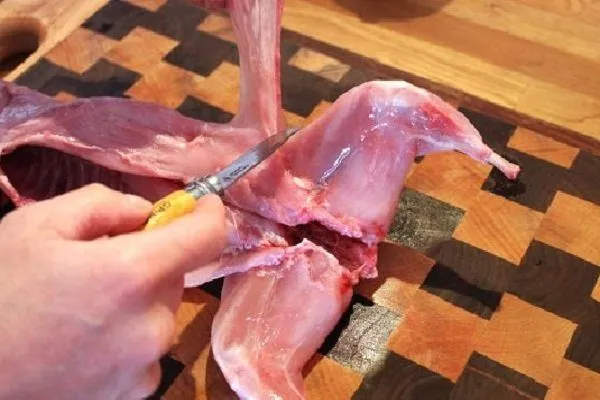
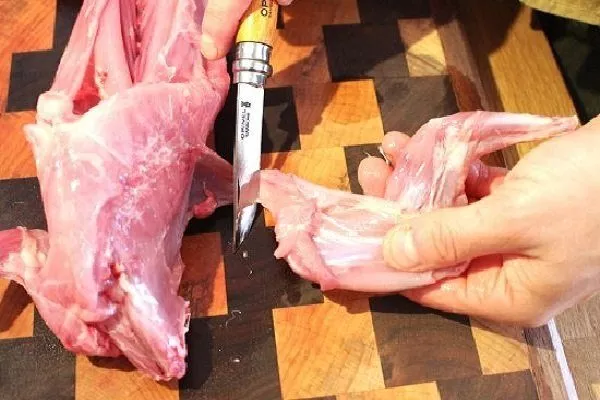
There is a simplified technology for cutting up a rabbit:
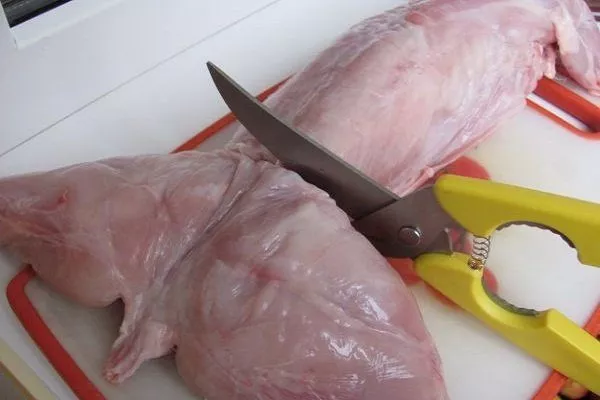
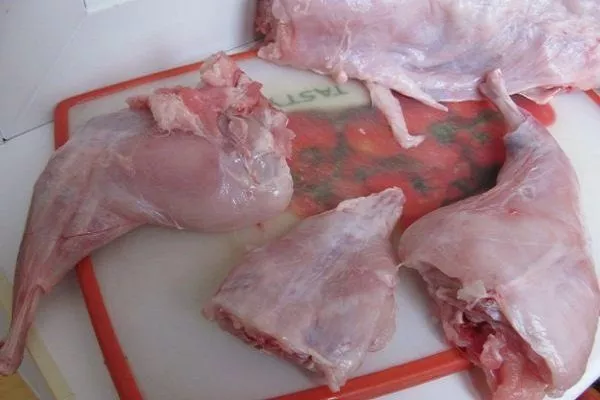
- Place the carcass on its spine, legs spread apart. Separate the back from the front using scissors.
- Cut off the hind legs at the joints.
- Divide the legs into pieces, you need to prepare small portioned pieces.
- Remove the front legs with a knife.
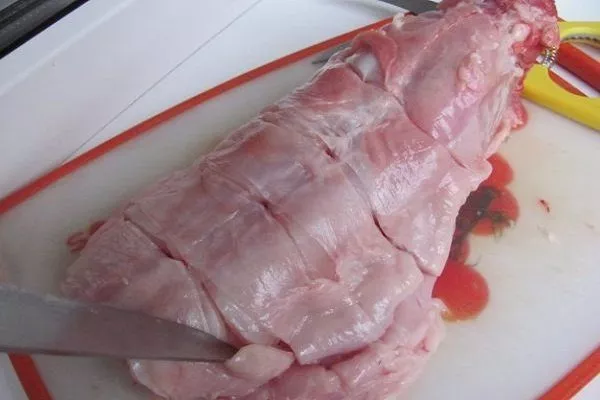
- Turn the carcass over onto its belly and make crosswise cuts along the back. This will mark the portions.
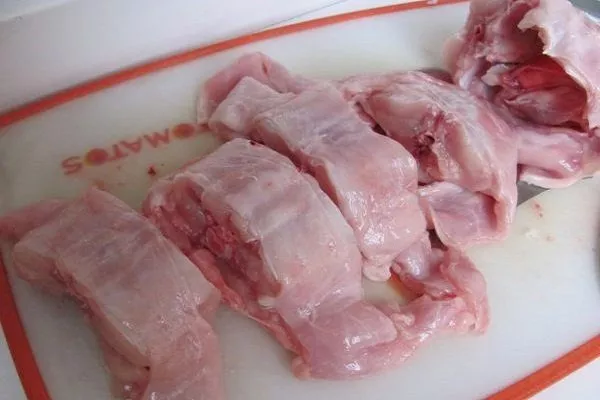
- Cut the body into sections strictly along the cuts. For convenience, you can use a knife and scissors at the same time.
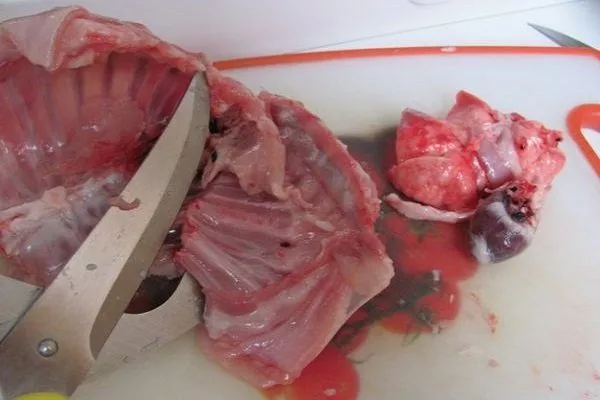
- If you didn't remove the lungs during gutting, do so now. Then, use scissors to separate the vertebrae. These are usually used for stock.
Filleting
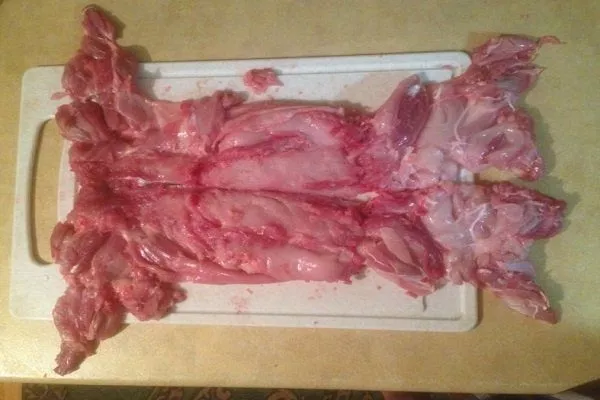
The fillet is cut off exclusively from large rabbits, since from small individuals you will not get a fillet, but ordinary portioned pieces.
To properly separate a piece, you need to proceed in stages:
- Place the rabbit on its side.
- From the spine side, make a deep cut along the ridge.
- Using a knife, begin separating the meat from the bone bases, moving from the tail to the neck. Work alternately on each side of the carcass.
- Cut off the fillet from the back legs, carefully separating the paw bones.
- Place your torso on the board with your back down.
- Carefully cut off the rib portion with scissors.
- Cut off the meat from the front legs as well.
For more ideas on how to make rabbit fillet, watch the video:
Whole carcass
If you're slaughtering several rabbits at once and don't plan to cook them right away, you can store the carcasses in the freezer. It's best to freeze the rabbits whole—this way, you'll have the flexibility to prepare any dish you like, even roasting the whole carcass in the oven.
Before freezing, prepare the meat as follows:
- Trim off any fat (it will shorten the shelf life).
- Scrape off any dirt with a knife.
- Clean the carcasses with a cloth towel, removing excess moisture from the meat.
- Prepare a room for cooling the rabbits, as the meat should not be placed in the freezer immediately after slaughter. The room temperature should be between 2 and 5°C.
- To ensure even cooling, tie the hind legs with rope and hang them on hooks.
- Leave for at least 5 hours, maximum 8 hours.
- Place each carcass in individual plastic bags, preferably with a zip-lock. If you don't have one, create an artificial vacuum to remove all the air. Quickly tie the bag with string (or thread, etc.) or secure the top with a knot.
Do not store unpackaged in the freezer; the temperature should be at least -18°C. In this case, rabbit meat will keep for up to 6 months.
Experienced rabbit breeders recommend brushing the meat with vegetable oil (refined only) before freezing, which will increase shelf life and improve the carcass's appearance after defrosting.
Disposal and sanitization
Pathogenic microorganisms persist for a long time on rabbit skin and in their blood, so to prevent infection, the premises, tools, clothing, etc. are sanitized after slaughter. Any rabbit waste must be disposed of.
At home you will have to do the following:
- Carefully sweep the room where the animal was huddled with a broom.
- Rinse the floor with running water.
- Disinfect. This can be done in two ways: steam treatment or special disinfectants, such as those based on phenol, hydrogen peroxide, formalin, alcohol, chloramine, etc.
- Process the skins according to all the rules of dressing.
- Burn any remaining wool, blood, intestines, etc. that is prepared for disposal.
- Disinfect the equipment.
Pathogenic microorganisms spread rapidly throughout the entire area, so if the premises are not disinfected promptly, the risk of infection of other rabbits, pets, livestock, and humans increases.
Butchering a rabbit isn't difficult; the key is to master one of the techniques, prepare sharp tools, follow sanitary and hygienic rules, and act confidently. Even if you don't do it well the first time, you'll definitely improve the next time.