
Gray Giant rabbits were developed back in the USSR, but remain popular even today. This is due to their relatively easy breeding, attractive appearance, and good productivity. Some people even keep them as pets. Let's take a closer look at the characteristics of this breed.
History of the breed
The Gray Giants were bred quite a long time ago—in the late 1940s and early 1950s. This occurred at the Petrovsky state farm in the Poltava region of Ukraine. The farm's specialists began crossing the Flanders rabbit breed with common local rabbits.
It was from the Flanders that the Grey Giants inherited their large body mass and skeletal structure. From common local rabbits, the breed inherited their ease of maintenance, fertility, and undemanding diet. These rabbits have been noticed not only in Russia and Ukraine, but also abroad. Today, they are bred in Asia and Europe.
Appearance
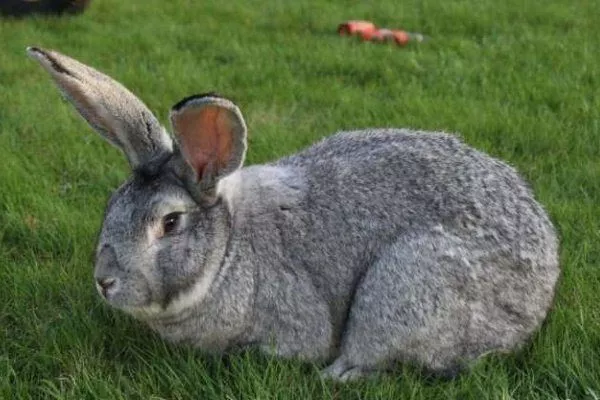
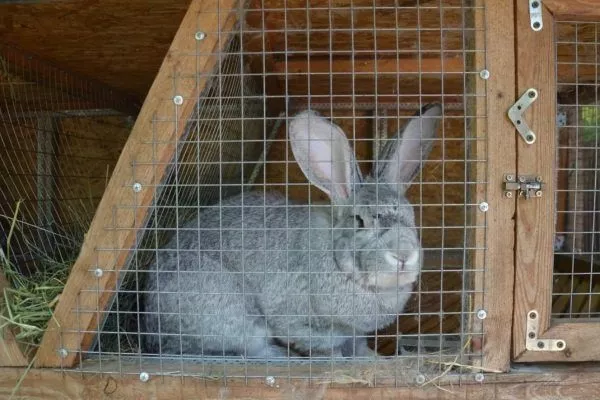
Gray giants are very attractive. They are very cute, but quite large pets. They can weigh up to 6-7 kg and reach a length of about 66 cm. Their size gives them their name.
Constitution
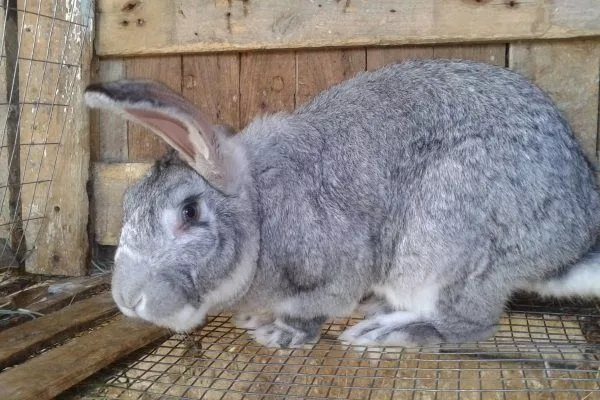
The overall body structure of the animal is quite strong and powerful. The chest is deep and wide, measuring approximately 37-39 cm in circumference. A dewlap is sometimes present. The back is straight and wide. The legs are large and strong. The head is massive, with large, straight ears that form a V-shape when viewed from the front.
Fur
Unfortunately, the fur of this breed is not particularly valuable. It is thick but uneven. Because of this, the fur component of rabbits can only be used in inexpensive products. However, the pelts themselves are quite large – up to 3,000 square centimeters.
Skin
The fur of these rabbits is uneven and divided into distinct color zones. This breed comes in several colors. Gray giants have a standard gray coat. Sometimes this breed exhibits brownish, dark gray, or "iron" tones.
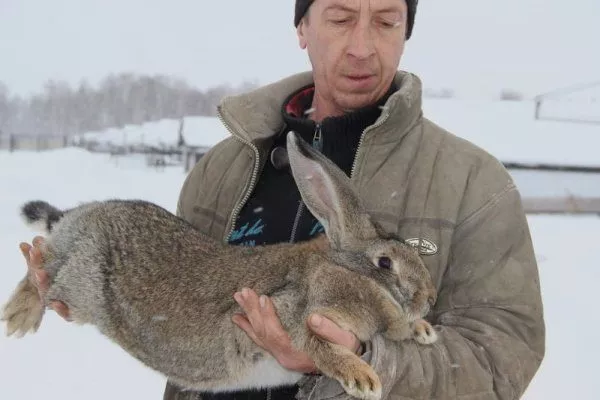
A grey giant with a brownish tint to his fur
The animal's belly is usually lighter than its back. The insides of the legs are also white. Pure colors (black, white, or gold) are very rare in this rabbit species.
Characteristics, signs and qualities of the breed
If we highlight the main characteristics of the breed, they will be as follows:
- large size of the animal;
- strong body;
- big head;
- long and straight legs;
- slightly rounded, V-shaped, long ears;
- fairly dense wool;
- large skin;
- tasty meat.
Productivity
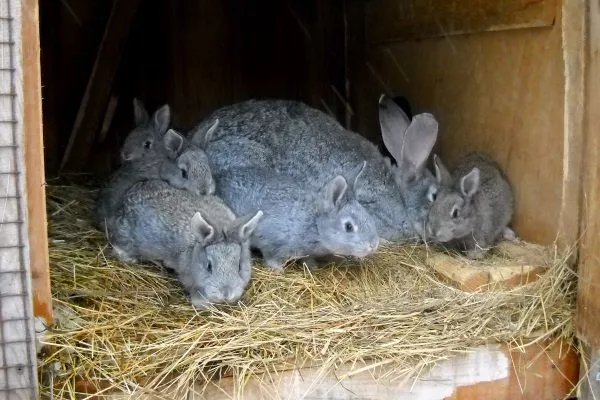
Female rabbits of this breed are noted for their fertility. Typically, a litter contains around 8 kits, but litters of up to 14 have been known to occur. Furthermore, Gray Giant females do not eat their young, increasing the likelihood of raising a large litter.
Baby rabbits typically weigh around 80 g at birth, but grow quite rapidly. Depending on their diet, they can weigh 2-2.2 kg by 3 months, and 2.5-3 kg by 4 months. The slaughter yield in this case is approximately 55-56%.
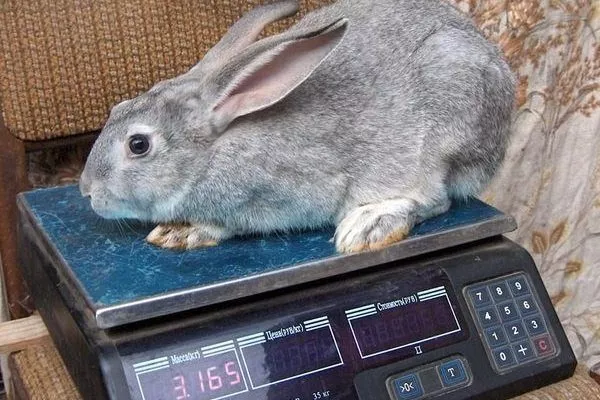
Gray Giant baby rabbit at 4 months
Advantages and disadvantages of Gray Giants
The advantages of the breed are:
- fertility and developed maternal feelings in females;
- no tendency to eat offspring;
- good adaptation to various conditions of detention;
- not picky about food;
- immunity to many diseases;
- calm and friendly disposition;
- pleasant appearance;
- possibility of keeping at home.
As for the disadvantages, they are as follows:
- voracity;
- the risk of rabbits being born with crooked and thin legs;
- low slaughter yield compared to other meat breeds;
- not very high quality fur with uneven color and density;
- lower quality meat compared to Flanders;
- decrease in the taste characteristics of meat after 7 months of the animal's life.
Keeping rabbits
Gray giant rabbits were bred in mild climates and thrive in these conditions. However, this breed can also be bred in northern regions. These rabbits adapt to cool temperatures fairly quickly and are able to reproduce comfortably if provided with optimal conditions.
- ✓ Optimum temperature for maintenance: +12°C to +20°C.
- ✓ Minimum cage size for one rabbit: 80x90x60 cm.
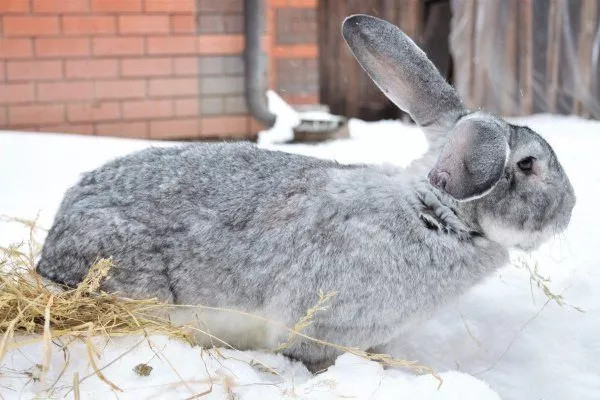
In cages and enclosures
This breed is best kept in hutches or wooden cages. For easy inspection, equip the hutches with a lid and line the floor with iron to prevent rats from getting into the rabbits' enclosure.
Observe the following conditions for keeping rabbits:
- Place cages or enclosures in sunny places, but without direct sunlight;
- avoid drafts and strong winds;
- make sure that there is no dampness or mold in the cages;
- Keep the rabbit hutch clean.
Gray Giant rabbit cages should be spacious enough, as this rabbit is quite large (a single-rabbit cage measuring at least 80 x 90 cm is suitable). Provide a separate nesting box for the female rabbit.
At home
Thanks to their gentle nature and pleasant appearance, Grey Giants are sometimes kept as pets rather than for slaughter. Children are especially delighted with this furry little creature, as they are kind and affectionate with people.
But when getting such a rabbit to keep at home, keep the following in mind:
- Rabbits chew on everything, so hide flowers, as well as all wired and wooden devices;
- It is not possible to train an animal like a dog, although you can train it to use a litter box and walk it on a leash;
- Only let your rabbit out of the cage under the supervision of a family member.
When the heat season begins, female rabbits become nervous and restless, and males may mark their territory. Therefore, if you plan to keep rabbits indoors, have them spayed or neutered.
Care
Gray Giants require care to ensure they grow healthy and strong. Providing optimal living conditions for rabbits is the key to their long life and successful breeding.
Rabbit nutrition
Gray giants need a balanced diet. To achieve this, follow these guidelines:
- Give your rabbits a varied diet – monotonous foods can negatively impact productivity and lead to illness;
- Do not feed animals rotting vegetables or moldy grains - food products must be of high quality, clean, and not spoiled or dirty;
- create a specific feeding schedule that your rabbit will get used to;
- Give dry food along with clean and fresh water so that the animal can drink after eating;
- change the water as needed, it should always be easily accessible to the rabbit;
- feed rabbits succulent food (dried greens, vegetables) along with hay;
- do not give rabbits grass immediately after rain or dew, as it is damp and this may cause bloating in the animals;
- add mineral and vitamin supplements to the diet of pregnant and lactating rabbits, as well as newly born rabbits;
- give the grain crushed or in a mash;
- Make the transition from the spring or autumn diet gradually, gradually adding new products to the food over the course of a week.
Feed your rabbits frequently, but in small portions. Avoid overfeeding or underfeeding. Overfed or underfed rabbits are reluctant to mate and can also develop digestive problems. For more information on feeding rabbits, see here.
Hygiene
Hygiene in the rabbit's enclosure is crucial. Clean the cages daily or every 2-3 days, depending on the procedure. Prevent mold, dampness, and unpleasant odors. All these signs can promote the proliferation of disease-causing insect larvae and the spread of viruses.
To keep your animals clean, disinfect the premises from rodents and pests at least twice a year (depending on the scale of the problem).
Immediately before kindling, when new rabbits are transferred to cages, or during outbreaks of infection, disinfection is mandatory.
Methods of disinfection:
- burn the cage with a blowtorch - this is the easiest way;
- treat the room with a 10% bleach solution;
- whitewash with slaked lime.
Breeding and raising rabbits
Raising Gray Giants is not difficult. Male rabbits of this breed are quite prolific, and the females are excellent mothers.
Basic rules for breeding rabbits:
- start forming rabbit families when the animals are 6-7 months old - there should be 5 females per 1 male;
- The hunting season for rabbits lasts every 2 weeks for 6 days - during this time the female begins to fuss on the bedding and eats weakly;
- Place one female rabbit next to the male rabbit 4 times a day - 2 times in the morning and 2 times in the evening, and try to do this when it is not hot;
- a female rabbit's pregnancy lasts about 30 days, and a few days before giving birth she begins to nest and pave a place for herself - if she does not do this, you should take care of this by building a warm and clean nest for the future rabbits;
- After the birth, make sure that the rabbits do not crawl away from their mother, otherwise they will die, but do not pick up the babies in your arms - if the baby rabbit crawls away, gently push it back (your hands should be in gloves);
- Baby rabbits should not crawl away from their mother until they are 1.5 weeks old, when they can see, otherwise they will get lost and won't find their way back. When the baby rabbits are 3 months old, wean them away from their mother and move them to a separate cage.
- after Relocation of baby rabbits from a female rabbit Care for the babies like other adult rabbits.
Don't introduce a male to a female, as he will begin exploring the territory rather than attending to the female. Also, don't breed rabbits that are related by blood. Read more about mating rabbits. Here.
Breeding prospects
The Grey Giant breed is extremely popular among amateur livestock breeders today, but large farms that breed these animals have begun to lose interest in them.
This is because the breeders who developed the breed sought to "reward" them with the ability to survive in harsh conditions and disease resistance. These are precisely the qualities that ordinary farmers value in them.
| Parameter | The Gray Giant | Flanders |
|---|---|---|
| Killer exit | 55-56% | 60-65% |
| Average weight at 4 months | 2.5-3 kg | 3-3.5 kg |
Large farms and nurseries, however, prioritize the breed's productivity, which in this case is low. Furthermore, the poor quality of the Grey Giants' fur prevents it from fetching a high price. This explains the low interest in the breed among ordinary farmers and the low interest among professionals.
Use of rabbits
This breed is primarily bred for meat production, and less commonly for the pelt market. Some people buy Grey Giants as pets, thanks to their gentle nature and attractive appearance.
Farmers' reviews of this breed of rabbits
The Gray Giant breed is popular among hobby farmers. These impressively sized rabbits are extremely easy to care for and breed. They are often used for meat production or as pets.