
Breeding White Giant rabbits doesn't require any special skills. They are relatively easy to care for and don't require any special conditions. They are considered one of the most successful breeds for breeding, as they provide not only valuable dietary meat but also beautiful white fur.
History of the breed
The breed emerged recently, in the 20th century. German and Belgian scientists bred it, using the Belgian Giant as the basis. This large breed was widespread in Belgium and Germany, but had a number of shortcomings, including low fertility and poor vitality. It was these flaws that scientists spent a long time honing.
First, the Belgian Giant was crossed with chinchillas, then with the Gray Giant. This selection resulted in the first White Giant specimens with thick fur and a large size. But the breeders didn't stop there. They were faced with the task of creating a pure white rabbit with no hint of another color. Such fur has always been in demand in the fur industry.
All individuals with a dominant gray color were culled, leaving only the white, long-eared ones. Thus, step by step, a new breed, the White Giant, was developed, becoming a multiple exhibition winner.
It arrived in Russia in the 1920s, in the 20th century. However, the first specimens brought to Russia perished due to the vast climate differences and genetic defects. Only the strongest individuals survived, serving as the future gene pool for the creation of a Soviet population of this breed with improved traits.
On its basis, new rabbit breeds were obtained - the black-brown rabbit and the Soviet chinchilla.
General description
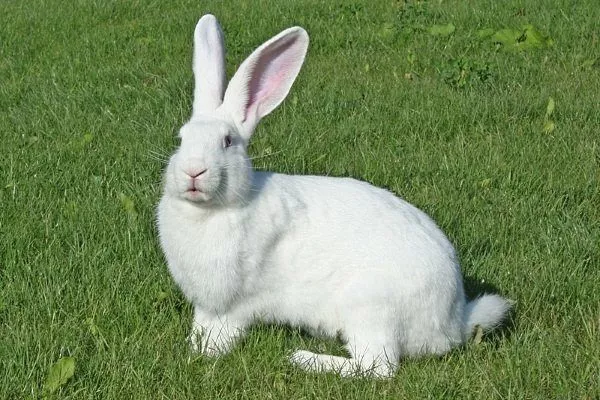
The White Giant rabbit breed lives up to its name. These big-eared creatures are easily recognizable by their snow-white fur and relatively large size.
Constitution
This is a powerful animal with a broad, straight back and strong, long, widely spaced legs. Due to their heavy weight, calluses often form on them. The ears are wide, erect, and long. According to the standard, their length should correspond to 1/4 of the body length, or 12-15 cm. They are rounded at the tips.
The body is elongated, with a rounded rump and a broad chest. Females and males are virtually identical in structure, with the exception of the head, which is more rounded in males.
Fur
The breed's primary characteristic is its thick, perfectly white fur. A true White Giant has no tan markings, spots, or other colored markings, and there should be no yellowing.
Individuals with milky fur are discarded. Their coat is smooth, dense, and soft to the touch. The hair length is 4 cm.
Traits and defects of the breed
A purebred rabbit should have thick, snow-white fur. Their body length averages 50 cm, with some individuals reaching 60 cm. Their chest circumference ranges from 36 to 38 cm. Depending on their weight, rabbits are divided into three classes:
- elite (weight is approximately 5,800 g);
- first class with a weight of 5,300 g;
- second class - 4,800 g.
Since only albinos were selected for the breed, all specimens have red eyes. In the Soviet population, any other color is not allowed. European or English specimens may have blue eyes.
Individuals with the following deficiencies are not allowed to reproduce further:
- narrow chest;
- strongly developed brisket;
- clubfoot;
- individuals with signs of rickets - a humped or drooping back, with splayed front legs.
Behavior
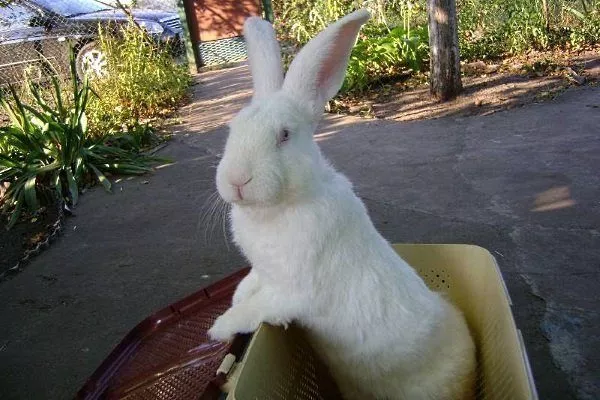
White giants are phlegmatic creatures with a peaceful disposition. Their calm nature makes them ideal pets, so they are often seen in apartments. They quickly become attached to their owners and are not aggressive toward people or other animals. However, if necessary, they can fight back and punish those who offend them.
Some individuals periodically enter a trance or torpor, meaning they remain motionless for a period of time, stare at a fixed point, and do not respond to external stimuli. This behavior is not considered a defect, but rather a characteristic of these albinos.
Productivity
White giants are bred primarily for their white fur. Meat is a secondary consideration. The breed is considered a meat breed. An adult male weighs up to 6 kg, while females weigh less, up to 5,200 g.
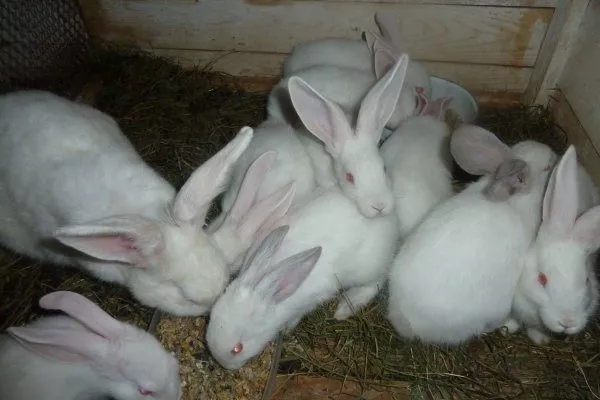
The doe is known for her high fertility. She produces 7-8 kits per litter. Cannibalism is not typical for this doe; she will never eat her own offspring. The kits are left with their mother without fear, and she nurses them. The survival rate of the kits reaches 99%. The kits grow quickly, have an excellent appetite, and can weigh up to 5 kg by 10 months.
Advantages and disadvantages
The advantages of the breed include:
- high quality fur;
- rapid weight gain;
- calm character;
- fertility;
- unpretentiousness in food.
Disadvantages include body conformation issues, small litter sizes, and poor litter survival. However, all of these drawbacks apply to the European and English White Giant populations. In the CIS, rabbit breeders primarily breed and raise specimens from Soviet selection, which corrected these shortcomings. The Soviet White Giants still have the following flaws:
- the appearance of calluses on the paws - pododermatitis, which causes the animal to suffer greatly;
- The female is prone to mastitis, so the breeder should very carefully monitor their condition and health.
In the video below, the breeder provides an overview of the White Giant rabbit breed:
Prospects for breeding in Russia
The White Giant is often found on farms. This breed is suitable for both established breeders and beginning farmers. Products made from its warm white fur are still in demand, so the breed remains very promising commercially.
Rapid weight gain and high meat taste, but, on the other hand, moderate feed conversion make its breeding profitable even without taking into account the production of skins.
Content Features
These long-eared rabbits are easy-going and undemanding when it comes to keeping conditions. Even a beginner rabbit breeder can create a comfortable environment for them.
Representatives of Soviet selection are not afraid of frost and can safely walk outdoors in winter. However, the colder it is outside, the more caloric their food should be. These animals can be kept in cages outside.
Keeping rabbits in cages
Rabbits are usually kept in cages. Thanks to their thick, warm fur, the "house" doesn't require additional insulation. The main thing is that there be no drafts.
The cage should be spacious enough to prevent the rabbits from feeling cramped. Place the "houses" in the shade, avoiding direct sunlight. Because rabbits are prone to developing calluses, special attention should be paid to the floor. It should be smooth and solid; wood flooring is acceptable.
Mesh flooring is strictly prohibited for this breed.
The doors are made of mesh material, with the optimal mesh size being 2 x 2 cm. In winter, they are covered with burlap to keep out the cold wind.
The cages are equipped with feeders and waterers made of easy-to-clean material. Since rabbits eat food that is favored by other rodents, such as mice and rats, it's important to protect them from such neighbors. To do this, the bottom and sides of the cage are lined with iron to prevent rodents from entering. Otherwise, the rabbits will suffer from hunger and may contract infectious diseases from the rodents.
How to make a drinking bowl yourself, read here.
Content mother cell
Females preparing for kindling should be placed in a mothering cage (nest) 7-10 days before the babies are born. It is attached to the side and has the following dimensions:
- width - 30 cm;
- length - 60 cm;
- height - 35 cm.
They also provide a removable roof to facilitate inspection of the nest and brood.
All areas are kept clean and disinfected regularly once a month, using a blowtorch or whitewashing. Droppings are removed two to three times a week.
Feeding
Compared to other rabbit breeds, the White Giant requires more protein food, which ensures normal development of the long-eared rabbit and rapid growth of muscle mass.
- ✓ To maintain healthy fur and meat, the diet should contain at least 18% crude protein.
- ✓ In winter, increase the proportion of roughage to 40% to maintain warmth.
We recommend reading the article –How, when, and what to feed rabbits.
Norms ration
On average, the dietary norm looks like this:
- 50-70% is allocated to concentrated feed - compound feed, bran, oilcake;
- 20-30% of roughage is hay and grass, they contain fiber;
- Root crops, silage, and melons make up 15-20% of the feed. These are fed during the autumn and winter.
When preparing a diet, it is necessary to take into account the sex, age of the rabbit, weather conditions, and time of year.
Selection of herbs
The selection of herbs for the livestock must be approached responsibly, as many plants contain substances toxic to rabbits - these include representatives of the nightshade family, milkweed, celandine, datura, henbane, and others.
Before feeding the rabbits, plucked grass should be slightly withered. This process makes it more digestible. Wet grass causes intestinal fermentation. Beets should be given with caution as they have a laxative effect.
In winter they give alfalfa hay, but the rest of the time they do without it, because the rabbits start to get fat on it.
Water bowls should always be stocked with water, warm in winter. Rabbits don't drink, so they get enough fluid from fresh grass or juicy root vegetables.
Reproduction
White rabbits are ready to mate almost year-round, so there are no problems with this. Furthermore, females are good mothers who care for their offspring and nurse all their kits.
Large, defect-free animals are selected for breeding. Females are ready to breed as early as 4 months, but they are bred at 8-9 months. Early pregnancy results in the death of the doe and the entire litter.
Young males are introduced to females at 5-6 months. Delayed introduction to the opposite sex makes the male passive and he begins to gain weight quickly.
Before mating, the female rabbit is sent to visit the male and left for 1-2 hours. She is then returned to her home. A week later, another mating takes place. If the female shows aggression toward the male (biting or fighting back), this means she is already pregnant.
Read the article about mating rabbits, rules and features of their mating.
Pregnancy lasts 30-31 days. One and a half weeks before the birth, the mother begins preparing the nest. At this time, a queen cell is placed in the cage.
Care for the young
Doe rabbits usually give birth, even for the first time, without any problems. The newborn babies lie in a pile in the nest, covered with fur. They begin to emerge from the nest after 2-3 weeks. During this time, the babies eat the same food as their mother. The rabbits are separated from the mother rabbit. at the age of 2-3 months.
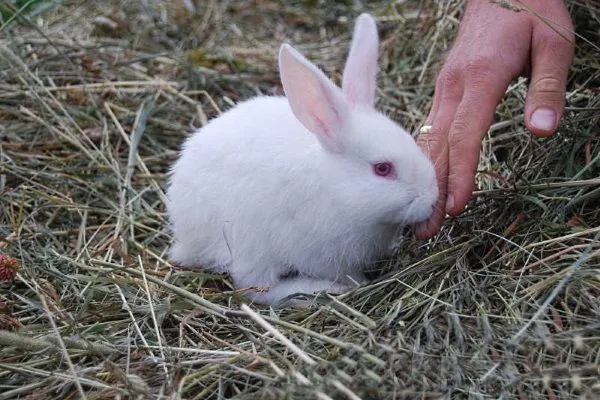
Since the intestines of young rabbits are weak, new products are introduced into the diet gradually, starting with small doses and increasing them over 2 weeks.
Diseases and pests
The main condition is pododermatitis, or corns. If a rabbit becomes lethargic and moves little, the hind legs are the first thing to examine.
In the first stage of the disease, the skin is affected, with calluses becoming clearly visible. Cracks then form and increase in size. Without proper treatment, these cracks worsen with bleeding, making it painful for the rabbit to move, causing loss of appetite and diarrhea. In the final stage, the disease affects the tendons and bones.
Slaughter and skinning
Animals are sent for slaughter at the age of 3-5 months. By this time, they weigh 2.5-3.5 kg. A stick with a rubber hose attached to the end is used as a weapon. The rabbit is grabbed by the hind legs and hit on the back of the head. This is one of the most humane methods. The carcass is then dressed by hanging it by the hind legs from a crossbar or branch.
Cutting off the head is not practiced, since the animal's nervous system continues to function for some time, and the rabbit suffers greatly.
Where to buy and prices for White Giants
It's best to buy rabbits from specialized farms or a reputable seller. Soviet White Giants are inexpensive. The price depends on the quality of the parents and the seller's markup. Typically, a month-old rabbit costs between 300 and 500 rubles.
The chances of buying the wrong breed are slim, as the Hungarian White Pannon has recently become more popular. Its price is significantly higher than that of the White Giant, and it's likely that the White Giant will be passed off as a Pannon.
Reviews from White Giant rabbit owners
Because this breed is so easy-going, it's especially popular with farmers. Reviews are quite positive.
Overall, I took the advice and I don't regret it. I'm not considering other breeds yet, but this one suits me in every way.
Thanks to their calm disposition and low maintenance, White Giants have gained immense popularity among rabbit breeders. The breed is considered one of the most promising for breeding. With proper care, these calm and peaceful animals have high rates of precocity, fertility, and meatiness.