
When breeding rabbits, having hutches is essential. These can be purchased ready-made or custom-made. However, these are expensive, and the structure may be unreliable and short-lived. Therefore, building your own hutches is the best option.
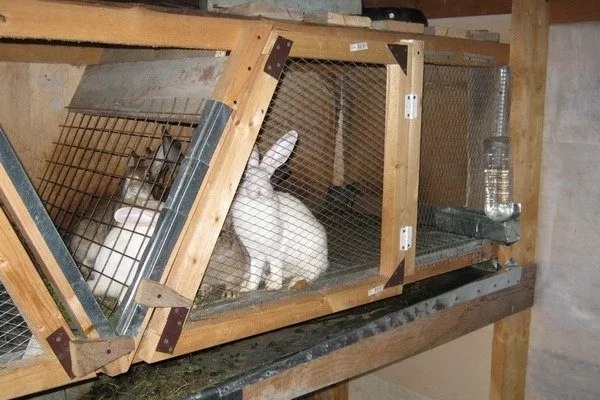
Selecting a location for the cage
When building cages for rabbits, the question arises: where to place them? It's important to choose a location where the animals won't be exposed to negative factors and will feel as comfortable as possible. Follow these guidelines when keeping animals in a permanent location:
- Protect rabbits from drafts. Wind gusts over 30 m/s can trigger acute illnesses, leading to mortality. These animals are very sensitive to cold drafts.
- High temperatures and humid air encourage the active growth of pathogenic microorganisms, which originate from feces. Therefore, ensure adequate ventilation to eliminate stagnant air and oxygenate the room.
- Prepare the hutches for winter. Don't skimp on bedding; insulate the walls of the hutch if it's outdoors, or turn on the heating if it's indoors. Maintain the temperature between 10 and 20°C.
Pay special attention to the insulation of the rabbit's home for pregnant females and rabbits with babies.
Depending on the climate, the size of the flock, and the availability of space, rabbit hutches can be located outdoors or indoors. Each option has its own specific requirements.
Terrain requirements for outdoor cage placement
Keeping rabbits in cages outdoors is possible in regions with mild climates, where winters are relatively mild and short, without severe frosts. Otherwise, the animals simply won't survive the cold and die.
The location of an outdoor rabbit cage must meet certain requirements:
- Keep them dry, which means keeping them away from artificial or natural bodies of water. Avoid placing cages in low-lying areas or where groundwater is close to the surface. This is necessary because rabbits do not tolerate humidity above 75%. The animals become sickly, stunted, and may eventually die.
- Cages should not be placed in direct sunlight. Trees or shrubs should be placed to diffuse direct sunlight, or a canopy can be erected.
Requirements for closed premises
In harsh climates, an enclosed shelter is essential. Such shelters must meet several mandatory requirements:
- To ensure the cells are warmed by the sun during the day and to allow maximum light in, place windows facing south. This will ensure the most natural daylight hours.
- If daylight hours are short, additional lighting will be required. Also consider how to maintain heat during the winter. Infrared lamps are an excellent option for providing light and warmth in the room.
- Plaster the interior walls. This will prevent condensation and help retain heat in the shelter during the winter.
- The room should provide such an arrangement of cells that air can circulate freely between them, and the façade of the houses should face east.
- Place indoor cages on supports at least 60 cm high. This will prevent rodents and other pests from accessing the cages, ensure optimal microclimatic conditions, and make it easier for people to care for the animals.
Necessary materials
You can build a rabbit hutch using a variety of building materials. To ensure an environmentally friendly environment, natural wood is recommended. It should be treated with antifungal agents to improve its performance.
The necessary materials used in the construction of a rabbit hutch also include:
- wooden beams and boards;
- wooden slats 30-40 mm wide;
- plywood;
- a metal mesh with small cells (otherwise the rabbits may get stuck and injure their paws);
- knitting or other metal wire of medium diameter;
- plastic trays of the appropriate size for the cages.
- ✓ Wooden slats must be at least 30 mm wide to ensure sufficient strength.
- ✓ The metal mesh must have cells no larger than 12.5 x 50 mm to prevent injury.
It is not recommended to use chipboard instead of plywood, as it absorbs moisture, quickly becomes unusable and crumbles, creating conditions for the proliferation of microbes, which negatively affects the well-being of rabbits.
What tools will you need?
Tools familiar to almost everyone will come in handy. To ensure smooth and calm work, without having to look for them, prepare your equipment in advance.
To assemble a rabbit hutch you may need:
- electric jigsaw (or hacksaw);
- roulette;
- screwdriver and screws;
- hammer and small nails;
- construction stapler with staples;
- wire cutters or pliers for wire mesh;
- copper or aluminum wire;
- sheet bending machine.
Cell dimensions and drawing up a drawing
The type and size of the rabbit hutch depends primarily on the number of individuals and the breed. For example, for decorative rabbits, a space of up to 0.5 square meters is quite sufficient, but for medium and large breeds kept for commercial purposes, this space will be insufficient, and the hutch will need additional rooms for specific functions (kindling, rearing young, etc.).
According to the type of construction, rabbit hutches can be:
- single-tier or multi-tier;
- portable or stationary;
- with and without walking;
- sheds, etc.
There are also many original designs, for example, according to the method of Zolotukhin, Mikhailov, Nikitin, and others.
Rabbit cages vary in layout and size depending on the sex, age, and breed of the animals. Females are kept separately from males to avoid conflicts arising from competition between the sexes and unplanned matings.
Features of cells for different cases:
- Pregnant female rabbits require individual housing to ensure a peaceful pregnancy and the birth of healthy offspring. These cages always include a mother litter, where lambing occurs and the babies grow.
- Group cages can be provided for animals of the same sex and age group. Aggressive males should be placed in individual cages.
To create a diagram or blueprint of a rabbit cage, take a regular piece of grid paper, A4 paper, or graph paper, a ruler, and a pencil. Draw the desired cage, indicating its dimensions and maintaining the proportions on the paper. Include the locations of the door, feeder, and waterer in the drawing. Indicate any additional compartments and partitions. List the necessary materials and the blanks they will be made from.
Ready-made cage designs are available online and in publications dedicated to rabbit breeding. Use one of these designs or create your own based on them.
Drawing single-tier cage for young animals and females with cubs It can have any shape and design. It's only important to improve it if necessary by adding a mother cell:
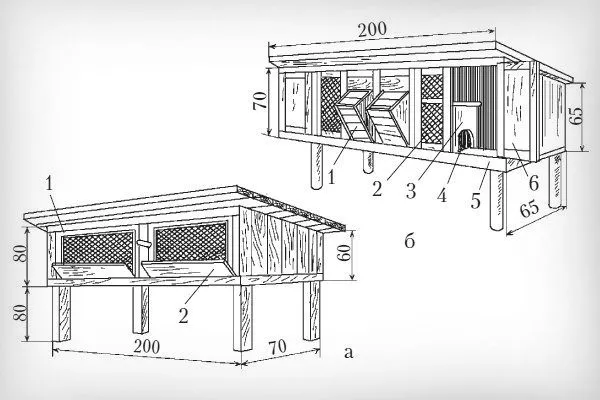
a – cage for keeping young animals: 1 – door; 2 – folding feeder; b – cage with a permanent nesting compartment for keeping two nursing females: 1 – feeder; 2 – mesh door; 3 – partition; 4 – manhole; 5 – nesting compartment; 6 – queen cell.
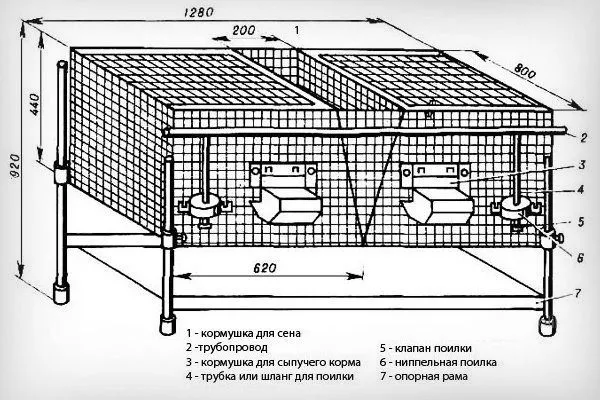
A cage made entirely of wire mesh might look like this:
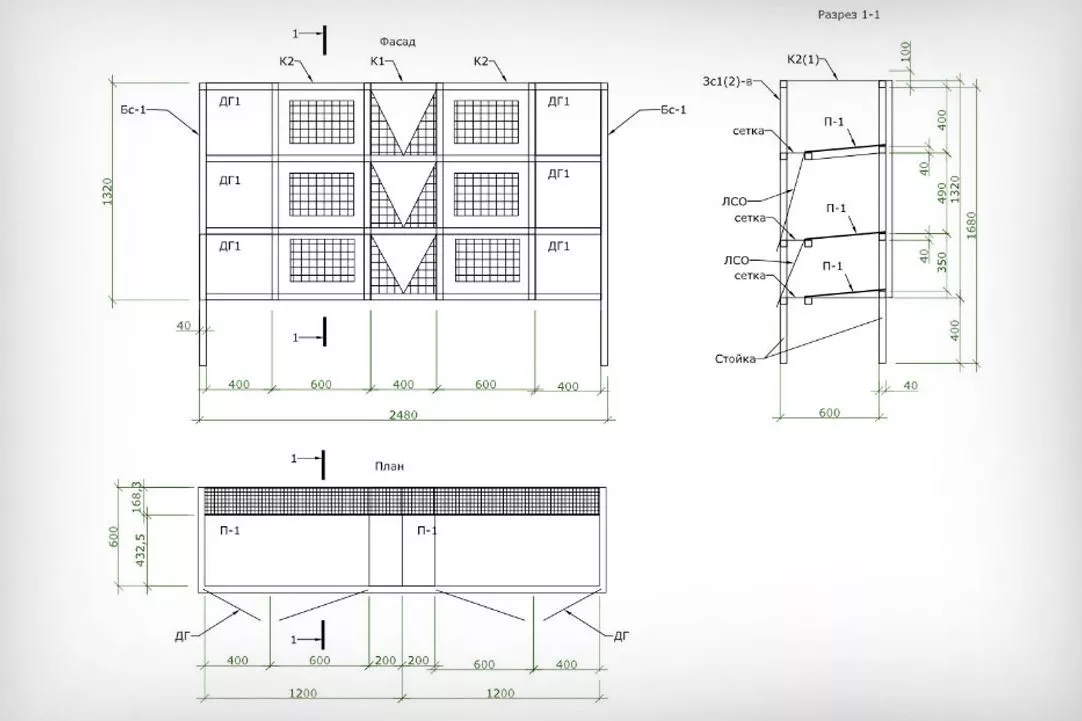
Multi-tiered rabbit cages provide space savings and make animal care easier:
Rabbit cage parameters depending on breed and age
Each cage should house one adult female or male. If the animals are young, 5-6 animals are housed per cage. Replacement females are housed in groups of 2-3 individuals, while replacement males, once they are 100 days old, are placed in a single cage.
To optimize the space in your rabbit hutches and efficiently house your rabbits, consider the size of the hutches based on their breed and age. Recommended hutch sizes are listed in the table below:
| Age category and breed | Length of dwelling, cm | Housing width, cm | Height of the dwelling, cm | Area required for 1 animal, sq. m |
| An adult specimen of a medium breed | 100-120 | 70 | 60-80 on the front and 45 on the back wall | 0.6-0.7 |
| An adult specimen of a large breed | 150 | 70 | 70-80 on the front wall and 45 on the back wall | 1.05 |
| Juveniles (group of 6 individuals) | 100 | 38 | 50 at the front and 35 at the back | — |
Step-by-step instructions for making cells
Building a rabbit hutch is not particularly difficult if you have a diagram, the necessary materials and tools.
Single-section cage for an adult
Although the size of the houses and their appearance may vary significantly, the construction of the cages involves a single assembly algorithm, which consists of several stages:
- Before assembly, all wooden building materials must be treated with a fungicide or preservative. This will prevent wood rot during use and prevent pathogens from penetrating and multiplying. Choose gentle treatments with minimal chlorine and other substances that can have a negative impact on rabbits.
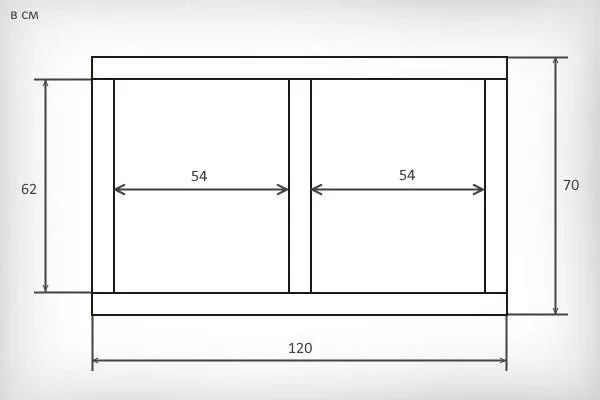
- Prepare a 40x40 mm beam. Cut it into lengths of two 120 cm pieces and three 62 cm pieces. Connect them according to the diagram using wood screws with press washers:
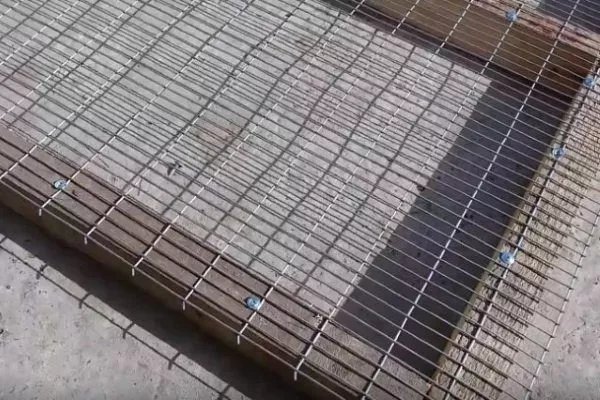
 This will be the frame for the cage bottom. Next, take a 120x70 cm mesh with 12.5x50 mm mesh and 2 mm wire diameter and secure it to the frame with screws.
Winter cages require a wooden floor. Assemble it from slats, securing them with screws. Leave small gaps between them. This type of flooring is environmentally friendly, natural, and warm, but over time it will need to be replaced due to rot.
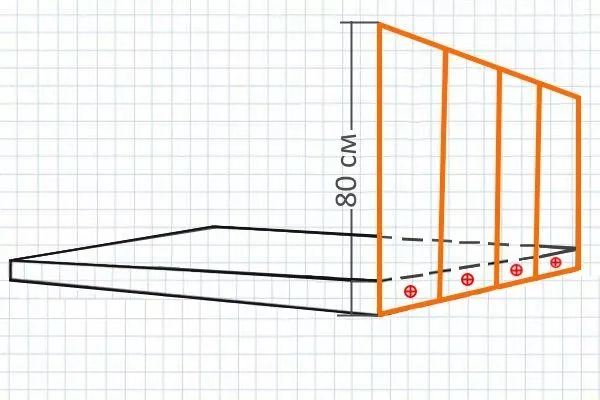
- For the sidewalls, you'll need 200mm wide and 40mm thick edged boards. For each wall, you'll need four pieces, each 80cm long. Use screws to secure each board to the cage bottom frame:
- For the back wall, prepare four boards, each 200 mm wide, 40 mm thick, and 120 cm long. Secure each board end-to-end along the back wall of the cage using screws.
- For the roof, take four boards, each 200 mm wide, 40 mm thick, and 150 cm long. Join the boards end to end and screw them to the ends of the side walls with screws.
The roof can also be made from a sheet of slate, ondulin or moisture-resistant plywood, covered with a piece of linoleum.
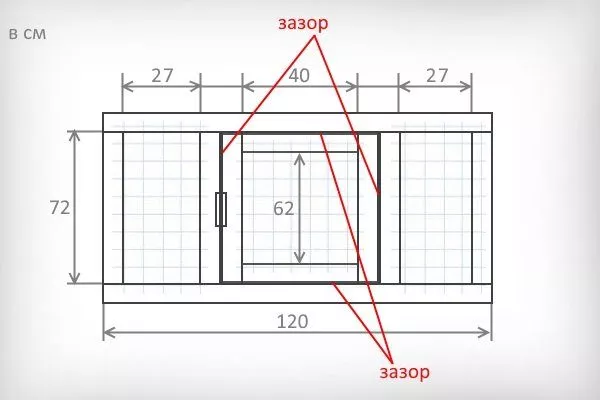
- Construct the cage's façade using wire mesh (25x25 mm mesh, 1.6 mm wire thickness) to ensure the rabbits have adequate light, warmth, and fresh air. Furthermore, the animals will be able to explore their surroundings through the transparent wall, allowing the breeder to keep an eye on them without disturbing them.
The door frame is made from 40x20 mm lumber. Attach the mesh as shown in the diagram below. Attach the door to the hinges. Remember to leave a 1 cm gap to allow the door to open and close freely.
We install a latch on the door. - Attach legs made of 50x50 mm lumber to the assembled structure. The cage should be 60-80 cm above the ground. Keep in mind that the legs may need to be dug into the ground for stability, so their length can be increased to 100-120 cm.
- The final stage is the installation of feeders and drinkers.
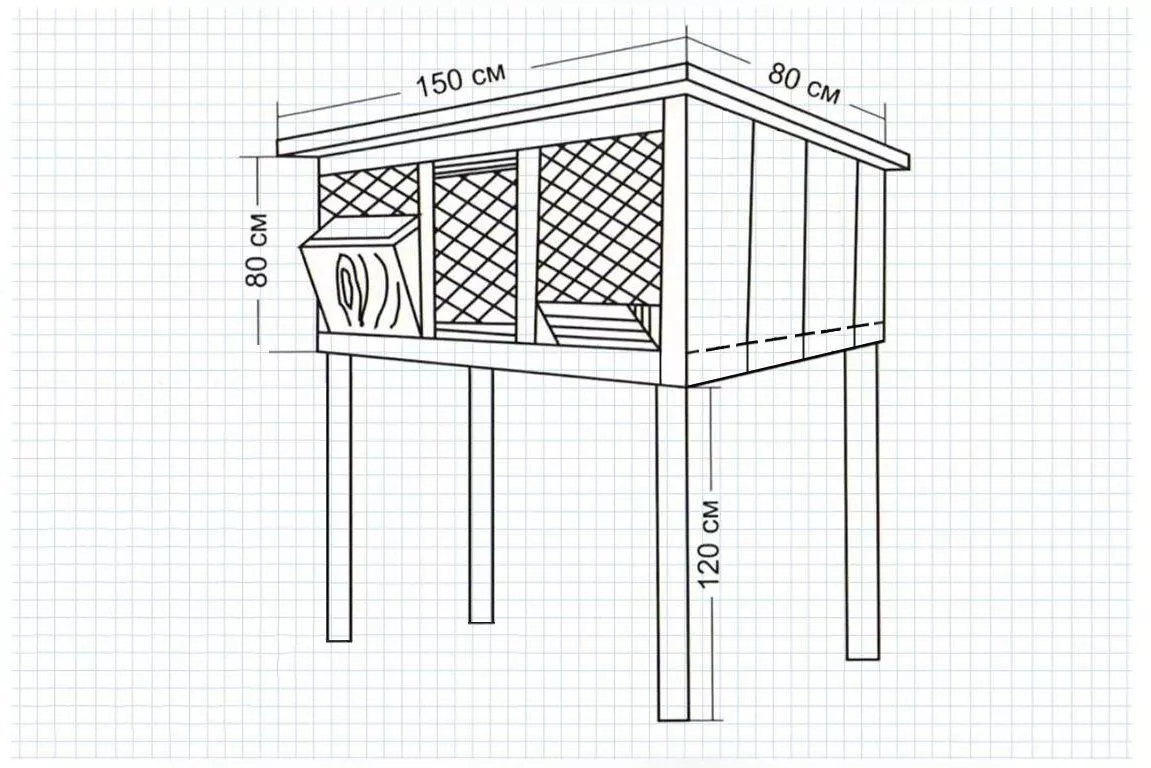
The arrangement of cells on several floors allows for significant savings in floor space.
Cage for males
Males require separate cages to prevent conflicts and fights between them. When building a rabbit hutch, keep in mind that rabbit fertility is directly dependent on sufficient space. Overcrowded conditions will cause males to become less active and lead to obesity. This will reduce the quality of mating.
For a doe with babies
In nature, a female rabbit gives birth in a burrow, where the babies are warm and cozy. Therefore, before this event, it's essential to place the doe in a cage with a brood box. This allows the animals to feel safe and comfortable.
Newborn rabbits are furless, so one of the main requirements for a nest box is to retain heat inside and protect the babies from even the slightest draft.
To build such a cage, use the proposed scheme or create your own according to individual requirements:
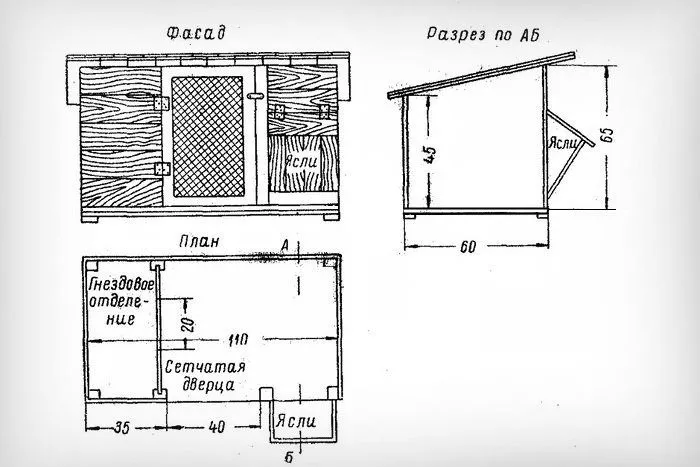
* dimensions in cm
To assemble the cage with a nesting compartment, you'll need boards, plywood, slats, mesh, screws, small nails, a hand saw or jigsaw, and door hinges. Cut the box parts to the dimensions shown in the drawing and begin assembly. The assembly procedure is as follows:
- Make a rabbit hutch frame from slats according to the diagram below:
Use blocks at the corners to add rigidity to the structure. - Cover the frame with boards, making sure the slats are on the inside. Leave the front wall alone for now.
The inside of the rabbit hutch can be lined with plywood. The space between the boards and the plywood can be filled with sawdust for insulation, if required by the hutch's conditions.
- On the front wall, use slats to create a doorway and a space for the manger. Cover the front wall with boards, as shown in the diagram below:
- Cut the partition from a sheet of sanded chipboard according to the dimensions shown in the diagram above.
- Cut the door to size, remembering to allow for clearances so it opens and closes easily. Install the hinges and install the door.
- Make the manger. The top lid needs to be movable, so attach it with hinges.
- It's recommended to install the roof on hinges so that it can be lifted on hot days to allow ventilation of the nesting box. This roof will also make caring for the rabbits more convenient.
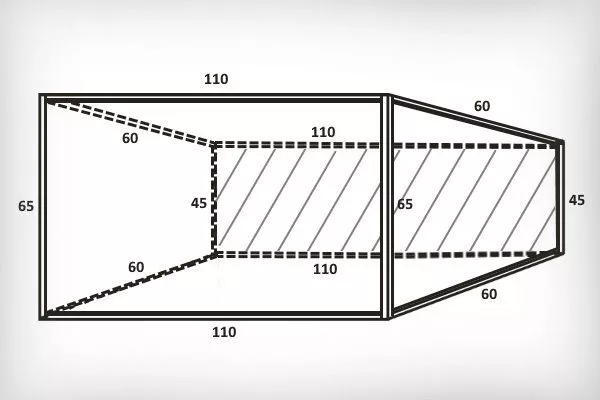
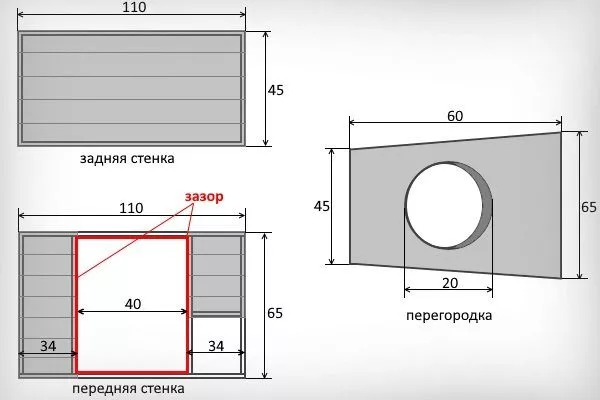
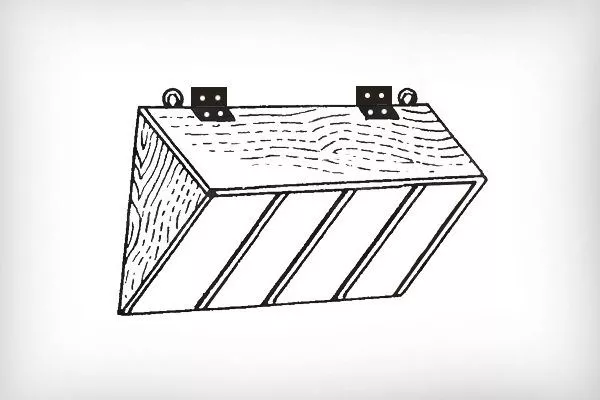
The cage with a nesting box for the female and offspring is ready.
For fattening young animals
Fattening cages are necessary for weaning young rabbits from their mothers after 40 days of birth. These measures are essential because the babies and their mother are already cramped, and there isn't enough milk for everyone.
Initially, the animals are kept together in fattening cages, but when the youngsters reach 3.5-4 months of age, they are separated by sex. Allow at least 0.15 square meters of space per individual.
The sizes of the fattening houses are presented in the table below:
| Cell length, cm | Cell height, cm | Cell depth, cm | |
| Group housing of young animals up to 3.5-4 months | 60 | 30 | 60 |
| Individual housing for fattening older young animals | 30 | 30 | 60 |
This type of dwelling is built from a standard set of materials and requires no specialized knowledge or skills. It's advisable to first create a drawing to avoid errors in cutting the elements and assembling the blanks.
Prepare the following materials and tools for construction:
- wooden boards and beams;
- fine-mesh metal mesh;
- tin sheet;
- canopies and locking mechanisms;
- hammer;
- tape measure and pencil;
- pliers and side cutters;
- screwdriver or drill;
- fasteners (wood screws, nails, etc.);
- saw or jigsaw.
The construction process of a cage for fattening young rabbits:
- Assemble the main frame from wooden beams.
- When building a cage consisting of several tiers, make tin slopes to remove animal waste.
- Make a floor from planks, leaving a gap of 1 cm between them.
- Divide the overall area into individual cells using rectangular pieces of fine-mesh wire mesh, securing them together with wire or rivets.
- Cover the side walls of the frame with wood.
- Assemble the door frame and secure it with mesh. Install two hinges on each door.

- Place the necessary utensils in the house and feel free to move the rabbits into it.
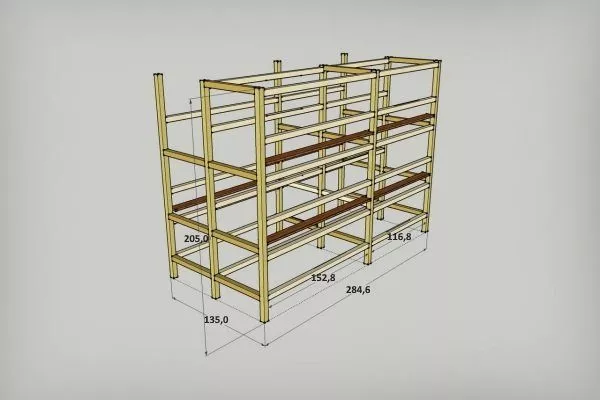
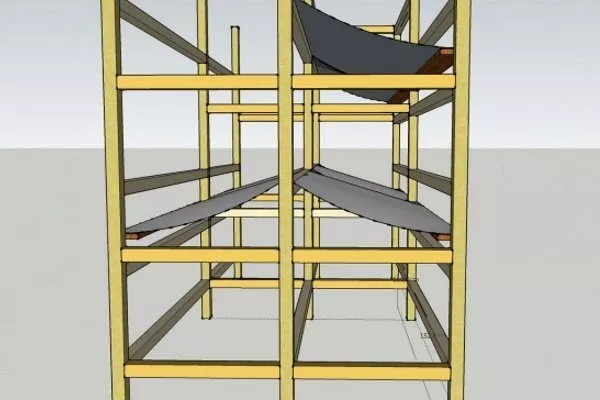
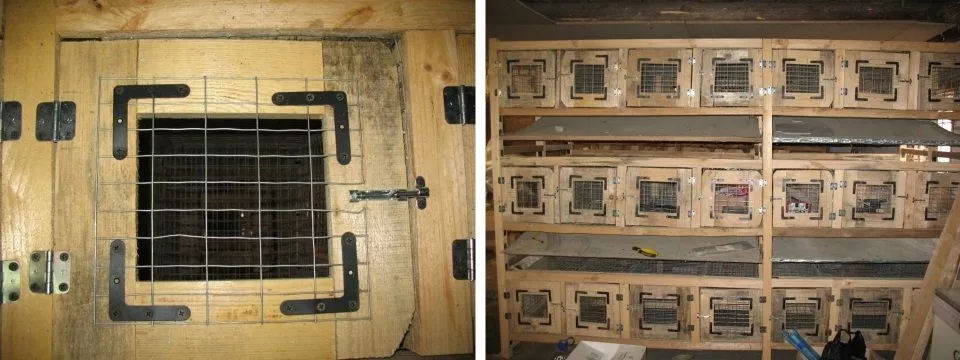
If placing the house outdoors, create a gable roof using slate or moisture-resistant plywood covered with tarpaulin.
Cages for rabbits after weaning
Rabbits under three months of age are often kept in large groups (15-20 animals) in the same area. The hutch differs from adult rabbits' hutches only in size and a special feeding trough. To build such a hutch, follow these tips:
- Build a housing structure similar to the one used for adult rabbits, allowing 0.5 square meters of space for each rabbit. There's no need to divide the house with partitions separating each individual's space. Divide the entire area into a feeding compartment, taking up three-fifths of the space, and a nesting area, occupying the remaining space.
- Cover the nesting area with wood. Create a plywood partition, cutting a hole in it for entry.
- Make the front and bottom of the aft compartment from fine-mesh wire mesh. Secure the doors to additional vertical wooden supports located between the main beams using a pair of hinges. Install the locking mechanisms.
- The feeder is positioned along the entire feeding compartment, with half of it inside the cage and the other half protruding. If the feeder is made of wire mesh, raise it 3-5 cm to prevent the food from mixing with waste and coming into contact with it.
Such a rabbit hutch can easily accommodate up to 10-12 young rabbits.
Two-tier (three-tier) sheds
A shed is a rectangular barn with cages arranged in several tiers. Between the rows of cages, a 1-1.5 m wide space is left, allowing the breeder to access each cage simultaneously. The roof is a gabled slate.
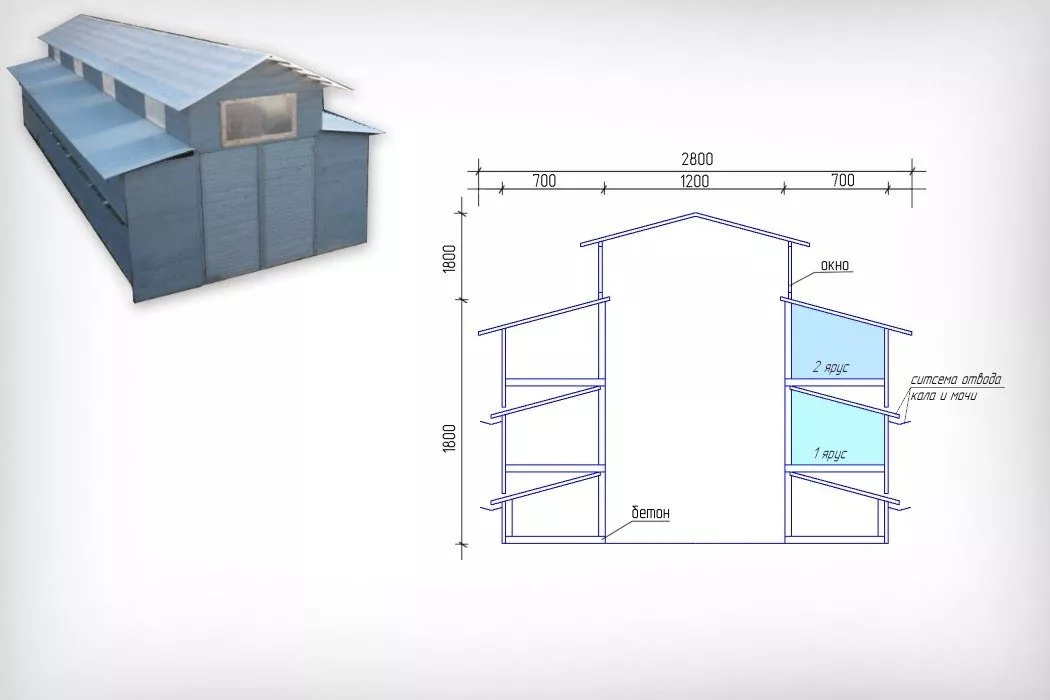
Such structures are very successful in large rabbit farms housing up to 500 animals. Small breeders build shed systems to house 30-50 animals. Building sheds is more cost-effective than building a rabbit barn.
When building sheds, consider some features:
- Sheds should be located under a roof made of slate or other roofing material.
- The basis for the system is a rectangular wooden or metal frame, which provides for the parallel arrangement of rabbit houses on both sides.
- Under the cages there are metal sheets with a slight slope, which ensures that the cages remain clean.
- The bottom tier of cages must not touch the ground. It must be positioned at least 50 cm above ground level to prevent the rabbits from freezing during the winter.
- The use of sheds is advisable in regions where winter air temperatures do not fall below 35°C, and summer temperatures do not rise above 35°C.
Before building, be sure to familiarize yourself with various shed designs and determine the one that best suits your needs. Transfer the drawing to paper, tailoring it to your personal preferences and available materials. The most common design is the classic two-tiered shed, shown in the image below:
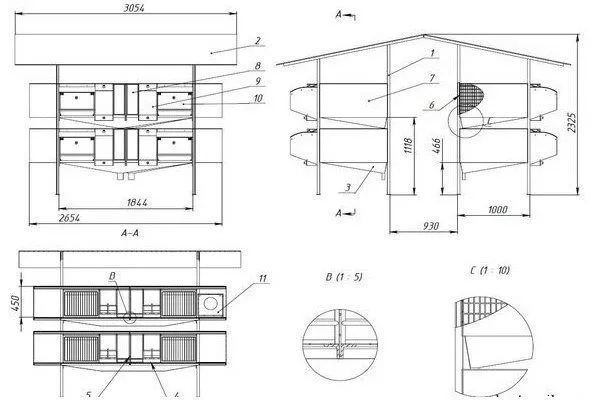
The construction of such a shed involves the following work algorithm:
- Create a sturdy structure of metal and wood. It will support the entire system, so be especially careful and check the vertical and horizontal alignment frequently with a level. Don't skimp on fasteners. It's better to redo something now than to end up with a structure that's unusable.
- Divide the base frame height by the number of tiers you plan to build. Remember that the floor-to-ceiling clearance in the cage cannot be less than 40 cm. When installing tiers, avoid placing them too close together, leaving a distance between them equal to the size of the waste trays.
- Make the floors of the cages out of wood, leaving a distance of 15 mm between the slats.
- Use wire mesh to cover the frame. Install wooden-framed doors with mesh inside on the front side, securing them to the hinges. Provide locking mechanisms.
- Install animal feeding accessories.
- Once the previous work is complete, the only thing left to do is install the roof. Use any available roofing materials. Design the roof in a shape that prevents precipitation and drafts from entering the structure, and most importantly, into areas where animals live.
- Fill the floor inside the shed with concrete, tile, or wood.
Before the winter period, sheds need to be insulated, and if they are located in cold regions, it is recommended to provide a complete heating system.
Shed structures optimize the breeder's work in caring for rabbits and create particularly favorable living conditions for the animals.
Making a rabbit hutch yourself using Mikhailov's method
Igor Mikhailov, a Russian academic, developed an autonomous system for housing rabbits in the 1970s. The design minimizes the breeder's labor and maximizes the animals' living conditions.
Rabbits are kept outdoors year-round, breathing fresh air, and a smart cage ensures proper care. Rabbits raised this way are distinguished by their hardiness, high-quality fur, and accelerated growth.
A simple modification of a cell using Academician Mikhailov's method looks like this:
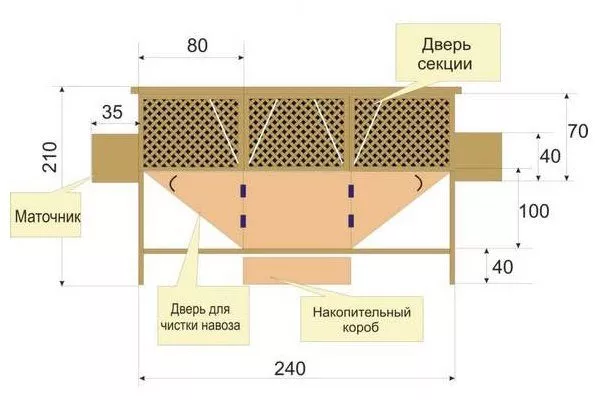
The rear view of the structure is shown in the figure below:
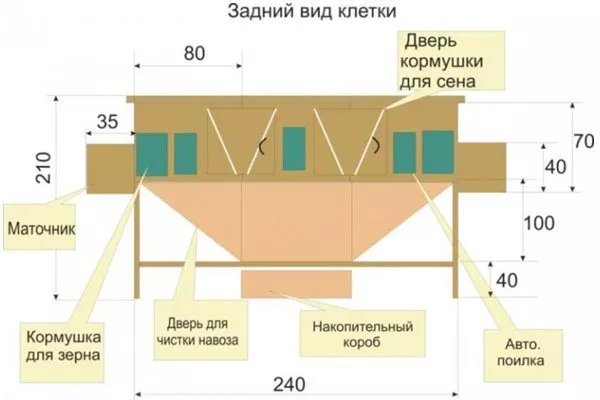
It is possible to build a multi-level house for pets, which will contain up to 20-25 individuals.
The features of rabbitries using this technology include:
- General sealed box for collecting manure.
- The autonomous design allows for heating of feeders and drinking bowls during the cold season.
- The cage has one blank wall - the northern one.
To keep 2 animals, the cage must be made according to the following dimensions:
- total height - 210 cm;
- total width - 240 cm;
- the width of each compartment is 60 cm;
- compartment height - 70 cm;
- height of the uterine compartment - 40 cm;
- width of the uterine compartment - 35 cm;
- the angle of the inclined surface in the waste collection box is 45°.
Building a Mikhailovsky rabbit town doesn't require any special building materials. The range is limited to standard wooden blanks made from lumber, plywood, metal mesh, and sheet metal.
To build such a cage with your own hands, follow several step-by-step instructions:
- Build a stand from a wooden beam. It should be as strong and stable as possible to support the weight of the entire structure and the rabbits. Ideally, it should be built using a metal frame.
Be sure to insulate the base frame by covering it with plywood or other wood. - Assemble the base of the cage and lay a floor of slats in it, with centimeter gaps between them.
- Install drinking bowls and animal feeders.
- Cover the north wall with plywood or OSB. Cover the remaining sides with mesh. Hang the prepared doors on the facade.
- Place a partition for the uterine compartment, making an entrance hole in it.
- Make a single-pitched roof out of any material. It's advisable to cover the wood with tarpaulin or linoleum.
- Build a rectangular funnel-shaped box out of tin to roll away waste and feces.
- At the bottom of the box, install a tray or other container to collect manure.
It's not necessary to strictly follow the dimensions and order of the rooms in the cage. Vary the location of the nest box to suit both the animals and you.
Making a Zolotukhin cage
Nikolai Zolotukhin has long been breeding rabbits, observing them and striving to improve their living conditions to the maximum. As a result of this work, the breeder developed a unique type of rabbit hutch, built using his own method.
For a review of rabbit cages using Nikolai Ivanovich Zolotukhin's method, watch the video below:
Zolotukhin cages provide rabbits with constant fresh air and an optimal amount of light, are easy to build, cost-effective, save space, and make animal care easier.
The design of a rabbit hutch has its own special nuances:
- The cages are arranged in three tiers, with each tier offset back by 10-20 cm. This space is covered with mesh, through which the rabbits' waste flows into a septic tank, preventing it from reaching the cages below.
- According to the rabbit breeder, animals experience extreme discomfort if the cage floor is covered with mesh or slats with gaps. Therefore, his cages require solid wood or slate flooring. Mesh is installed only along the back wall to remove feces.
- The design does not require the queen box to be permanently located inside the cage. During warmer months, a separate space lined with straw serves as the queen cell, and a temporary nest box can be installed during the winter.
- The feeder is attached to the door frame so that half of it is located inside the cage and the other half protrudes outward. This makes it easier to clean and add food.
Nikolai Ivanovich doesn't provide exact cage dimensions, claiming that each rabbit breeder will decide for themselves how much space they can allocate to the structure. Therefore, below we present the average cage dimensions for medium and large rabbit breeds in table form.
| Width, cm | Height, cm | Depth, cm | Mesh width, cm | Floor slope, cm | Doors, cm |
| 200 | 150 | 80 | 15-20 | from 5 to 7 | 40×40 |
The installation of Zolotukhin's rabbit hutch should not present any difficulties or problems during the work, which will require a standard, simple set of construction materials and tools.
To build, follow the following algorithm of actions:
- Assemble a frame base from beams measuring 200 x 80 cm. Install the bases for each tier.
- Cover the floors of the tiers, remembering to cover a 20 cm wide strip at the back wall with mesh. To create a slope at the front of the cage, attach a 5 cm high wooden beam.
- Install slats in the middle of each floor, keeping a distance of 25-30 cm between them. These will be used for feeding troughs for grass and hay.
- It's preferable to cover the back wall with polycarbonate to prevent moisture from the manure from damaging the material. Secure it so that it forms a slope: the top of the first tier wall begins where the grating of the upper tier ends.
- Assemble a common door for all floors and attach feeders to it. Make the doors for the brooding compartment out of plywood to prevent light from entering the nesting area, which could irritate the babies.
- Cover the sides of the cage with thick plywood or other wooden material.
- Protect the wooden corners inside the cage with metal corners to prevent damage by animals.
- For roofing, use slate, laying it so that the edges extend at least 5 cm from the cage walls. This will prevent precipitation from seeping into the cage.
- Prepare the mother box according to the general plan so that you can use it when the cold weather sets in.
- Make the feeders and hay rack and install them. Cover the feeders with sheet metal to prevent rabbits from chewing on the wood.
The cage is ready. It can be placed either outdoors or indoors.
Do you need a cage with an outdoor area?
A house with a run is not necessary, but if it is possible to place it in an area with lush, lush grass, the rabbits will be incredibly happy about it.
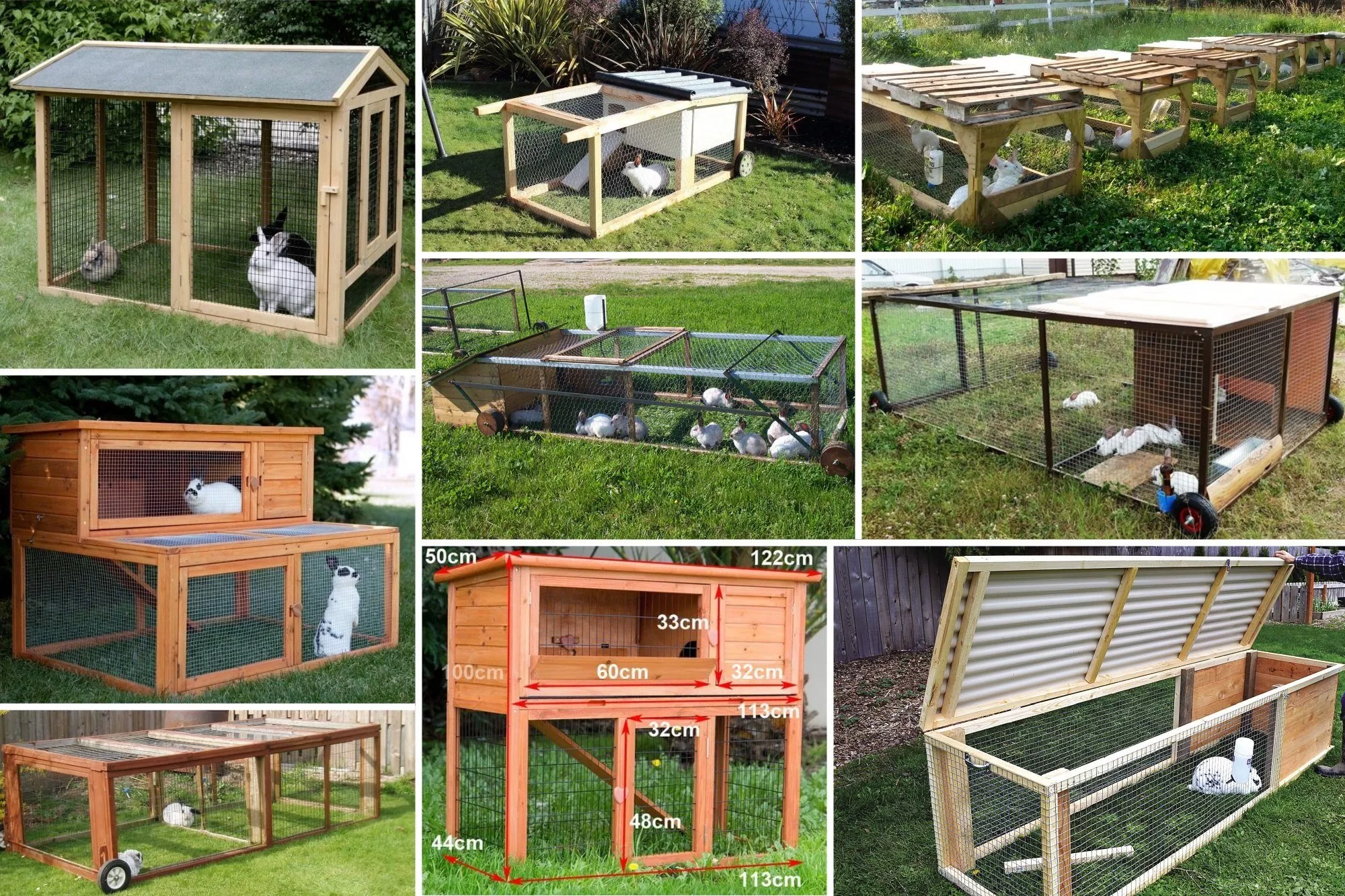
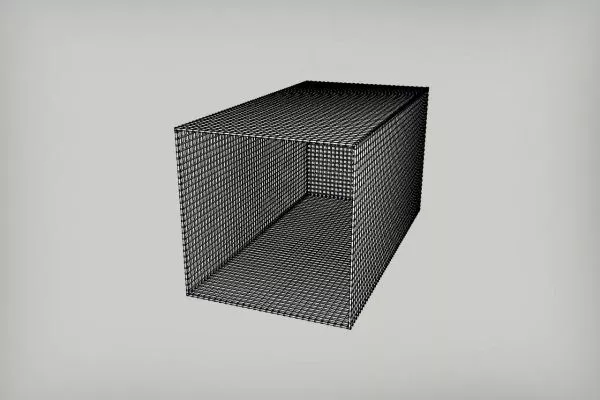
A run can be built separately or attached to an existing hutch. Most often, such a hutch is constructed from wire mesh in the shape of a square structure. Running inside it helps the animals maintain their muscular system, strengthen their immune system, and prevent obesity.
Each breeder decides for himself whether to build a run or not.
Arrangement of the cage
Feeders and waterers are essential items in a rabbit hutch. These can be purchased in stores or made at home. When setting up the hutch, consider the following tips:
- Avoid using plates or other flat containers as feeding accessories. Rabbits will knock them over, contaminating the cage itself.
- Containers made of flimsy, thin plastic will quickly fail due to chewing by animals. Pets can also injure themselves on sharp edges when breaking off fragments or swallowing them.
- Metal containers are stronger than those made of plastic, but the water in them quickly becomes cloudy.
- It is recommended to hang waterers and make them automatic. Ready-made ones are available commercially, in various designs and modifications (throttle, nipple, vacuum, etc.).
- Make hay feeders from mesh.
- Provide feeders for bulk mixtures and vegetables.
- Keep feeding accessories clean.
Building a rabbit hutch yourself is a simple and enjoyable project. The end result will bring satisfaction to the breeder and will ensure comfortable breeding. Healthy offspring, well-fed rabbits with excellent fur and meat quality—all this is possible with a homemade hutch and favorable living and care conditions.