
Rabbit waterers are an essential part of their diet. There are several types, some easy to make yourself, while others are more complex and expensive. This article discusses various options with detailed instructions.
Characteristics and requirements
When making it, you need to take into account the following nuances:
- Safety for animals.Bowls should be free of sharp or pointed objects or sharp edges to prevent scratching. Cans are not suitable (or should be treated to remove any jagged edges).
- Clean waterThe quality of the fluid is important for the well-being of rabbits. It should be free of dirt and debris, and no grass should be present.
- Simplicity and comfortThe water bottle should be easy for your rabbit to use. Make sure the animal can reach the water.
- Rollover preventionAnimals are very active, so the device is securely attached to the cage or to the floor.
Material
Plastic, metal, or stainless steel are all suitable for making drinking bowls. A plastic bottle with a lid can also be used. Metal troughs are also suitable.
- ✓ Consider the material's resistance to chewing by rabbits, especially for plastic drinkers.
- ✓ For metal drinkers, corrosion resistance is important, especially when used outdoors.
Dimensions
The calculation is based on the amount of water the rabbits need. Depending on the number of animals, make a series of identical devices. The daily water requirement per animal is one and a half liters.
Types of drinking bowls for rabbits
Let's consider what types of drinking bowls exist.
| Name | Material | Size | Type |
|---|---|---|---|
| Cup drinker | Metal, plastic | Depends on the number of animals | Open |
| Nipple drinker | Plastic, rubber | 1 liter | Closed |
| PVC pipe drinking bowl | PVC, plastic | Depends on the design | Semi-closed |
| Vacuum drinker | Plastic, tin | Depends on the bottle | Closed |
| Autonomous drinking bowl | Plastic, metal | Large capacity | Auto |
Cup drinker
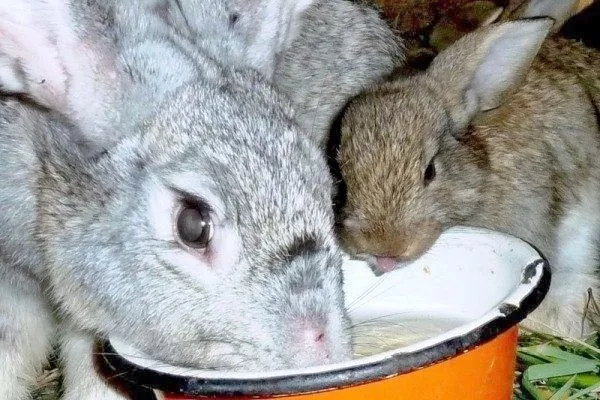
The advantage is the large capacity of the tank, as well as the ease of cleaning and adding water.
There are several disadvantages here:
- Tipping over. Animals are very active, and the bowl won't stay in place for long. To prevent this, secure the bowl to a wall.
- It gets dirty quickly. Since the container is open, grass, dirt, and feces get into it. This type of waterer needs to be cleaned a couple of times a day.
An important aspect: rabbits love to chew on any plastic objects, and metal containers get very cold in winter.
How to make such a drinking bowl?
Metal bowls and cups are suitable, preferably stainless steel. Check the surface; it should be smooth, without any sharp edges that could harm the animal. If there are any sharp edges, file them down with a metal file. Secure the bowl to the side of the cage and fill it with water.
Nipple drinker
The device uses a special nipple for drinking bowls. When the tongue touches the ball or stem, a drop of water appears.
The main advantage of these waterers is that they cannot be tipped over. Furthermore, the water is protected from dirt, spills, and there's no need to constantly change or refill the water.
Cons:
- If you have a large herd, significant costs will be required, since the lids of such drinkers are not durable and quickly begin to leak, in addition, rabbits like to chew on the plastic and rubber parts of the drinker;
- Nipple drinkers dispense water little by little, which can cause rabbits to take a long time to drink, creating a queue, or simply become tired, or even refuse to drink at all, which can lead to dehydration.
How to make a similar drinking bowl?
A medium-sized plastic container, such as a 1-liter bottle, will do. A nipple can be purchased at a store and is inexpensive. The device fits into the lid or threads onto the neck of the bottle.
Watch a video of a breeder making two types of nipple drinkers for his rabbits:
The container is secured to the cage with clamps or wire at the top and bottom to prevent movement. If the container is plastic, it's best to secure it outside the cage to prevent the animals from chewing it.
PVC pipe drinking bowl
The advantage of this waterer is that it refills itself, and the water is protected from dirt and spills. The design is sturdy and fairly simple, making it easy to make yourself.
There are also some downsides:
- If you use a small bottle, you will need to add water frequently;
- rabbits may chew on the water bottle;
- the bottle compresses when the system is filled (it is better to take a bottle made of hard plastic or, for example, a tall glass jar from under pomegranate juice);
- At low temperatures the liquid freezes quickly.
How to make such a drinking bowl?
Prepare the following materials:
- a piece of sewer pipe;
- sewer corner;
- pipe plug;
- plastic bottle.
Cut a rectangular hole in the pipe. Install a plug on one end and a corner piece on the other. Insert a bottle into the open end of the corner piece so that its neck is submerged in water without spilling over the edges of the pipe.
How to make such a drinking bowl is shown in the video below:
Fill the water bowl with water outside the cage before placing it near the rabbits, otherwise everything around them will get wet. Alternatively, attach the water bowl to the outside of the cage.
The following video shows how to install such a waterer:
Vacuum drinker
The device works by using pressure differences. The bottle is tilted upside down and placed in the bowl. Water will evenly fill the bowl as it empties.
The advantage of this design is that it is a simple and inexpensive device, and it is easy to make yourself, since no special materials are required to make the drinker.
Disadvantages of this type of drinker:
- leaks due to improper installation;
- Dirt and grass get into the bowl, so the drinking bowl needs to be washed frequently.
How to make a vacuum drinker?
Prepare everything you need:
- plastic bottle;
- not a tall container, such as a tin can;
- clamps.
Place a tin can in the cage and place a plastic bottle on top, making sure the neck doesn't touch the bottom of the can. Secure the bottle securely with clamps. Some water will flow into the container and cover the neck of the bottle. The pressure difference will prevent the water from leaking over the sides of the can. This way, the can will fill with liquid as the rabbits drink.
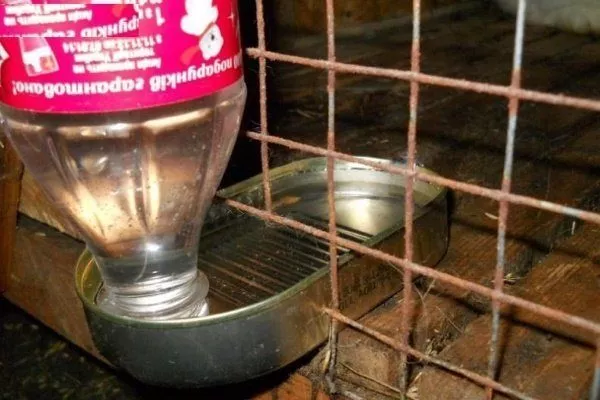
Rabbits love to chew on everything. To make your waterer last longer, make a protective box out of stainless steel and file down any sharp edges to prevent injury. Alternatively, install the waterer outside, as shown in the photo above.
Autonomous drinking bowl
Water from the large container (1) flows through a hose (3) into the tank (5). A float (4) in the tank regulates the liquid level. When the waterers (8) located in the cages (7) become low on water, the system refills automatically, effortlessly.
Additionally, you can install a filter (2) at the large-capacity outlet to purify the water (if tap water or water from a silted-up well is used). You can also install a drain plug (9) at the end of the main pipe (6) to allow water to be drained and the tanks to be cleaned.
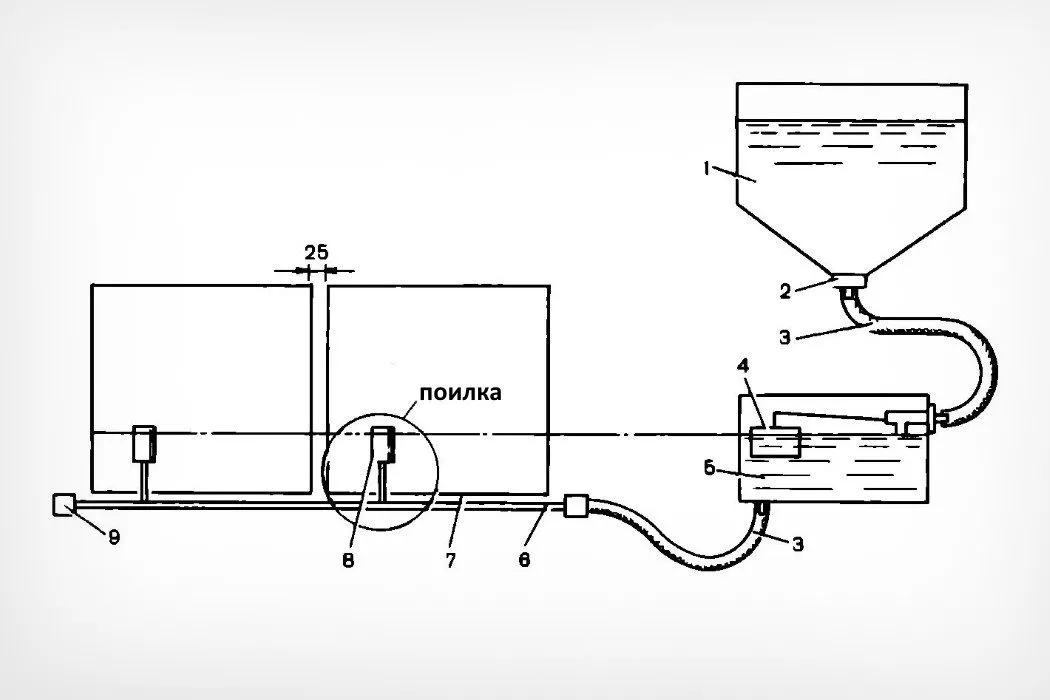
The advantage is the convenience and autonomy of the waterer. If you have a large flock of rabbits, it's worth considering an automatic waterer. The animals always have a fresh supply of liquid, and the maintenance time required is minimal.
The disadvantage is the high price (the device is unprofitable for small farms) and the complex design to make on your own.
Making a stand-alone drinking bowl
If you decide to make a stand-alone waterer yourself, you will need the following elements:
- large capacity;
- tank;
- float system, like in a toilet cistern;
- plastic hose or tube;
- small diameter plastic pipe;
- plug;
- drinking bowls (“glass”);
- filter (if necessary).
The water tank is installed above the cage level to allow the liquid to drain downward. A distribution (main) pipe leads to each cage, which is then installed in the waterers.
Winter drinking bowl
During the cold season, rabbits need warm water. There are several devices that can help warm the water:
- Aquarium thermostatYou can buy it at a pet store and place it inside a closed container with water.
- Heat retentionTo insulate the drinking bowls, you can wrap the containers with warm cloth.
- Underfloor heating systemThis technology can be used to maintain optimal temperature in the cage.
This way, rabbits will drink water at a comfortable temperature even in winter.
Care and cleaning of drinking bowls
Place water bowls so that they are easy to refill and clean. Avoid placing the bowl in the far corner of the cage.
Cup and vacuum devices need to be cleaned a couple of times a day, as they quickly become dirty. Nipple, bottle, and stand-alone drinkers don't require frequent maintenance and should only be cleaned as needed.
- ✓ Use thermal insulation materials to insulate drinking bowls during the cold season.
- ✓ Check the water temperature regularly to avoid freezing.
How to teach rabbits to use a water bottle?
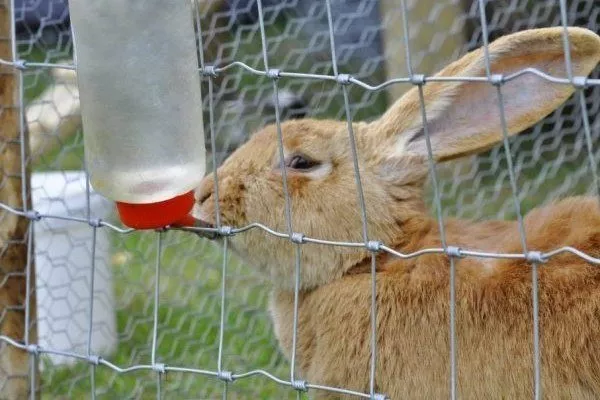
Using bowl waterers shouldn't be difficult. However, you'll need to get your rabbit used to a nipple water system. To do this, follow these tips:
- First, make sure the device is working. Touch the ball and see if water drops come out.
- When your rabbit first moves into the cage, give it time to settle in. A few hours is enough.
- Carefully pick up your pet, being careful not to startle it. Place it near the water bottle. Follow these steps: touch the ball, wet your finger with water, and lubricate the pet's nose and mouth. Repeat.
- It may happen that the animal doesn't approach the waterer. In this case, lubricate the nipple with something fragrant that might attract the rabbit. This could be carrot juice or milk.
- During training, do not shout at the rabbit. Raising your voice will frighten it, which may prevent it from coming near the water bowl. Successful training requires patience and determination.
- Monitor the water supply. If it doesn't decrease, the animal isn't drinking. Dehydration can kill it. In this case, check the nipple's functionality and observe whether the rabbit has learned to use it.
For a small flock of rabbits, simple, budget-friendly options that can be easily constructed from household items are suitable. For single rabbits, a ready-made nipple waterer from a store is a suitable option. If you have a larger flock, consider stand-alone waterers, which significantly simplify animal care.