
With the onset of cold weather, domestic goats are moved to a barn. In winter, it's important to provide the animals with a suitable habitat and food, which differs from what they need in summer. The specifics of keeping goats in winter are discussed further in the article.
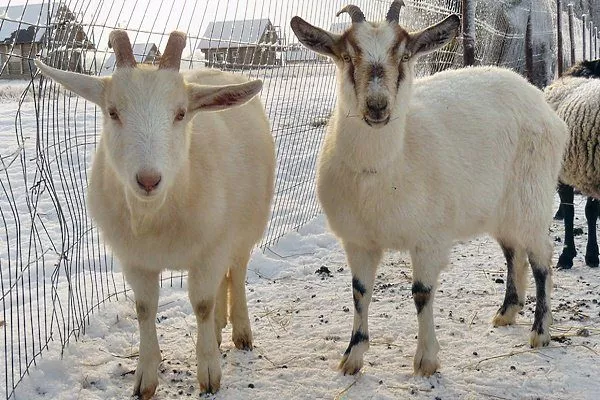
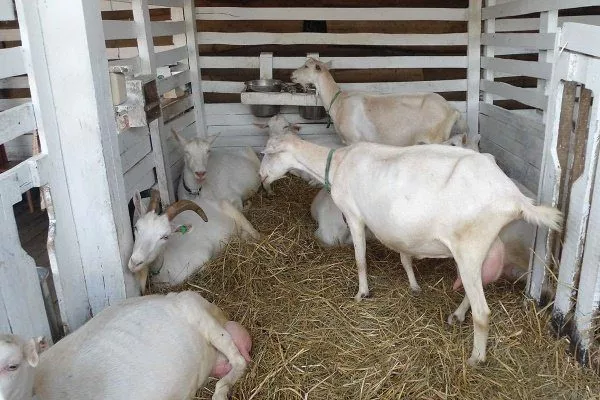
Shed for wintering goats
The main requirement is a dry barn free of drafts. Heating in the barn is only necessary when raising newborn kids. Adult goats regulate their own body temperature, so they tolerate freezing temperatures well in unheated rooms.
During the winter, they are kept in stalls, and it is important for the owner to take care of the living conditions and stock up on nutritious food.
- ✓ Humidity levels should not exceed 70% to prevent respiratory diseases.
- ✓ The temperature regime should be maintained in the range of +5°C to +10°C for adults.
When building a goat house, it is necessary to take several points into account:
- place it away from garbage dumps and manure pits;
- the presence of windows is essential, natural light should enter the barn in large quantities;
- The room must be dry, as animals do not tolerate humidity. Moreover, drafts can easily lead to pneumonia—an inflammation of the lungs.
This is why wood is used for construction; it retains heat better, while concrete or brick retain more moisture and dampness.
Winter maintenance conditions
The optimal barn temperature is +7°C for adult goats and +10°C for goats with kids. At lower temperatures, goats should be provided with warm clothing. This is done by placing old jackets or coats over their front legs and fastening them at the back. The emphasis is on protecting the animal's chest to prevent the development of colds.
Each animal requires its own space. Goats are freedom-loving animals, so they need ample space. The stall space required per animal varies depending on the individual animal:
- kid from 6 months to 1 year old - 1.2 sq. m;
- for a barren goat and a stud goat - 2 sq. m;
- female with cubs - 3.5 sq. m.
There are two types of feeders. Roughage (hay and straw) is placed in the manger, while concentrates and vegetables are placed in special individual feeders. These are installed 40-50 cm above the floor.
Preparing the barn for winter
To ensure that wintering for goats goes smoothly, prepare the goat house following these recommendations:
- It's better to have several small windows on the south side of the goat house than one large one. They should be installed at a height of more than 1.5 meters, otherwise the jumping goats might accidentally knock them down with their hooves. For the winter, they should be insulated, and all cracks should be sealed.
- Ventilation is also an important part of the barn, as it allows air to circulate and removes excess moisture. This is especially important during cold weather, as manure in the stalls is removed less frequently to conserve heat.
The optimal option is to equip the room with two ventilation systems.One is located in the form of a quadrangular pipe under the roof of the goat house, through which stale air is removed. A second pipe or several holes are made below the floor at the beginning of the walls, due to which fresh and clean air is constantly supplied to the room and circulated. - To conserve heat, dampers are installed in winter. Some farmers install special filters that warm the incoming air.
- The walls are whitewashed with lime mortar and repainted twice a year. They are insulated using the traditional method of sawdust or wood, or a more modern method is used, such as adding an additional artificial wall.
- Animal beds (sleeping areas) are attached along the insulated walls—70-80 cm long and 50-60 cm wide. These serve several purposes: the goats have a luxurious place to rest, their fur gets less soiled with manure and bedding, and the risk of catching a cold is reduced. The beds should also be whitewashed.
- It's recommended to use a plank floor, as it's easier to clean manure. However, this doesn't mean concrete, clay, or earthen floors are out of place. The floor should be raised 20-25 cm and sloped (2 cm per square meter of floor space) to allow the manure to drain away. To remove it from the shed, it's recommended to dig trenches that will direct the waste directly to cesspools.
- The floor is covered with a thick layer of bedding made from natural materials—peat, sawdust, hay, dry leaves, straw, or moss. If the barn doesn't have bedding, the animals will have to sleep on the floor, so the flooring must be carefully chosen.
- A well-lit entryway is provided in front of the goat barn entrance. This prevents the room from becoming too cold.
- Check and repair the ventilation system a month before the onset of cold weather.
- Prepare a sufficient amount of bedding material at the rate of 1 kg per animal per day.
- Organize a walking area with protection from wind and precipitation.
Winter walks
Goats are active animals and need exercise even in winter. To allow the animals to get outside for exercise in good weather, a small yard is built next to the barn. When the temperature does not drop below -10°C and there is no wind, they are fed here. The yard is designed to be 5 square meters per animal.
The breeder shares what a yard for walking goats in winter should look like in the video below:
Daily walks and exercise help improve the overall health of animals.
Feeding goats in winter
Winter diet for goats undergoes significant changes. The following rules are followed:
- They increase the proportion of roughage and grain feed and reduce the amount of light feed (they are used as supplementary feed).
- The number of feedings varies from 2 to 4 times a day.
- Since goats are ruminants, their primary food is hay and straw. These should always be available in the manger so the animal can feed at any time.
- The diet is structured so that hay, twigs, and straw account for the majority of the food. Meadow or forest hay made from young plants is considered the most beneficial. Juicy vegetables, both fresh and cooked, are a must, and apples and pears are preferred as fruit.
- Vegetables are also added to the feed, which can be partially replaced with oilcake or bran. A dairy goat requires up to 1 kg of this feed.
- Or they feed grains of cereals and legumes. They must be pre-processed in some way to improve digestibility: crushing, sprouting, fermentation, or roasting. Experts do not recommend feeding whole grains to animals, as they negatively affect the digestive process.
- Feeding goats large amounts of concentrated feed—compound feed, grain, or food scraps—is contraindicated, as they can trigger the development of urolithiasis. When purchasing compound feed, choose feed specifically designed for goats. Its composition is balanced and meets all their body needs. It is usually fortified with ammonium chloride.
- To prevent urolithiasis or urolithiasis, goats should be fed and maintained accordingly. If the disease begins to develop, phosphorus-rich concentrates should be reduced or eliminated entirely. The proportion of green fodder should be increased, micronutrients such as cobalt, zinc, manganese, and copper should be added, and adequate water should be provided.
- The main succulent feeds are potato tubers, cabbage leaves, and root vegetables, particularly fodder beet. Potato tubers are boiled and fed up to 2 kg per day. Other vegetables are pre-chopped and fed raw, up to 2-5 kg.
- Cabbage tops and leaves are sources of vitamins. However, when feeding beet tops, chalk is added. For every 1 kg of greens, use 1 g of crushed chalk. It effectively neutralizes the various acids found in the leaves.
| Type of feed | Energy value (kcal/kg) | Protein content (%) |
|---|---|---|
| Meadow hay | 2000 | 8 |
| Straw | 1500 | 3 |
| Compound feed | 2500 | 15 |
It is better to mix all feeds with hay, it helps to more fully absorb vitamins and other nutrients.
Brooms are prepared from tree branches:
- aspen;
- rowan;
- maple;
- ate;
- willows;
- acacia;
- birch trees;
- raspberries;
- willows;
- nettles.
For one animal, 80 brooms are sufficient. Birch twigs are fed in limited quantities, always alternated with other species. If for some reason they are not harvested in time, they are replaced with leafless branches of deciduous trees. These contain many nutrients essential to the animal.
Some farmers play it safe and add vitamin complexes directly to the food of high-yielding, pregnant (pregnant), sick and weakened goats.
How much and what kind of food is required for one adult individual for the winter:
- hay, straw, twigs - 500 kg;
- concentrates - 200 kg;
- vegetables - 200 kg;
- mineral supplements - meat and bone meal, dry milk, chalk - 5 kg;
- salt - 3-4 kg.
When it comes to drinking, it's best to install heated waterers. Goats are quite hot animals, with a normal body temperature of 40°C (104°F), so they drink hot water. Water should be readily available, especially for males, as they are prone to urolithiasis.
You can find more information about goat nutrition at different times of the year. Here.
What diseases can goats get during the cold season?
In winter, goats are susceptible to developing the following diseases:
- Helminthiasis. Goats can harbor worms year-round, but in winter, their presence negatively impacts their overall health—they become weaker, their immune system malfunctions, and feed is poorly digested. All animals must be dewormed before winter.
- Frostbite. Goats that are out for walks in winter are not immune to frostbite in their most sensitive body parts, such as the udder or ears in long-eared breeds. To reduce the risk of frostbite, the most vulnerable parts should be thoroughly coated with Vaseline, a rich cream, or a special ointment. Goats should not be allowed out of the barn if the temperature drops below -10°C.
- Hoof injuries. Animals love to frolic, and nothing can stop them—neither snow nor ice. After each walk, the condition of their hooves is checked, as they can become clogged with snow or damaged by sharp edges of ice. The yard is promptly cleared of snow and ice.
You can study information separately on goat diseases. here.
In winter, goat care revolves around proper feeding and creating comfortable conditions in the barn. The most important thing is to avoid drafts and dampness. This way, the animal will survive the winter without adversely affecting its milk yield.