
Nutrition in the first days and weeks of a kid's life affects not only the animals' future health but also their productivity. Feeding rules and methods are discussed below.
Activities before the first feeding
Before feeding the kid for the first time (after its birth), the following steps should be taken:
- Cutting the umbilical cord.
- Wiping the newborn kid with a dry and sterile towel.
- Remove mucus from the kid's mouth and nostrils to prevent it from entering the lungs. Failure to do so increases the risk of infection.
- Washing the udder with warm water.
- Milking a few streams of colostrum. The first few streams are the most dangerous, as they may contain pathogenic microbes.
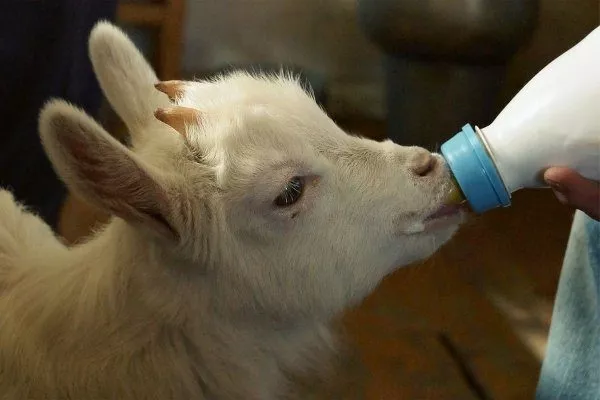
- Feeding begins from the first hour of life. Feeding is done directly from the udder or from a bottle with a nipple.
- ✓ The temperature of colostrum must be strictly 38-40°C to prevent the kid from refusing to feed.
- ✓ The bottle and nipple must be absolutely sterile to avoid infections.
The kid is covered with a warm blanket to keep warm. Newborns have problems with heat exchange; their skin is not yet able to retain and absorb heat.
Colostrum is essential for kids—it builds their immunity for life. The first portions of milk—colostrum—are rich in easily digestible protein, fats, and enzymes necessary for digestion.
A mother goat must lick her kid—this is not only beneficial for the newborn's joints and muscles, but also for future lactation. Licking initiates milk production.
If a newborn doesn't receive colostrum within the first hour of life, it will be stunted and unsuitable for replenishing the herd. Delaying the first feeding by 2-3 hours results in a 50% mortality rate for the young.
Options for feeding kids
There are two main methods for feeding kids: with or without a mother. The choice depends on the goats' productivity and the purpose of raising them—for milk or to increase the herd. If the farmer is interested in high milk production, the kids are hand-fed. If high milk production is not required, the task is simpler—the mother does the feeding.
Kids from low-yielding mothers are raised under their mothers. The kids stay with these mothers for up to 3-4 months.
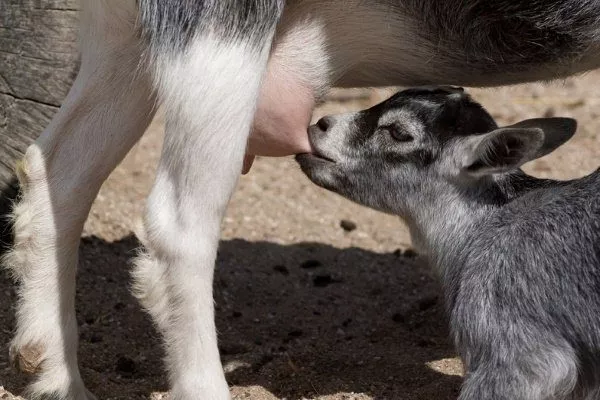
Under the uterus
This is the simplest and most convenient option for both the animals and their owners. By leaving the kid with its mother, you're freed from the painstaking task of feeding—the kid, with free access to the udder, will receive everything it needs for growth, development, and immunity.
When nursing kids under the mother, a person doesn't control the rate and volume of milk, but they do monitor the udders. After suckling, milk remains in the mammary glands, which must be removed to prevent mastitis.
At first, a kid feeds exclusively on its mother's milk. As it matures, its diet changes. Starting at three weeks, it is fed mineral supplements—salt, bone meal, and chalk. These components are essential for calcium absorption and bone strength. The animal is given 10 grams of these products per day. At three months, the amount doubles.
Advantages of breastfeeding:
- kids develop strong immunity
- the nutritional value of milk is higher than when fed from a bottle;
- kids grow and gain weight quickly;
- reducing the time spent caring for kids;
- The learning ability of young animals improves – they quickly learn to eat adult food and get used to the order on the farm.
We recommend watching a video where a breeder talks about feeding kids:
Disadvantages of breastfeeding:
- the risk of mastitis in goats increases;
- Due to damage to the rudimentary nipples, the queens develop painful swelling, and the animal has to be treated with medication.
Artificial feeding
If the kids are to be raised without a mother, they are removed from their mother after birth. The kids are hand-fed with warm colostrum from a sterile bottle with a nipple. The colostrum is milked by hand and given to the kids when they are fresh. Bottle-fed kids are fed five times a day for the first 10 days.
If the mother's milk runs dry, replace it with cow's milk or store-bought pasteurized milk. Whole milk can be replaced with Kormilak. You can also prepare your own formula for kids. The first feeding is at 5-6 a.m., the last at 9 a.m. The optimal milk temperature for feeding is 38°C. Bottles with nipples, bowls, and saucepans are used for feeding; rinse with boiling water after use.
Advantages of artificial feeding:
- the possibility of dietary correction;
- Goat milk is sold and not spent on young animals.
Disadvantages of artificial feeding:
- wasting time and money on purchasing artificial nutrition;
- animals develop a weaker immune system than when fed naturally;
- Saving on food often leads to slow development of kids.
An approximate scheme for feeding young animals is given in Table 1.
Table 1
| Age | Number of feedings | Amount of milk for one feeding, g | Estimated time |
| Day 1 | as needed | as needed | as needed |
| 1 week | 6 | 300 | 8, 11, 14, 17, 20, 23 |
| 2-3 weeks | 5 | 300 | 8, 12, 16, 20, 23 |
| 4-6 weeks | 4 | 600 | 8, 12, 16, 20 |
| 7-8 weeks | 3 | 600 | 8, 14, 20 |
| Week 9 | 2 | 600 | 8, 20 |
| Week 10 | 1 | 600 | as needed |
Bottles or buckets with nipples are used to feed young animals. Feeding from cups or troughs is not recommended, as they can choke if they swallow too much milk. Furthermore, swallowing large amounts can cause the milk to curdle in the digestive system, leading to diarrhea and exhaustion.
Baby bottles, like those used for human babies, are suitable for feeding kids; they can be purchased at pharmacies or baby stores. To optimize the feeding process, it's best to use special devices—buckets with attached nipples. A single device can "feed" several kids at once.
Table 2 shows comparative characteristics of feed for kids.
Table 2
| Type of feed | Fat, % | Protein, % | Peculiarities | Cost, RUB/kg |
| Whole goat milk | 3.6 | 3.2 | The best option for kids | 40-80 |
| Whole cow's milk | 3.4 | 3.2 | It is less digestible than goat's milk. | 20-40 |
| Dry milk (DMP) | 25 | 25.5 | Incomplete vitamin and mineral composition | 160-200 |
| Felutsen milk replacer for kids | 12 | 22 | Contains vegetable fat | 100-120 |
| Baby formula | 4.5 | 12 | It's expensive | 500-2000 |
Combined feeding
The method combines artificial and natural feeding:
- For the first 3-4 days, newborn kids live close to their mother, suckling. During this time, the kids strengthen their immune systems.
- On the fifth day, the kids are removed from the mother and transferred to artificial feeding. The mother is then milked, achieving high milk yields.
The health of kids can be assessed starting at one month of age. Before this time, it's difficult to detect weakness in an animal. To stimulate growth, weakened kids are given concentrated feed—at one month, their stomachs can handle this type of food. Weakened animals receive 30-50 grams of concentrate daily.
Feeding rules and diet by age
Goat kids' nutrition depends on the type of feeding and their age. From the first day of life until adulthood, their diet changes qualitatively and quantitatively. Table 3 shows the approximate amounts of milk and feed consumed by kids of different ages.
Table 3
| Age, days | Feedings, once a day | Amount of milk per feeding, g | Daily requirement of milk, g | Liquid oatmeal, g | Mixtures of concentrated feeds, g | Root vegetables, g | Hay, g | Table salt, g | Chalk, g |
| 1-2 | 5 | 100 | 500 | — | — | — | — | — | — |
| 3-4 | 5 | 140 | 700 | — | — | — | — | — | — |
| 5-6 | 5 | 180 | 90 | — | — | — | — | — | — |
| 7-10 | 4 | 250 | 1000 | — | — | — | — | — | — |
| 11-20 | 4 | 300 | 1200 | 200 | — | — | to my heart's content | 4 | 4 |
| 9:30 PM | 4 | 300 | 1200 | 300 | 40 | — | to my heart's content | 4 | 4 |
| 31-40 | 3 | 350 | 1050 | 400 | 50 | 100 | 100 | 5 | 5 |
| 41-50 | 3 | 250 | 750 | 500 | 100 | 150 | 150 | 5 | 5 |
| 51-60 | 3 | 200 | 600 | 600 | 15 | 200 | 200 | 5 | 5 |
| 61-70 | 3 | 150 | 450 | 500 | 200 | 250 | 250 | 6 | 6 |
| 71-80 | 2 | 150 | 300 | — | 250 | 300 | 300 | 6 | 6 |
| 81-90 | 2 | 150 | 300 | — | 300 | 400 | 350 | 6 | 6 |
Feeding newborn kids
Newborn kids are fed colostrum and milk 5-6 times a day. During the second week, the number of feedings is reduced to 4 times. Feeding guidelines:
- For the first 4 days, kids are given 200 g of milk.
- On the 5th day give 250 g, on the 6th – 300 g.
- From the 11th day, if the kids' milk is not enough for them, their diet is supplemented with liquid oatmeal or semolina porridge. Add 1 tablespoon of oatmeal to 0.5 liters of water. A small amount of milk is added to the cooked porridge.
Feeding 2-week-old kids
From two weeks of age, kids can eat hay, and if fresh grass is available, they can also be fed that. Early exposure to roughage helps kids' stomachs adapt more quickly to the adult goat diet.
Starting at three weeks of age, kids are given a "growth elixir"—fish oil. To create a vitamin-rich drink, 15 grams of fish oil, 10 grams of salt, and 2-3 eggs are diluted in milk. The prepared feed is fed little by little, gently warmed.
After two weeks of age, kids are introduced to chalk, bone meal, and concentrated feed. They are then given finely chopped root vegetables. The initial portions should not exceed 20-30 g.
There are specially formulated feeds for kids. Experienced goat breeders often prepare their own feeds. Here's an example of feed for 2-week-old kids:
- rolled oats;
- bran;
- chalk;
- bone meal.
Feeding month-old kids
Starting at one month of age, kids' milk is diluted with water. To gradually replace the diet, flaxseed meal or bran is added to the liquid feed. Boiled potatoes are often added to increase nutritional value. From one month on, kids can be taken out to pasture.
If it's winter, kids are given hay and stored vegetables. They are fed washed carrots, beets, and cabbage leaves. From two months of age, the mainstay of the young goats' diet consists of grain, succulent feed, and roughage. Milk consumption at this age decreases to 30%. By three months of age, the kids are offered an adult "menu."
Diet for a 3-month-old goat
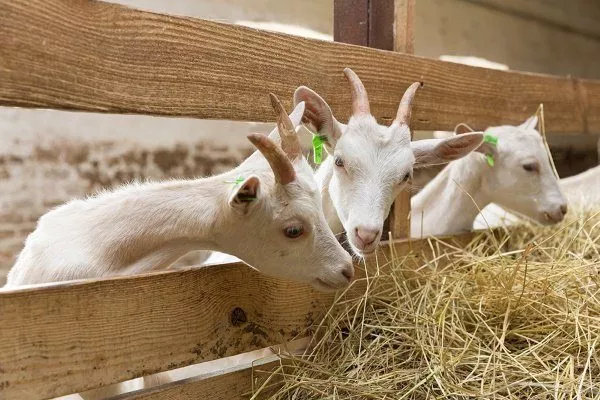
By three months, the kid is transitioned to an adult diet. Milk is not on the menu for young kids reaching this age. Instead of milk, kids eat:
- grass;
- branches;
- silage;
- hay and straw (in winter);
- vegetables and root vegetables;
- concentrated feed – 200 g;
- ground grains - alternately oats, corn, wheat;
- legumes and their tops (peas, beans, asparagus);
- vitamin and mineral complexes.
If goats are eating with gusto and rapidly gaining weight from three months of age, there's no need to restrict their feed. It's likely that the animal will develop into a highly productive dairy goat.
Feeding with whole milk replacer
If a goat dies after lambing, the farmer is responsible for raising the kids. On a large farm, the breeder uses milk from other goats to feed the kids. Farmers often stockpile colostrum in case of the loss of a goat.
On large goat farms, kids are fed whole milk replacer (WMR). The replacement is selected based on the age and species of the animal. There is a special goat milk replacer designed for kids. Feeding kids WMR for calves is not recommended; it will not only provide no benefit, but may even be harmful.
Rules for using ZCM:
- The amount of water given should be appropriate for the kid's age. Avoid overfeeding. If the kid overeats, it will develop diarrhea, which can be fatal.
- As the feeding volume increases, the frequency of feedings decreases. The older the kid, the less frequently it should eat.
- Formulas cannot replace colostrum. If the mother goat dies, the newborn should be given colostrum from another sow or from the freezer (warmed).
- Young animals are gradually transitioned to milk replacer to avoid gastrointestinal upset. It's important to remember that milk replacer contains antibiotics, which can cause gastrointestinal upset.
- If you can't find colostrum or whole milk replacer, you'll have to resort to cow's milk. Kids fed on cow's milk survive, but are significantly less productive and healthy than kids raised under a mother.
- When introducing milk replacer, it's important to ensure the waterers are clean. They should be positioned so that the kids don't contaminate the water.
Recipe for the mixture
Growing kids on milk replacer takes one and a half months. During this period, each animal consumes approximately 9 kg of dry mix. Here's how to prepare the mix:
- The dry mixture is mixed with water - 5 liters per 1 kg.
- Stirring continuously, heat the mixture over a fire to 40-45 °C.
- After straining, feed the warm mixture to the kids. Straining is necessary to remove lumps.
Daily intake of milk replacer:
- From 1 to 7 days – 900-1200 ml.
- From 1 to 3 weeks – 1300-1600 ml.
- Up to 2 months – 1700-1900 ml.
Then the kids are transferred to an adult diet and do not need milk replacer.
Feeding pasteurized milk
Instead of milk replacer, you can use naturally pasteurized goat's milk. Pasteurization destroys all microbes in the milk, making it completely safe and suitable for feeding kids.
Pasteurization is carried out using two methods:
- FastMilk is heated for 30 seconds to 74 °C.
- Slow. The milk is heated to 64°C for half an hour.
| Method | Temperature | Time | Efficiency |
|---|---|---|---|
| Fast | 74°C | 30 sec | High |
| Slow | 64°C | 30 min | Very high |
To prepare pasteurized milk, use a regular stove or a household pasteurizer. After pasteurization, the milk is cooled. The container into which the milk is poured must be sterile. Any object that touches the milk must be sterilized.
Colostrum is heated using a different technology: it's heated to 56°C and then held for 60 minutes. This heating process kills all harmful microbes, while the nutrients the kid needs remain active.
Feeding from a pot
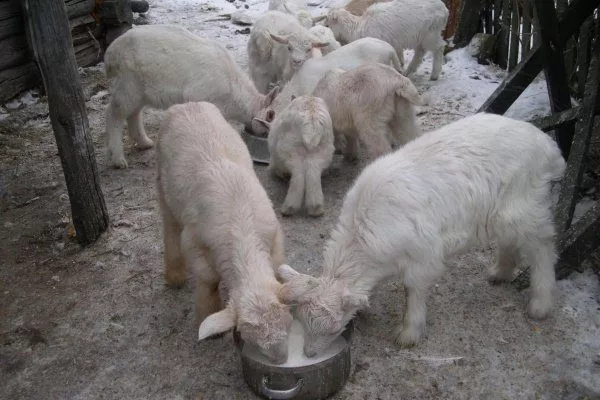
From the very first days of life, kids can be taught to drink milk independently. Feeding from a pan is not the most popular method. However, young goats are extremely happy with this feeding method, as they can drink as much milk as they want at any given moment.
What to feed a sick kid?
Not all kids are born healthy. Signs of a sick kid:
- weighs less than 2 kg;
- can't stand on his feet;
- eats without appetite;
- doesn't hold his head up well.
The condition accompanied by the above symptoms is called antenatal hypotrophy.
If the kid isn't from a close relative and the mother didn't have a magnesium deficiency, it can be saved. Here's how to care for a sick newborn:
- Weakened and sick kids are given Gamavit or Katozal, which contain placental extract, as well as vitamins and immune-boosting substances. These medications treat anemia and boost metabolism.
- If the kid is unwilling to eat, colostrum is administered orally using a syringe. 50 ml of colostrum is injected at a time. Once the kid is strong, it can be fed from a nipple or bowl.
- Sick kids need improved living conditions. The kid is kept in a box with a thick layer of bedding at the bottom. To prevent hypothermia, the kid is given a heating pad and covered with warm blankets.
- Overfeeding sick kids with colostrum is strictly prohibited. If the animal does eat more than the recommended amount, you will have to skip the next feeding, halving the normal portion.
Useful tips for farmers
Please note the following recommendations from experienced farmers:
- It is recommended to give a dill infusion to a goat after lambing. To prepare the infusion, take several large dill sprigs, salt (1 tablespoon), and sugar (150 g). Give the infusion warm – about 40°C. This drink helps the goat recover more quickly after lambing.
- After milking the goat's colostrum, it is warmed in a water bath. Do not heat colostrum in a microwave.
- The first day passes without any rationed feeding. The kid eats frequently. The first feedings are every hour.
- As early as the second day of life, the kid can emerge from the kennel. Kids are curious and active, and they quickly begin to develop muscles. At three days old, a kid can walk up to 1 km.
- After weaning the kid from the mother, the mother is milked 4 times a day to produce more milk.
- Young fish should have access to clean water from birth. The water should be at room temperature.
Lambing is a crucial event for any farm. The birth of kids adds to the farmer's workload, especially when they are bottle-fed. Proper nutritional care for kids is the key to raising healthy and highly productive goats.