
Goat farming is considered a profitable business, bringing not only income and products, but also a great deal of interest. Goat breeding is a serious endeavor—it's essential to know how to care for the animals and what to feed them depending on the season.
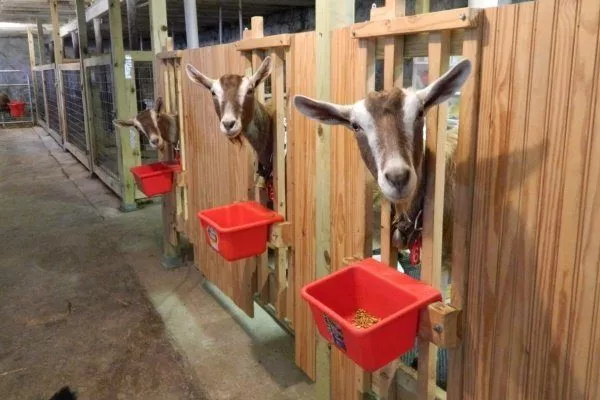
Prospects for goat breeding
Like any branch of livestock farming, goat farming has its own unique characteristics and drawbacks. Down breeds are also raised for meat, while dairy goats are less successful in this regard.
Native goat breeds are easy to care for and maintain, but are unlikely to achieve peak productivity in any one area. Unlike lamb, few chefs are willing to work with goat meat. And cheesemaking with goat milk requires significant resources for refrigeration to store both the raw milk and the finished cheese.
Peculiarities of home and commercial breeding
Today, approximately 80% of all goat population in Russia is concentrated in private households. Large livestock farms specializing in this species also exist, but there are only a couple dozen of them in the entire country. However, in recent years, the situation has begun to change. Entrepreneurs developing the agricultural sector have become increasingly interested in commercial goat milk production, which is why the number of farms breeding goats is likely to increase.
Many investors interested in investing in this agribusiness have been put off by the cost of goat milk, which is three times higher than cow's milk. However, in the current economic instability, this disadvantage has become goat farming's main advantage: the investment payback period is 5-6 years, compared to 10-12 years for cattle farms.
Goats are convenient farm animals for small businesses—they don't require large, spacious facilities. Unlike cows, goats can thrive in a small barn, which is ideal for those willing to invest in a low-cost start-up. Goats are easy to keep and aren't picky eaters (read more about goat nutrition here). here). All this makes breeding animals at home a convenient type of business.
Goat's milk is valued higher than cow's milk, as it contains more nutrients and vitamins. The product is widely used for medical and cosmetic purposes.
A breeder shares his experience of home-breeding goats in the video below:
For those who have decided to take up goat breeding, on the website there is an article, which briefly covers the basics of goat breeding for beginners.
Goat breeds and their productivity
Before choosing a goat breed, you need to decide what product you're most interested in. There are three main types of goat farming: meat, dairy, and down.
- ✓ The level of adaptation of the breed to the climatic conditions of your region.
- ✓ Average productivity of milk, meat or down in your area.
Meat
Goats of any breed can be bred for meat. However, for best productivity, it's recommended to breed goats specifically designed for this purpose. The most popular meat breeds include:
| Goat breed | Characteristics |
| Boer | It produces little milk, but is characterized by good meat quality. The meat is tender and juicy, somewhat similar to veal. There is no unpleasant odor. |
| Gorky | An adult female goat weighs over 50 kg, while a male buck weighs around 60 kg, sometimes 75 kg. Female goats are prolific, often producing several kids at lambing. They produce approximately 500 liters of fatty milk per year. |
Dairy
| Name | Milk productivity (l/year) | Weight of an adult (kg) | Peculiarities |
|---|---|---|---|
| Saanen | 1000 | 90-100 | High milk productivity, thick milk |
| Toggenburg | 1000 | 50-60 | Average fat content of milk, good productivity in winter |
Dairy goats produce up to 5 liters of milk per day. They reach peak productivity after their second lambing, and this productivity continues throughout their life (approximately seven years). Popular dairy goat breeds include:
| Goat breed | Characteristics |
| Saanen | Originating from Switzerland, they are characterized by a pure white coat, usually with spots on the udder and skin. They are large animals, reaching 90-100 kg in weight. They have large udders and well-developed teats.
A breed with high milk production, they produce up to a ton of milk per year—a thick, creamy product. It is used to make butter, cottage cheese, and cheese. |
| Toggenburg | The breed was developed in Switzerland. It has a brown coat and white stripes on its face. It is not as large as Saanen goats, weighing around 50-60 kg.
Milk yield is slightly lower, but still reaches up to a ton. The product has a medium fat content—around 3.5%. It makes a delicious cheese. The advantage of the breed is its ability to produce a lot of milk during the winter period. |
Downy
| Name | Down productivity (g/year) | Weight of an adult (kg) | Peculiarities |
|---|---|---|---|
| Orenburg | 300-800 | 45-60 | Gray or white fluff, thin |
| Pridonskaya | 1000 | 50-60 | Males have more down, which means they are well adapted to steppe conditions. |
One goat of this breed produces up to 700 grams of down per season. The animals' hides are used to make various leather goods, including shoes, gloves, and warm clothing.
The most popular breeds are presented in the table:
| Goat breed | Characteristics |
| Orenburg | Males weigh about 60 kg, females 45 kg. They produce a small amount of milk—up to 250 liters per year. The goats' down is gray, short, but finer than that of other breeds. Sometimes the down is white. A single animal can produce about 300, sometimes 800 grams, per year. |
| Pridonskaya | These goats are medium-sized. The animals adapt well to steppe conditions. Males have horns. Hair is thickest on the back, chest, and neck. Males produce more down than females—up to 1 kg per year. The best quality down is produced when combed in the fall and winter. |
Buying goats
Buying goats is a responsible business that requires the right approach. Consider not only the animal's appearance but also other criteria:
- Goats should appear healthy. Their fur should be smooth and free of clumps. They have 32 teeth in their mouths.
- All veterinary certificates must be provided. Ask about vaccinations.
- Avoid purchasing young goats, as dairy does are most productive after their first lambing. Avoid purchasing goats over 7 years old, as productivity declines at this age.
- Don't buy a buck at the initial stage—it's not cost-effective. It's better to hire a breeding buck directly for mating.
- If possible, try milking the future goat. This will help you determine the animal's personality.
Take a veterinarian with you if you're buying an adult dairy goat. Some unscrupulous breeders tend to sell "defective" animals. An experienced professional can help avoid awkward purchase situations.
Keeping goats
Maximizing animal productivity, regardless of age, is achieved by creating comfortable living conditions. Goats of all breeds are kept in a mixed-feeding system. Animals are kept in pastures during warmer months, when the pastures are lush and green. The rest of the year, the goats are kept in a stable 24/7, where they feed on pre-prepared feed.
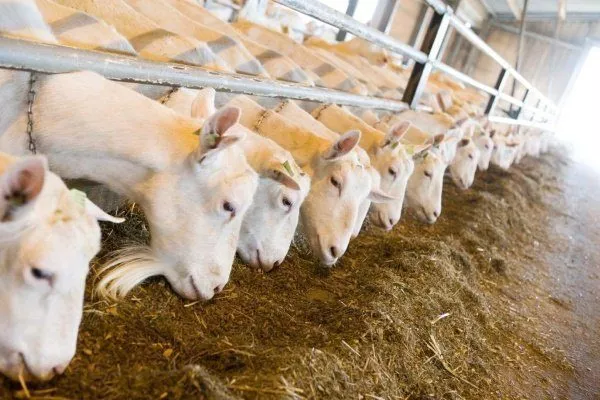
Goat's house
The premises for keeping goats must meet the basic requirements that must always be observed:
- It must have good ventilation. Animals react poorly to damp and polluted air.
- Young, pregnant, and recently foaled females are kept separate from the main herd. This also applies to breeding males.
- The goat's barn must be kept clean and fresh. A dirty room and neglected care can lead to the development of certain diseases.
- Providing good lighting is essential. This directly impacts the animals' milk production.
- During the winter, maintain an optimal temperature of 18-20 degrees Celsius. The key is to keep the temperature in the goat barn at least 10 degrees Celsius, and in the room where the young are kept at least 12 degrees Celsius. The same climate is maintained in the summer.
- ✓ The temperature in the goat's house should not fall below +10°C in winter and rise above +25°C in summer.
- ✓ Air humidity should be maintained within 60-75% to prevent respiratory diseases.
Regardless of the type of housing, goats need space, so it is not advisable to tie them up or restrict their movements.
Pastures
A farmer must take care of the pasture. Goats are herbivores. In a single day, they can eat more grass than can be harvested in the entire surrounding area. Grazing goats on unknown pastures can lead to various diseases that can be transmitted to humans.
Experienced farmers recommend leasing land in advance if they don't have their own plot. The land is then seeded with high-quality perennial grasses.
Pens
Goat pens should be located on the farm's property during the summer. It's best to install shelters in the pens to provide shelter from the rain and the scorching sun.
Milking
There are several options for milking goats: hand milking and machine milking. The choice depends on the number of goats on the farm.
Manual
To ensure your goat regularly produces large quantities of delicious and nutritious milk, it's recommended to milk your goat at specific times. Ideally, milk three times a day, at regular intervals. Breeders confirm that this system increases goat productivity by approximately 20%.
The choice of hand milking technique depends on the size of the udder.
With a fist
This milking technique is suitable for goats with large udders. The milking schedule is as follows:
- Squeeze the nipple near the base with your thumb and index finger.
- Press several times to remove the first portion of colostrum.
- Squeeze the nipple in your fist, expressing milk with rhythmic movements.
With a pinch
The pinch milking technique is similar to fist milking, but uses fingers instead. This hand milking method is suitable for goats with small udders.
Mixed
This hand milking technique is considered the most popular. The bulk of the milk is extracted with a fist, and the remainder is extracted with pinches. The key is to milk the goat completely, as the milk residue left in the teats contains more fat.
Hardware
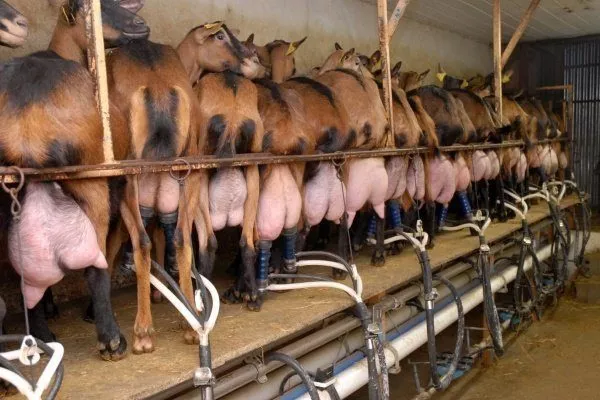
Mechanical milking is performed using specialized equipment. This type of milking is recommended for farms with more than five goats. Milking machines not only securely hold the animal but also help milk out the milk. This type of milking can process up to 20 animals per hour. One drawback is the high cost of these machines.
Feeding goats
Feeding is an important aspect of goat care. Goat health and productivity directly depend on the quality, quantity, nutritional value, variety, and timing of food.
In summer
During the summer, goats feed on grass found in the pasture. During this time, the animals are also fed hay specially prepared for them. Farmers often feed their animals compound feed as a nutritional and vitamin supplement – it effectively strengthens the immune system and prevents the development of a variety of diseases.
In winter
In winter, the animals eat what the goat breeder prepared for them in the summer:
- hay – 1-2 kg (per 1 goat);
- tree branches (birch, cherry, etc.);
- compound feed;
- greens preserved in acid.
In summer, the farmer must carefully prepare for winter by stocking up on winter food for the animals.
More information about feeding goats in winter can be found here. here.
Goat care
If you have just a few animals, managing them yourself won't be difficult. But if you have many more, you'll need help. Goats are not only fed regularly, but also bathed, brushed, milked, and their stalls are cleaned.
It's equally important to remember that the resulting product will need to be processed and sold. It's most convenient to deliver the milk to collection points. Selling it yourself is more difficult, as it takes a lot of time and effort. It's unlikely you can manage it alone.
There must be a veterinarian on staff or a nearby veterinary clinic, since animals tend to get sick periodically, and only a specialist can treat them.
Mating and lambing
When purchasing young animals, females are kept separately. They are ready for their first mating at 1.5 years of age. When mating, the female is brought to the buck during the most favorable time for estrus. The cycle in goats lasts approximately three weeks. This is often determined by swelling of the genitals and the doe's behavior—she becomes restless.
If the mating is unsuccessful, a second attempt is not necessary. However, if the goat is restless again after 2-3 weeks, the mating is repeated.
Gestation in animals lasts 147-150 days, so September is the best time to mate. This way, the babies will be born in early spring, giving them enough time to recuperate before the green shoots emerge and they are ready to graze.
It's not recommended to breed closely related animals, as this will degenerate the breed. For this reason, it's best to purchase males and females from different breeders.
Goating is considered a natural process that requires no human intervention if the female is healthy and the pregnancy has been uncomplicated. The main signs of impending labor include:
- The goat has no appetite and is showing signs of anxiety.
- The external genitalia begin to swell.
- The goat begins to bleat quietly, often looks back, and digs at the bedding.
- After the fetus takes the birth position, the goat becomes less bulky and dimples may appear in the groin.
- The animal strains every 5-10 minutes.
- A week before birth, a depression forms between the ischial bones, caused by the relaxation of the ligaments connecting the pelvis and the caudal vertebrae.
- About a day before birth, rectal temperature drops by a few degrees. The normal range is 39-40 degrees.
- As contractions begin, the cervical plug—a clear, straw-colored mucus—comes out of the vagina. If the mucus is white or creamy, it may indicate a medical condition called vaginitis. In this case, consult a veterinarian.
Caring for young animals
After the kids are born, the farmer chooses one of two options for raising the young:
- Immediately after the mother licks the baby goat, it is placed in a separate pen. The baby goat is fed with its mother's milk for the first month of life, but milking and feeding the goat are the responsibility of the breeder. If goat breeding is a business, this is considered the most optimal option for keeping young animals.
- The kid is kept with the mother. In this case, all the milk goes toward feeding the offspring. This means the farmer will not make a profit for the first few months. However, the advantage of this method is the ease of caring for and feeding the kid. Goats are renowned for their strong maternal instincts, so they are quite capable of caring for their offspring.
When kids are raised separately from their mother, they are kept in a separate pen from birth and bottle-fed with a rubber or plastic nipple. Later, the kids learn to drink from a bowl. During the first week, they are fed five times a day, with a 3.5-hour interval.
On the first day, kids are given 100 ml of milk, then the dose is increased and the number of feedings is reduced. Until 10-20 days of age, the daily milk intake is up to 1.2 liters. From 40 days of age, this amount is gradually reduced. During this period, kids should be fed concentrated, succulent, or roughage feed.
Starting at 10 days of age, it's recommended to feed kids liquid oatmeal or oatmeal broth, adding 150-200 ml of milk per kid. The supplementary feed is cooked daily, strained, cooled, and salted. Gradually increase the amount to 600 g per day, and then gradually phase it out from the kids' diet from 2 months of age.
From 10 to 15 days of age, it's best to let the young goats out for walks in good weather. In summer, pasture is recommended. If this isn't possible, feed the kids 3-3.5 kg of mixed green grass daily.
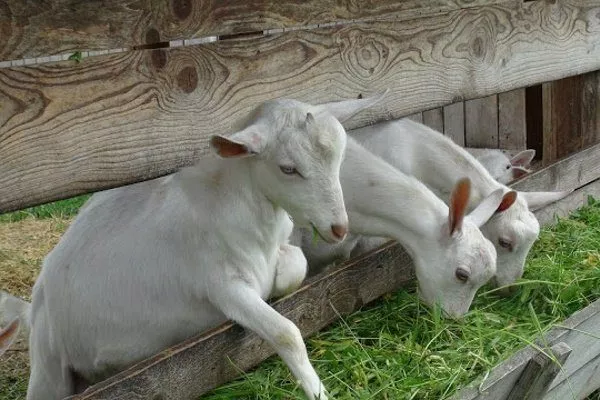
When raising kids with their mother, they are also fed concentrated feed, root vegetables, and hay. Once they enter the stall-feeding period, the young are fed like adult goats.
Goat diseases and treatment methods
Animals can suffer from infectious and non-infectious diseases. It is important to know which ones goats are susceptible to diseasesto cope with the disease in time:
| Disease | Reasons | Symptoms | Control measures |
| Gastroenteritis | A non-infectious disease that causes inflammation of the gastrointestinal mucosa. It is caused by feeding poor-quality food. | The young animals suffer from rapid breathing, increased body temperature, loss of appetite, and constipation, which alternates with diarrhea. | Withhold food for 24 hours, but ensure water is available. Antibiotics should also be administered. |
| Pneumonia | A non-infectious disease that occurs due to a weakened immune system as a result of hypothermia, overheating, or staying in a dusty room for a long time. | Goats experience increased breathing, purulent mucus discharge from the nose, increased body temperature, loss of appetite, and coughing. | Goats need to be moved to a clean, dry area, their diet adjusted, and given penicillin and norsulfazole. |
| Mastitis | Infectious disease. | This causes the goat's udder to enlarge and harden, taking on a blue-purple hue. Appetite and chewing are lost. | Sick animals are isolated and the common area is disinfected. The udders are gently massaged and the milk is expressed. The sick goats are then given penicillin and erythromycin intramuscularly. |
| Dyspepsia | A non-infectious disease common in newborn animals. It occurs due to a metabolic disorder leading to dehydration and intoxication. It is caused by an unbalanced diet in the pregnant goat before and after giving birth. | The young animals suffer from diarrhea, bloating, and low body temperature. | Isolate sick animals and stop feeding them for 6-12 hours. Give the babies a sodium chloride solution or plain boiled water 5 times a day. |
| Echinococcosis | An infectious disease in which bacteria invade the lungs, liver, kidneys and spleen. | It manifests itself as jaundice, gastrointestinal problems and thinness. | There are no treatment methods. |
| Poisoning | A non-infectious disease caused by feeding animals feed treated with pesticides. | The animal refuses food, vomiting, and diarrhea occur. Convulsions and limb paralysis occasionally occur. | Rinse the goat's stomach, give it a laxative and activated charcoal. |
Sales of products
In addition to caring for the animals, selling the resulting products is equally important. A farmer can't simply place a barrel of milk or display their produce anywhere in the city.
According to the Technical Regulations of the Customs Union, trade in dairy products is permitted only at agricultural markets with mandatory documentation confirming veterinary and sanitary inspection.
Farmers sell milk from their own goats at markets, to procurement companies, and through retail chains or online. There's potential for selling their products to trading cooperatives, which are willing to enter into long-term contracts with farmers. Veterinary certification is required to sell the products.
Goat meat is sold at markets, catering establishments, and specialty stores. To increase profitability, some farmers set up mini-production operations on their farms. Goat milk is used to make yogurt, cottage cheese, butter, cheese, and sour milk at home. Goat meat is smoked and used to make sausages, stews, and snacks.
It is even possible to sell goat manure – it is actively used by owners of vegetable farms and private household plots.
The farmer must always have the following documents with him, which he will provide to buyers:
- documents containing information about the supplier and his/her contact details;
- trading permit;
- documents about the seller;
- papers with the shelf life of the product and the date of its production;
- health certificate;
- a certificate of sanitary treatment of the barrel (if it is milk);
- seal number;
- documents confirming the quality of the goods with marks on the implementation of scheduled annual veterinary measures;
- Veterinary certificate Form No. 2 (for transporting milk to the market).
Must have:
- passport for keeping animals;
- a conclusion from the state veterinary service certifying the product's compliance with veterinary standards;
- a quality certificate from any certified laboratory;
- a conclusion from the veterinary service on compliance with all rules and regulations.
Goat Breeding as a Business: Creating a Business Plan
To determine where to start a business and what to do next, it is initially recommended to draw up a business plan. This will help you determine the expenses and income of the future enterprise, as well as attract financial investments from investors.
A farmer will tell you how he started his goat breeding business in the following video:
Product Information
Goat breeding is typically done for milk production. This aspect is always included in the business plan, along with the stages of production required to obtain the final product for sale. For example, selling goat milk requires several steps:
- Purchasing young or adult goats. It's recommended to purchase at least two animals when starting out.
- Organizing proper care: feeding, maintenance, grazing, washing, etc.
- Receipt and sale of products.
Production plan
A production plan describes in detail how production will take place. For example:
- Purchase of animals for approximately 50,000 rubles.
- Purchase of special feed for complete nutrition – 15,000 rubles.
- Construction of stalls and renovation of the building for keeping animals – 17,000 rubles.
- Contributions to the Pension Fund of the Russian Federation – 6,500 rubles.
- Transportation of goats – 3,500 rubles.
- Revenue from the sale of goat milk. For example, the plan is to sell 600 liters of product at 200 rubles per liter.
Milk production from purchased goats is planned after the animal's first mating. Depending on the age of the kids, a specific figure is specified, for example, after one year.
Thus, the total annual revenue will be 120,000 rubles, and expenses will be 92,000 rubles.
Marketing plan
At this stage, you choose the methods of product sales:
- directly (there is a list of potential buyers);
- at the market;
- sales to various stores and shops as a supplier.
Organizational plan
This plan includes people involved in business development. This includes not only farm workers but also those who finance the project:
The organizational plan should indicate:
- How is the business registered? It's best to register as a sole proprietor (IP).
- The entrepreneur's first name, last name, and patronymic.
- How much money is invested in the business (own and received from someone else).
- Plans to attract hired labor to help with farm management.
- The total cost of the project, divided into individual amounts: personal investment in the business, borrower funds, government subsidies, etc.
Financial plan
A financial plan is prepared only after obtaining sole proprietor status and is filed with the tax office. It is prepared in stages:
- Find out what taxes will be levied on your income. It's best to switch to a specialized tax regime, the unified agricultural tax.
- Specify the tax rate under which the organization operates – 4%, 6%, etc.
- Identify the taxable item. In your case, this is the business's income, reduced by the amount of expenses incurred by the farmer.
- Specify in the plan how the state treasury will receive pension contributions.
The final step is to create tables indicating some nuances:
| Income and expense plan | Cash flow plan |
|
|
Only by calculating expenses and income from sales will it be possible to more accurately calculate how long it will take to generate a stable net profit from such a business.
This is where the planning process ends and a decision is made as to whether it is profitable for you to breed goats on your home farm or not.
Goat farming is a serious business and requires a responsible approach. If the animals aren't properly cared for, they won't produce much, and revenue will decline. This could lead to the business not being profitable, and debt mounting.