
Goat meat isn't often found commercially because it has a distinctive flavor and odor that isn't to everyone's taste. However, goat meat is considered a valuable product, recommended for certain illnesses and conditions. Farmers raise goats not only for meat, but also for wool, milk, hide, hooves, and horns.
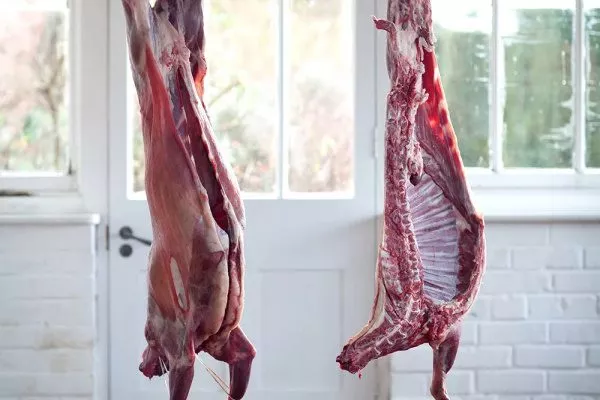
Description and taste of meat
Goat meat is considered dietary because it contains a minimal percentage of pure white fat, which accumulates only in the abdominal region. Goat meat can be used in almost any dish, but it's best to buy or slaughter goats that are at least 2-2.5 months old. This meat will be especially tender and delicious.
- ✓ Bright meat color, indicating the freshness and youth of the animal.
- ✓ Minimal amount of fat, concentrated only in the peritoneal area.
The specific aroma and flavor deserve special attention, but not all goats possess it. Features:
- The unpleasant odor comes from sweat and urine. Experienced farmers take special care during slaughter to prevent the odor from transferring to the meat. This is achieved by not touching the meat after skinning.
- The meat of dairy goats has a more unpleasant taste than that of meat breeds.
- It's generally accepted that male goat meat smells more strongly than female goat meat. However, if a male goat is castrated at a young age, the odor will be eliminated.
The health benefits of goat meat
Modern livestock farming involves raising goats for milk—of the country's total goat population, only 10-11% are used for meat. This is unfortunate, as goat meat is considered highly valuable and nutritious, containing a huge amount of amino acids and proteins.
Composition and presence of useful substances
Goat meat is considered a low-carb food—the maximum carbohydrate content is only 1.5%, while protein is almost 20%. Other nutritional and calorie values include:
- fat – 6%;
- water – 70-78%;
- proteins – from 15 to 20%;
- total caloric content – from 78 to 120 kcal.
Goat meat is rich in tryptophan, valine, leucine, isoleucine, threonine, methionine, lysine, and phenylalanine. These amino acids are considered essential and help speed up metabolism.
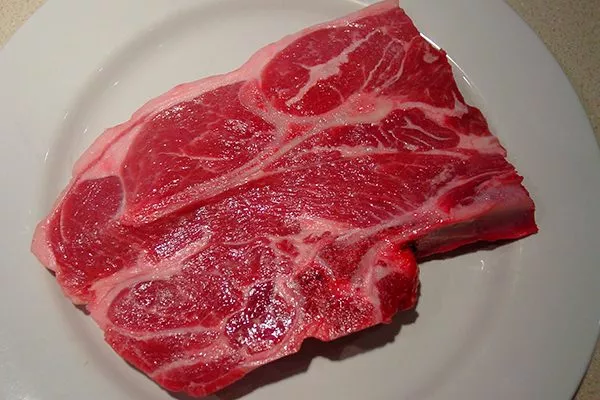
Meat is also rich in other substances:
- phosphorus;
- sodium;
- gray;
- chlorine;
- potassium;
- zinc;
- magnesium;
- iron;
- vitamins A, B1, B2;
- para-aminobenzoic, pantothenic and folic acid.
These elements participate in acid-base and water-salt metabolism, regulate osmotic pressure, and improve myocardial function.
Medicinal properties
Goat meat has a very low cholesterol level, so people who raise goats for meat rarely suffer from cardiovascular diseases. Thanks to its fatty acids, goat meat is never parasite-free.
Goat meat is recommended for people with the following problems:
- atherosclerosis;
- old age;
- heart and vascular diseases;
- indigestion;
- weakened immunity;
- prostate diseases;
- poor condition of hair, nails, skin.
In the presence of diseases, it is recommended to use the meat of young goats or castrated goats - they contain more nutrients.
In cooking
Goat meat is lighter in color than lamb and is used in the cuisine of many different cultures. It's used to prepare a wide variety of dishes, from first courses to appetizers, but pilaf is especially delicious. Young or castrated goat meat is cooked fresh, while older goat meat is first marinated in red wine.
Goat meat is used for:
- baking;
- extinguishing;
- drying;
- frying;
- grilling;
- cooking soups and broths.
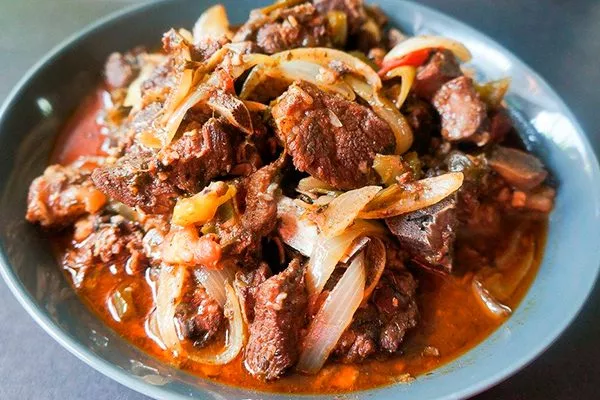
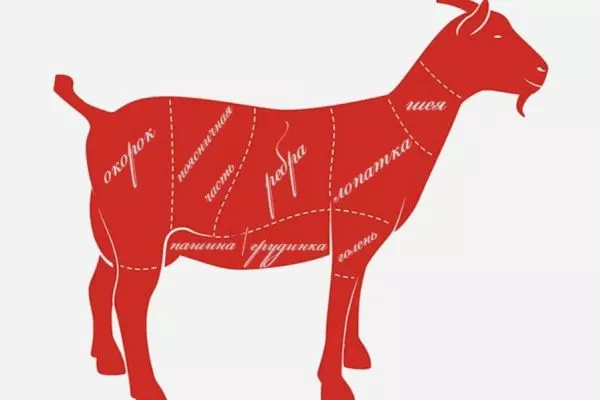
The most tender cuts of goat meat (those with little connective tissue) are the loin, ribs, and tenderloin. The back rounds are best sliced thinly and pounded thoroughly. All other cuts are used for long simmering or braising.
Goat meat goes best with marjoram, thyme, cumin, oregano, basil, dill, parsley, tarragon and borage.
The dangerous properties of goat meat
Goat meat is harmless to the human body, but only if there are no contraindications. These include meat allergies. However, goat fat is prohibited in the following cases:
- cholelithiasis;
- pancreatitis;
- cholecystitis.
Evaluation of the quality of goat meat
Goat carcasses are divided into 2 categories:
- Developed muscles. In this case, the meat contains little fat, and the withers and loin have spinous processes. The fat layer is translucent.
- Undeveloped muscles. This meat is completely lean, as there is almost no fatty tissue and the bones protrude significantly.
In addition, meat comes from old, young and castrated animals.
Step-by-step description of slaughter and cutting
Before slaughtering a goat, it's important to determine its age—for large breeds, this is a maximum of 6 months, for standard breeds, 10 months. This is the age at which you can obtain the most odorless and completely tender meat.
- ✓ Check that all necessary tools are available before starting the process, including sharp knives, ropes for fixation, and containers for collecting blood and offal.
- ✓ Ensure adequate lighting and cleanliness in the slaughter area to minimize the risk of meat contamination.
What stages of preparation for slaughter need to be completed?
Much depends on the preparatory measures that novice livestock breeders ignore – the taste and smell of the meat, the quality of the skin, the absence of animal suffering.
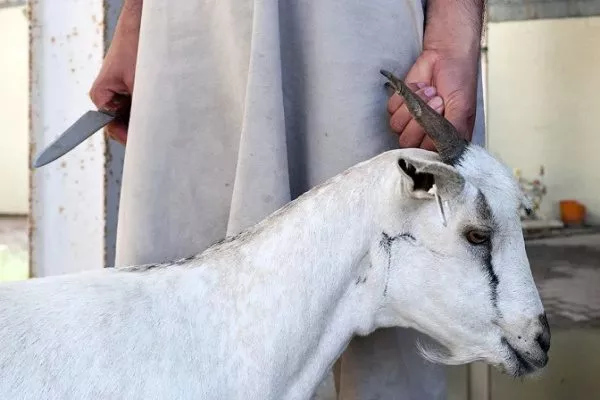
The preparatory stages consist of several steps:
- change in diet and water intake;
- medical examination of the animal;
- goat trimming;
- preparation of tools, equipment and location.
Particular attention is paid to the animal's diet, which is stopped completely the day before slaughter. Failure to do so will result in a full intestine, resulting in poor meat quality. However, water intake should not be restricted during the last 24 hours, otherwise the meat will be dry and tough.
Vaccination, clipping and medical examination of the animal
Vaccination is essential not only for the animal's health but also for the safety of the resulting meat. Preventative treatment against skin parasites and helminths is especially important. Please note that meat or hides cannot be sold without proof of vaccination.
A few days before slaughter, the animal is sent to a veterinarian, who examines it and makes a conclusion.
Preparing the site and equipment
First, you need to find a place to slaughter the goats—it should be far from the goat barn. This is important because the agitation of the goats significantly reduces the quality of the meat—it becomes tough and not very tasty.
Other features:
- lighting must be sufficient to prevent errors during slaughter and cutting;
- Be sure to carry out sanitary cleaning and disinfection of not only the floor and walls, but also all instruments;
- Place a frame indoors for hanging the carcass;
- Make sure that the structure stands securely and will not tip over when hung;
- Sharpen your knives and prepare the rest of your tools.
How to properly secure an animal before slaughter?
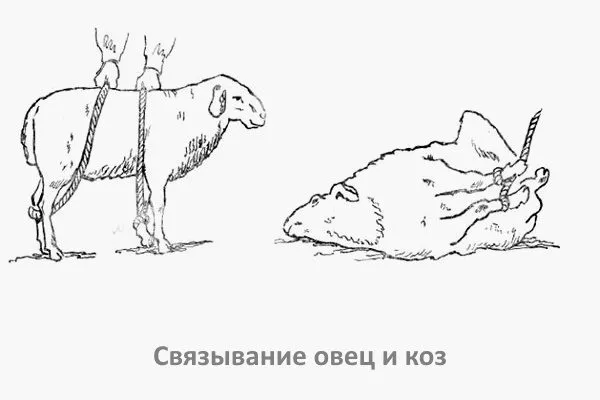
The animal must be properly restrained before slaughter, otherwise it may break free. The location is new and unfamiliar, so the goat will be nervous, and the slaughterer may make an improper cut, which could delay the animal's death.
The goat is restrained using strong ropes—all its legs must be tied together. If the goat is very agitated and it becomes difficult to restrain, you can stun it on the head first.
Methods of goat slaughter
There are various ways to slaughter goats, but the key is to inflict as little pain and suffering on the animal as possible. Keep in mind that you'll need to act quickly.
Basic slaughter methods:
- Stun. A hammer, axe, or a back axe is used for this. After the animal loses consciousness, its throat is immediately slit and it is hung up to be bled.
- Hanging. The goat can be suspended by its hind legs in advance, after which a cut can be made in the throat or a puncture can be made.
- Fixation along the horizontal line. The idea is to place the goat on a table or other surface, but so that its head hangs over the edge.
- Saddling. One slaughterer sits on the goat and clamps it with his knees, then lifts its head. The second person makes the cut.
How to cut up a goat carcass?
Immediately after slaughter, all the blood must be drained. To do this, hang the goat up by its hind legs, and then do the following:
- Cut the belly lengthwise.
- Using a knife, carefully remove the skin. Work from the belly to the back on both sides. Make circular cuts in areas with holes, and make nicks in the skin around the extremities.
- Remove the offal and place it in a bowl of clean water.
- Divide the carcass into two halves and place them on the table, then cut according to the diagram below.
How to process goatskin?
Immediately after skinning a goat, it is left to cool and rest for approximately three hours. The maximum time is eight hours, but no longer, otherwise putrefaction will begin.
Next, do this:
- Lay the skin out with the fur facing down.
- Sprinkle generously with preservative salt on all sides.
- After half an hour, roll the skin up with the wool facing out and put it away for storage.
- On the fourth day, start dressing.
Watch the video below to see how farmers process goat skins:
How to slaughter a goat so that the meat doesn't smell?
The meat of male goats has an unpleasant odor, and to eliminate this odor after slaughter, it's important to learn how to kill a goat properly. Here are some tips:
- Be sure to castrate the animal while it is still alive;
- Immediately after slaughter, the bladder and all genitals must be removed;
- After this, wash your hands and the knife, and only then proceed to cutting.
Interesting facts about goats
Goats and their meat are legendary. For example, in ancient times, goat meat was used as a therapeutic and preventative measure, as it is rich in nutrients. There are other interesting facts:
- goats do not get brucellosis and tuberculosis, like many other farm animals;
- Among the huge variety of breeds, there are fainting (myotonic) ones, which fall down when frightened (muscle paralysis occurs);
- it was goats that were most often sacrificed;
- goat skin was once used to make parchment;
- Only goats have rectangular pupils with a 300 degree field of view;
- In the 7th century BC, goats were the first of such animals to be domesticated;
- Wild goats have a developed sense of smell and vision, while domestic goats have a developed sense of smell and taste.
Production
Goat meat yield is low, making production unprofitable. Compared to the 49% slaughter yield of rams, goats' slaughter yield is only 43%. Furthermore, the carcass weight of a young goat ranges from 17 to 20 kg (an adult's is considerably larger).
Goat meat is considered healthy and nutritious, and if slaughtered before 10 months of age, it's also tender and flavorless. You can slaughter and butcher the goats yourself, but be sure to strictly follow all professional instructions.