
Saanen goats are known as a high-yielding breed. Producing up to 8 liters of milk daily, these animals can form the basis of a profitable dairy business. These hornless creatures are prized for their high productivity, ease of maintenance, and good nature.
History and origin of the breed
The breed takes its name from the town of Saanen (Switzerland). It is considered one of the best in milk production. The breed has no precise pedigree—the goats were developed through folk selection in the 19th century. The "breeders" were ordinary shepherds grazing their cattle in the Swiss Alps. Attracting breeders with its milk yields, the breed quickly spread across the world.
Today, several lines of the Saanen breed are distinguished:
- American;
- Dutch;
- British;
- white;
- Russian.
The first Saanen goats appeared in Russia at the beginning of the 20th century. The batch of goats imported to the USSR numbered only 20 individuals, but it was with them that the history of the Saanen breed in Russia began.
Recommended terrain and breeding zones
Saanen goats originate from the "milk land" of the Swiss Alps. This breed is known for its excellent acclimatization abilities, easily adapting to life in various regions of Russia and neighboring countries. They are particularly widely bred in the south and west of Russia, but can also be raised in the north, provided they are properly cared for and maintained. This breed is also popular in Moldova and Belarus.
Description of Saanen goats
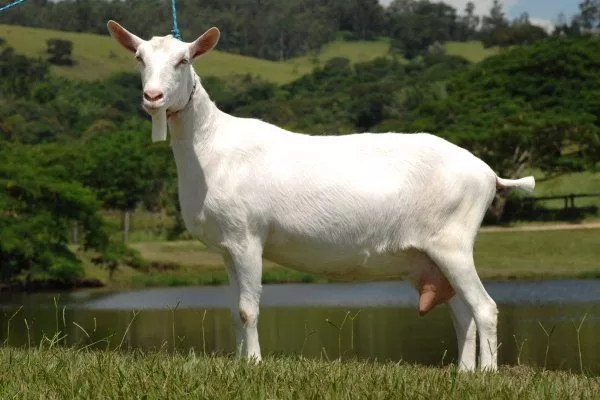
A specialist can immediately identify a high-yielding Saanen goat breed simply by its appearance. These goats are close to ideal in their measurements. The white animals, with strong bones, have an elegant appearance—as befits high-yielding dairy goats.
Exterior
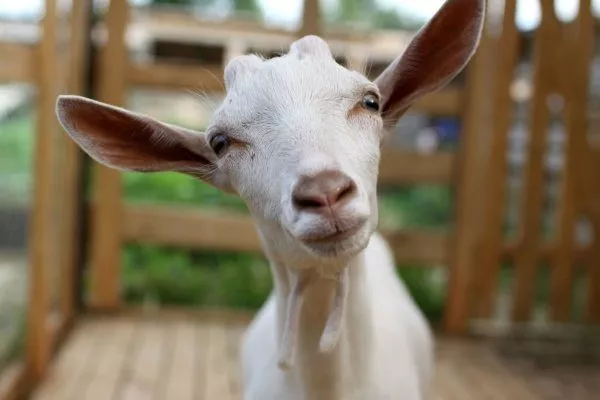
Both male and female Saanen goats are polled. Saanens look like the very definition of a domestic goat. They have a well-developed, strong body and excellent bone structure. At the same time, their appearance is not coarse or massive; the females are sweet and neat.
Exterior features of Saanen goats:
- The body is wide and elongated.
- The head is beautifully, refinedly sculpted, the muzzle is narrow.
- The ears are elongated, erect, slightly tilted to the side.
- The muscles on the thighs are poorly developed.
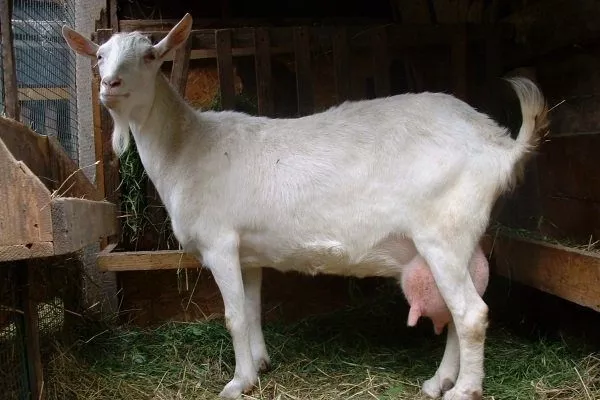
- The udder is large and pear-shaped. The teats are well developed.
- The hooves are light yellow.
Every male goat has a beard. Sometimes, females also have one. The breed standard does not allow drooping ears. However, "earrings"—skin growths on the neck—are not considered a defect and can occur in both purebred and mixed-breed goats. Experienced breeders prefer to remove these growths to avoid damaging them.
Last century, the Saanen breed's main distinguishing features were considered to be its snow-white coat and hornlessness. But standards have since changed. Today, only three-quarters of individuals are polled. Previously, horns were considered harmful to a herd breed, as females could injure each other during conflicts. However, breeders have discovered that breeding only hornless animals leads to infertility and hermaphroditism in subsequent generations. Therefore, many farmers today retain horned animals. To make caring for the animals easier, they cauterize the horns of young animals.
Size and weight
The maximum weight of Saanen goats is 55 kg. Males are much larger, weighing up to 80 kg. These goats are the largest among dairy breeds.
Weight of kids:
- newborn goats/kids – 3.5/4.5 kg;
- 2-month-old goats/kids – 9-10/11-12 kg.
Weight gain from birth to two months allows this breed to be classified as early maturing. Daily weight gain is 160 g. Saanen goat parameters are listed in Table 1.
Table 1
| Parameters | goats | goats |
| Body length | 81 cm | 84 cm |
| Height at withers | 78 cm | 95 cm |
| Chest circumference | 88 cm | 94 cm |
| Height at the sacrum | 77 cm | 88 cm |
| Chest width | 18 cm | 18.5 cm |
| Width of the back | 17 cm | 17.5 cm |
| Live weight | 45-55 kg | 70-80 kg |
Advantages and disadvantages of the breed
Advantages of the Saanen breed:
- High milk production. After their first lambing, females produce 700 liters per year.
- High fertility. A herd of 100 heads produces 180-250 kids.
- Long lactation. A goat produces milk for 11 months a year.
- Rapid weight gain.
- High fat milk.
- High adaptive abilities.
- They represent excellent breeding material and are used to improve other breeds and increase milk production.
- They can graze on difficult terrain – in mountains, ravines, etc.
- The meat of three-month-old goats is suitable for food.
Given the excellent milk production characteristics, all the existing disadvantages can easily be forgiven for Saanen goats:
- clubfooted;
- sagging;
- developed sabre-like behavior (an exterior defect associated with the positioning of the legs);
- underdevelopment of muscles in the thigh area.
The breed is also accused of having a "Roman nose" and producing oversized males. These flaws are not an obstacle to successfully breeding high-yielding goats. Farmers choose this breed for high milk yields.
Productivity characteristics
Saanen goats are bred for milk, so milk production is the primary concern for breeders. Milk quality and living conditions are also important.
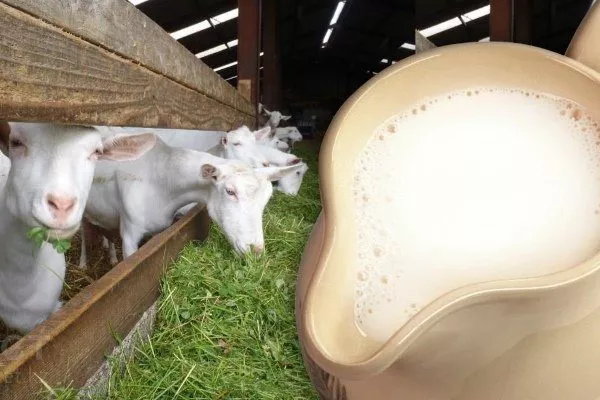
Saanen goat milk is a benchmark for dairy production. It's delicious and practically odorless—no foreign odors whatsoever. Its fat content is 4-4.5%. Daily milk yield is 3.5-8 liters. Goat milk is ideal for making cottage cheese, cheese, and butter.
Milk yield depends on the quality of feed and animal welfare. Annual milk yields:
- The average figures for Russia are 600-700 l/year.
- Under ideal conditions and enhanced rations – 1200 l/year.
- The Saanen breed's record is 2,400 liters per year. This result was achieved in the breed's homeland, Switzerland.
Milk yield is calculated based on the number of lambings each year. Milk production decreases before lambing. The more lambings a goat has, the higher its milk production. Maximum milk yield occurs after the fourth lambing. During this period, females can produce up to 2,000-2,500 liters of milk. The annual milk yield is 20 times greater than the goat's own weight.
Comparison with other breeds
Several breeds of dairy goats are bred in Russia. They all differ in various parameters, including milk yield, lactation duration, and milk fat content. A comparison of the parameters of popular dairy breeds is presented in Table 2.
Table 2
| Breed | Milk yield per day, l | Fat content, % | Duration of lactation, days | Average milk productivity, l/year | Adaptation to climate in Russia |
| Saanen | 5 | 3.7-4.5 | 300 | 900-1200 | + |
| Czech brown | 4-6 | 3.5-4.5 | 300-330 | 900-1200 | + |
| Nubian | 4-5 | 4.5 | 300 | 1000 | + |
| Alpine | 4 | 3.5 | 300-350 | 750-900 | + |
| La Mancha | 3-5 | 4 | 300 | 900-1000 | + |
| Gorky | 3 | 4-5.5 | 250-300 | 500 | + |
| Russian | 2.5 | 4.5-5 | 240 | 400-600 | + |
| Toggenburg | 2.5 | 3.5 | 200-240 | 500-800 | — |
| Cameroonian | 1.5-2 | 5.3 | 150 | 200 | + |
| Megrelian | 1-2 | 4.5 | 180 | 100-250 | + |
Keeping and caring for goats
Saanen goats are kept using a stall-and-pasture system. The breed adapts well to cold weather, but does not tolerate heat and humidity well—these climate conditions can cause the death of the entire herd. Saanens are demanding in terms of housing conditions—to achieve good milk yields, the animals must be provided with appropriate conditions. In warm weather, the herd grazes on pastures; in cold weather, they are kept indoors. Approximate durations of the periods are:
- pasture – 185 days;
- stall – 180 days.
Stall
When kept in stalls, goats spend a lot of time in the barn. The barn should be free of dampness and drafts. Goats are typically kept in stalls without tethers.
- ✓ The optimal temperature in the stall should not be below 0°C, but should not exceed 20°C.
- ✓ Humidity in the room should not exceed 75% to prevent diseases.
Content requirements:
- humidity no more than 75%;
- temperature – not below 0°C;
- lots of natural light;
- high-quality ventilation system;
- availability of an outdoor walking area - make a fenced area;
- the presence of straw bedding in the stalls – at least 50 cm thick;
- the presence of feeders and drinkers fixed to the walls;
- complete cleaning and disinfection of the barn twice a year.
Every six months the goats' hooves are trimmed.
One person is enough to look after the goats. The bedding is changed as it becomes soiled. Biothermal processes occurring in the straw bedding generate heat, reducing heating costs.
Goats should not be confined to stalls. They must be given regular exercise:
- in frosty weather – 1-2 hours;
- in mild frosts – 4-5 hours.
Benefits of walking outside:
- metabolism improves;
- immunity is increased;
- the quality of wool improves.
The walk is cancelled if:
- it's snowing;
- the frosts are too strong;
- the snow cover thickness is more than 10 cm.
The barn can also be used in the summer for overnight stays. It is ventilated in the winter and aired in the summer. The temperature should not exceed 20°C (68°F) – Saanens dislike heat. When spring arrives, the animals are transferred to pasture.
Pasture
Animals should not be abruptly forced out to pasture; they must gradually acclimate to natural conditions. The herd should not be too large, as this will make the animals restless. Furthermore, with many goats, it is difficult to give each one attention, as illnesses often increase. The recommended ratio of sows to one buck is 25-50. When forming a herd, keep in mind that quantity does not always lead to quality.
Requirements for pasture maintenance:
- The opening of the grazing period should be determined taking into account the temperature, climate and quality of grass in the pasture.
- Goats should not be allowed to live in damp areas, as they will trample many useful plants.
- When the season has just begun, the herd should be released into well-lit areas, preferably on elevated ground.
- When letting goats out to pasture, their hoof horn, which appears during wintering in stalls, is removed in advance.
- The herd is driven out to pasture before sunrise. Only in early spring and late fall are they driven out later, after the cold dew has cleared the grass.
- Animals are not allowed to be exposed to the scorching sun. Between 10:00 and 16:00, they are given a break and herded under shelters.
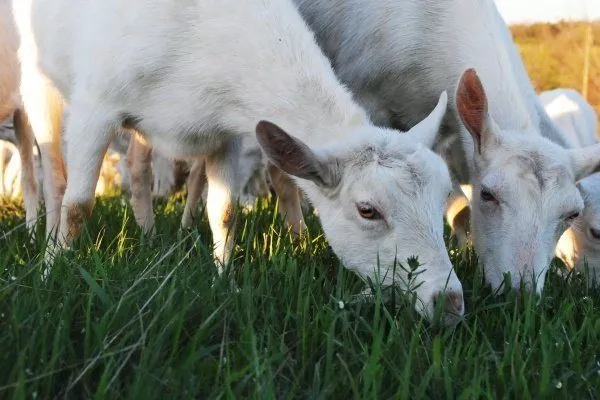
- Goats are herb connoisseurs. They won't eat grass they don't like—they choose only the tastiest and juiciest. Therefore, avoid sending your herd to pastures with grass they don't like.
- Saanens don't tolerate changes in atmospheric pressure well. It's best for them to avoid grazing in the rain.
- Goats shouldn't be given complete control of the pasture, as they will quickly deplete it. They should be used sparingly to allow the grass to regenerate.
- The optimal range area for a dozen goats is 2.5-3 hectares. In this area, the goats can feed for about six days, no more.
- To visualize the boundaries of the plots, it is recommended to place pegs.
- It's advisable to adjust the herd's position relative to the sun—it should be behind or to the side. If the sun is in front, it's difficult for animals to find the plants they need.
- While the animals are under a canopy, which is set up near the pasture, they can be fed dried grass.
- Goats' satiation time on a high-quality pasture is six hours. They spend the same amount of time chewing their cud, during which time they settle down on the ground and rest.
- Saanens grazing in the pasture are given water twice a day. If the grass is lush and it's not too hot, a single watering may be sufficient. The best times for watering in the pasture are early morning and during the midday break. During particularly hot weeks, when the grass becomes coarse, goats are given additional water two hours after the start of grazing and two hours after the afternoon rest.
An important aspect of Saanen goat husbandry is the refusal to eat regular grass. These goats are recommended to be fed grains and legumes, often using artificial pastures.
During grazing, a female goat eats an average of 6 kg, while a male buck eats 8 kg. To provide goats with daytime rest and nighttime rest, resting areas should be provided. Rest areas are usually not fenced, but it is recommended to install portable fences to create temporary enclosures for counting the goats.
Feeding and diet
To ensure goats produce plenty of high-quality milk, they need a balanced diet. Goat feeding schedule:
- Fresh hay is given in the morning.
- A few hours later – branches of birch, alder, and willow.
- Pasture feeding is grass. If there are trees and shrubs nearby, goats can enjoy their branches and leaves.
- In the evening they are given a mash with potatoes, bran and forage.
Animals should be accustomed to both types of food—dry and fresh. To fully digest food, their stomachs must develop specialized bacteria for digesting specific foods. New food components are introduced gradually to avoid diarrhea and other gastrointestinal problems. Weaning animals to one type of food takes about a week. The transition from a winter to a summer diet should also be gradual, giving animals time to adjust.
Daily nutritional requirements
During stall housing, to achieve a milk yield of 5 liters, each goat must be provided with a complete and balanced diet. Sample diets for stall-housed goats are shown in Table 3.
Table 3
| Diet | Amount of feed, g |
| Option No. 1 | |
| oats | 300 |
| hay | 1500 |
| brooms | 1000 |
| sunflower cake | 400 |
| roots | 3000 |
| bran | 500 |
| salt | 15 |
| Option No. 2 | |
| hay | 2100 |
| succulent feed | 2500 |
| concentrates | 800 |
| salt | 15 |
15 g of salt is the required daily intake. The following proportions are recommended:
- concentrated mixtures – 40%;
- roughage – 20%;
- green fodder – 40%.
Daily hay requirements for Saanens, depending on age and gender:
- goat – 3 kg;
- goat – 2.2 kg;
- kid up to one year – 1 kg.
When feeding females, the reproductive phase and health status are taken into account:
- During dry periods, to obtain 1 liter of milk, a goat needs 0.8 feed units and 30 g of protein.
- During lactation, to obtain 1 liter of milk, 0.36 feed units and 55 g of protein are needed.
Before weaning (the end of lactation), goats are put on a special feeding system to ensure healthy and strong kids are born. The emphasis is on protein. Here's a sample diet:
- hay – 1-1.5 kg;
- oatmeal mixture – 4 kg;
- concentrated feed – 200 g.
Another option for a goat's diet before launching:
- hay – 1.2 kg;
- oatmeal and pea mixture – 3 kg;
- concentrated feed – 100 g;
- pasture food - unlimited.
Feeding with brooms
Saanen goats are very fond of eating brooms made from branches. When kept in stalls, brooms and leaves are an important part of their diet. The daily allowance is one broom per goat. For the winter, an average of 100 brooms per goat should be stored.
Rules for preparing brooms:
- Suitable trees include oak, birch, linden, alder, maple, and aspen. Willow is the best choice. Avoid overdosing on birch trees, as they can cause kidney problems.
- Branches should be harvested in early June. The recommended branch thickness is 1 cm. The ideal time for cutting is dawn, but you can also cut branches after sunset. These are the periods when the branches are most nutritious.
- The cut branches are laid out outside to absorb vitamin D, which is produced by UV rays. After 3-4 hours, the dried branches are tied into a broom. Twine is used for the tying. The broom should be up to 100 cm long and up to 20 cm wide.
- The final drying takes place in an attic or shed, where the brooms are hung on the walls. They are left to dry in this position for a month.
- In the fall, fallen leaves can replace the brooms. The collected leaves are dried for five days, stirring occasionally. Then they are stored in the attic. There, the leaves are spread on a cloth or straw mat.
By feeding branches, it is possible to improve rumen digestion in goats, which is extremely important during the period of stall keeping.
Feeding tips
Domestic farms that have been raising Saanens for many years have accumulated considerable experience in breeding them. They also have several important feeding tips that they are happy to share with newcomers:
- To increase the energy value of milk, goats should be fed chopped hay. The resulting milk will be more nutritious and can be sold at a higher price.
- It is essential to give compound feed, preferably concentrated mixtures and dietary supplements.
- Be sure to hang a salt lick near the feeder.
- It's best to dry hay before feeding. The optimal moisture content is 16-17%.
- The best feed for Saanen goats is bean and pea straw.
- Access to water must be available 24 hours a day.
- Feed for kids and goats should be flavored with bran.
- Never give goats kitchen scraps.
Breeding Saanen goats
The breed is prolific and is often used for selection and improvement of the milking characteristics of other breeds. Reproduction rules:
- At least 200 days must pass between the last lambing and insemination.
- If there is no stud goat, artificial insemination is used.
- Females are released 2 months before kidding.
- Females begin insemination at the age of 12 months, not earlier. The recommended age is 14-16 months.
- Special rooms for lambing are not required.
With proper care, there are no problems with breeding Saanen goats.
Breeding principles:
- Mating is carried out when the female is in heat.
- Once the female is covered, the goat can be removed from her.
During the three months of pregnancy, the goat is milked fully. Then, the frequency and volume of milking are gradually reduced until lactation ceases completely. The goat needs to gain strength before lambing. If milking continues, and the goat is neglected, the kids will be born weak, and the goat will suffer.
For successful breeding, it's important to have a good stud buck. He, like dairy goats, should be sourced from reputable breeders. Before buying expensive purebred Saanens, it's worth trying breeding regular goats. A Saanen goat costs as much as a cow. And if you make a mistake in breeding techniques, you could suffer significant losses.
Newborn kids are raised in two ways: they are weaned immediately and transferred to artificial feeding, or they are kept with the mother goat until they are four months old. After four months, the kids have a stronger digestive system and are gradually transitioned to roughage. This method reduces milk production and is therefore rarely used.
When a kid is kept with a goat, the number of milking days per year is 210. If weaned early, the lactation period is 300 days per year.
Maintenance, care and feeding of kids
As soon as the kid is born, the mother immediately licks it. The broken umbilical cord should be tied with coarse thread, leaving 1 cm from the ligature site. Then the ends of the umbilical cord are smeared with brilliant green or iodine.
If the kids are to be separated from the mother goat for artificial feeding, colostrum should be expressed immediately after lambing and fed to the newborn within 40 minutes of birth. Colostrum is essential for newborns to activate their immune system. However, kids are quickly transitioned to artificial feeding to conserve milk.
Colostrum and milk are diluted with water—cooled boiled water is preferred—in a 1:1 ratio. The kids are fed through a nipple. The female goats are given more food—the more they eat, the more milk they produce. Kids consume much less milk. When the young goats are two months old, they are fed from a bowl.
It's important to remember that overfeeding can cause eating disorders in kids. To prevent them from becoming overly fond of milk, limit their intake. Kids should drink no more than 2 liters of milk per day. Weaning is gradual. Table 4 shows the feeding schedule for a bottle-fed newborn goat.
Table 4
| Age, days | Number of feedings per day | Milk, ml | Liquid oatmeal, g | Concentrates, g | Root vegetables, g | |
| per feeding | per day | |||||
| 1-2 | 4 | 200 | 800 | — | — | — |
| 3 | 4 | 225 | 900 | — | — | — |
| 4-5 | 4 | 250 | 1000 | — | — | — |
| 6-10 | 4 | 300 | 1200 | — | — | — |
| 11-20 | 4 | 300 | 1200 | 200 | — | — |
| 9:30 PM | 4 | 300 | 1200 | 300 | 30 | — |
| 31-40 | 3 | 350 | 1050 | 500 | 50 | 40 |
| 41-50 | 3 | 250 | 750 | 700 | 100 | 60 |
| 51-60 | 3 | 150 | 450 | 800 | 150 | 100 |
| 61-70 | 3 | 150 | 450 | 800 | 200 | 200 |
| 71-80 | 3 | 150 | 450 | — | 200 | 250 |
| 81-90 | 3 | 150 | 450 | — | 300 | 250 |
It's prohibited to feed kids milk from goats with mastitis. This disease causes colostrum to be teeming with pathogenic bacteria. Antibiotic treatment for mastitis lasts for 5 days, during which time colostrum is unfit for human consumption. For such emergencies, frozen colostrum is recommended; it can be stored for a long time in the freezer.
Before milking a goat, wash her udder with clean water and soap, such as "Children's Milk." The first stream is milked into a separate container for disposal. The colostrum is first strained through 3-4 layers of cheesecloth before being fed to the kid. Feeding utensils—the milk pail, bowl, and jars—are thoroughly washed with hot water and soap. Store the utensils upside down.
If you bottle-feed a kid, it's very difficult to wean it off. To avoid the hassle of bottle-feeding, you should immediately train it to eat from a bowl. Cooled colostrum can be warmed, but it should not be overheated—temperatures above 40°C destroy immunoglobulin and other valuable proteins.
Natural feeding norms for a kid depending on age are shown in Table 5.
Table 5
| Day | Number of feedings | Single serving, ml |
| 1-2 | 6 | 50 |
| 3 | 5 | 70 |
| 4 | 5 | 100 |
| 5:30 | 4 | from 100 to 1500 (gradually increase the norm so that by the end of the month the kid eats 1500 ml per day) |
More tips for caring for a kid:
- After feeding the kid, be sure to rinse its face with water and then wipe it dry with a clean cloth. Otherwise, the milk that has dried on its face will harbor pathogenic bacteria.
- On the 10th day, the kids are offered boiled water. It should be slightly warm. Water is given between feedings. A bunch of hay is hung near the feeding area.
- On the 20th day, the kid can be offered finely grated vegetables - cabbage, carrots, pumpkin.
- Oatmeal is used as a complementary food; semolina cannot be substituted. Oatmeal is cooked into porridge with milk.
- At 4 months, instead of porridge, kids are given a crushed grain mixture consisting of oats, wheat and barley, taken in equal parts.
Complementary feeding is introduced no earlier than the 20th day to avoid overloading the kid's digestive system. Introducing complementary feeding earlier results in poor weight gain, as the unfamiliar food impairs milk digestibility.
Milking goats
High-yielding Saanen goats can be milked using either of two methods:
- Manually. This option is suitable for small farms. The hand milking technique involves pinching the teat between your index finger and thumb and pulling it downward. To get the milk flowing, the movements must be repeated in a specific rhythm.
- Machine method. Used primarily on large farms, the "Burenka" or "Belka-1" machines are typically used.
Goats quickly lose their fear of machine milking. After just three milkings, they stop being nervous when the machine is turned on.
The number of milkings is directly related to the raising of kids:
- If kids are transferred to artificial feeding, then in the first week after lambing, the goat is milked 5 times a day, gradually reducing the number of milkings to 3 times a day.
- If the suckling-milking technique is used, the sow begins milking only at eight weeks. The number of milkings is once a day. Once the kids are fully transitioned to adult food, the number of milkings increases to twice a day.
Tips for proper milking:
- The goat must be trained to stand still during milking. To achieve this, she is always milked in the same place.
- Hands must be washed before milking. Nails should be kept short to avoid damaging the udder.
- Place feed and water in front of the animal—enough to last the entire milking process. While she's being milked, the goat will eat.
- During milking, you should praise the goat - these intelligent animals understand intonation and kind words very well.
- It is advisable to train the goat to stand still in advance – 3 months before lambing.
- To keep your nipples elastic, you need to massage them regularly.
- In summer, goats need to be milked at least three times a day – fresh and succulent feed increases lactation.
- Milking should be regular – then milk yield will be stable.
- In cold weather, when feed consumption decreases, the number of milkings can be reduced to 2 per day.
Diseases, treatment and prevention
Providing Saanen goats with high-quality care will minimize the risk of disease. However, it increases during lambing and the transition from stall-based to pasture-based housing. To prevent disease during this period, it is recommended:
- After lambing, place the goat in a separate stall, monitoring her condition. At the first sign of lethargy or loss of appetite, call a veterinarian. The sac may not have fully separated, and her weakened body requires treatment.
- When the transition to pasture begins, there's a risk of poisoning from inedible grasses. Goats are quite good at picking out herbs, but they often ingest poisonous ones, which are harmless in small quantities.
Symptoms of poisoning:
- vomit;
- frequent urination;
- rapid heartbeat;
- heavy breathing.
If similar symptoms appear in several goats grazing in a pasture, they are likely poisoned by chemicals used in agriculture. It is important to carefully examine the area where the goats will be grazing before releasing them.
The most common diseases of Saanen goats, their symptoms, treatment and prevention are in Table 6.
Table 6
| Name | Signs of the disease | How to treat? | Prevention methods |
| Acute tympany of the rumen |
|
|
|
| Poisoning |
|
|
|
| Necrobacteriosis of the hooves |
|
|
|
| Mastitis |
|
|
|
| Foot-and-mouth disease |
|
|
|
A common problem in dairy goats is cracked teats. The cause is chapped skin. This problem usually occurs in goats that have recently lambed. Separating the goat from the herd—this is recommended for all goats after lambing—and closely monitoring the goat can help prevent the problem.
Cracks can also be caused by improper milking, rough bedding, or udder trauma. Cracks can be treated with a boric acid solution—take a teaspoon of the powder and dissolve it in warm, boiled water. Alternatively, apply antiseptic ointments prescribed by a veterinarian. Crack prevention:
- lubrication of nipples with Vaseline;
- As soon as the slightest abrasions appear, immediately treat them with antiseptics.
If there is damage on the animal’s body, the wound is washed with potassium permanganate (a weak solution is needed), lubricated with iodine, sprinkled with naphthalene, and, if necessary, bandaged.
It's important to prevent helminthiasis. To rid animals of parasites, they are given carbon tetrachloride. For prevention, all goats in the herd and dogs used by shepherds for herding are dewormed. Fecal deworming should be performed for another week after the treatment.
What should you pay attention to when choosing a purebred goat?
To breed Saanen goats, you need to buy breeding stock from reliable sources—breeding farms. However, for many people wanting to keep Swiss goats, traveling to a breeding farm is too difficult, as it requires a long journey. Therefore, most interested parties purchase their stock from farmers.
- ✓ The coat should be snow-white without any shades, short and shiny.
- ✓ The back should be straight, without any signs of humping or concavity.
When buying goats from private farmers, you're not guaranteed 100% purebred—no one can guarantee this. However, knowing a few signs can increase your chances of acquiring a purebred. When choosing Saanen goats, pay attention to the following:
- Wool. It should be snow-white—without any tint. Any tint indicates the presence of foreign blood. Otherwise, the seller should lower the price—no one will pay the same price for half-breeds as for purebred goats. You should also pay attention to the fur—it should be short and shiny. If the fur is dull and matte, the animal is likely ill.
- Back. It should be smooth. If the animal shows signs of "hunchback" or "concaveness," it is not a Saanen.
- Height at withers. Saanen cattle reach at least 75 cm by the age of one year. Growth may be shorter if housing conditions are not met. Such animals, even purebred ones, will produce less milk.
- Age. It's not recommended to buy a goat after her fourth lactation. Milk production begins to decline at this age.
- Milk. It shouldn't have any specific odor. If the milk smells, it's a sign of poor care. Milk odor usually develops when male and female goats are kept together.
To choose a goat, especially a purebred one, you need to have at least some experience breeding these animals. An inexperienced buyer might be sold a completely ordinary white goat as a Saanen.
Information to note
Useful information for beginning livestock breeders:
- Goats won't pick up feed lying on the ground unless they're really hungry. But you can't let the animals get that way. To prevent feed from falling on the floor, you need to properly design the feeders—they should be comfortable for the goats, and nothing should fall out.
- A slight drop in temperature in the stall isn't critical, but drafts are unacceptable. Drafts are a common cause of illness in Saanen goats.
- The stall must be clean and dry, the bedding must be changed every day.
- During the winter, artificial lighting should be turned on. Daylight hours should be at least 10 hours.
- The diet needs to be adjusted—you can't limit yourself to a single recipe or feeding standard. Everything is very individual; feed and standards vary depending on age, housing type, lactation period, gender, and other factors. Sometimes you have to increase the amount of succulent feed, sometimes, conversely, decrease it, adding dry hay to the diet.
- Overfeeding, like underfeeding, is harmful to Saanen goats. Their diet should be monitored while they're grazing. To prevent the goats from trampling the pasture, they can be kept in a corral and feed can be brought in by mowing from the area. If there's ample grazing land, the goats can simply be moved more frequently.
To fully reap the benefits of the highly productive Swiss goats, you'll need to ensure the appropriate conditions are created. Without providing purebred Saanens with a balanced diet, ample exercise, and a warm, clean barn, they will produce no more milk than a typical goat.