
The Russian White goat is the most popular dairy breed in Russia. In terms of milk yield, these goats are very close to the best dairy breeds – the Saanen and Toggenburg. Below, we'll learn about the characteristics of this breed, how to breed it, and how to avoid mistakes.
Origin of the breed
Breeding took many centuries. The breed was gradually refined, generation after generation. Work was carried out to increase productivity, hardiness, and adaptability to challenging climates.
The breed was formed in stages:
- For centuries, "natural selection" was practiced. The breed's qualities were improved through so-called "folk selection."
- At the end of the 19th century, professional breeders took up the breed, noticing its potential.
- With the advent of the 20th century, the Russian breed began to be crossed with European goats, which, while superior in productivity, were unable to survive in the harsh climate typical of Russia. Males from English, German, and Swiss breeds were used for crossbreeding. This selective breeding did not yield significant results.
- In the 1970s and 1980s, breeders made a second attempt. Females of the Russian breed were crossed with the renowned Toggenburg and Saanen breeds. This resulted in the development of goats with increased milk yields.
Exterior and defects
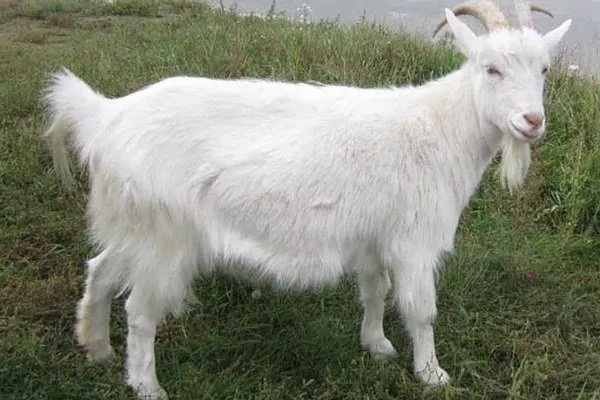
The breed belongs to the medium-heavy group. It is easily distinguished from other dairy goats; the Russian White is much smaller than the Saanen and Toggenburg goats, the undisputed leaders in milk production.
External signs:
- Body. Strong and elongated. Chest – broad.
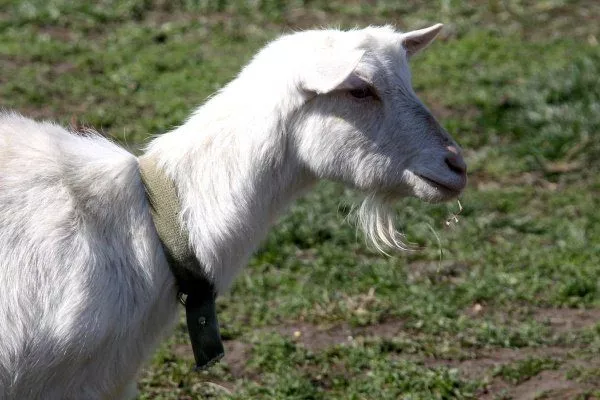
- Head. Small and neat. Some individuals have "earrings" under their jaws.
- Neck. In females it is elongated, in males it is short.
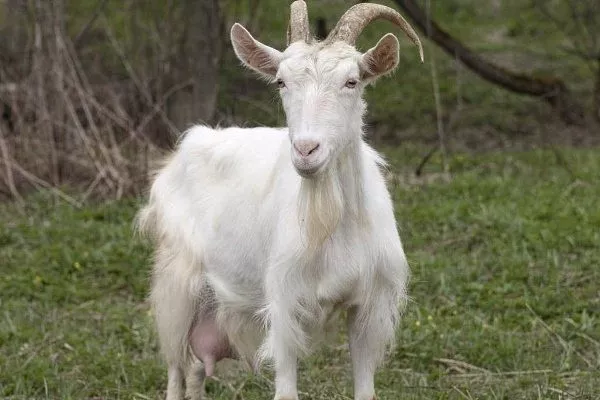
- Horns. Curved like a sickle. In male goats, they are often curled backwards. Up to 15% of goats are hornless.
- Ears. Small, standing type.
- Legs. Length - medium, joints - strong.
- Beard. In males and females.
- Wool. Thick, medium length.
- Color. Mostly white. Variations include grayish or white with beige markings.
- Udder. The shape is correct, round. The nipples are elongated.
A breed defect that determines its purity is folded ears. Ideally, ears should be erect and slightly pointed. Individuals with folded ears are not allowed to breed.
Standards for females and males:
| Parameters | Goat | Goat |
| Live weight, kg | 73 | 52 |
| Height at withers, cm | 83 | 54 |
| Height at sacrum, cm | 80 | 59 |
| Chest depth, cm | 42 | 29 |
| Chest width, cm | 19 | 16 |
| Oblique body, cm | 75 | 57 |
| Chest circumference, cm | 103 | 82 |
| Width in lapels, cm | 5 | 14 |
| Metacarpus circumference, cm | 18 | 8 |
| Head length, cm | 20 | 21 |
| Forehead width, cm | 12 | 13 |
Male goats have long bodies, strong bones, and well-positioned legs. Female goats are also quite large, but in most respects they are still smaller than males.
Main characteristics of Russian White goats
This breed is considered a dairy goat. The primary purpose of breeding is milk production. All other sources of income are secondary. As befits dairy goats, Russian Whites have long teats, suitable for hand and machine milking.
The main difference between the Russian breed and its foreign counterparts is the presence of down under its thick fur. This characteristic is associated with the breed's ability to survive in harsh conditions.
Productivity
Productivity objects:
- Milk. A single goat produces 500 to 850 liters of milk per year. Milk yield depends on care. Other milk production indicators:
- lactation duration – 270-280 days;
- daily milk yield – 1-2 l;
- caloric content – 687 kcal/kg;
- fat content – 4-5%;
- protein – 2.8-3.2%;
- casein – 2.1-2.5%;
- lactose – 4.5-6%.
- Meat. It has a pleasant, tender flavor. Carcass yield is 56%. Due to the breed's high reproductive capacity, young animals are often raised for meat. Individual weights vary by sex and range from 55-85 kg.
- Wool and fluff. One goat produces 150-200 grams of down per year. Sometimes, they can produce up to 400 grams. The wool is used to make warm, soft yarn. The amount of wool depends on the breed subspecies—there are short-haired and long-haired goats.
- Fertility. Females give birth to 1-2 kids per year. Lambing frequency is twice a year.
- Leather (goatskin). It is used to make expensive leather materials – morocco, chevrolet.
The Russian White produces 0.4 kg of milk per minute. The average milking time is 3 minutes.
Males are often used at breeding farms to improve the milk production of other breeds. In large herds, Russian Whites are used for crossbreeding with Saanen goats and other foreign breeds that carry the gene for high milk production.
Goat's temperament
The breed is distinguished by its even temperament. Other character traits of White Russian goats:
- not prone to butting;
- changeable - quickly moves from obedience to stubbornness;
- smart;
- gluttonous - eat greedily;
- They are smart and love to dominate - this is what the hornless females suffer from, as they are unable to fight back against their horned fellow tribesmen;
- If frightened or ill, they may show hostility.
Watch the video below for an overview of the Russian White goat breed:
Distribution areas
The Russian White goat, as well as its subspecies, the Gorky breed, is most widespread in the central and northwestern regions of Russia. Most farms here breed these goats. The total population of this breed in farms in the Moscow, Leningrad, Ivanovo, and Yaroslavl regions reaches hundreds of thousands of head.
In addition to the regions listed above, Russian white goats are also actively bred in the Krasnodar Krai, Mordovia, Saratov, and other regions of the Russian Federation. White goats are popular in Belarus and Ukraine.
Advantages and disadvantages
Over hundreds of years of natural “evolution”, as well as as a result of systematic selection, the breed has acquired advantages:
- They give a lot of milk.
- Hardy.
- Milk without odor.
- Friendly and sociable, they recognize the herd owner as the leader and obey him.
Disadvantages of Russian White goats:
- The breed is prone to degeneration. When animals of different sexes are kept in the same pen, the offspring may be weak and sickly. Such matings can also result in the birth of deformed animals.
- Pugnaciousness in youth.
Content nuances
There's nothing complicated or special about keeping Russian White goats—these goats are prolific, easy-to-care-for, and hardy. The main things they need are clean, dry sheds and a nutritious diet.
- ✓ The optimal temperature in the goat house should be maintained at +12…+18°C to ensure comfort and high productivity.
- ✓ The humidity level in the room should not exceed 70% to prevent the development of diseases.
Housing requirements for the White Russian breed
Requirements for the goat's rue and conditions of maintenance:
- A dry, clean, well-ventilated goat barn is essential, but there should be no drafts. Goats don't tolerate strong winds—they get sick. Fresh air reduces the risk of illness.
- The floors are sloped. They are made of concrete, with planks laid on top. Sawdust or straw is placed on top to prevent the animals' hooves and feet from getting frostbite.
- The air in the barn should be moderately humid. Excessively damp rooms increase the risk of viruses and infections.
- Cleaning is necessary on a regular basis. If the barn is not cleaned, parasitic insects may infest the walls and straw.
In the south, goats can be grazed year-round. In temperate latitudes, pasture-stall management or stable housing are practiced. The breed is suitable for both small private farms and large-scale breeding.
How and what to feed?
A proper diet is essential for high milk yields. Until cold weather sets in, grass is the main source of nutrition for goats. They particularly readily eat clover, alfalfa, and wheatgrass.
Tips for feeding goats:
- Vetch-oat mixture. A mixture of cereal and legume hay. The recommended feeding rate is 2 kg, but free access is ideal.
- Corn silage. It is given during the active milking period. The norm is up to 1 kg per day.
- Dry bean hay – up to 400 g.
- Vegetables and fruits. Up to 300 g per day.
- Chalk and salt. They are added to feed during cold weather. Alternatively, compressed salt and chalk are placed in bowls near the waterers.
- Grass brooms - nettles and quinoa, or from branches - aspen, birch, oak.
- Water. Goats should have free access to fresh drinking water, which is changed twice a day. In winter, it is advisable to warm the water.
Goats happily nibble on young branches of shrubs and gnaw bark from trees. These animals should be kept away from fruit and berry plants.
We recommend reading the article about feeding goats in winter.
Mating: Features for the Russian White Breed
The breed is based on wild and mongrel ancestors, from whom the Russian White inherited its early sexual maturity. Young goats are ready for mating as early as 3 months. However, they should not be mated before 7-9 months. The ideal age for mating is 1 year.
Types of mating
Goats' estrus cycle ranges from 17 to 22 days. Mating typically occurs within 5-7 days, during which time the female is restless.
Mating options:
- Artificial insemination. The most reliable and effective method. The procedure is performed by a veterinarian equipped with high-quality semen, ensuring a successful outcome.
- Hand mating. The owner selects individuals for mating. It is important to avoid mating between closely related individuals.
- Free mating. Animals mate chaotically, as they are kept together – males and females.
It is best to breed animals in the fall so that the kids are born in the spring – spring offspring are considered the strongest and most resilient.
Gestation period and lambing characteristics
Gestation lasts from 143 to 155 days. Everything necessary for lambing is prepared in advance:
- warm water;
- scissors;
- clean rags.
- Two weeks before the expected lambing, reduce the amount of succulent feed in the goat’s diet.
- A week before lambing, prepare a separate, clean and dry place for the goat and future offspring.
- On the day of lambing, ensure constant supervision of the goat and readiness to provide assistance if necessary.
Goats usually manage without human assistance. In rare cases, veterinary assistance may be needed. The doe's imminent lambing can be indicated by her restless behavior.
Lambing procedure and features:
- The first baby is born head first, the next ones are born head first.
- They remove mucus from the mouth and nose, cut off the umbilical cord, and disinfect it.
- An hour after the kids are born, the placenta comes in. It must be removed quickly.
Sometimes a kid is born lifeless. It can be helped by wiping its face of mucus and breathing air into its mouth. The newborn is also placed on its back and its legs are flexed and straightened. These measures usually help the kid breathe.
Once the newborns are dry, they are fed colostrum and placed in a special barn for young goats. If the offspring are left with their mother, her milk production will decline and will be difficult to restore.
Kids: weight, litter size, and care
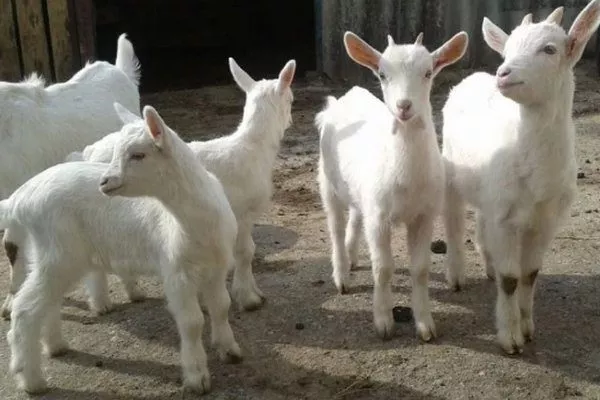
A kid's birth weight is 2.4-3.7 kg. Young animals grow quickly, reaching 25-30 kg by 6-8 months. A litter usually contains 1-2 kids, rarely three. The kids develop quickly and are very viable. They quickly stand upright, gain weight rapidly, and begin grazing with the adult herd early.
Feeding features:
- As is customary for dairy breeds, kids are fed through a bottle. They are fed colostrum for 10 days, then taught to drink from a bowl.
- At first, kids are given milk 4 times a day, then 3 times.
- At two months, liquid porridge and mashed potatoes with warm milk are introduced into the diet. Kids begin eating hay. At 20 days, they can be introduced to compound feed. Goats raised for milk production are fed milk for three to four months.
Read the article about How and what to feed kids.
How to milk a goat?
Russian Whites are easy to milk by hand, but machine milking can speed up the process. If you have several dozen head of cattle, the best option for milking is to use a milking machine.
Components of the milking machine:
- The container is where the milk is placed. The inside of the container is coated with a special antimicrobial compound.
- Milking mechanism.
- Pump with motor.
- Glasses with suction cups or clamps.
- Milk hose.
Milking procedure:
- Secure the animal so that it stands still and does not interfere with the operation of the device.
- Place a bowl of food – something tasty – near the goat.
- Shave the udder.
- Apply disinfectant to the nipples.
- Milk the first streams by hand into a separate container. The milk should be clear, without any blood or curdled clots. Their presence indicates illness. Such milk is not suitable for consumption.
- If there are no impurities in the milk, wipe the udder with a dry and clean towel.
- Attach warmed milking cups to the udder.
- Remove the cups from the teats. Feel the udder—if there's still milk, express it by hand.
- Lubricate the nipples again with an antimicrobial preparation.
- Wash and dry the machine – this should be done after each milking.
The maximum number of milkings is five. Goats are placed in milking stalls. A goat produces its maximum milk after lambing. Intensive lactation lasts for about eight months.
How to buy a purebred goat?
If you don't have experience raising goats, you might easily be sold a mongrel. When buying goats, it's helpful to know the signs of a purebred Russian White:
- The coat color is snow-white.
- Beautiful and healthy hooves.
Visit the farm and observe how the work is going. This will help you determine whether the meat and milk will have the distinctive goat smell.
Common diseases in the breed
The breed is distinguished by its increased resistance to diseases common to local goats. Russian White goats have a relatively long lifespan of 10-15 years, partly due to their strong immune system. The breed rarely suffers from colds, brucellosis, and botulism, but is not completely immune to infectious and other diseases.
Goats of this breed can suffer from:
- Tympany. This is a bloat that occurs when cattle are put out to pasture early, before the dew has melted. In its early stages, the disease is easily treated. If treatment is not taken promptly, the animal dies.
- Parasitic diseases. Goats' fur is often infested with lice and mites. Regular washing and brushing is essential.
The breed practically does not suffer from vitamin deficiencies and hypervitaminosis - even when fed only hay, White goats remain healthy.
Differences from the Saanen goat
In appearance, Russians are white and Saanen goats very similar. Differences:
- Beard. This is the main difference. All Russian goats—both males and females—have beards, but the latter have a more luxuriant beard.
- Behavior. Saanen goats have a calmer nature.
- Size. Saanen goats are larger and have more strict body proportions.
Where can I buy purebred Russian White goats?
The Russian White goat is bred in all regions of Russia, from the south to the north. It's best to buy goats from breeders, such as:
- At the "Kozy Dvor" nursery in Krasnoyarsk, you can purchase both adult and young animals, as well as mated and dairy goats, breeding and castrated bucks.
- At the Valeria farm in Nizhny Tagil, they offer dairy goats at an affordable price. Milk yields up to 4 liters per day.
White Russian goats are cheaper than European breeds:
- a breeding goat costs 15-20 thousand rubles;
- dairy goats – from 5 to 12 thousand rubles;
- kids – 1-3 thousand rubles.
Mongrel white goats are often offered at the market, passing them off as "Russian White." They sell for 3,000-3,500 rubles.
Mistakes in keeping goats
Mistakes made by inexperienced goat breeders:
- Overfeeding kids. This can lead to bloat. It's important to monitor the amount of food given. Overfeeding can lead to death.
- Early coverage. This is detrimental to the health and productivity of goats. It's best to begin the first mating at one year of age. This will ensure consistent milk production and prevent many diseases. Early mated does are prone to complications during lambing, have poor postpartum health, age quickly, and must be slaughtered prematurely.
- Milking before the first lambing. Young goats born to high-yielding mothers often develop udders before they are covered. If there is no milk in the udder, it should not be milked. Once a goat begins to milk, she stops developing. The nutrients necessary for her development are absorbed into the milk.
In addition, early milking causes the udder to form incorrectly – it becomes sagging and easily injured while walking; it can bleed and become inflamed. - Family ties. It is impossible to obtain strong offspring and high milk yields by crossing related individuals.
- Lack of walking in winter. Young animals and pregnant females especially need walks. They need sun and exercise. This strengthens the immune system and skeletal structure. Pregnant goats need walks for preventative purposes—to ease the birthing process. A walk should last at least an hour; if a goat simply stands and chews hay, it's of little use—she needs to be actively moving.
- Overfeeding a goat after giving birth. For the first 10 days, goats are given only hay, water, and brooms. Drink, grain, compound feed, and succulent feed can cause udder swelling, gastric arrest, and death. Feeding goats with mash after birth is also strictly prohibited, as it can cause swelling and mastitis. Improper feeding can lead to rumen failure and, consequently, death.
- Hasty slaughter of uncovered goats. The animal should rest for 2.5 months. Then it can be turned out like a mated goat and then milked.
- Poor diet during pregnancy. Deficiency of vitamins and microelements leads to the birth of weakened offspring and poor milk yield.
- Hooves are rarely trimmed. Hooves should be trimmed starting at 3 months of age. Trimming frequency is every 2.5-3 months. Long hooves cause suffering for animals and can lead to foot rot and other complications.
Goat Reviews
The Russian White breed is suitable not only for small private farms but also for large-scale farms. These goats are optimally adapted to the local climate, are virtually disease-free, are easy-to-eat, productive, and produce delicious milk.