
Why are fainting goats called fainting goats? Read on to learn about the breed's interesting characteristics and history, the reasons for their unusual behavior, the characteristics and care of these goats, and much more useful and interesting information.
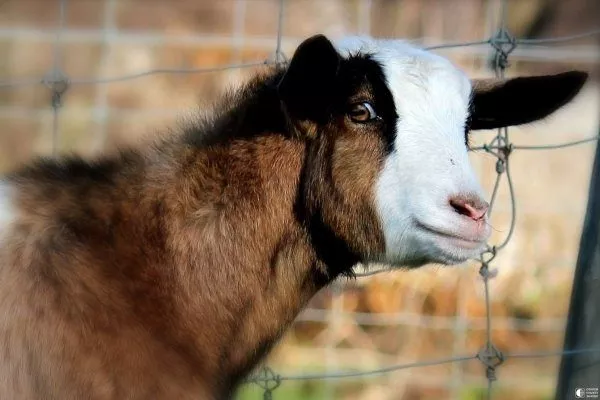
A strange peculiarity of the fainting goat
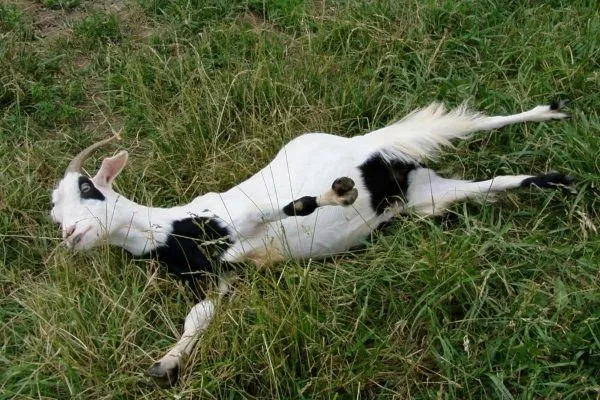
The fainting goat got its name for a reason. In moments of danger or great excitement, these nervous creatures abruptly fall to their sides, like corpses, with their legs outstretched, and remain motionless for 10 to 60 seconds.
From the outside, this may seem funny, and many try to give her a good scare, however, the poor animal does not experience any euphoria from the sudden paralysis.
Do all goats react the same way?
Animals react differently to severe shock. Some are prone to fainting at the slightest sound, while others react to sudden, intense frights.
Young animals are most susceptible to attacks; with age, the disease weakens and may even disappear.
A bit of history
The first mention of this breed was recorded in the 1880s in the US state of Tennessee, when a farmer (presumably from Nova Scotia) arrived with four animals. The goats quickly adapted to the new environment and became a hit with ranchers. Because they were good meat producers, they didn't require high fences due to their reluctance to jump or climb.
Moreover, many farmers have taken to using them as "bait" when herding their flocks. When threatened, sheep huddle together, creating chaos in the ranks, making them vulnerable to attack by predators. If a fainting goat was among them, it would save the flock by sacrificing itself. When attacked by a pack of wolves or coyotes, it would "faint" and fall into the predator's jaws, while the others had a chance to escape the sharp teeth.
In the 1950s, several animals were purchased by Texas ranchers and brought to their state. Gradually, the popularity of the "wood goat" (another nickname for these animals) began to decline, replaced by breeds with superior characteristics.
Over time, their numbers steadily declined, reaching critical levels. In 1988, they were placed on the American Livestock Conservation Priority List and declared an endangered breed. They remain on this list to this day, although the goat population is growing, thanks to farmers who, in most cases, raise them for the hobby.
Why do goats faint?
So what's the reason for this strange behavior? If they froze at every sign of danger in the wild, it's likely that not a single individual would have survived to this day, as natural selection still exists. Goats would be "convenient" food for predators.
But this goat is a domestic animal, so it survived, and recently, thanks to YouTube, its fame has returned. Videos featuring them are gaining a lot of views, and numerous tourists come to the farms specifically to interact with these amazing goats.
But in reality, a frightened goat doesn't faint—there's no need to talk about a sensitive nature here—but rather suffers a brief paralysis. Fainting is a brief loss of consciousness due to a lack of oxygen to the brain. A fallen animal, on the other hand, is fully conscious but unable to move due to muscle problems.
Check out the video below for a look at these amazing fainting goats:
All individuals of the fainting breed have a congenital condition called myotonia. This genetically determined disorder is classified as a neuromuscular disorder. It is characterized by delayed muscle relaxation. After a seizure, the goat gets back on its feet and goes about its business as if nothing had happened.
Animal description and breed standards
The fainting goat breed is also known as the Tennessee or Myotonic. Debates about its international recognition are ongoing, but so far, to no avail. In the United States, considered the goat's birthplace, it is unconditionally considered a distinct breed. Currently, members of this breed are protected and enjoy protection.
European breeders disagree with this opinion and classify it as a separate breed, as each breed must have precise characteristics (standards) for exterior, interior, and productivity. However, Tennessee goats share nothing in common except a specific behavior caused by a genetic mutation. Their appearance is so varied that it's difficult to determine whether a goat is myotonic.
The fainting goat is considered a meat breed, as myotonia promotes muscle growth. Therefore, it produces a high yield of meat, renowned for its delicate flavor.
Characteristic features
There is a Myotonic Goat Registry that tracks purebred representatives of this breed based on the following characteristics:
- Head and profile. Concave or straight "Roman" head profile, medium sized head with a broad, rounded muzzle.
- Nose. The nose is of medium length, wide and flat.
- Eyes. Bulging, brown with a blue tint.
- Forehead. Slightly convex wide forehead.
- Horns. Most goats have horns, which can be any size—from small to large—and any shape—from simple to twisted. Hornless specimens are also acceptable.
- Ears. Medium in size, set horizontally or slightly forward towards the muzzle.
- Neck. Short and muscular. In males, the skin on the neck may be wrinkled and thick.
- Back. Wide, strong and even.
- Color. The color palette is varied, with black and white becoming the preferred choice recently. The coat can be solid or feature various patterns, markings, and spots.
- Wool. The hair is short or long. Thick hair is smooth or shaggy, but straight. The coat should not be wavy. Goats with long, shaggy hair are more resistant to adverse weather conditions.
- Legs. Proportionate to the body, strong, even.
- Hooves. Symmetrically located in relation to each other.
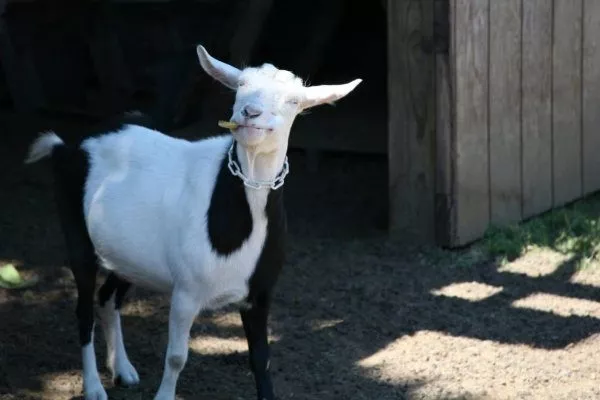
Depending on the breed (Texas or Tennessee), the height at the withers varies from 45 to 70 cm. In Tennessee, they are developing a dwarf breed intended for domestic use. In Texas, the emphasis is on the meat component of the animal.
| Branch | Average weight | Height at withers | Main direction |
|---|---|---|---|
| Tennessee | 35-45 kg | 45-70 cm | Decorative |
| Texas | 40-75 kg | 45-70 cm | Meat |
However, the main characteristic is the presence of congenital myotonia. A goat that never goes into stupor but exhibits all the characteristic traits of the breed is not used for further breeding.
Character
Strong positive and negative experiences—from fright to seeing a large amount of their favorite food—cause goats to go into paralysis. They are impressionable and nervous creatures, but on the other hand, they are calm, peace-loving, avoid conflict, and are characterized by a sedentary, lazy nature. They are not seen jumping over fences, frolicking, or climbing mountains. Females have a well-developed maternal instinct.
If you plan to keep these animals, you should purchase at least two. Goats are social animals that require constant contact with their fellow goats.
Health status
Animals have good immunity to various diseases, are resistant to parasites, and adapt well to adverse conditions, but are susceptible to cardiovascular diseases.
The attacks of paralysis themselves don't cause any harm to their health, but they come on suddenly. Therefore, the animal may fall awkwardly or stumble over a sharp object.
Productivity
Goats reach their peak weight by age four. Tennessee goats weigh between 35 and 45 kg, while Texas goats weigh between 40 and 75 kg. Rarely, a male goat can reach 90 kg. The meat is highly palatable. It is tender, tasty, and low in fat. The meat-to-bone ratio is 4:1.
Females are known for their high fertility and strong maternal instincts. Twins and triplets are not uncommon, and the female does a great job of caring for her offspring and nurturing them all. The genetic disorder is passed down through generations.
Crossbreeding them with other breeds is impractical, as the kids are latent carriers of this gene, and after several generations, offspring with abnormalities may be born. Furthermore, due to the small population of these nervous goats, experts advocate for purebred breeding to save them from extinction.
Keeping Fainting Goats
Goats are easy-to-care-for animals. Their lifespan averages 12-15 years. They feed themselves during the summer, eating grass, leaves, and twigs. They are supplemented with grain and hay. Salt, mineral supplements, and clean, fresh water must be available at all times. Water should be stored in a shallow container to prevent drowning if the animal falls.
- ✓ Make sure the pasture does not contain poisonous plants such as bracken or milkweed, which can cause poisoning.
- ✓ Provide protection from predators by installing a fence at least 1.5 meters high, as goats, despite their myotonic response, can become easy prey.
The diet is adjusted depending on the season. Goats are ruminants, with four stomachs. Each stomach contains specific bacteria. These bacteria digest the food and make it digestible.
Roughage and fiber are essential in the daily diet. They promote proper digestive function and help move food through the gastrointestinal tract.
Any dietary changes should be made gradually, starting with small doses to avoid disrupting the rumen microflora. Grain should not exceed 50% of the total feed volume, as this can trigger acidosis. This condition causes animals to either refuse food completely or eat very little, develop diarrhea, and become indifferent to everything around them. In severe cases, the animal dies.
Overeating also causes serious health problems.
They are ideal for grazing, but only in remote pastures where there is no noise from operating machinery or large crowds of people.
Interaction with humans
While the "wooden" goat was once most often used as bait to rescue herds and also as a source of tasty meat, they are now bred more often for entertainment. In America, there are dedicated farms that are very popular with tourists.
Scientists still haven't been able to explain this phenomenon or its causes. Every October, admirers of fainting goats flock to Tennessee for a festival dedicated to these nervous creatures, where they hold various contests and fairs.
The unusual behavior of fainting goats is directly related to a rare genetic disorder called myotonia. Farmers do not breed this particular breed of goat, as they consider it impractical. However, these goats are known for their gentle nature and low maintenance, so they are often bred as ornamental animals to attract and entertain tourists.