
The forest polecat, or black polecat, as well as the common polecat, dark polecat, or black polecat—all names for a small animal of the mustelid family, a carnivore order. It is widely known among exotic pet lovers, gets along well with people, and feels comfortable both in the wild and in domestic settings. Read more about the forest polecat and its characteristics below.
What does a European polecat look like?
The ferret is small in size, but its exterior is typical of its family.
Constitution
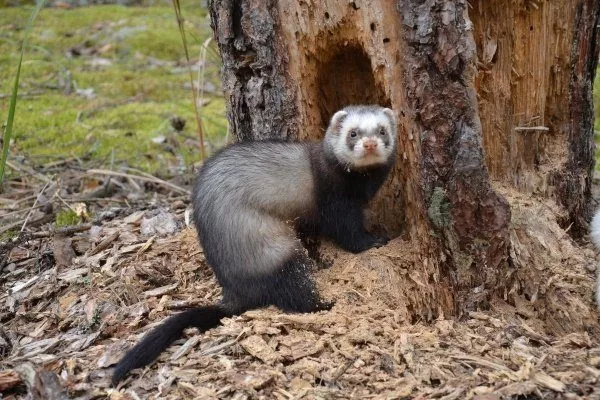
The ferret's body is elongated, flexible, and stocky, with short but strong legs. This structure allows it to stalk its prey silently. The ferret's neck is elongated, its head is small and oval, and its muzzle is elongated, slightly flattened toward the nose.
Basic parameters of the forest polecat:
| Body length | Weight | Tail length |
| 29-46 cm | 650-1500 g | 8-17 cm |
Color
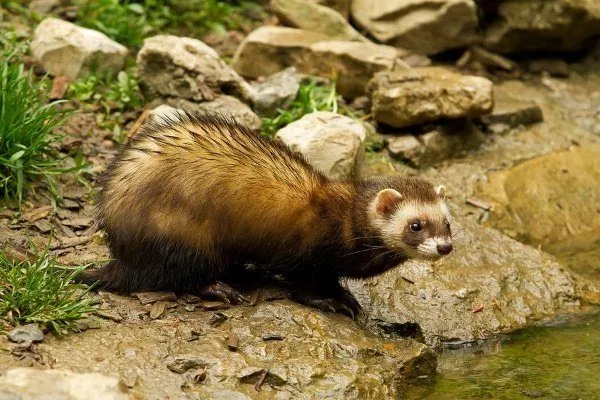
These animals have long fur, which can reach 6 cm, and come in a variety of colors, from dark gray to black. However, in the wild, individuals with brown, reddish, and yellow fur are also found, as are albino specimens.
The color is never uniform. The tail, belly, and paws are always darker than the body, and the face has a white mask, a distinctive feature of the ferret.
In winter, after molting, the forest ferret's color becomes darker than in the warm season.
Structural features
The main structural features of the animal include:
- a small head smoothly flows into a flexible and elongated neck;
- the ears are small, not set high, with a wide base;
- eyes are brown, shiny, like beads;
- the legs are short and thick, even in the largest individuals the length of the hind legs is only 6-8 cm;
- the paws have 5 toes, between which there is webbing;
- The forest polecat has 28-30 teeth, including 4 canines, 12 premolars, 12-14 incisors;
- Near the animal's tail there are special glands that, in case of danger, secrete a secretion with a foul odor.
Where does it live?
Their habitat extends across Eurasia and northwestern Africa. They are most commonly found in Russia, China, England, and Ukraine.
Not long ago, black ferrets were brought to New Zealand to reduce the rodent population, and they ended up taking root there and feeling more than comfortable.
These animals inhabit small woodlands and isolated groves. They prefer not to venture deep into the forest, preferring to settle at the edges of forests and clearings. European polecats are sedentary and very attached to their chosen location. They occupy a small territory, most often using natural shelters—wood piles, rotted stumps, haystacks, and deadfalls—as permanent shelters. They almost never dig their own burrows; they may live in the branches of badger or fox burrows.
- ✓ Presence of natural shelters (deadwood, haystacks, rotten stumps).
- ✓ Proximity to water bodies to ensure water balance.
- ✓ Avoid dense forests and open spaces.
They never choose dense taiga or open spaces for living; in extreme cases, they settle near human settlements.
Lifestyle and behavior
Ferrets are aggressive and fearless by nature, and can attack an animal larger than them if they sense danger. They sleep during the day and rarely emerge from their shelter during daylight hours. At night, they hunt. They lie in wait for prey at the entrance to their home or give chase, sometimes even catching prey on the move. Ferrets are good swimmers, so they can be found near small rivers and other bodies of water.
Types and their characteristics
The European polecat has two domesticated species:
- Ferret — the colored ferret. A decorative specimen, it has fluffy fur in sable, gold, or pearl shades. It is a very sociable, active, and inquisitive animal. Its body length is 25-50 cm, and it weighs 800-2500 g. Ferrets love to sleep, sometimes dozing for up to 20 hours a day, especially in winter. Ferrets are trainable, can use a litter box, and can even be walked on a leash. Their diet includes mice, mealworms, porridge with meat, and dry food. Do not feed them raw food and dry food at the same time; choose one over the other.
- Furo — an albino ferret. Its fur is white (due to the absence of melanin) or champagne-colored. Individuals with sable and pearlescent colors are also found. This predator measures 25-45 cm and weighs approximately 400 g. Its distinguishing feature is its red eyes. It shares the same traits as the European polecat. It enjoys active play and attention. Its diet should include white meat, chicken eggs, vegetables, veal, and fresh fish. Feeding Furos sweets is prohibited, as they can be fatal in large quantities.
Since European ferrets feed at night in the wild, these species also need to be fed at specific times—around midday, during the day, and late in the evening. Ferrets eat poorly in the morning.
- ✓ The need for separate feeding of raw food and dry food.
- ✓ No sweets allowed for albino ferrets.
- ✓ Feeding schedule that matches night activity.
Nutrition in the wild
Although the European polecat is relatively large, it is a typical mouse-eater. Its primary diet consists of:
- small rodents - mice, rats, gerbils, voles, moles, gophers and ground squirrels;
- frogs and toads;
- large insects, such as locusts;
- hares and rabbits, can penetrate into animal burrows and strangle young individuals;
- reptiles - lizards and snakes;
- small birds and their chicks, as well as eggs from ground clutches;
- invertebrates, such as worms;
- carrion - if there is no other source of food, the ferret will not disdain carrion.
One interesting characteristic of the European polecat is noted: when attacking a bird's nest or entering a hare's burrow, the animal completely destroys them and strangles all the individuals inside, although it only consumes a small portion.
Reproduction
A young ferret begins sexual maturity just one year after birth. The mating season begins in April-May, although in some cases this period can begin as early as February or end in August, depending on the climatic conditions of the ferret's home region.
Females can give birth up to 6 years of age!
Pregnancy lasts one and a half months, and a female can bear 4 to 6 pups at a time. Ferret pups are born tiny and helpless, blind and deaf. Newborns weigh 10 grams and measure 5.5 to 7 cm in length. Females are very caring and attentive mothers, rarely leaving their pups. If they must leave their offspring, they seal the entrance to the nest tightly with straw. Females selflessly protect their puppies from any danger.
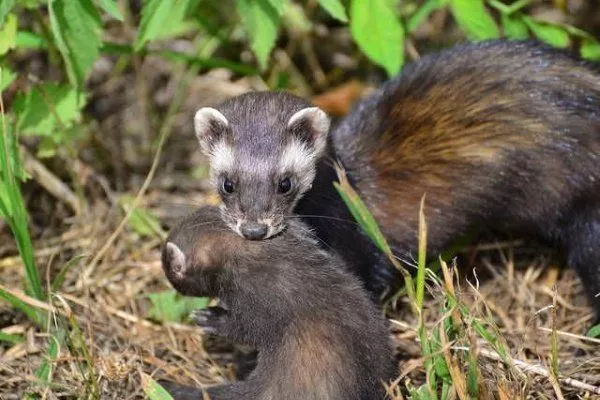
Within a week, the puppies are covered in silky white fur. A month later, their eyes open and their fur turns gray-brown.
The mother feeds her offspring milk until they reach one month of age, and when their baby teeth appear, even before the end of lactation, she begins to feed them meat. The offspring stay with their mother until autumn, and in some cases until the following spring. At three months of age, ferrets are considered adults.
The young can be recognized by the presence of a special juvenile "mane".
As for males, they participate in the process only at the mating stage, while all care for the offspring falls entirely on the female.
Natural enemies of the forest polecat
Since ferrets are small animals, they have enemies in the wild that pose a mortal danger:
- Wolves. Although ferrets are fast runners, they rarely manage to escape a wolf in open areas. Therefore, they tend to avoid open spaces and settle in areas with plenty of bushes and similar shelters.
- Foxes. Another land predator that's not averse to feasting on the European polecat, especially in winter, when foxes are short of food. The cunning fox can even reach the polecat in its own shelter if it's truly hungry.
- Lynx. Being a cunning "ambush master," the predator leaves the animal no chance of survival. Its sharp teeth can cut a ferret in half with a single bite.
- Stray dogs. If a forest ferret gets close to a human settlement, a dog may lie in wait for it there.
- Birds of prey. At night, when the ferret goes hunting, it is also hunted by eagle owls and owls. During the day, golden eagles and falcons pose a danger. However, the ferret often wins the fight, as it is capable of aggressive and fearless counterattacks.
- Human. Human factors cannot be excluded from this list, as humans are capable of reducing the animal's population through illegal hunting for valuable fur. Human activities, such as deforestation, also harm ferrets.
Interesting facts about the animal
There are some interesting facts worth knowing about this animal:
- Among rural residents, the forest polecat has earned a negative reputation because it attacks poultry;
- It is considered a valuable fur-bearing animal, but hunting for it is not carried out and is prohibited by law, since the number of ferrets is small;
- listed in the Red Book;
- in the wild lives 3-4 years, in captivity lifespan increases by 2 times;
- the sensory system is well developed, but does not distinguish colors;
- In the wild, hybrids of the forest ferret and mink are often found; they are called honoriki;
- the ferret is depicted on the coat of arms of the city of Boguchar (Voronezh region) and the city of Oboyan (Kursk region);
- An angry or frightened European ferret may make a strange sound, similar to hissing;
- the ferret's stomach is not able to digest organic fibers;
- To prevent domestic ferrets from emitting a characteristic musky odor, the special gland is removed;
- Leonardo da Vinci's painting "Lady with an Ermine" depicts not an ermine at all, but a ferret;
So far, the resourceful and tenacious ferret has managed to maintain its population. However, humans and their activities are still considered the main threat to its existence. It's possible that very soon the animal will only survive in its domesticated forms.