
Since the end of the last century, the American ferret population has been restored through artificial breeding. Nowadays, efforts are being made to reintegrate the animals into their natural habitat, with varying success.
American Ferret: Description
The American (black-footed) ferret is a small carnivore of the mustelid family. This mammal's habitat is North America. Its closest relative is the steppe polecat. In the 1930s, the animal became completely extinct (was exterminated) in Canada. In the 1960s, it was listed as a critically endangered species in the United States.
- ✓ Optimum room temperature for breeding: 18-22°C.
- ✓ Humidity level: 40-60%.
- ✓ The need for shelters to reduce stress in animals.
Appearance
The black-footed ferret is 45 cm long (including its 15-centimeter bushy tail). The animal, whose Latin name is Mustela nigripes, weighs 650-1400 g. Like most members of the weasel family, the animal is distinguished by its characteristic squat, elongated body and very short legs.
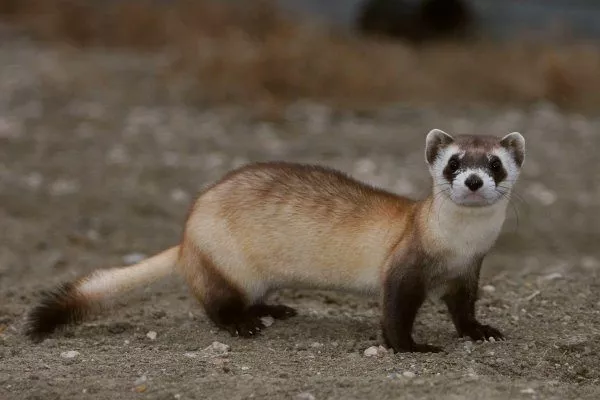
The ferret's fur is almost white at the base and darker at the tips. Overall, the animal's base coloration is yellowish-brown. Black fur predominates on the paws and the end of the tail. The black fur on the animal's face forms a distinctive mask. This overall color scheme helps these predators remain unnoticed in their habitat.
You might also be interested to know,What types and colors of ferrets are there?.
Character and behavior
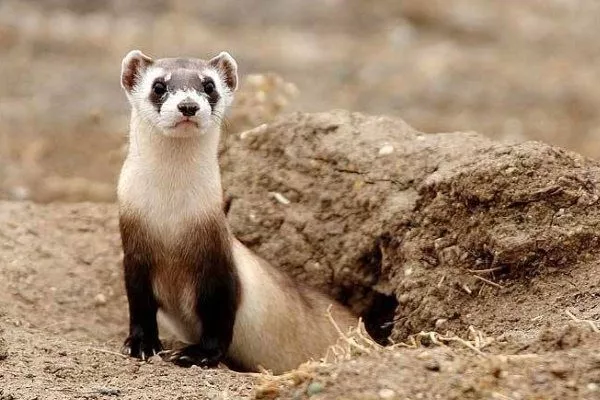
The American ferret is primarily nocturnal, emerging from its burrow to hunt at dusk. In winter, the animal is significantly less active but does not hibernate, although it may remain in its burrow for several days at a time. Mustela nigripes are burrowing animals, using the underground tunnels of prairie dogs for their own purposes.
The black-footed ferret leads a solitary life, not forming communities. The exception is the breeding season. However, the male plays no role in raising the offspring.
The American ferret is a territorial creature, actively defending its territory from other individuals. These animals are especially intolerant of competitors of the same sex.
- ✓ Brightness and shine of the coat as an indicator of good health.
- ✓ Activity and curiosity in behavior.
- ✓ No discharge from the eyes and nose.
These animals are alert, active, and very curious. American ferrets have an excellent sense of smell, good eyesight, and excellent hearing. These animals actively use olfactory communication. They mark their territory to mark their territory or to find their way back to their burrow during nighttime journeys.
Mustela nigripes are secretive but noisy creatures, producing chirping sounds. American ferrets hiss when threatened or attacked.
Life expectancy
According to various estimates, the lifespan of black-footed ferrets in the wild ranges from 3 to 5 years. Occasionally, individuals live up to 7-8 years. In captivity, these animals live for 8-9 years, and some long-lived individuals reach 10-11 years.
Area and habitat
The black-footed ferret was once found in many parts of North America, including southern Canada and northern Mexico. Today, they live in northern and eastern Montana, western South Dakota, and southeastern Wyoming.
Many populations in these areas have been artificially restored after being virtually exterminated. Mustela nigripes are also kept in North American zoos and research facilities, where their numbers are being restored.
In the wild, black-footed ferrets prefer steppe and hilly areas. When occupying prairie dog habitats, these predators actively utilize the complex underground infrastructure of their burrows, hunting and hiding from danger. A single individual can occupy 30 to 50 hectares of space. Here, the animal hunts and reproduces. A female with her cubs occupies an even larger territory—50-60 hectares. Sometimes, the ferrets' home ranges overlap.
Lifestyle
The black-footed ferret's habits and lifestyle are little different from those of its European cousin. Like other members of the vast mustelid family, it is primarily nocturnal, becoming active at nightfall.
The animal has an excellent sense of smell and excellent hearing, allowing it to hunt easily at night. With its incredible agility and modest size, the hunter easily enters its prey's den, where it dispatches them. The ferret often remains in the vacated burrow, using it as a temporary or permanent shelter.
The American ferret is directly dependent on prairie dogs, as it feeds primarily on these rodents of the squirrel family. Black-footed ferrets spend the majority of their lives near or within their colonies.
The ferret's flexible body structure allows it to easily penetrate and navigate the tunnels dug by prairie dogs. This gives the hunter an advantage over its prey, but it also prefers to attack when mammals of similar size are sleeping.
Male black-footed ferrets are more active than females, but both species' hunting instincts diminish with the onset of cold weather. During this period, the animals conserve their stored food and only hunt in dire straits.
On the ground, the American ferret typically moves by hopping or galloping at an average speed of 7-12 km/h. This predator can cover up to 10 km in a night, simultaneously exploring up to a hundred prairie dog burrows. Males can travel twice as far as females while hunting.
American ferrets don't tend to form packs and spend most of their lives in splendid isolation. Consequently, they have no hierarchical relationships, with the exception of breeding season.
Nutrition
The American ferret typically hunts prairie dogs. Less frequently, it eats mice, large insects, small birds, ground squirrels, and other small creatures. Black-footed ferrets require 50 to 70 grams of meat per day to survive. A distinctive feature of this subspecies is that it never uses hiding places to store its prey.
What you can feed a ferret at home is described here.
Reproduction
Black-footed ferret females reach sexual maturity about one year after birth. Males reach sexual maturity a little later. American ferrets breed between March and April.
Unlike its European cousin, the male black-footed ferret does not immediately become active during the female's estrus cycle. He waits a few hours, after which pairingThe process can take 2-3 hours.
The female's gestation period lasts 35-45 days. Typically, a female gives birth to a litter of 2 to 5 puppies. It's rare to have one or more than five puppies.
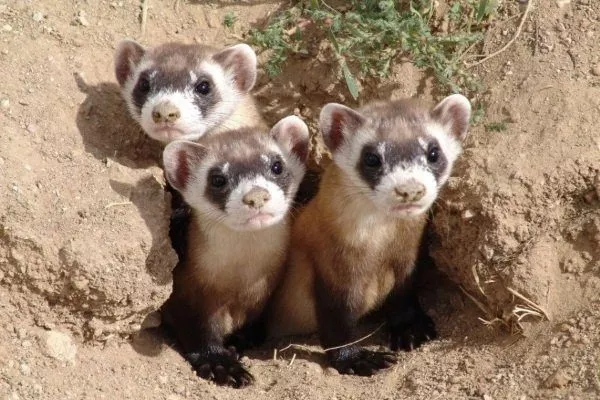
The young emerge from the burrow 40 days after birth. During the summer, the cubs live with their mother, but with the onset of autumn, the family splits up and the new generation begins its independent life.
Hunting and enemies
The main threat to the American ferret's existence comes from humans. It was poaching and agricultural practices that once brought these animals to the brink of near-extinction. This threat remains significant today, despite the animal being a protected species and hunting prohibited.
By reducing the prairie dog's habitat, humans indirectly impact the existence of the American ferret. Furthermore, diseases such as distemper and poisoning negatively impact the population.
Thanks to their stealth and agility, this subspecies has few natural enemies. These are primarily large predatory animals and birds.
Preservation and protection
Federal agencies across the United States collaborate with private landowners to conserve the American ferret and its native habitats. The animals are bred at special facilities and animal centers, and are subsequently released into the wild. Restored habitats are concentrated in states such as Montana, South Dakota, Arizona, Utah, and Colorado.
The American ferret is a relatively rare animal, found only in the northern United States. It is a protected species and is listed as endangered. Estimates of the number of these animals in the wild range from 1,500 individuals.