
Keeping ferrets at home is very fashionable these days. A breeder immediately faces the question of where to house their pet and what kind of cage it should be. To avoid wasting money, let's look at various ferret house options and the possibilities of building one yourself.
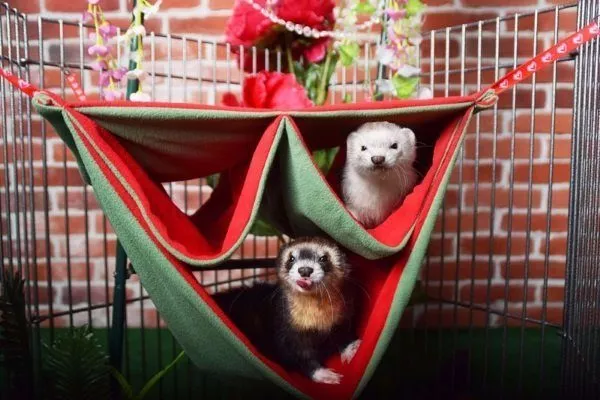
The main types of cages for ferrets
| Name | Material | Durability | Suitable for temporary accommodation |
|---|---|---|---|
| Primitive houses made from cardboard boxes | Cardboard | Low | Yes |
| Cages made of fine-mesh metal wire mesh | Metal | High | No |
| Wooden and metal houses | Wood and metal | Average | No |
| Wooden and plywood cages | Wood and plywood | Average | No |
| Frame houses covered with fabric | Matter | Low | No |
| Cages whose frames are covered with wicker or made of rods | Vine or twigs | Average | No |
Ferret cage options are astonishingly diverse. However, they can be divided into several groups:
- Primitive houses made from cardboard boxes. They can be single-story or formed into a tower by connecting several boxes. This option is suitable for temporary housing of a ferret, as cardboard absorbs all odors and gets soggy very quickly.
- Cages made of fine-mesh metal mesh.
- Wooden and metal houses.
- Cages made of wood and plywood.
- Frame houses covered with fabric.
- Cages whose frame is covered with vines or made of rods.
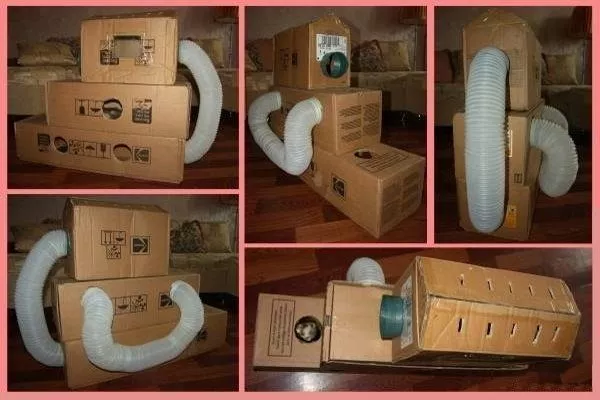
Ferret house made from cardboard boxes
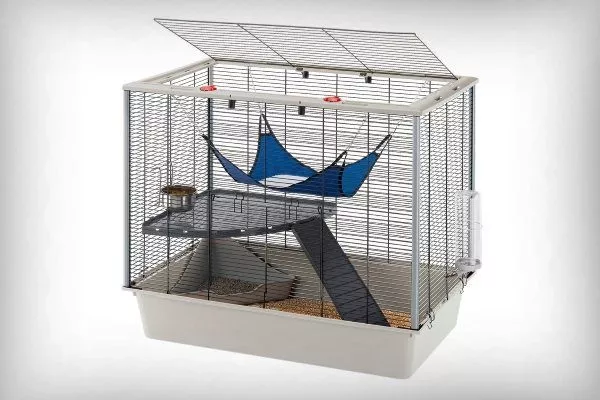
Wire mesh cage
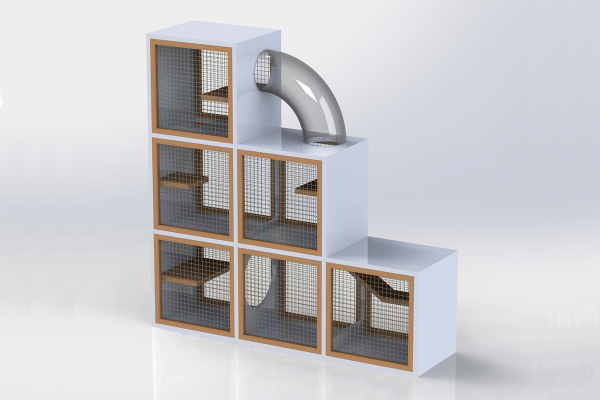
Wooden and metal house for a ferret
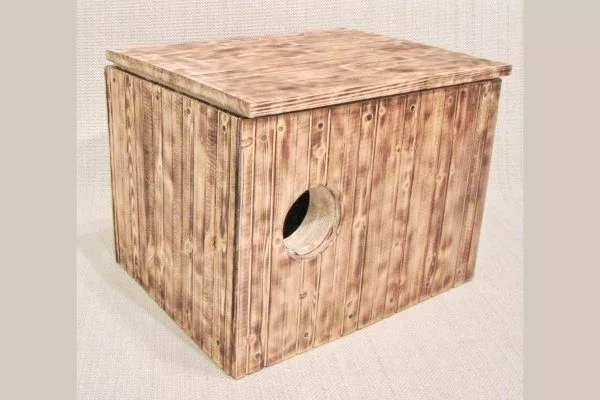
Ferret house made of wood and plywood
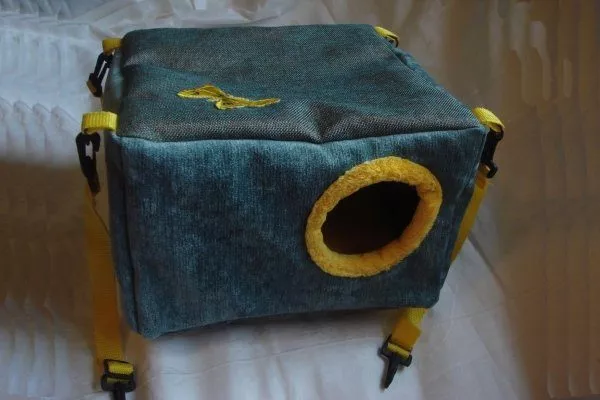
A hammock house for a ferret, covered with fabric
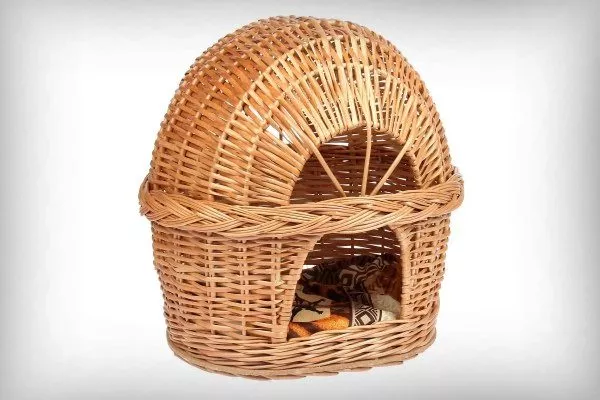
Ferret house covered with wicker
This list goes on, as every owner can design a unique cage for their pet using a wide variety of materials. Most often, houses are built from readily available, inexpensive, yet durable materials.
Selecting a design
When choosing a home for your pet, consider several nuances that will affect the final result:
- Length of time a ferret spends in its home. The more time a ferret spends in its home, the more spacious its cage will need. On average, a ferret requires approximately 0.8-1 square meters of space, and the cage height should be at least 40 cm.
- The ability to move the cage. This aspect is more important for the owner than for the animal. The ability to quickly and easily move or reposition the cage without assistance is essential for daily cleaning, repairs, and other life situations. Therefore, it's preferable for the cage to be on wheels.
Also, consider a collapsible cage so that you can easily assemble your ferret's home if you move or travel.
The ideal home for a pet should meet the following requirements:
- It must be spacious. Ferrets need constant exercise to keep their muscles active and strong, otherwise they will atrophy. Therefore, their home should be filled with all sorts of play and running equipment, as well as essential items for feeding and sleeping. Multi-story cages can help solve the problem of accommodating all of this equipment.
- Gaps between connecting materials and gratings should not exceed 2.5-3 cm. If this distance is greater, the ferret will be able to leave the cage freely at any time, which would defeat the purpose of acquiring a home.
- Availability of a pallet.All waste and waste from the animal will be collected in the litter tray, not on your apartment floor. When cleaning the cage, the contents are discarded, and the tray itself is rinsed with water and disinfectant to eliminate odors and bacteria.
- Robust construction with a reliable locking system,to ensure the animal's safe stay in it.
- Convenient for cleaning.Ferrets like to hide food in corners and places of the cage that are difficult for humans to reach, so the design should take this into account and have additional doors or a removable roof for access to any part of the home.
Selecting a location and taking measurements
A ferret's cage should be a cozy home, not a permanent or temporary place to live. If the pet doesn't like the current habitat, keeping it in such a structure is out of the question.
You'll understand your ferret's attitude toward the cage literally from the first minutes. Therefore, when purchasing a house for your pet or building one yourself, consider your pet's interests first.
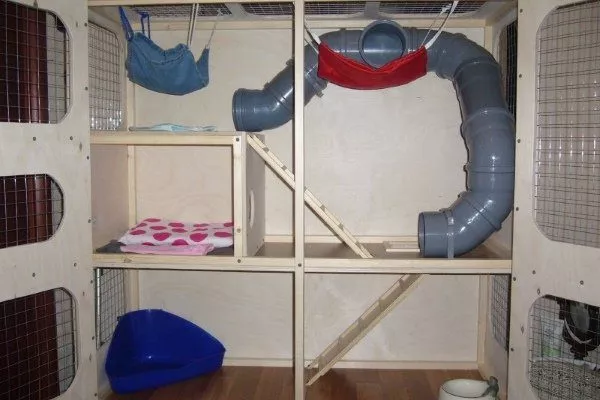
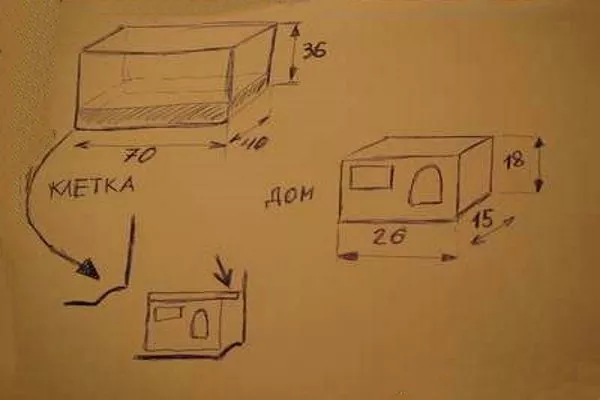
The base of the ferret's home should be at least 60 x 80 cm. Each floor should be at least half a meter high. The finished house will resemble a closed shelving unit with ladders and passages, equipped with the necessary accessories for your pet.
Please note that the house should have several rooms or zones:
- gaming;
- toilet;
- for sleep;
- for eating.
To avoid problems with placing water bottles, feeders, attractions, and other items in the cage, purchase them in advance and take the dimensions into account when planning the space.
Choosing a location for the cage is important for the animal. Ferrets do not tolerate drafts, dry, hot air, and direct sunlight. Therefore, locations near heating units, south-facing windows, entry doors, and vents are not suitable.
Once you have a rough idea of the cage and know where to place it, feel free to start drawing up plans and purchasing materials for the structure. Drawings and diagrams will help you visualize it and prevent alterations and errors during construction.
Making a cage from plywood
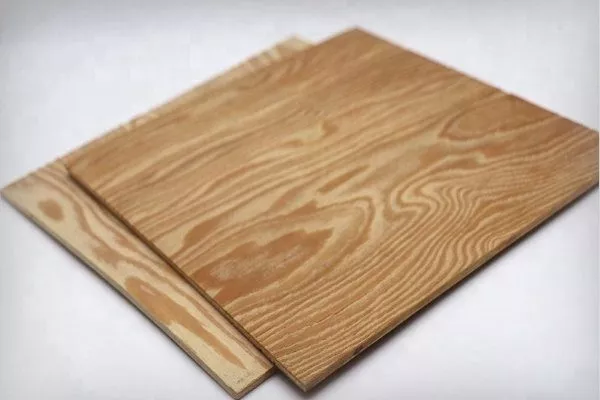
Plywood is an inexpensive building material that's easy to work with, even for beginners. Cages made from it are stable, durable, and comfortable. To build a plywood ferret house, you'll need the following materials and tools:
- timber with a cross-section of 50-100 mm;
- self-tapping screws 3×19, 4×25;
- plywood with a thickness of 3 to 5 mm, for the base it is recommended to use 10;
- linoleum;
- fabric for wall upholstery;
- stapler and staples for it;
- metal mesh;
- door fastening mechanism;
- electric jigsaw;
- screwdrivers or a screwdriver;
- tape measure and ruler, etc.
- ✓ Use only non-toxic, ferret-safe materials such as E1 grade plywood or higher.
- ✓ Ensure that all paints and varnishes used for finishing do not contain harmful substances and dry quickly.
Frame and walls
When choosing plywood, consider not only the thickness but also the emission class, which indicates the presence of harmful substances. It is advisable to purchase Class A plywood.
Assemble the frame and walls following the following sequence of actions:
- Prepare the wooden pieces according to the dimensions in your drawing. Sand the plywood to prevent injury to the ferret during use. If necessary, sand the lumber as well.
- Build the frame from timber. Install the partitions, ceilings, and walls, leaving the front section for the doors. Cover the side panels with fabric using a stapler. Lay linoleum on the floor to prevent the wood from absorbing odors and moisture.
- Secure the remaining parts.
Attach all partitions with special care to ensure they can withstand your ferret's active lifestyle. Make sure screws don't penetrate the material. Remove any sharp edges or uneven surfaces for your pet's safety.
Roof and facade
The appearance of the facades depends on the creativity of the craftsman. Options include painting, upholstery with various materials, varnishing, and much more. It is important to use the most environmentally friendly materials and paints with the lowest odor and toxicity.
The use of plexiglass and plywood is only possible with additional windows for ventilation and a light source inside the cage. One of the most popular options is a lattice or metal mesh façade.
The roof can be made of plywood, mesh, or lattice. The roof's shape is determined by the design and concept: a single-pitched roof, straight or sloped, a gable roof, a curved roof, a multi-level roof, and more.
Double doors
Equipping the cage with double doors makes cleaning much easier. To make your own, follow these tips:
- Assemble 2 frames from wooden slats to fit the size of the front part of the house.
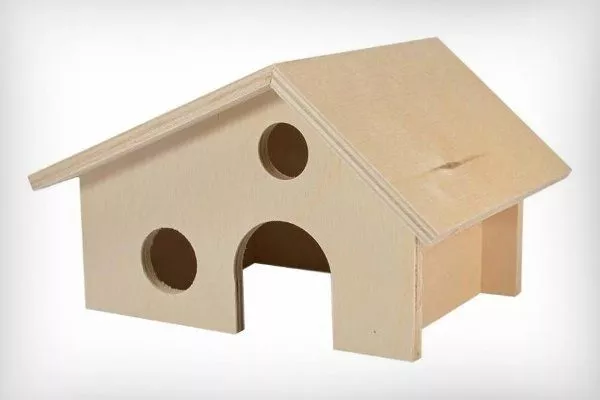
- Cover them with plywood and use a jigsaw to cut out the holes of the desired shape on each level of the cage.
- Fill the resulting gaps by stretching the mesh inside or inserting gratings.
- Nail small wooden sides to the back side to prevent food scraps and debris from spilling out of the house when the door is opened.
- Install the resulting doors on the hinges and adjust them.
- Screw on the locking mechanism.
Internal arrangement of the cell
An important part of preparing a ferret's home is purchasing and arranging the interior accessories. There's a wide selection available on the pet supply market, and prices vary widely.
- ✓ Make sure all toys and rides do not contain small parts that your ferret could swallow.
- ✓ Place waterers and feeders so that they can be easily cleaned and filled without disturbing the animal.
Tray
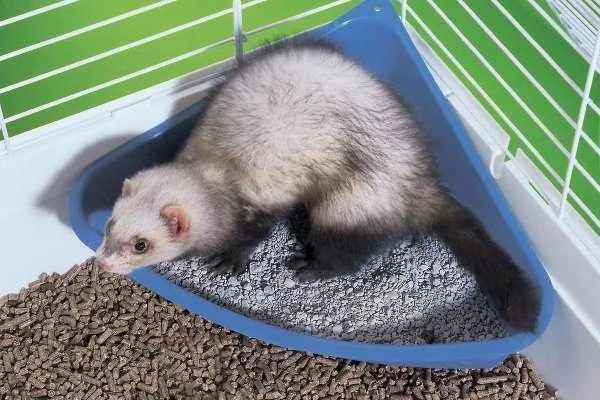
Before purchasing a litter box, consult a sales associate. They will help you choose the right size for your ferret. A corner litter box is preferable—it will help optimize a small space. Keep in mind that the litter box will need to be replaced periodically.
To prevent your pet from digging in the litter box and spilling its contents, you can cover the container with a net.
The litter box is filled with a special mixture, available at specialty stores. Change the contents as needed to prevent odor buildup.
Feeders and drinkers
Ferrets are meticulous eaters, so choose small food and water bowls. Consider accessories with mounting hardware. In addition to a static location, they can be placed on the same floor as the toilet, rather than in a separate room. This is especially true for smaller cages.
It tells what exactly to feed a ferret Here.
Sleeping place
Be especially careful when organizing your pet's sleeping area. If it doesn't like it, your ferret will sleep anywhere but in the sleeping area.
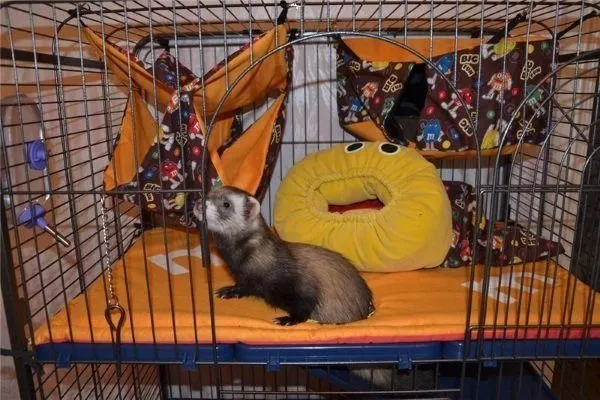
Ferrets really enjoy special sleeping houses inside their cages. You can buy them or sew them yourself. You'll need a small amount of foam and fabric for the upholstery, imagination, and sewing skills. The minimum sleeping area is 30x50x30.
A simple cardboard box with a mattress and pillow inside serves as a basic sleeping arrangement. Make the entrance to the sleeping area spacious, at least 10 cm in diameter. It's best to create a semi-dark environment inside.
Recreation area
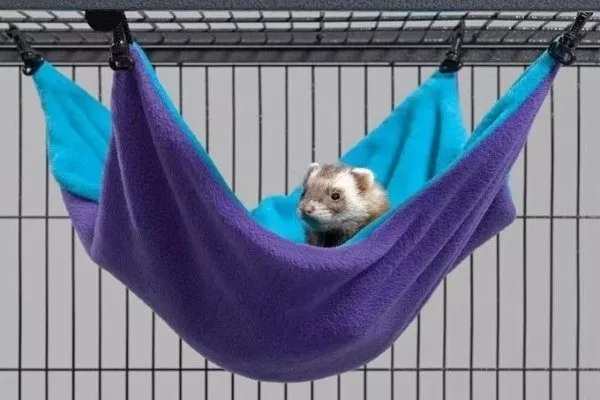
Ferrets love to swing in hammocks when resting, so be sure to place one in the resting area and, if possible, on every level of the cage. Hammocks are easy to make yourself from thick fabric and strong rope, but if you don't want to mess around with them, you can buy them at a pet supply store.
To sew a hammock:
- Take a piece of denim or other heavy-weight fabric, fold it in half, and sew it together, leaving an opening. The size of the fabric depends on the size of your pet.
- Fill the resulting envelope with a thin layer of synthetic padding or place foam rubber inside.
- Sew rope or cords along the narrower sides of the hanging bed to allow for hanging the structure.
The design of the cage determines how the hammock is secured. You can attach the hammock to the ceiling or stretch it between the walls. Use safe and secure fasteners when installing.
Tunnels and attractions
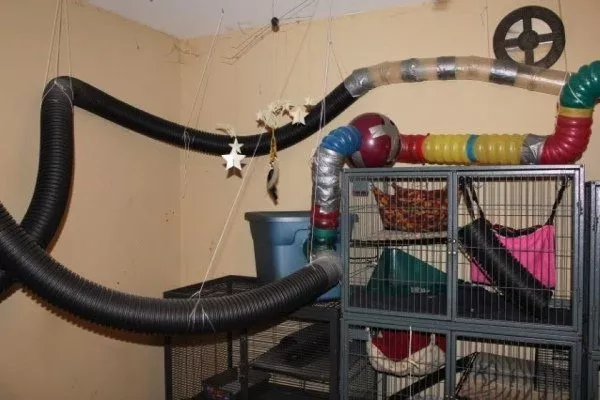
In the wild, ferrets live in burrows. Even if they've never been outside, indoor ferrets retain their instinct to crawl through narrow passages. To satisfy their need for exercise, construct a tunnel out of 110 mm diameter sewer pipe trim and 45° elbows. The spaces between the tunnels can be lined with fabric, making the crawling experience much more interesting for your pet.
It can be placed in the cage and extended from the bottom to the top floor, or used when letting the ferret out for a walk from the house.
Provide your pet with a variety of toys to keep them entertained, and install ladders. This way, they'll focus their energy on spending time with things they find interesting, rather than on damaging things around the apartment or their home.
Tips for making
When making a cage, pay attention to the following nuances and tips:
- A plywood house will be quite heavy, so if this parameter is important, it is better to make a cage from a metal mesh with a frame made of hollow pipes.
- When choosing finishes and materials, remember that ferrets can chew on cages, causing particles to ingest or injure the animal. For example, it's not advisable to use plastic of questionable quality or paint on metal pipes.
- Don't use glass for construction. Empty aquariums are unsuitable for keeping ferrets, even for short periods.
- Secure all elements in the cage with safe, reliable fasteners, otherwise the animal may tear them off and injure itself during play.
Other types of homemade cages
In addition to a plywood ferret house, you can build a cage yourself from galvanized steel mesh with 25 x 25 mm mesh. The main tools required for construction are wire cutters and pliers. The base of such a cage should be sturdy—a thick plastic tray, a wooden box, etc.
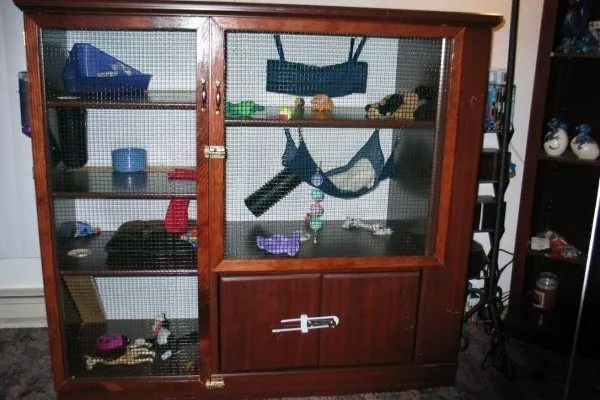
An old closet or individual sections can be repurposed as a pet house. Simply replace the door panels with mesh and cover the interior with linoleum and fabric. Drill additional holes in the walls to allow warm air and oxygen to enter.
Choosing a Good Cage for Your Ferret
When choosing a cage for your ferret, pay attention to the following points:
- Size. You shouldn't skimp on this indicator, as a small cage won't be able to become your animal's favorite habitat.
- Cage material.To perform its intended function, a cage must be made of high-quality, durable materials. With a cheaper option, repairs are inevitable due to various faults: bent bars, broken partitions, loose locks, etc.
- Appearance.This is not always the optimal indicator when choosing a cage, but it is important given that the ferret's house will need to fit into the interior of your home.
- Versatility.There are collapsible cages that can be assembled into a portable cage if necessary, or the sequence and number of levels can be changed, thus modifying the design.
The video below shows an example of how to build a ferret cage yourself, taking into account the animal's habits:
When choosing a cage or building one, the interests of the future owner come first. The ferret's attitude toward its new home will determine whether the effort and money spent were wasted. Therefore, before starting work, carefully consider all possible options and create a comfortable, functional, and beloved home for your pet.