
Winter mushrooms are not a myth. Ordinary people know little about them, but avid mushroom hunters regularly visit winter forests in search of this species of macromycetes, so they can bring home fresh, natural mushrooms.
Do mushrooms grow in winter?
Mushrooms don't grow in forests in the depths of winter. Mycelial growth in the soil requires above-zero temperatures. However, during the initial frosts and the first snowfalls, certain mushroom species are found on tree trunks (including fallen ones) that are suitable for picking and eating.
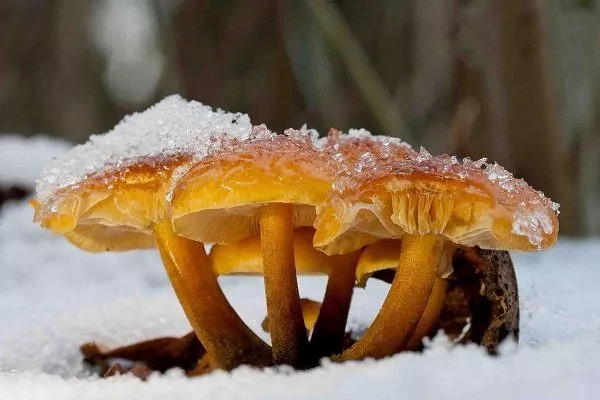
There aren't many such mushrooms. Almost all of them grow in ordinary broadleaf, coniferous, or mixed forests in central Russia.
What mushrooms are called winter mushrooms?
Winter mushrooms are members of a certain genus that can grow in late autumn (October, November) or early December—that is, during the period of thaw.
After intense frost, they retain their appearance and properties. This condition is observed when frozen in a freezer. After being harvested in the wild, winter varieties retain their flavor and nutritional qualities upon thawing.
What mushrooms can be picked in winter?
Winter mushrooms belong to the family of edible and conditionally edible macromycetes. This means that some species can be safely used immediately after harvesting, while others require pre-preparation.
Below is an overview of the mushrooms that can be found in winter forests. Most of them are familiar to people from their summer and autumn counterparts.
| Name | Growth type | Fruiting period | Place of growth |
|---|---|---|---|
| Oyster mushroom | Group | October-December | Deciduous forests |
| Winter honey fungus | In bunches | November-December | Mixed forests |
| False honey fungus | In bunches | October-November | Coniferous forests |
| Winter tinder fungus | Single | Early spring, late autumn | Deciduous forests |
| Birch chaga | Single | All year round | Birches |
| Auricularia auriculata | Group | All year round | Deciduous trees |
| Hygrophorus late | Group | Late autumn - early winter | Pine forests |
Oyster mushroom
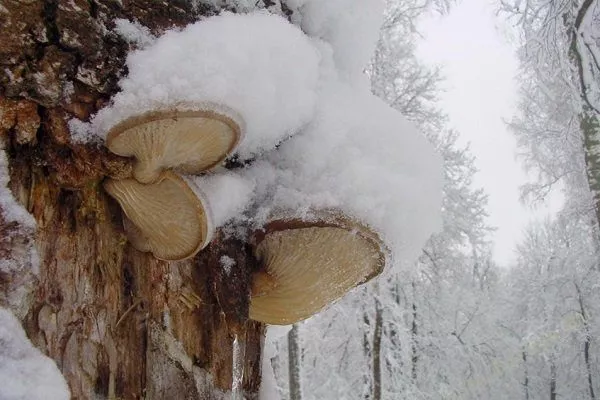
The oyster mushroom is also known as the oyster mushroom. This is the same mushroom grown in greenhouses and sold in stores.
Description:
- the cap is round, smooth (in young representatives of the species it is convex, in mature ones it is funnel-shaped), with a diameter of up to 20 cm;
- color varies depending on age from dark gray to white with a gray tint;
- stem with a smooth texture, up to 3 cm long, tapering towards the base;
- the underside of the cap is covered with white plates in young specimens and yellow or greyish in adults;
- the pulp is dense, white;
- The mushroom smell is faint.
Oyster mushrooms are often found in deciduous forests. They thrive on dead but still living poplars, aspens, birches, and other softwood trees. The mushrooms grow in clusters, forming multi-tiered structures.
Active fruiting occurs in mid- and late autumn and early winter. It tolerates low temperatures well.
Useful properties of the product:
- low-calorie;
- rich in vitamins B, PP, C, micro- and macrominerals (iron, calcium, etc.);
- high content of amino acids and protein.
Winter honey fungus (winter mushroom)
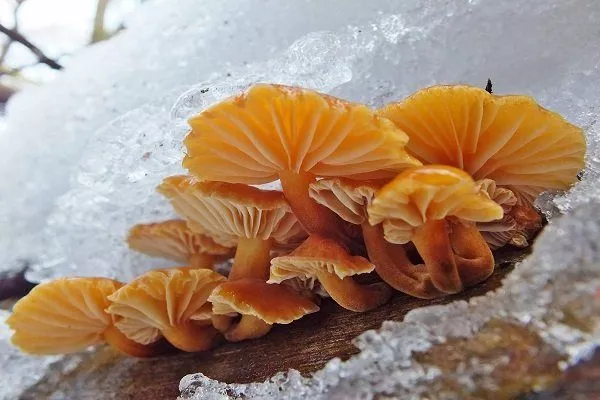
This species is truly winter-hardy. Its active fruiting period occurs in November and December. Frosts are not a problem for this mushroom. It freezes, then thaws and continues growing at the slightest warming.
Description:
- the cap is small in diameter (from 2 to 8 cm), spherical in the young generation and flat in older representatives, slightly rough;
- the color scheme combines various shades of yellow;
- the stem has the shape of a cylinder, reaches a height of 7 cm, changes color from light yellow at the cap to dark brown at the base;
- on the inside there are fused plates of cream or yellow color;
- The pulp of the fruit is white, creamy, with a pronounced mushroom aroma.
Honey fungus grows in clusters on dead trees and stumps. It is predominantly found at the edges of mixed deciduous forests. It is also found near bodies of water on the trunks of damaged willow, birch, and maple trees.
Beneficial properties:
- contains the substance flammulin, which is famous for its antitumor effect;
- has an immunity-boosting effect.
- ✓ Oyster mushroom: no ring on the stem and a lamellar underside of the cap.
- ✓ Winter honey fungus: a pronounced mushroom smell and the absence of a rusty tint on the gills.
- ✓ False honey fungus: bluish or grey gills on adult mushrooms.
False honey fungus
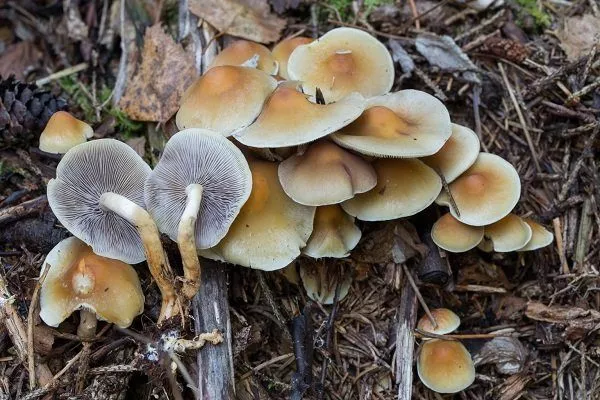
Another name is the poppy honey fungus. It's a close relative of the winter and autumn honey fungus species. Even in appearance, it's not much different from its relatives. Despite its suspicious name, the mushroom is edible.
Description:
- the cap is small in size (in old mushrooms it is no more than 8 cm in diameter, in young ones – 2 cm), the shape is round, as it matures it becomes like a plate;
- the color varies from light yellow to red-brown, sometimes brownish;
- the stem is cylindrical, up to 10 cm long, of different colors at the base and cap (there is no ring);
- the gills at the bottom of the cap in the young generation are light yellow or white, in older mushrooms they are bluish or gray;
- When cut, the fruit has white or yellow flesh with a rich mushroom aroma.
Its habitat is coniferous forests (stumps, above-ground root parts, and dead wood of coniferous trees). Like all honey fungi, the false honey fungus grows in clusters. It bears fruit in October and November. During warm winters, it can be found in December. It has properties typical of honey fungi.
Winter tinder fungus
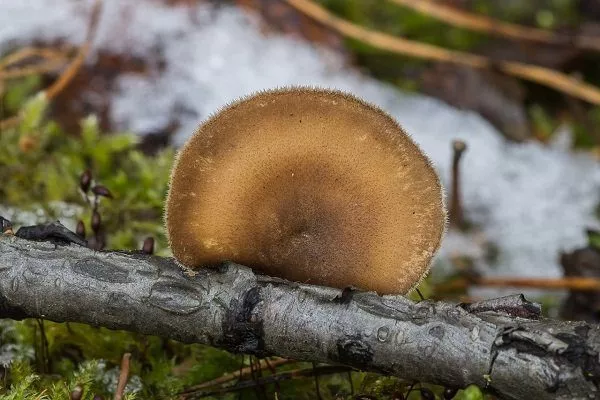
This species of macromycetes differs from other tinder fungi in appearance. It looks like a common mushroom on a stalk. Its active growth period is early spring and late fall.
Description:
- the cap is up to 10 cm in diameter, sunken or convex in shape (depending on age), with edges raised upwards;
- coloring is brown or gray;
- the stem has a velvety surface, is thin and long (up to 10 cm in height);
- the lower part of the mushroom is white or cream-colored, the tubular layer is short and dense in structure;
- The flesh of young mushrooms is elastic, while that of mature mushrooms is very hard.
The tinder fungus grows on rotten deciduous trees. It is not eaten. It is not poisonous, but its dense consistency makes it unsuitable for cooking. It is most often used in crafts.
Birch chaga
Chaga is a type of polypore. It results from a tree's infection by a parasitic fungus. After three years, chaga mycelium forms in the rot.
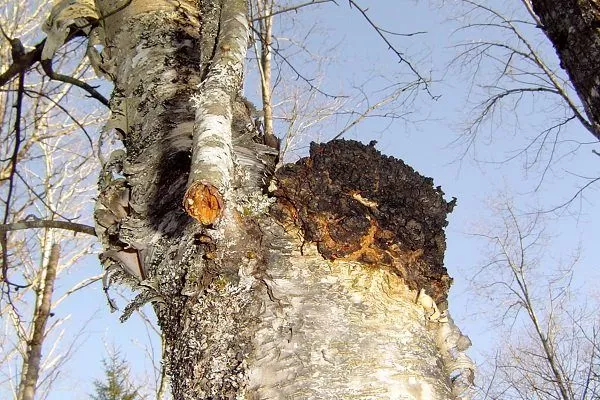
Chaga's appearance makes it difficult to classify it as a mushroom. It appears as a large growth (up to 40 cm in diameter and 15 cm in thickness) on the stem, which has a hard structure. Its color, depending on age, ranges from brown to black.
Chaga is a medicinal mushroom. Crushed and dried, it is used to make infusions. It is not used in cooking. However, chaga chunks have long been considered a good and beneficial ingredient for making kvass and brewing tea.
The fungus's spores develop primarily on damaged birch trunks. Chaga is rarely seen on other deciduous trees. This mushroom is long-lived, remaining viable for up to 40 years. It develops throughout the year.
Auricularia auriculata
The mushroom resembles a jellyfish. It grows in small clusters on the dead trunks of deciduous trees (alder, elder, maple). The fruiting body is shaped like an ear, hence the name.
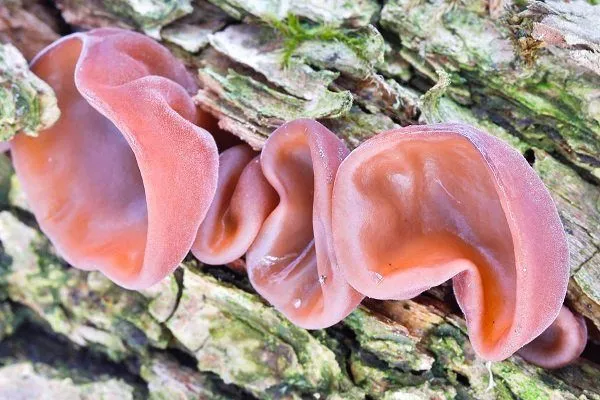
The mushroom's upper surface is reddish, while the lower surface is grayish. The fruiting body diameter is up to 10 cm. It has no stalk.
The fresh flesh of the mushroom is gelatinous and hardens when dried. It is used primarily in Japanese cuisine.
Hygrophorus late
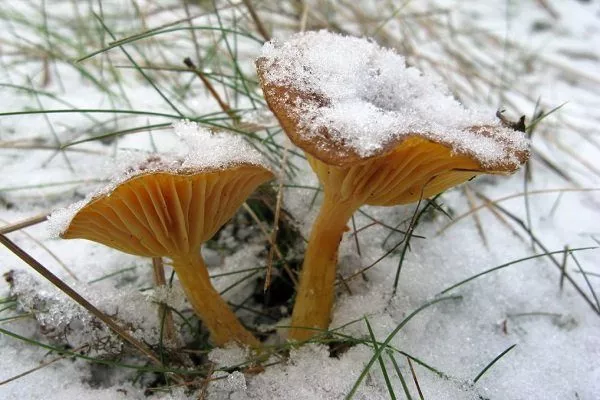
The mushroom resembles a toadstool in appearance. It is harvested in late autumn and is often found after snowfall in early winter.
Description:
- the cap is small (no more than 6 cm in diameter), the shape changes with age (from convex in young specimens to funnel-shaped in adults);
- the cap color is light brown, in young mushrooms it is olive;
- the outer surface of the cap is covered with mucus when humidity is high;
- the inner side is characterized by rare yellowish plates;
- the stem is thin and high (up to 10 cm), often curved, cylindrical in shape, also slimy;
- The pulp is brittle, white, and has no specific odor.
The habitat is limited to pine forests. The mushrooms form a symbiotic relationship with tree roots. The fruiting bodies grow close to each other.
The mushroom is widely used in cooking for various mushroom dishes. It is also excellent for canning.
When and how to pick winter mushrooms?
The harvest season is October-November. Mushrooms are still fresh and contain the full range of beneficial properties of this type of food. The deadline is early December, before the snow has settled thickly. All winter mushrooms are clearly visible among leafless trees or against the white blanket of snow.
Different types of late-ripening mushrooms require different harvesting methods. For harvesting, you'll need:
- a regular kitchen knife (for honey mushrooms, oyster mushrooms, auricularia);
- a hatchet for removing chaga or tinder fungus from the trunk.
Hygrophor can be easily removed from the substrate without the use of improvised means. It does not harm the mycelium.
Winter mushroom picking is a great opportunity to spend time outdoors. Furthermore, winter mushrooms are quick to prepare. Many require no pre-preparation.