
The oyster mushroom (Pleurotus pulmonarius) belongs to the genus of the same name, in the family Polyporaceae. Its Latin name is Pleurotus Pulmonarius, while common names include beech, spring, and whitish oyster mushrooms. It grows wild, is cultivated commercially, and is also found on farms.
Description of the pulmonary oyster mushroom
The oyster mushroom is rarely encountered by mushroom pickers, as it prefers rotting trees, which people usually avoid. It is a beautiful edible mushroom used in cooking for numerous dishes.
hat
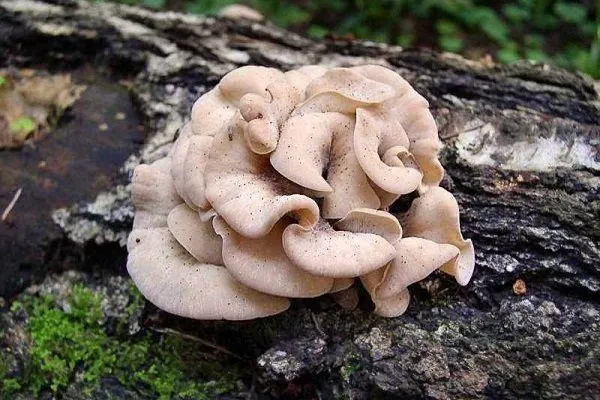
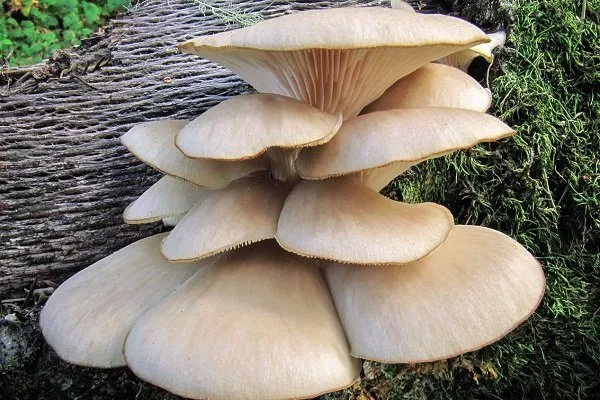
The oyster mushroom is very graceful and fragile in appearance. The cap is characterized by the following features:
- color – snow-white at first, then acquires a grayish, yellowish or creamy tint, but there are also specimens with a light-brown surface;
- diameter – varies from 3 to 10 cm, depending on age and growing conditions (a mushroom with a maximum diameter of 16 cm was found);
- edges - thin, curved upwards, wavy or straight;
- form - fan-shaped, many compare it to an ear;
- surface – can be smooth or finely scaly.
Hymenophore
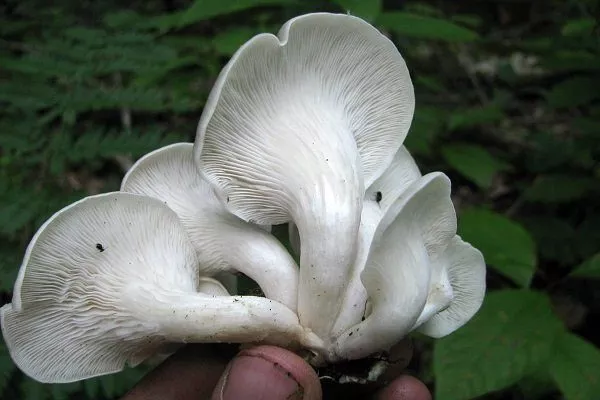
The spore plates are quite sparse, but smooth and compact. They extend from the cap margins down to the stem. Their color is the same as the cap, but when young, they are exclusively white.
Pulp
The flesh is firm but soft in the cap, while the flesh on the stem is always firm. The color is grayish-white, and the aroma is pleasant, mushroom-like with hints of fruit.
Leg
The stem is only 3-4 cm long, 0.5-1.5 cm in diameter, and is more cylindrical in shape. Its structure is not hollow, but very dense, which increases its rigidity. It is located in the central part of the cap and is identical in color to the cap. The surface is smooth at the top and hairy at the bottom.
Fruiting period and growing place
The oyster mushroom prefers warmer seasons, so it begins fruiting in April and finishes in September. It can grow singly or in groups, but in all cases it forms clusters.
Favorite places:
- fallen trees;
- rotten logs;
- dead-standing plantings;
- area under trees/stumps;
- branches, trunks.
The mushroom is most commonly found in beech, oak, willow, aspen, and alder forests, but can also adapt to other deciduous trees. The key is plenty of shade, as the oyster mushroom does not tolerate direct sunlight.
The mushroom is a saprotroph, so it promotes rapid wood decomposition. The oyster mushroom's carnivorous nature allows it to destroy nematodes, which are converted into nitrogen after digestion.
False doubles
| Name | Cap color | Cap diameter (cm) | Hat shape |
|---|---|---|---|
| Oyster mushroom | snow-white, grayish, yellowish, cream, light brown | 3-10, up to 16 | fan-shaped, ear-shaped |
| Orange oyster mushroom | light, orange-yellow | 20-80 | fan-shaped |
| Crepidot saffron-lamellar | light brown, brownish-orange | about 5 | semicircular |
| Wolf's-foot or felt-leaved saw-leaf | yellow-brown | not specified | not specified |
There are no poisonous oyster mushrooms, but among the vast number of mushrooms from other families, there are some that are identical in appearance to the pulmonary species. It's important to learn to accurately distinguish them to avoid severe poisoning, which can be fatal.
The most similar false doubles:
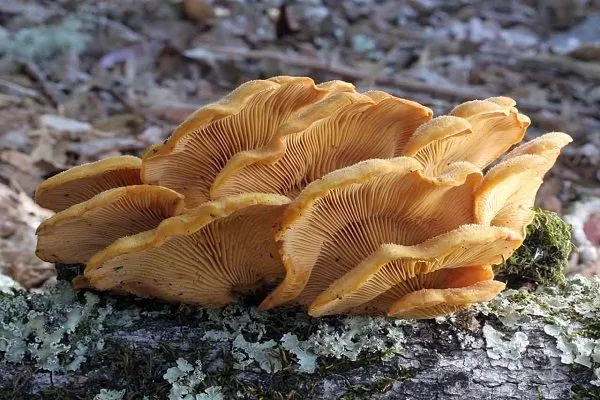
- Orange oyster mushroom (Phillotopsis nidulans). The name is similar, but the mushroom belongs to a different family and genus—Tricholomoides and Tricholomes. Another name is Phyllotopsis nidiformis. It is distinguished by its enormous size—the cap ranges from 20 to 80 cm in diameter, but is also fan-shaped.
The surface is densely covered with hairs. When young, the color is light, but with age it acquires a bright orange-yellow hue, with the stem being virtually invisible. The odor is unpleasant, and the taste is bitter. It can only be found in the autumn – from September to November.
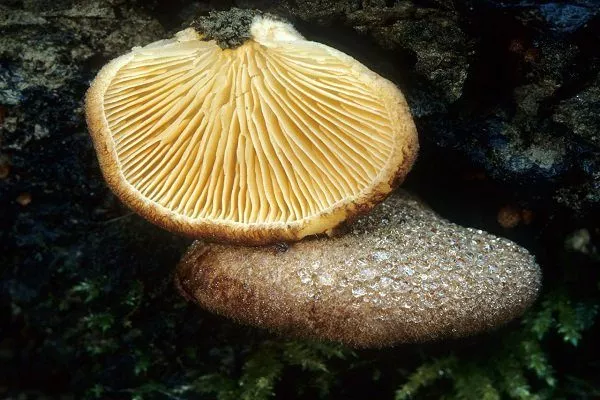
- Saffron-laminated crepidotus (Crepidotus crocophillus). Another common name is "sunny ears." The cap is about 5 cm in diameter, but its shape is semicircular with upturned edges, so it can only be confused with the oyster mushroom when young.
The surface is covered with small scales, and the color is light brown or brownish-orange. There is no odor, but the taste can be either bitter or sweet. - Wolf's-foot or felt-leaf saw-leaf (Lentinus vulpinus). The main difference between a poisonous mushroom and an edible one is the felt surface of the cap and stem, as well as the presence of a yellow-brown tint in adulthood and a rough fruiting body.
- ✓ The presence of a fruity aroma in the pulp, which is a unique feature of the pulmonary oyster mushroom.
- ✓ The absence of a hollow structure at the stem, which distinguishes it from some false doubles.
Similar edibles
| Name | Cap color | Cap diameter (cm) | Hat shape |
|---|---|---|---|
| Oyster | light ash, dark gray | 5-25 | auricular, funnel-shaped |
| Abundant or horn-shaped | light, ocher | not specified | not specified |
All pleurotaceae are identical in appearance, so even a novice mushroom picker might confuse them without causing any problems. However, many people value knowing the exact type of mushroom they've found. The most similar edible oyster mushrooms are:
- Oyster. Unlike the pulmonary cap, it has a darker overall color and is larger. The cap varies in diameter from 5 to 25 cm, and is also ear-shaped, but more funnel-shaped.
The surface is smooth and matte, with a light ash or dark gray hue.
The stem is only 3 cm tall, and stripes appear at the base on a white background. Fruiting peaks in autumn—September-October—but can also be found in April-June. - Abundant or horn-shaped. The main difference is the drooping edges and thinner flesh. They are similar in size, but their color can range from light to ochre as they develop. Occasionally, specimens with a lateral stem are found.
Even within the cap, the flesh is tough and fibrous. The surface of the stem is covered with gills.
Nutrition and usefulness
Pulmonary oyster mushrooms are not considered a dietary product, as 100 g of mushrooms contain at least 65 kcal, 1 g of fat, 10 g of carbohydrates, and only 5 g of protein. They contain numerous minerals and vitamins, giving them the following properties:
- neutralization of harmful cholesterol;
- suppression of E. coli;
- prevention of gastrointestinal diseases and ulcerative lesions;
- strengthening the heart muscle;
- acceleration of blood circulation and metabolism;
- cleansing the body of helminthic infestations;
- prevention of the development of cholecystitis.
Back in 1950, and many times later, scientists proved that the oyster mushroom also contains the following substances:
- Pleuromutillin. It is a naturally occurring antibiotic that kills and inhibits salmonella, pseudomonas, escherichia coli, staphylococcus aureus and other bacteria.
- Perforins. These elements destroy cancer cells and prevent the development of cancerous tumors.
Possible harm and contraindications
All types of oyster mushrooms are considered harmless to humans. However, they can still cause harm in the following cases:
- if there are contraindications;
- In case of overdose, bloating, diarrhea, and heaviness in the stomach occur.
In what cases should you not eat oyster mushrooms:
- age up to 5-7 years, since the mushroom is difficult and takes a long time to digest (in old age it should also be consumed with caution);
- individual intolerance to mushrooms – an allergic reaction to spores develops;
- some chronic diseases of the gastrointestinal tract - severe upset occurs;
- kidney and liver pathologies;
- disruption of the endocrine system.
Collection rules
Pulmonary oyster mushrooms are best eaten young, as the flesh becomes tougher and the flavor diminishes as they mature. Therefore, mushrooms should be harvested when their diameter ranges from 5 to 8 cm.
Rules:
- It is forbidden to dig out of the ground;
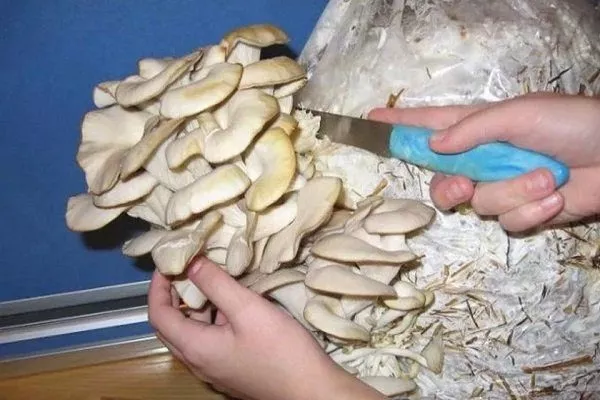
- the mushroom is cut with a thin and sharp knife in one cut;
- cut off small specimens as well, as they will not grow further;
- Place them immediately in the container in which you will deliver the oyster mushrooms home, since it is forbidden to move them from one place to another (this will damage the structure).
Preparation
The oyster mushroom is classified as a Category 3 mushroom for edibility. It is used in cooking to make sauces, soups, casseroles, mushroom patties, and so on, making it a versatile mushroom.
Cooking subtleties:
- Oyster mushrooms contain a small amount of chitin, so it is advisable to boil them for 20-30 minutes before cooking;
- Since the mushroom has open gills, a lot of dirt, dust, and insects accumulate in them, so soak it in water for 20 minutes;
- When washing, be careful, as the structure is very fragile and brittle.
Growing at home
Pulmonary oyster mushrooms can be grown in any substrate, even old stumps and logs, making them suitable for industrial cultivation. This can be done even on a small farm or in a private home.
The main conditions for obtaining a rich harvest:
- temperature regime – from +20 to +30˚С;
- humidity level – from 55 to 70%.
- ✓ The substrate temperature should be no lower than +20°C and no higher than +30°C for optimal mycelium growth.
- ✓ The humidity in the room should be maintained at 55-70% to prevent the substrate from drying out.
There are 2 methods of cultivation:
- Wood. Old logs, stumps, and similar materials are used, as long as they have a tree trunk. The raw materials are stored outdoors in the yard, so harvesting occurs only during the fruiting season.
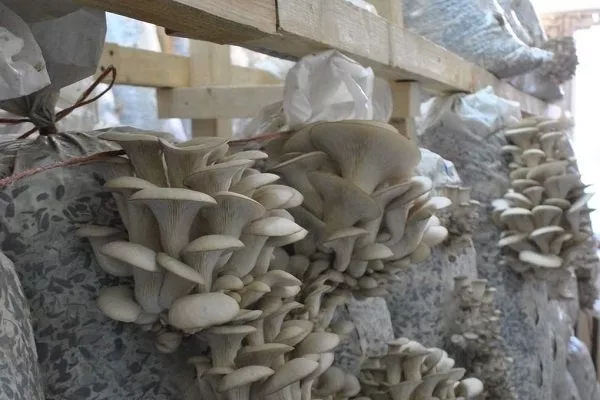
Alternative options include using old trees growing in the garden and installing the logs in a basement or greenhouse. The mycelium then grows into the holes in the wood. - Polyethylene bags. They are filled with a substrate that is pre-disinfected (filled with boiling water, baked in the oven, soaked in a pink solution of manganese, hydrogen peroxide, etc.).
The bag itself and the room must be disinfected, using bleach or a special antifungal solution. A layer of substrate is placed in the container, followed by the mycelium, and so on, all the way to the top.
The thickness of the material is 5 cm, the mushroom spores are 0.5 cm. Be sure to leave a hole with a diameter of 1 cm.
What to take as a substrate:
- sawdust;
- sunflower seed husks;
- crushed corn cobs;
- buckwheat husks;
- straw from barley or wheat;
- foliage;
- cotton and other waste;
- coffee grounds, etc.
The incubation period is 20-22 days. The grower can monitor the growth process, as it's best to use a transparent plastic bag. This is due to the mycelium's particular need for light, requiring the lights to be on in the room for 12-15 hours.
Other growing features:
- Ventilate the room daily – otherwise, pathogenic microorganisms will develop due to excessive humidity;
- the first harvest is collected after 30-35 days;
- the second harvest is collected after at least 20-25 days;
- Change the substrate to a new one once every 4-7 months, ideally after the third harvest.
How to store?
After harvesting, oyster mushrooms can be stored in the refrigerator for 4-5 days, after which they begin to spoil. If you don't grow the mushrooms but simply forage them in the forest, use the following storage methods:
- Freezing. Like any mushroom, oyster mushrooms can be frozen and stored for about 10-12 months. It's important to freeze them dry. To do this, spread the mushrooms on a paper or cloth towel after washing or boiling.
- Drying. Drying mushrooms can be done in the oven, in a special dehydrator, or outdoors. In the first two cases, the mushrooms should be cut into thin slices. In the latter case, whole oyster mushrooms can be strung on a string and hung in a warm, ventilated area.
- Marinating, salting. The shelf life in this case is not long - up to 3 weeks in the refrigerator, but there are many variations of the recipe.
- Conservation. The method is convenient because you can open the jar at any time within 1-1.5 years and immediately use the finished product.
No matter how you store mushrooms, remember that they must first be cleaned of dust and dirt, but this must be done carefully due to the tenderness of the flesh.
To harvest oyster mushrooms, carefully examine their appearance to avoid mistaking them for another species. For growing, familiarize yourself with the key growing techniques and conditions, and you'll have oyster mushrooms on your table year-round.