
Growing truffles is an expensive endeavor, as the planting material is expensive and the harvest takes 3-5 years. However, the price of the finished product is well worth the effort. The cultivation techniques are demanding, as the mushrooms thrive in specific conditions.
Truffle characteristics
The Latin name for truffle is tuber. The mushroom belongs to the ascomycetes class of the truffle family. Its distinctive feature is its mycotic nature, so it grows in symbiosis with tree roots (the optimal tree species is oak) at a depth of at least 15 cm. The vegetative body is called mycelium.
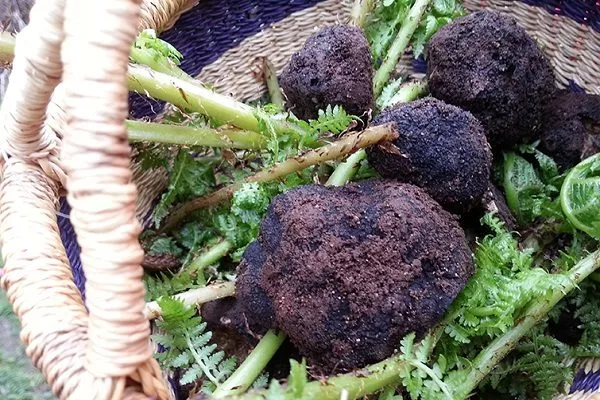
Appearance features:
- shape - spherical, tuberous (like a walnut, potato);
- the outer shell is smooth and textured, with a cracked surface and wart-like growths;
- peel color - depending on the variety: white, gray, black, chocolate;
- pulp - white, gray, yellowish-brown;
- structure - marble with veins of white or red hue;
- size - minimum 2.5 cm, maximum 20;
- The weight of one fruit ranges from 20 to 200–250 g, but there are specimens weighing 800–900 g or more.
Other characteristics:
- fruiting period - 25 years;
- the shelf life of a truffle after cutting is 4 days;
- one nest contains from 5 to 8 bodies;
- taste and aroma - specific, with notes of chocolate, seeds, nuts, alcoholic drinks, mushrooms, herbs, etc.;
- valuable varieties for consumption are Piedmontese, Perigord, winter;
- vegetation period - 3-5 years (fruit formation takes 5-8 months);
- mycelium - in appearance it resembles a pile of fluff or cotton wool;
- nest structure is fibrous (threads-hyphae);
- Favorite soil: deciduous, calcareous, mixed, loose.
As it grows, the upper part of the mycelium becomes covered with buds, from which fruiting bodies are formed.
Types of truffles that are eaten
There are approximately 30 known in the world varieties of truffles, but not all of them are edible. Chefs distinguish several main types of tuber that are commonly grown on farms.
| Name | Size (cm) | Peel color | Pulp color | Taste |
|---|---|---|---|---|
| Black Summer (Russian) | 2.5-10 | black with a brown or bluish tint | from white to brown | sweetish, sharply nutty |
| Black winter | 8-15 | red with purple, black when ripe | white, gray, gray-violet | with a musky tint |
| Black Perigord (French) | 3-9 | reddish-brown, coal black when mature | gray or pinkish-brown | slight bitterness |
| Chinese | up to 9 | dark gray, black when overripe | dark brown | almost not felt |
| Oregonian | 5-7 | light brown | golden with snow-white veins | herbaceous-fruity |
Black Summer (Russian)
In Latin, it's called Tuber aestivum. It's distinguished by the following characteristics:
- size - from 2.5 to 10 cm;
- color - black with brown or bluish tint;
- the pulp is dense when young, loose as it grows;
- the color of the internal body is from white to brown;
- taste qualities - sweetish, sharply nutty.
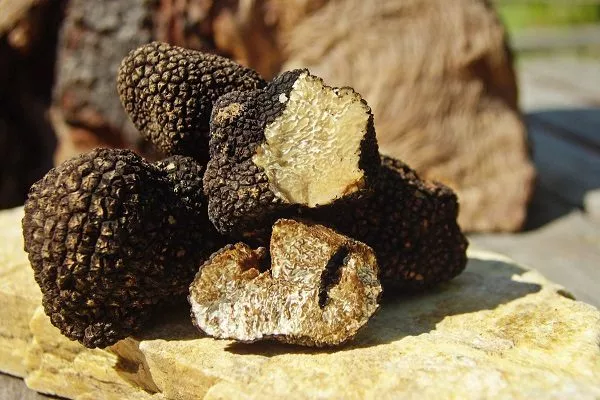
This species of truffle is common in Russia and Europe. Fruiting begins in the summer.
Black winter
Scientific name: Tuber brumale. This mushroom has the following characteristics:
- diameter - from 8 to 15 cm;
- shade - red with purple at the beginning of growth, black when ripe;
- pulp - color changes as it matures: white, gray, gray-violet;
- taste - with a musky tint.
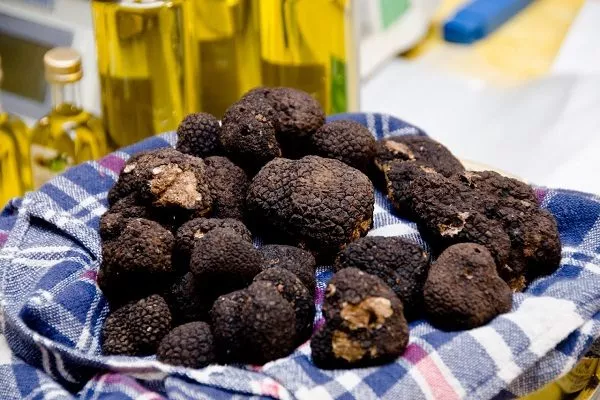
A distinctive feature is the white and yellow-brown veins in the flesh of the fruiting body. It grows in Ukraine, Russia, Italy, France, and Switzerland. Ripening period: November to March.
Black Perigord (French)
A variety of black truffle, Tuber melanosporum is identified by the following characteristics:
- parameters - from 3 to 9 cm;
- color range - initially red-brown, when mature - black coal, and if crushed it acquires a rusty hue;
- the interior of the fruiting body is elastic, gray or pinkish-brown, the cross-sectional pattern is red or white;
- taste - a slight bitterness is felt.
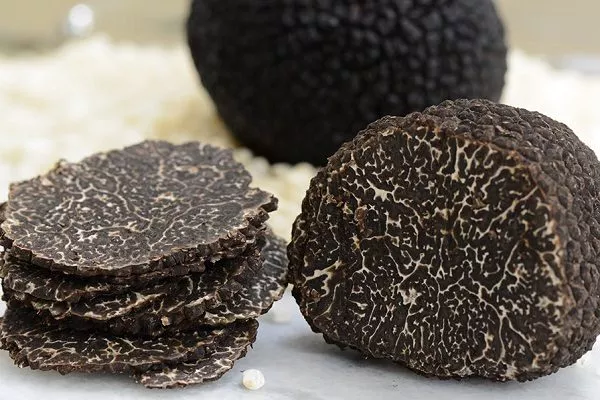
Most commonly found in Spain, Italy, and France. Harvest begins in November and ends in March.
Chinese
An Asian delicacy, Tuber indicum has the following characteristics:
- diameter - maximum 9 cm;
- shade - dark gray, black when overripe;
- vegetative body - dark brown;
- aroma - almost imperceptible.
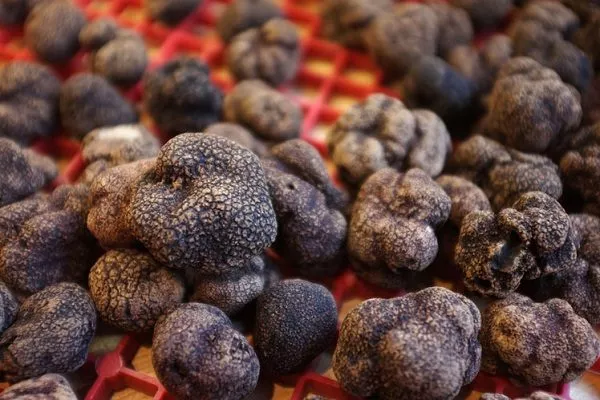
It is widely grown in China and is occasionally found in Russia. It bears fruit throughout the winter. Its distinctive feature is its very tough flesh and surface, making it difficult to chew.
Oregonian
This mushroom belongs to the white variety and is distinguished by the following characteristics:
- parameters - up to 5–7 cm;
- color - light brown;
- the pulp is golden with snow-white veins;
- taste - herbaceous-fruity.
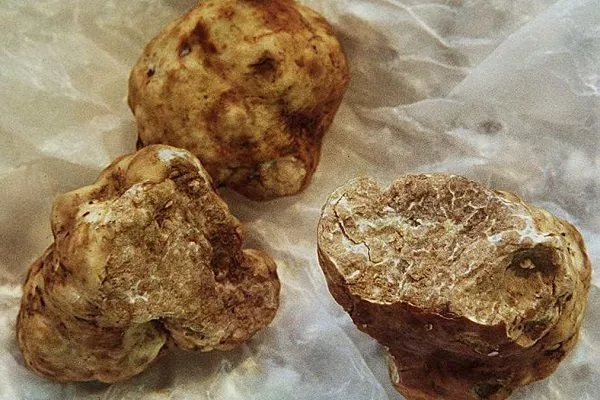
It grows exclusively in Oregon and throughout the United States. It is also cultivated artificially in Russia and Europe. It prefers the upper layers of soil with coniferous foliage (other truffle species do not grow in coniferous foliage).
Conditions and features of truffle cultivation in Russia
This is the most expensive mushroom, cultivated artificially in almost every country in the world, but especially in France. Until 2000, tuber was not cultivated in the Russian Federation.
That year, the first truffle farm opened in the Krasnodar region. Mycelium and oak seedlings were imported from France. The mushroom grower grew the mushrooms outdoors, as the region's climate allows (truffles prefer temperatures between 22 and 25°C).
In northern Russia and the central region, mycelium is grown in basements or greenhouses. These are equipped with heating systems to maintain optimal temperatures year-round.
How to grow truffles at home?
While common mushrooms grow by parasitizing the root system of plants, truffles develop through a symbiotic relationship with the roots. They require organic matter, which they obtain from trees. In exchange, the mushroom shares moisture secreted from its vegetative body.
Growing scarce mushrooms on a personal farm involves a host of subtleties. Agricultural practices must be strictly followed. Otherwise, all your efforts will be in vain.
Choosing a location
When growing truffles, especially if you plan to plant them outdoors, consider the following factors:
- the maximum slope of the surface is 10–13°, it is even better if it is flat;
- other mushrooms should not be grown nearby;
- tuber does not tolerate weeds;
- soil fertility 30–40 cm deep;
- the site must contain oak, hazel, beech, hornbeam, orange, lemon, tangerine trees, sequoia, olive;
- It is forbidden to plant where coniferous trees (fir, spruce, pine, thuja), willow, chestnut, poplar grow or previously grew;
- the distance between plants is at least 5 m.
Soil preparation
The main soil requirement is a pH of 7–8. This level is achieved by using soil containing rotted fallen leaves. If you're planting truffles in a basement, greenhouse, or open garden bed, follow these guidelines:
- Priming. It shouldn't contain any other fungal spores or pathogens. Therefore, disinfect the soil beforehand. Use a steam generator or oven for this.
- Sand and sawdust. The wood shavings should be from a tree species suitable for truffle cultivation. Sand acts as a soil loosener.
- Fallen leaves. Disinfect by any means.
- Minerals. Add more calcium to the soil mixture to promote vegetative growth. Nitrogen, humus, sulfur, iron, and alkali are essential.
- ✓ The soil pH level must be strictly between 7.5 and 8.3 for optimal truffle growth.
- ✓ The soil must contain a high level of calcium, which is critical for the formation of fruiting bodies.
Selection of planting material
The main planting material is mycelium. It is sold at specialized retailers and online. It's best to choose licensed, official sources.
There are 2 types on sale:
- alive - stored for no more than 6 months;
- dry - unlimited shelf life.
The stock culture is spread on a grain base from which mycorrhiza must be grown. Mycelium embedded in tree seedlings can also be purchased. The price of such material ranges from 600 to 900 rubles.
The duration of infection is 11–13 months, so mushroom pickers, to save time, prefer mycelium already planted on grain or sprouts.
Mycelium infection
There are two ways to grow mycelium. The first involves planting it directly in the garden, the second involves using seedlings.

Infection process:
- Select trees of the desired species that are at least 5–6 years old.
- Dig holes around them, 20–25 cm deep and 8–12 cm in diameter.
- Fill half of the hole with prepared soil.
- Sprinkle peat and mycelium on top (the exact amount of planting material for one hole is indicated on the packaging of a specific variety).
- Fill the remaining space with the same prepared soil mixture.
- Tamp very tightly.
- Fill with water at the rate of 10 liters per hole.
- Cover the planting site with any natural material at hand - moss, leaves, dry grass, branches.
- Water again with settled water, but not into the hole, but around it.
Infection of seedlings by spores:
- Take an oak sprout.
- Sprinkle the roots with mycelium and peat.
- Place in a plastic bag for 15–20 days, leave in a warm place.
- Transfer to a sterile room.
- After 12–16 months, transplant to a permanent location. The mushrooms should reach 18–20 cm in size.
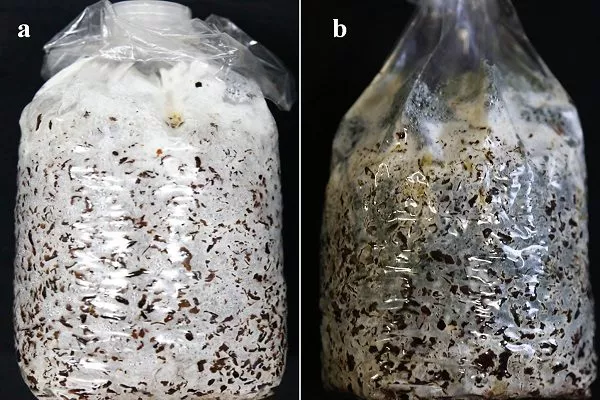
Freshly harvested tree bark can be used. The recipe is simple:
- Grind the wood raw material.
- Mix with spores and peat, place in plastic bags or 3-liter jars.
- Tie tightly or cover with a lid. After 3-4 days, make holes. Leave until fully germinated.
Planting mycorrhiza
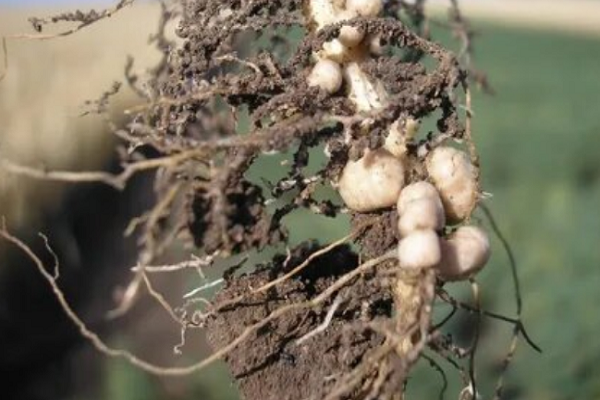
Working with prepared material. The process of planting mycorrhiza in a permanent location:
- Dig holes to a depth of 75–80 cm.
- Place the seedling, compact it and water it.
- Place mulch around the trunk (radius 40–50 cm, thickness 2–3 cm).
- Cover with film.
Care
During the first 24 months, keep the area above the truffles thoroughly clear of weeds.
What else needs to be done:
- in spring, loosen the area around the trunk, especially when fruiting begins;
- do not allow the soil to dry out - it should be kept moderately moist (to achieve this, do not remove the mulch);
- irrigate using the drip method so that water penetrates evenly to the mushrooms;
- Feed using preparations that contain iron, copper, magnesium, zinc and boron;
- fight the main enemies of truffles - black cockroaches and weevils;
- Prune trees in a timely manner to allow sunlight and precipitation to penetrate under the trunk.
Pests and protection against them
Among the pests, cockroaches and weevils are dangerous.
How to deal with them:
- do not plant field crops nearby;
- make bait - spread boric acid with honey or sugar on cardboard, place it around the mycelium;
- Buy special chemicals.
Harvesting
The first mushrooms can be harvested after 1–2 years, but during this period, no more than 5–8 fruiting bodies can be found in a single hole. After another 3–4 years, a full harvest can be obtained (9–12 kg per 100 sq. m).
Only ripe mushrooms are edible. How to determine:
- the ground is raised above the truffle;
- there is a concentration of midges around;
- The grass above the mushroom dries up.
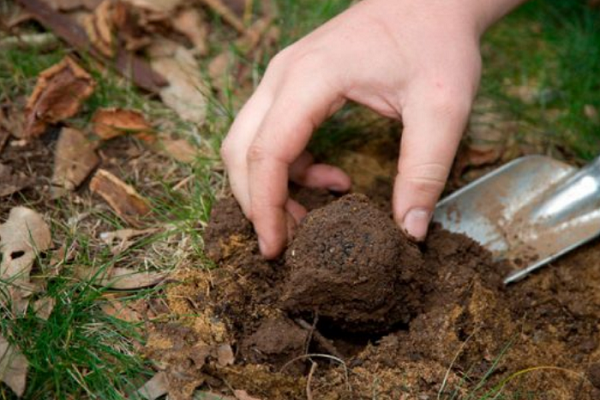
To harvest, use a small shovel to gently lift the soil layer and carefully cut off the fruiting body with a knife, holding it in place with your other hand. Be careful not to damage the mycelium or root system of the truffles.
Planting technology
Three main methods of growing truffles are used in Russia: in the garden, in a greenhouse, and in a basement. The first method is used exclusively in the southern regions of the country, while the other two are used throughout the country.
Into open ground
When planting truffles in beds, the distance between trees is maintained according to the scheme of 4 x 4 m or 4 x 5 m.
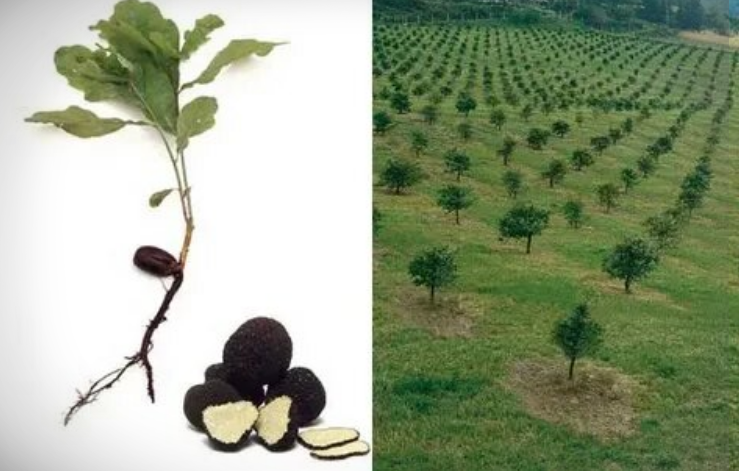
The approximate number of seedlings per hectare is 480–500. Growing conditions:
- air temperature at night - + 16–18°C, during the day - + 25°C;
- soil moisture – 70–80% (mulch is laid to maintain stability);
- seedling planting depth - 70 cm;
- Add rotted manure once every 2 months - this is necessary for the partner tree;
- Treat mulching materials with a weak solution of potassium permanganate to prevent the growth of pathogenic microorganisms.
Immediately after transplanting, cover the seedlings with agrofibre or plastic film. Keep them covered until the air temperature stabilizes at the optimal level.
Into the greenhouse
Tuber mushrooms prefer warmth and are frost-sensitive. Build the greenhouse out of polycarbonate. Glass or double-walled polyethylene are also acceptable.
- Check the greenhouse for air tightness and eliminate all possible sources of drafts.
- Install a drip irrigation system to maintain optimal humidity.
- Provide artificial lighting that excludes direct sunlight.
Features of growing truffles in a greenhouse:
- Avoid direct sunlight, as it kills the spores. It is better to use artificial lighting (alternatively, hang dark curtains or whitewash the ceiling);
- Before wintering, make sure the greenhouse structure is airtight - drafts and cold should not penetrate inside;
- install heating devices to maintain the temperature during the day at +23–25°C and at night at +15°C;
- install a ventilation system - it maintains the humidity level and prevents mold from forming;
- Water by spraying - apply water when a thin crust begins to form on the soil surface.
In the basement
To achieve a decent harvest, pay special attention to the growing environment. It should be as natural as possible. Here's a step-by-step guide:
- Fill the floor with concrete mortar, plaster the walls and ceiling.
- Divide the area into 2 parts - for mycelium cultivation and truffle growing.
- Install shelving (preferably metal-plastic).
- Disinfect. To do this, fumigate the area with sulfur, whitewash the walls and ceilings with lime, spray all surfaces with chlorophos, and ventilate.
- Install ventilation, exhaust and heating systems, supply water, hang lamps, a hydrometer and a thermometer.
Cover all openings to the outside with fine-mesh mesh to prevent insects from getting in. Maintain standard air temperature and humidity (as with other settings).
Methods and rules for storing mushrooms
Cut truffles can be stored for no more than 4 days. However, there are some tricks used in industrial production:
- do not remove the soil - it will protect the fruiting body from harmful environmental factors;
- Place mushrooms in the refrigerator to extend their shelf life;
- Place the fruiting bodies in dry rice, but first wrap them in parchment to prevent moisture from escaping.
Growing truffles as a business
Tuber mushrooms take a long time to grow, but the patience and effort are well worth it. Average profit margins are 250%. This is due to the high cost of the product (1 kg costs 50,000–100,000 rubles) and ever-increasing consumer demand.
This type of business is underdeveloped in Russia due to marketing challenges. The following options exist for selling truffles:
- elite restaurants/hotels (usually in large cities);
- shopping sites that sell delicacies;
- Business platforms - wholesale sales are rare; mushrooms are mostly purchased individually.
Once regular customers are found, the business will begin to grow. Customer searches are undertaken well in advance. Mushrooms have a short shelf life.
Growing truffles at home is entirely possible. Of course, the agricultural process is expensive, complex, and time-consuming. But ultimately, the effort will yield a bountiful harvest, and selling the fruiting bodies will allow you to recoup your investment. However, considering truffle cultivation as a business in Russia is not recommended. Selling the product on a large scale within the country is quite difficult.