
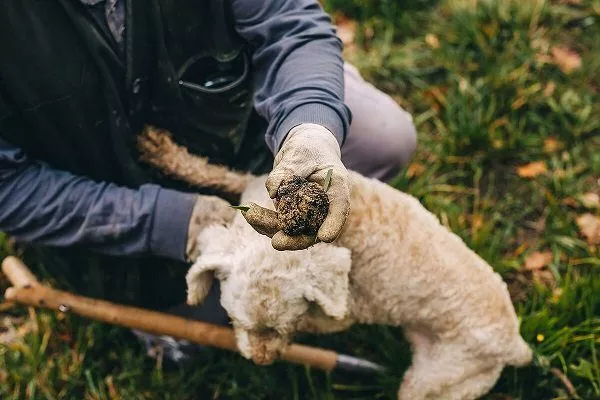
There are many varieties of truffles, most of which are edible. It is believed that cultivating them at home or commercially is impossible. Because they look nothing like mushrooms, they were once overlooked, but now they can fetch exorbitant prices.
| Name | Growing region | Fruit body size (cm) | Weight (g) | Pulp color |
|---|---|---|---|---|
| Piedmont truffle | Piedmont, Italy; France | 2-12 | 30-300 | Whitish or greyish-yellow |
| White Oregon Truffle | West Coast of the United States, Canada | up to 7 | up to 250 | Light cream |
| Black summer truffle | Crimea, the Caucasus, the European part of Russia | 2.5-10 | not specified | Yellow-white or grayish |
| Black autumn truffle | Central and southern Europe, rarely Russia | 2-8 | 20-320 | Lighter than the summer one |
| Black winter truffle | France, Italy, Switzerland, Ukraine | 8-15 | up to 1000 | White, then gray |
| Black Périgord truffle | Périgord, France; Italy, Spain | 3-9 | not specified | Light, then purple-black |
| Red truffle | Europe to the Urals | up to 4 | 5-60 | High density |
| Red shiny truffle | not specified | up to 3 | up to 45 | not specified |
| White March truffle | Italy, southern Europe, Crimea, Krasnodar Krai | 7-10 | not specified | Dark with white marble pattern |
| African truffle | North Africa, Middle East, southern France | 10-12 | 20-200 | From white to yellowish |
| Himalayan truffle | Tibet | up to 2 | 5-50 | not specified |
| Chinese truffle | India, China | up to 9 | not specified | Dark brown |
| Fluffy truffle | Europe, Urals | up to 2 | 3-20 | not specified |
Piedmont truffle
The name comes from the Piedmont region in northern Italy. It is also known as the true white truffle and the Italian truffle.
- ✓ Symbiotic relationship with certain tree species, without which truffles cannot grow.
- ✓ Specific soil composition, including high calcium content and optimal pH level.
One of the most expensive types of truffles, the most prized of the white ones. It is used raw in various dishes, as an ingredient in various sauces, a seasoning for hot dishes, and as an addition to meat and mushroom salads.
Description of the variety:
- Fruiting bodies have the appearance of irregularly shaped tubers.
- Size from 2 to 12 cm, weight – 30-300 g.
- The uneven surface is covered with thin, velvety skin. The color is light ochre or brown.
- The pulp is quite dense, whitish or greyish-yellow, sometimes with a reddish tint.
- Pronounced marbled pattern of creamy brown color.
- The spicy aroma is similar to a mixture of cheese and garlic.
| Truffle variety | Type of trees for symbiosis | Optimal soil pH level |
|---|---|---|
| Piedmont truffle | Oak, willow, poplar | 7.5-8.5 |
| White Oregon Truffle | Coniferous trees | 6.0-7.0 |
| Black summer truffle | Oak, hornbeam, birch | 7.0-8.0 |
The main region of distribution is Piedmont and adjacent regions of France, less often – Central Italy, some areas of Southern Europe.
The harvesting period lasts from summer to winter.
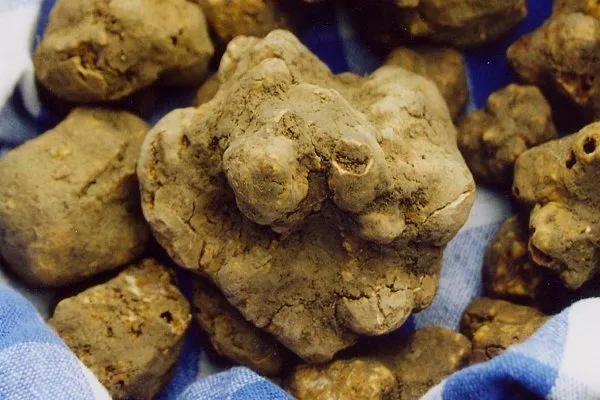
White Oregon Truffle
Native to the west coast of the United States and Canada, it is typically found near coniferous trees, which gives the mushroom its floral, herbal aroma.
The Oregon truffle reaches 7 cm in size and weighs 250 g. It has light creamy flesh with a white marble pattern and a pleasant, medium-bodied flavor.
The time of collection depends on the subspecies of Oregon truffle: spring - from March to May (less often, under favorable conditions, from February to June), autumn - from October to January (from September to February).
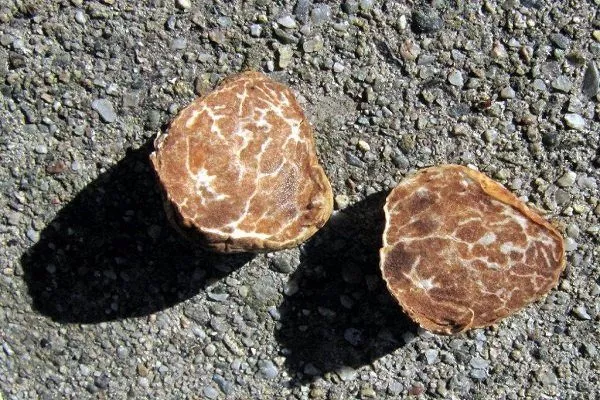
Black summer truffle
Another name is the black Russian truffle. It is the only representative of truffles that grows on the territory of RussiaThe main habitats are the forest-steppe zone of Crimea and the Black Sea coast of the Caucasus. It is sometimes found in areas of the European part.
Description of the variety:
- The size of the mushroom reaches 2.5-10 cm.
- The surface is bluish-black or black-brown, covered with brown pyramidal warts.
- Initially yellow-white or greyish, the flesh becomes brown or yellow-brown as it ripens, acquiring a marbled pattern.
The ripening and harvesting period depends on the region, but generally lasts from July to November.
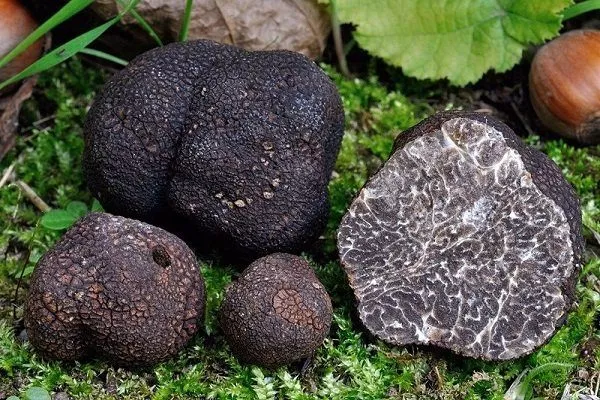
Black autumn truffle
The mushroom is very similar to summer black truffleSome researchers consider both species as one.
Description of the variety:
- The autumn mushroom is darker than the summer one, and when ripe, the surface takes on a chocolate color. The flesh is usually lighter.
- An adult mushroom grows up to 2-8 cm, weighing 20-320 g.
- The shape is round.
The black autumn truffle is widespread in central and southern Europe. It is occasionally found in Russia.
The ripening and harvesting period is from September to December.
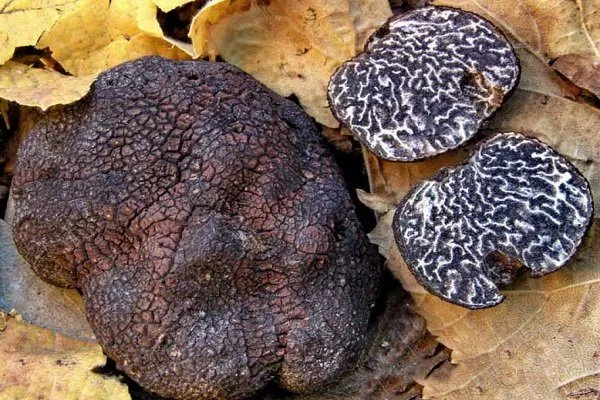
Black winter truffle
Also known as the black French truffle, it is widely distributed in France, less so in Italy and Switzerland, and is occasionally found in Ukraine.
Description of the variety:
- The mushroom has a completely round or irregular spherical shape.
- The size reaches 8-15 cm, sometimes 20 cm in diameter. Adult specimens grow up to 1 kg, sometimes more.
- On the surface there are warts in the form of polygons or shields, 2-3 mm in size, often deepened.
- The mushroom is red-violet on the outside and turns black when fully ripe.
- The flesh is initially white, then turns grey, sometimes with a purple tint, acquiring a marbled pattern of white or yellow-brown.
- The aroma is pleasant and sharp, with notes of musk.
The collection period is from November to March.
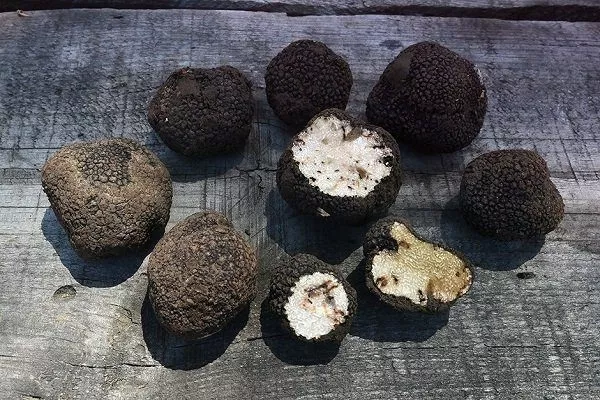
Black Périgord truffle
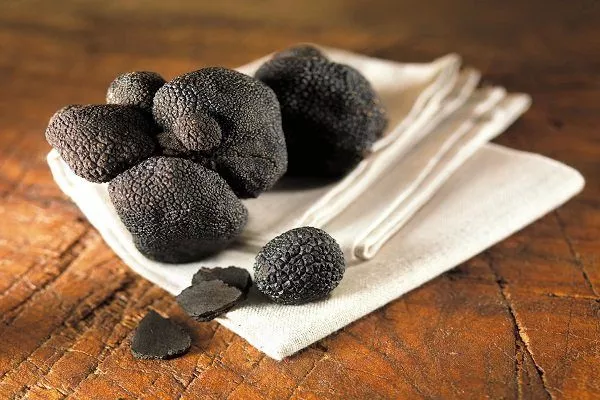
It gets its name from its growing region—the historical region of Périgord, France. It's also known as the French black truffle. Besides Périgord, the variety is also common in Italy, Spain, and southeastern France.
Description of the variety:
- The black truffle is irregularly round in shape, the almost black tuber reaches 3-9 cm in diameter.
- The surface is uneven, covered with numerous warty, multifaceted formations.
- The flesh is initially light-colored, but when ripe it becomes purple-black with a white marbled pattern.
- The aroma of the mushroom is strongly pronounced and may have notes of forest dampness, alcohol or chocolate.
Collection can be carried out from December to mid-March.
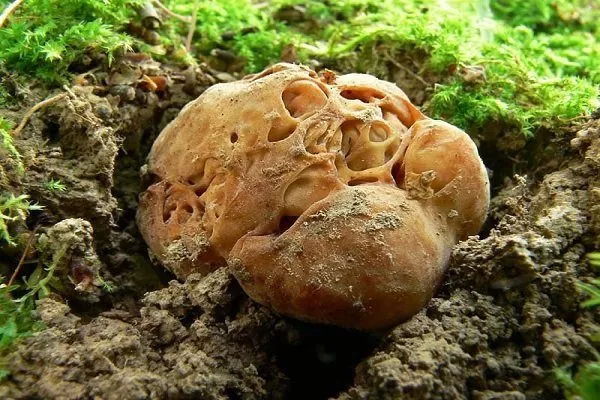
Red truffle
It is one of the most widespread and common truffles throughout Europe up to the Urals. It prefers deciduous and coniferous trees.
Description of the variety:
- The size of the mushroom usually does not exceed 4 cm, weight is within 5-60 g.
- The surface is reddish in color and rough.
- The pulp has high density.
- The taste combines notes of coconut, herbs and wine.
Fruiting lasts from October to January, and in suitable conditions from September to February.
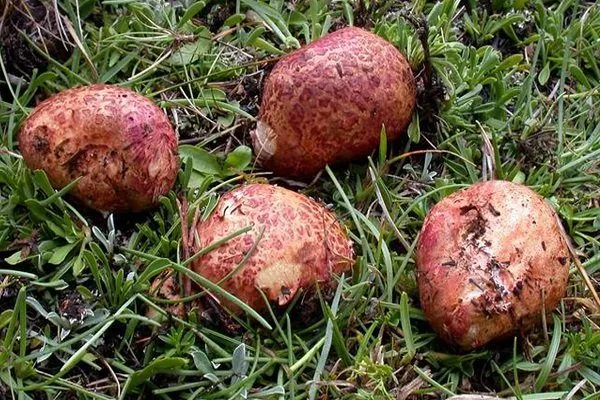
Red shiny truffle
It resembles a red truffle in appearance, but is smaller in size (up to 3 cm) and weight (up to 45 g). The surface is smoother, and the flavor is more pronounced, with notes of wine, pear, and coconut.
Fruiting lasts from May to August, and under favorable climatic conditions from April to September.
White March truffle
Its main distribution region is throughout Italy. It is also found in southern Europe, Crimea, and the Krasnodar region. It prefers coniferous trees, and less commonly, deciduous ones.
The March truffle is inferior in flavor to the white Italian truffle. It is considered edible. However, certain gastronomic properties make it unsuitable for consumption by many people.
Description of the variety:
- The mushroom has a round shape and a bumpy surface.
- Size 7-10 cm.
- The color ranges from white to light beige, changing to dark brown when ripe.
- The color is not uniform, with furrows and dark areas.
- The flesh is dark with a white marbled pattern.
- The taste is delicate, but when overripe the mushroom begins to smell strongly of garlic.
Fruiting lasts from February to April.
African truffle
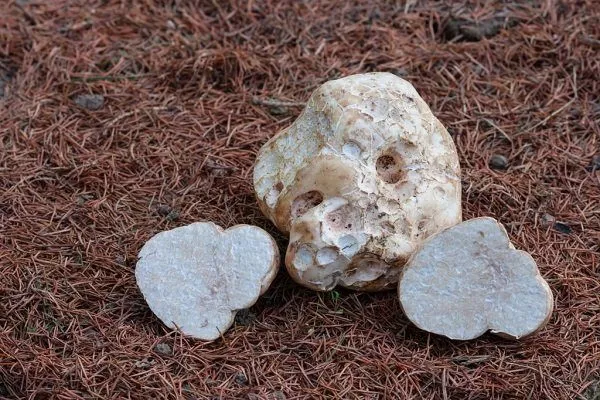
It gets its name from its primary distribution region, North Africa. It is also found in the Middle East and, less commonly, in southern France. It is also occasionally found in Azerbaijan and Turkmenistan.
Description of the variety:
- The shape of the African truffle is irregularly spherical, reminiscent of a potato.
- Size 10-12 cm, weight 20-200 g.
- The surface is smooth or fine-grained, initially white-pink, darkening to brown or black as it ripens.
- The pulp is fleshy, the color ranges from white to yellowish, turning brown over time.
- The smell is specifically mushroom-like, but the taste is not pronounced, which is why the mushroom receives lower ratings than other truffles.
Fruiting lasts from August to November.
Himalayan truffle
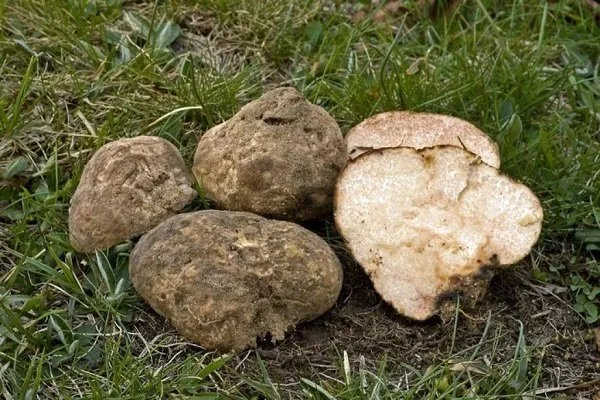
It grows primarily in Tibet. It prefers pine and oak for symbiosis. It belongs to the black winter truffle variety, so the two varieties are often confused. External size differences:
- The Himalayan species is smaller, its diameter does not exceed 2 cm, and its weight is 5-50 g.
- It looks like a small potato or an irregularly shaped nut.
Due to its small size, the Himalayan truffle is difficult to find, so it is rarely consumed. The mushroom has virtually no flavor, but it has a distinct, pleasant aroma that quickly dissipates.
The Himalayan truffle is a winter variety, ripening between December and February.
Chinese truffle
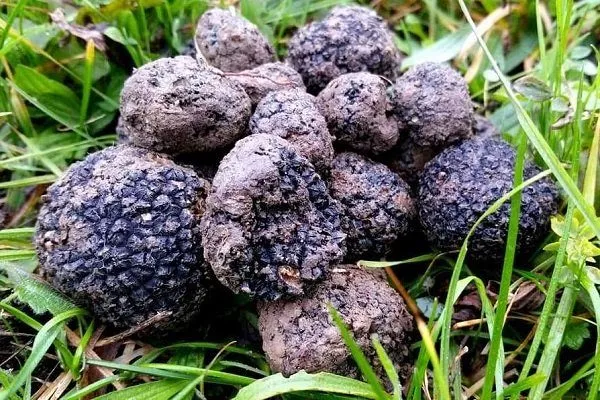
This species of truffle was first discovered in India, but was later found in China, from where it is now exported to many countries, hence the mushroom's name. It is sometimes called the Indian or Asian truffle.
It prefers symbiosis with pine, oak, and chestnut. A distinct aroma is present only in fully ripe specimens and lasts for five days. The flavor has nutty notes, but is much weaker than that of most members of this species.
Description of the variety:
- The Chinese truffle has a tuberous shape and grows up to 9 cm in size.
- The ribbed surface is brown or dark grey in colour.
- The flesh is dark brown, with a distinct white marbled pattern. It's tough, so it's only eaten after cooking.
The usual fruiting period is from December to February. In good weather conditions, November to March.
Fluffy truffle
Also known as the pubescent white truffle, it grows throughout most of Europe and the Urals, growing under broadleaf and coniferous trees.
The mushrooms are small, never growing more than 2 cm, and weigh from 3 to 20 g. Since the fluffy truffle does not have a distinct aroma or taste, it is of no commercial interest, although it is considered edible.
The mushroom fruiting period continues from April to October.
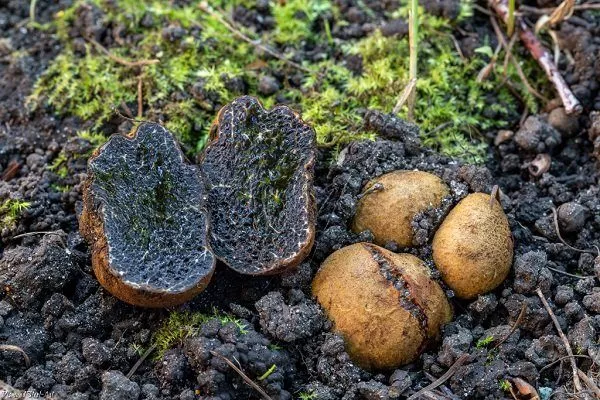
Melanogaster Bruma
Another name for this mushroom is the false truffle. It is considered inedible and has no commercial value. It was named after the English mycologist Christopher Broom, who studied it.
Description of the variety:
- The mushroom has a spherical or irregularly tuberous shape.
- Size 1.5-8 cm, at the base there are rare mycelial strands of brown color.
- The surface of a young mushroom is yellow-brown, darkening as it matures, becoming bare or slightly felty, and mostly smooth.
- The flesh is hard and gelatinous, from brown to brown-black, with white or yellow layers.
- When dried, a mature mushroom has a pleasant fruity smell.
It grows primarily in deciduous forests under fallen leaves. It bears fruit from June to July.
Each truffle variety has its own distinctive flavor, making them widely used in cooking. However, not everyone can afford to try this dish due to its high price. But if you do, the taste will be unforgettable.