
The truffle is a valuable mushroom, rare and not found in every country. This is one of the reasons for its high price. There are a huge number of varieties of this mushroom, some of which can be found in Russia, but finding them requires experienced mushroom pickers.
Do truffles grow on their own in Russia?
The truffle grows underground. It forms a close symbiosis with the roots of various trees. This mushroom can be confused with the Jerusalem artichoke (also known as the "earth pear"), as they are somewhat similar in appearance.
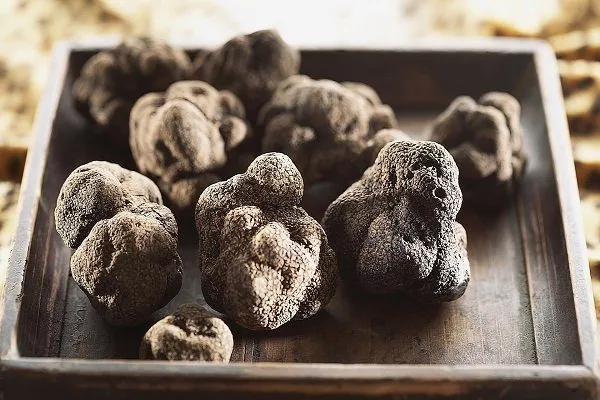
Truffles are distinguished According to various criteria, for example, by color: black, white, and red (slightly brown). There are divisions by seasons and months: summer, winter, March. There are also divisions by continents and countries: Italian, African, Himalayan, Burgundy, Chinese. And other divisions.
In our country, there are only two species of truffles that grow on their own:
- black summer (sometimes called Russian);
- white.
All other varieties grow only in greenhouse conditions.
Varieties
Truffles are found in almost every country in the world. In our country, three species are most popular: the black summer truffle, the winter black truffle, and the white truffle. The white truffle is further subdivided into several subspecies.
| Name | Fruit size (cm) | Fruiting period | Depth of occurrence (cm) |
|---|---|---|---|
| Black summer (Tuber aestivum) | 2.5-10 | Summer-late autumn | 3-15 |
| Winter black | ~20 | Late autumn - early spring | Not specified |
| White truffle | ≥5 | Midsummer-midautumn | Not specified |
Black summer (Tuber aestivum)
The most widespread species. It is most widespread in Europe. It is quite common in southern Russia. Over the years, people have given it other names:
- Saint-Jean;
- scorzone;
- edible;
- Burgundy.
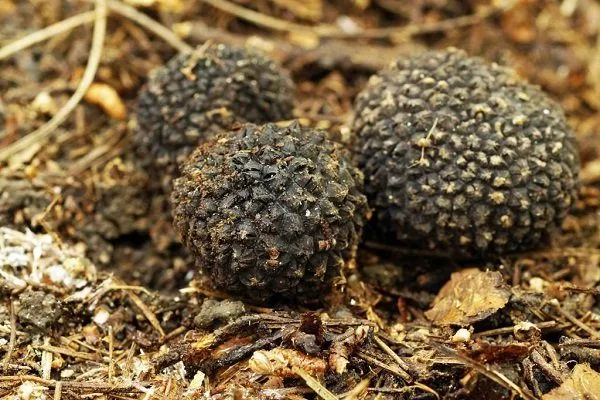
Brief description of the mushroom:
- size - from 2.5 cm to 10 cm;
- appearance - has furrows and a dark shade;
- taste - sweet with nutty notes;
- smells like fallen leaves;
- usually the ripening period lasts throughout the summer season and ends in late autumn, in areas with low temperatures (North) - from mid-July and also until the end of November;
- the fruits are located at a depth of 3 to 15 cm;
- can be located either in union with other truffles of their species, or alone;
- They often grow near oak trees.
Winter black
Widely distributed in central and southern Europe and in southern Russia, this truffle can be identified by the following characteristics:
- the size of a mature fruit is about 20 cm;
- The mushroom's blackness is characteristic only after collection; when in the ground, the mushroom will be burgundy in color with a rich violet hue;
- aroma - vaguely reminiscent of musk;
- fruiting period - from late autumn to early spring;
- The location of the winter black is birch or beech forests, often found in oak groves.
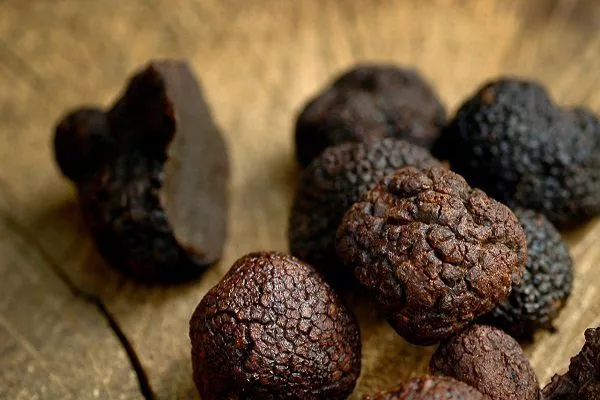
White truffle
The most expensive type of truffle found in our country, this truffle grows in Western European, Ukrainian, Belarusian, and Russian forests. Previously, it was found in very large quantities near Alexandrov and Sergiev Posad.
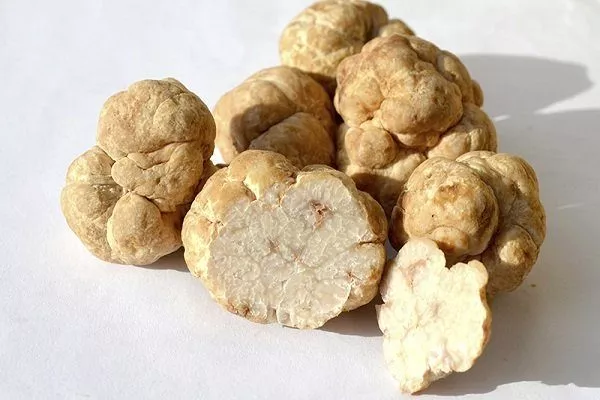
The fetus can be identified by the following parameters:
- size - not less than 5 cm;
- the surface of the mushroom is felt-like, while that of newly emerged fruits is smooth;
- looks like Jerusalem artichoke and has a yellow tint;
- the smell is very close to nutty, and the older the truffle, the more pronounced it is;
- The main fruiting period is from mid-summer to mid-autumn.
There are several other "white" truffles growing in Russia, but they are not particularly popular:
- Duron white. A less popular mushroom, it has a rather distinctive sweet-spicy aroma. Its flesh is dense and not widely harvested.
- Variegated white. This is also not a very popular variety. This variety has slightly bitter flesh and a faint, but quite pleasant, distinctive truffle aroma. It is used exclusively for flavoring, including in oil (used to impart a truffle aroma to dishes).
- Pubescent white. This type has absolutely no commercial value. Although it is edible, it has no distinct flavor or aroma.
Truffle habitats in Russia
Russia is famous for its vast territory, but truffles don't grow everywhere. The expensive mushroom can be found in its natural habitat only in a few regions.
European part of Russia
Two types of truffles grow in this part of Russia:
- black or Russian (breeds in forested areas near the cities of Podolsk, Belgorod, Tver, and can sometimes be found in the Leningrad region);
- white (a few kilometers from Orel and Tula).
Caucasus and Crimea
These regions are renowned for their mild and warm climate, just what truffles require. To find the mushrooms, head to:
- beech forests;
- oak groves.
Most of them are located in:
- steppe regions of the Crimean peninsula;
- regions of the Caucasus (especially in the Adagum-Pshishsky region);
- Republic of North Ossetia;
- near the resort towns of Anapa and Gelendzhik;
- not far from Lake Abrau-Dyurso.
Siberia
Given truffles' love of warmth, you wouldn't think they could be found in the north of our country. But the Siberian climate has proven favorable for their fruiting. Ordinary villagers collect these prized mushrooms by the kilogram.
Siberian mushroom pickers head to deciduous and coniferous forests to search for truffles. The highest concentrations of truffles have been recorded in the Tomsk and Chelyabinsk regions.
DIY truffle hunting: how to find truffles?
You can harvest this delicacy yourself. You just need to know a few rules and study the intricacies of growing it to succeed.
Growing characteristics
The truffle is a finicky mushroom. It won't grow in just any soil. Suitable sites for it are considered:
- a place where there are many tree roots;
- soil with loose soil and a high content of sand or lime.
If you manage to find such a place, it's a good sign. Once you've found one mushroom, feel free to look for more. Truffles rarely grow alone. Up to five specimens can be found in one place.
Searching for truffles in the forest
This delicacy-classified mushroom is difficult to find in the forest. Before heading out to pick mushrooms, here are a few tips:
- If there is an oak grove in your region, go there, but don't look for fruit in the clearings, as they are extremely rare there;
- the larger the root, the higher the probability of stumbling upon the desired object;
- a good start would be considered to be black soil with high humidity;
- pay attention to the color of the soil; where there are truffles, the earth has an ash tint;
- It's difficult to spot mushrooms, they are located at a depth of 10-15 cm, but if you notice a mound, dig it up, maybe you'll get lucky;
- insects - midges - often fly over the place where the mushroom grows, all because the larvae feed on the delicacy;
- Animals can help you find truffles, but don't forget to muzzle them;
- Before your trip, familiarize yourself with what real truffles look like and always keep this image in your head.
Animals for truffle hunting
Quite often, people go in search of valuable mushrooms together with animals:
- pigs;
- dogs.
| Search method | Efficiency | Cost of preparation |
|---|---|---|
| With the help of pigs | High, but the risk of eating mushrooms | Low |
| With the help of dogs | Very high | High (from 5 thousand euros) |
| Independent search | Low without experience | Minimum |
Pigs are especially good at this. Upon smelling truffles, the animal begins digging actively in search of the delicacy. It's important that the pig be muzzled. Otherwise, it will find the mushroom and eat it itself.
Dogs aren't particularly interested in mushrooms, but they won't just work for fun. They need to be specially trained to find truffles. This is time-consuming, and a capable dog costs at least €5,000.
You can learn about searching for truffles from the following video:
Growing truffles at home
Growing truffles at home without any experts is quite possible if you follow these recommendations:
- the mushroom does not tolerate temperature changes, so create a suitable atmosphere for it (temperature from plus 16 to 25, low humidity level), which will always be stable;
- tree roots infected with mycelium must be present;
- the place where the mushrooms will begin to grow should not be exposed to wind, direct sunlight also has a negative effect on truffles;
- the soil must be alkaline, an alternative is to add lime;
- fertilizers are not allowed;
- Follow the rules for planting trees:
- the hole is not less than 75 cm;
- Place the plant only in moist soil;
- Fill in carefully so that the roots remain intact;
- After adding to the soil, water the tree generously;
- the planting is covered with film;
- Next, you can use fertilizers developed by specialists specifically for truffles.
- ✓ The soil must have a pH of at least 7.5, which provides the necessary alkaline environment.
- ✓ The air temperature in the greenhouse should be maintained in the range from +16 to +25°C without sudden changes.
You can try harvesting your first crop a month after sowing. Don't expect good results right away. Impressive results will only be noticeable after 3-4 years. This is when peak yields will be reached.
From a business perspective, growing truffles is a contentious issue. On the one hand, this valuable mushroom is in high demand, and there's always a buyer. On the other hand, growing truffles is expensive. A single tree with spores costs at least $10. Plus, it's time-consuming.
Average cost of truffles when purchased
The truffle is sometimes called the "king of mushrooms." This is due to its price. In Russia, this delicacy costs between $500 and $2,000. White truffles are even more expensive, with prices starting at $800.
There are several reasons for such a high price:
- unique aroma and taste;
- For a long time now, demand has exceeded supply, and sometimes truffles even grow poorly if the weather is dry;
- mushrooms don't grow everywhere and it's hard to pick them;
- Search dogs are often needed, and training an animal takes a long time and is expensive;
- mushroom pickers suffer while collecting mushrooms, most of them have back problems;
- Most truffles take a long time to ripen;
- cut mushrooms can be stored for only a few days;
- the mushroom has aphrodisiac properties;
- There are also false truffles in nature, but only a specialist can identify them.
Truffles have long been a luxury item, and eating them is a sign of a person's wealth. This is another reason why sellers inflate their prices.
Although expensive mushrooms grow in Russia, they are quite difficult to find. Sometimes the effort may not be worth it. When setting out to find them, you need to carefully research many factors. But if you're lucky, you can not only sample the delicacy but also earn some money.
Truffles!!! And truffles grow in the same place as watermelons.
Thank you. Corrected.
Truffles in Siberia??? They've never been here! There are occasional rumors, but no documented evidence. The last mention was in 2011, when a resident of the Tomsk region allegedly found a white truffle. However, mycologists identified the mushroom as a common rhizopogon, and it has no relation to truffles, nor does it have any particular nutritional value. I suspect other similar rumors are specifically related to rhizopogon.
Almost every year I collect them in Tverskaya, sometimes tens of kilograms, but more often a few pieces per season.
The mushroom's appearance can be confused with the Jerusalem artichoke (commonly known as the earth potato). So, is the potato we're familiar with a tree potato or a water potato?
Jerusalem artichoke, also known as "earth pear," resembles a potato in appearance and is similar in composition. The author has corrected the typo. Thank you for your observation!