
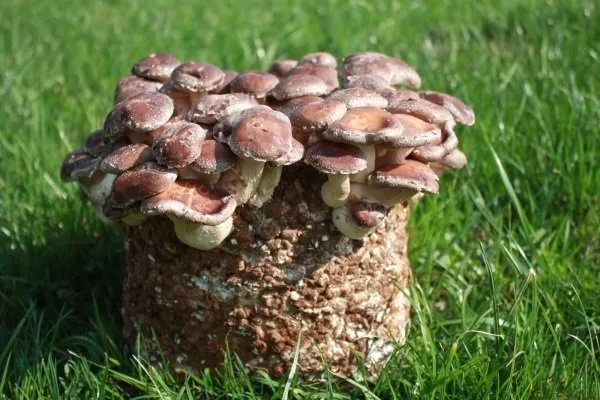
Shiitake mushroom Also known as the Japanese forest mushroom or lentinula edulis, shiitake can be grown at home using one of two simple methods. It has a convex cap, ranging from 5 to 20 cm in diameter, and is brown or coffee-colored. Let's explore how to grow shiitake mushrooms properly.
Growing methods
There are only two of them:
- IntensiveThe mycelium is added to a pre-prepared substrate. It should contain sawdust, deciduous wood shavings and chips, straw, hay, and grain. The resulting mixture must be sterilized, as fungal spores are weaker than mold spores. If sterility isn't maintained, mold will prevent the mushrooms from reproducing, preventing the desired harvest.
- ExtensiveIn the wild, mushrooms grow on freshly cut tree trunks. It's also possible to recreate environmental conditions as close to natural as possible. Spores are seeded in holes drilled into logs. However, the logs must first be kept in low-temperature, low-humidity conditions for a long time to allow the mushrooms to germinate. The entire process—from spore inoculation to 100% mushroom maturity—takes 1.5 to 2 years.
| Method | Time until the first harvest | Productivity | Requirements for conditions |
|---|---|---|---|
| Intensive | 2-3 months | High | Sterility, temperature and humidity control |
| Extensive | 1.5-2 years | Moderate | Natural conditions, minimal control |
To quickly harvest mushrooms, many people prefer to resort to the intensive method, which produces a harvest within a few months.
Intensive method – growing mushrooms in blocks
To ensure a successful harvest, it's important to follow the correct instructions—from preparing the substrate to harvesting the mushrooms. Let's look at each step separately.
Selecting mycelium
Shiitake mycelium is purchased from a specialized market. It comes in three varieties:
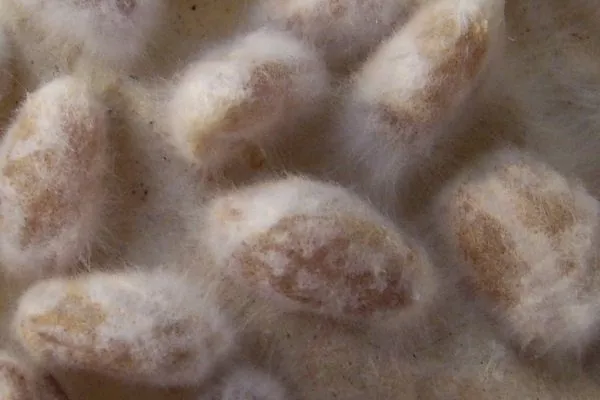
- CerealThis is a scattering of grain where fungal spores have developed. Grains are an excellent nutrient medium, where high-quality mycelium forms at an accelerated rate. To effectively propagate shiitake, you'll need to add about 2% of the contaminated grain to the total substrate.
- SawdustThe mycelium is propagated in a sawdust-bran mixture and used to grow mushrooms in a homogeneous substrate. The optimal concentration of this mycelium is 5-7% of the total substrate mass.
- LiquidThis type of mycelium grows in a liquid medium, such as beer wort. It is used quite rarely and only when the substrate is completely sterile. Liquid inoculation requires the use of a special dispenser. The recommended dosage for this type of mycelium is 20-45 ml per 2-4 kg of substrate.
- ✓ Mycelium type (grain, sawdust, liquid)
- ✓ Genetic characteristics
- ✓ Storage conditions
Mushroom growing experts recommend choosing grain-type spawn, as it preserves many of the organism's genetic characteristics. For example, it's recommended to purchase 18 kg of grain-type spawn, which should be packaged in 200 g plastic bags with a special zip-lock.
Packaging is carried out in a clean room without ventilation in the following order:
- Clean the table where all work will be performed and wipe it with a cloth soaked in bleach. Put on sterile gloves.
- Prepare bags – disinfect with 70% alcohol solution or 10% sodium hypochlorite solution.
- Remove the substrate parts and place them in a bowl, separating them into individual grains with your hands.
- Pour the mycelium from the basin into zip-lock bags. This should be done as quickly as possible.
- Prepare air filters from toilet paper - fold them into a multi-layer square measuring 30x30 mm.
- Insert the filter into the bag and close it with a clasp.
- Fasten all the finished bags together using a stapler.
The resulting mixture can be stored upright with the filter facing upward. Store in a refrigerator. The shelf life is up to 6 months. The mycelium can be removed immediately before inoculating the substrate.
Substrate preparation
Mushrooms are grown in blocks made from a substrate. The substrate consists of the following elements:
- Sawdust from deciduous trees. Its particle size should be no less than 3 mm. This is the basis of the mixture.
- Wood shavings or small chips from deciduous trees can be used to improve the composition's breathability. These can be replaced with hay or finely chopped oat or barley straw.
Coniferous trees are not suitable because they contain resins that prevent the development of mycelium.
- Grains, brewed grains, and legume flour are needed to increase the nutritional value of the substrate.
- Chalk or plaster. Helps improve the structure of the composition.
Experienced gardeners note that in large blocks, it's difficult for the mycelium to spread over the entire surface, so the optimal size is 1.5 kg. When preparing the substrate yourself, maintain the following proportions:
- sawdust – 50%;
- straw or wood chips – 25%;
- grain, bran, brew, flour – 25% in any combination;
- chalk or gypsum – up to 1% of the total mass.
The weight can be changed in percentage terms, but the total proportion of sawdust and straw or wood chips in the finished substrate should not be less than 70%.
The following types of substrate mixtures are also distinguished:
- 41 kg of sawdust, 8 kg of cereal bran, 1 kg of sugar and 25 l of water;
- bark and sawdust in a ratio of 1 to 1 or 1 to 2;
- bark, sawdust and straw in a ratio of 1:1:1;
- sawdust and rice residues in a ratio of 1 to 4.
Regardless of the composition of the substrate, it must be prepared for inoculation in three stages:
- CrushingTo obtain a compact mixture without large voids, which is ideal for mycelial growth, each portion of the substrate must be chopped. If straw is used, it should be divided into 5-10 cm pieces.
- MixingThe previous step yields the components, which must be thoroughly mixed to a uniform consistency in one container.
- ProcessingThe final stage creates a free growing space where the mushrooms can fruit. It allows the substrate to be cleared of bacteria and mold by sterilizing and forming blocks. Read below for details on how to do this.
Sterilization, inoculation and packaging of the substrate
In conditions favorable for fungal growth, mold also thrives, which can even inhibit the development of fungal spores. To prevent this, sterilization is necessary to kill all bacteria. This procedure can be accomplished in two ways.
Steam the substrate with boiling water and then pack it into bags.
The procedure is as follows:
- Pour all the substrate into a large, clean enamel container with a lid and add boiling water. Close the lid and wrap the container in a blanket. Leave for 10 hours.
- Drain off any excess water and cool the mixture to room temperature with the lid closed. Then, pour into clean bags. Wear gloves when handling the mixture. It's important to keep one thing in mind: shiitake mushrooms are grown in ventilated bags. You can initially purchase special ventilated bags, or you can use regular bags but poke holes in the sides yourself after the block has formed.
- Once the bag is filled, make a small well in the center of the mixture and evenly sprinkle the mycelium into it. Typically, the amount of mycelium should not exceed 3-5% of the total block weight. For example, if the block is 2.5 kg, 100 to 150 g of mycelium is required.
- Insert a 2-cm diameter stopper made of sterile cotton wool into the neck of the mushroom. This will allow for the special gas exchange necessary for mushroom development. If you're using special bags, there's no need to insert a stopper, as gas exchange occurs through filters.
- Tie the bag tightly.
Pack into bags and then sterilize in boiling water.
This method differs from the first in several nuances and is carried out in the following order:
- Fill the bag with the substrate and tie it loosely. Place it in the pot.
- Add water up to the tie. Reduce heat to low and simmer for 2-3 hours.
- Remove the bag and cool to room temperature.
- Put on sterile gloves and fill the mycelium in the same way as in the previous method.
- Form the block in the bag into a bar shape so that the bottom part is slightly smaller than the top, since in this case the mushrooms will develop both on the top and on the sides.
Incubation, mycelium germination
This is the period during which the fungus intensively utilizes the plant mixture and absorbs the necessary components for its development. For mycelium to develop indoors, it's essential to ensure the correct air temperature. Humidity levels aren't important, as the formation process occurs in containers.
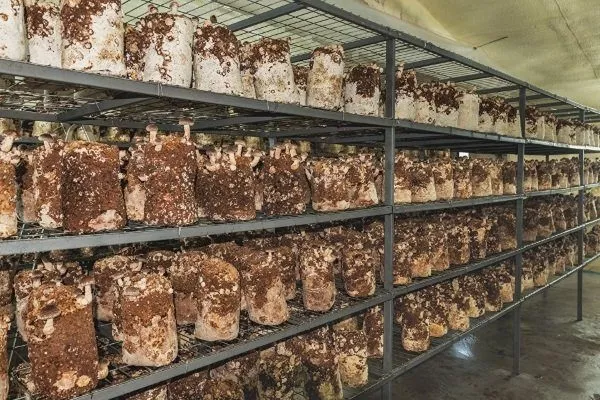
The blocks should be installed on an elevated surface—at least 20 cm above the floor. Alternatively, they can be hung on a hook to ensure maximum gas evacuation. In any case, the optimal temperature is 25 to 27 degrees Celsius. If it exceeds 28 degrees Celsius, the risk of mycelium death increases significantly, as the created conditions are favorable for the active growth of harmful organisms, especially Trichoderma or Neurospora mold.
Depending on the volume of mycelium added and the composition of the substrate, the incubation period can last from 40 to 110 days. During this time, fungal spores will gradually fill the tank, after which white bumps will appear, which will eventually turn brown, known as the "brown block" phase. This color is caused by polyphenol oxidase, an enzyme activated by strong light and the presence of oxygen.
It's worth noting that a protective layer gradually forms on the surface of the substrate, preventing harmful organisms from penetrating the mixture and preventing it from drying out. To strengthen this layer, illuminate the formations for 7-9 hours daily during the incubation period. The optimal light intensity is 50-120 lux. This will also speed up the process of primordia formation.
So, when the emerging bumps turn brown, you need to remove the bag from the block, and move the block itself to the room where further cultivation will take place.
To promote vigorous growth of the shiitake, after removing the bag, transfer the block to a container and fill it with cold water. After 24 hours, drain off any excess water.
Caring for mushrooms
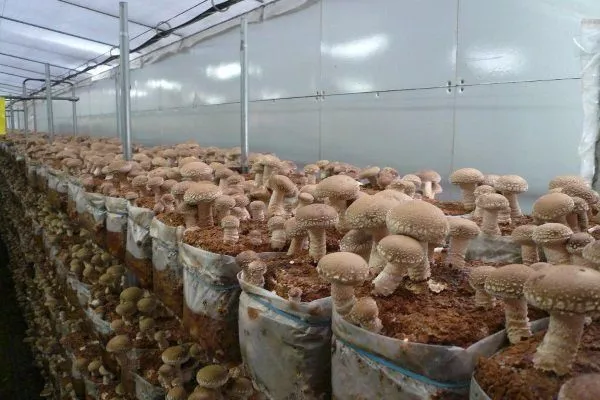
To achieve a good harvest during the fruiting period, it's necessary to provide a humid environment, cool temperatures, and good lighting. Otherwise, the primordia will be exposed to negative influences during their active development. To create such a microclimate, the following parameters must be set:
- the air temperature for heat-loving strains is +21 degrees, and for cold-loving strains - +16 degrees (the type of strains should be clarified with the mycelium seller);
- air humidity – 85%;
- Lighting – about 10 hours a day.
- Maintaining optimal temperature and humidity.
- Regular ventilation of the room.
- Daily spraying.
If daylight is absent, lamps should be used. The dimmer the lighting, the paler the shiitake caps will be.
Particular attention should be paid to spraying—it should be done daily. Regular ventilation of the room is also recommended.
Harvest and transition period
On average, you can harvest three times per season, after which the blocks need to be replaced. Mushrooms are ready for harvesting when the cap edges are almost straight and no longer curl inward. Harvesting is done as follows:
- Reduce humidity to 60% 4-6 hours before harvesting. This will help stiffen the cap cuticle, which is essential for extending the mushrooms' shelf life.
- Remove the mushrooms, making sure to remove any stems. These will attract pests or promote the growth of dangerous mold.
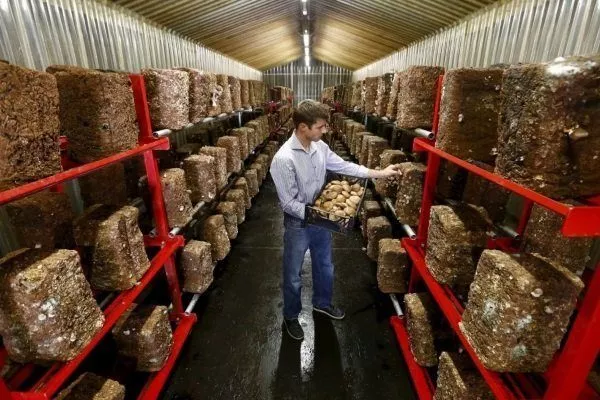
After harvesting, a transition period begins, during which the mycelium must accumulate nutrients from the substrate for the next fruiting cycle. To accelerate this process, the air temperature should be raised to 20–25°C. Humidity should also be maintained at a fairly low level—up to 50%. It's important to completely remove any remaining residue from the previous fruiting. Another secret to a good shiitake mushroom harvest is treating the blocks for various pests and diseases.
Typically, with proper care, one package can produce 2-4 ripening waves of fruit. The transition period between these waves is approximately 2-3 weeks.
Extensive method – growing mushrooms on log sections
When growing mushrooms this way, it's important to create conditions as close to natural as possible. This means the mushrooms will grow in their natural environment, not on substrate blocks, but on logs.
The stages of this method of growing shiitake can be found in the table:
| Stage | Requirements | Time and duration |
| Timber harvesting | Hardwood is selected. The logs should be 1 to 1.5 m long and 0.1 to 1.2 m in diameter. The optimal moisture content is 35 to 70%. | After the autumn leaves fall and before the sap begins to flow in the wood in the spring. |
| Preparing the logs | Place the logs in a woodpile for storage until the next step. If the wood is excessively dry, water 2-3 days before inoculation. Remove any lichens and moss. | 2-3 months after the first stage. |
| Inoculation | Drill holes in a staggered pattern at intervals of 10-15 cm. Fill them with mycelium and seal with wax or paraffin to prevent bacteria from entering and moisture loss. The mycelium application rate is 5 to 10% of the log's weight. | 2-3 months after harvesting. |
| Incubation | The air temperature should be between 20 and 26 degrees Celsius, and the humidity between 60 and 80%. The optimal location for logs is in sheds, hangars, greenhouses, hotbeds, and other places that provide suitable conditions. | 6-18 months after inoculation. When the mycelium emerges to the surface and the log no longer rings when struck, the incubation period is complete. |
| Induction of fruit formation | Soak the logs in barrels, a river or a pond to increase the wood's moisture content to 75-85%. | In summer – from 10 to 24 hours, and in winter – from 48 to 72 hours. |
| Fruit formation | The ideal air temperature is 12–18°C, relative humidity 70–85%, and illumination around 100 lux. Stack the logs in an X-shape and cover with a white protective blanket that allows light and air to pass through to stabilize the microclimate. | From 3 to 10 days. |
| Fruiting | Maintain the air temperature as during fruiting, but reduce humidity to 60-75% and increase illumination to 200 lux. Remove the protective covering to improve ventilation and reduce humidity. Mushroom yield is 15 to 20% of the log weight. | Lasts 7-14 days. In total, it lasts from 3 to 6 years. After the first flush, subsequent fruiting occurs after a dormant period, during which the trees are induced by soaking the logs. |
| Rest period | The normal air temperature is +20…+26 degrees, and the humidity is 60-80%. The wood moisture content should be maintained at 30-40%. | 1-3 months after harvest. |
The mushroom yield depends on each stage. We'll explore what's especially important to consider in such a delicate process below.
Preparing logs
The blocks will be made from tree trunk fragments. It's best to choose logs from the following trees:
- oak (best option);
- beech;
- chestnut;
- hornbeam;
- birch trees;
- willows;
- alder;
- aspen;
- poplars;
- maple.
Shiitake mushrooms contain tannase, an enzyme that helps break down tannins, allowing the mushroom to thrive in oak wood.
Trees should be felled when the sap is at its highest sugar content—between the fall leaf fall and the spring sap flow. The optimal wood moisture content is between 40 and 50%. Select wood fragments that show no signs of pest or xylotroph infestation.
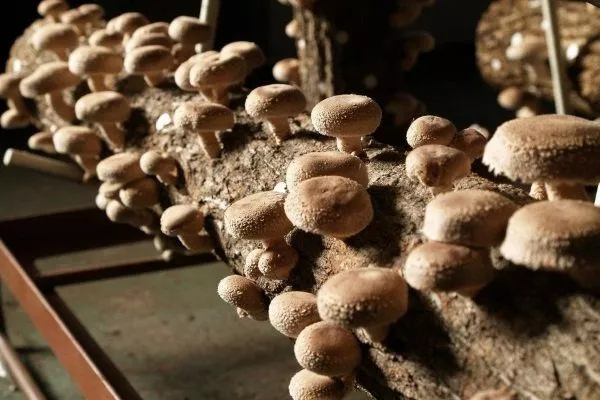
The logs should be cut into pieces 1-1.5 m long and 10-20 cm in diameter, which will need to be stored outdoors for 1 to 3 months. Only then can holes be drilled for seeding. It is recommended to perform this work on clean plastic film. The holes should be drilled in the center of the side surface of the log in a staggered pattern. The optimal diameter is 2 cm and the depth 1.5 cm. The distance between the holes around the circumference should be 6 cm.
Selection of strains
Seeding a log requires a fairly high mycelium consumption—at least 200 grams per linear meter of log. Depending on the climate in which shiitake mushrooms will be grown, the following strains are selected:
- heat-loving (summer) – bear fruit well from May to September in a humid, warm climate at temperatures of +14…+27 degrees;
- cold-loving (autumn-spring) – they produce a good harvest at temperatures of +7…+16 degrees from March to May and from September to November; the mushrooms are of excellent quality, but develop slowly;
- off-season – can bear fruit in wood at temperatures of +10…+25 degrees from May to November, and if these strains are used for growing mushrooms indoors under controlled microclimate conditions, a harvest can be obtained all year round.
Inoculation
It is carried out in the following order:
- Place grain mycelium into the holes of the seasoned logs and compact them so that 1 cm remains to the edges.
- Seal the holes with garden pitch or construction putty to prevent mycelium from escaping.
- Place the seeded logs in a stack in the area where they will bear fruit. This should be an area shaded by plants on three sides, with an open side facing west or east. A low-lying area with high air and soil humidity is ideal. The optimal air temperature is 24 to 28 degrees Celsius, and humidity is 70 to 90%.
In the central and southern regions, overwintering the mycelium won't pose any problems. Simply cover the logs with straw or move them to a basement.
Mycelium grows in wood over a short period of time—from 6 to 18 months. The exact duration of the incubation period depends on the quality of the mycelium, the amount of seeded material, the air temperature, and humidity. Generally, shiitake mushrooms live on logs for 5 to 7 years.
From stimulating mushroom growth to harvesting
Once the mycelium has fully sprouted, you need to stimulate the formation of fruits in the following way:
- Soak logs in water for 24-72 hours.
- Place the logs vertically or at an angle in a dark, but not warm place.
After just 7-10 days, the first fruiting bodies will appear. Shiitake typically bear fruit twice a year. After each fruiting period, there's a period of rest, during which the logs should be covered with a breathable material to maintain a stable environmental temperature.
Depending on the size of the logs, mushrooms take 2 to 5 years to grow. Over this period, an average yield of 200 to 250 kg can be harvested from 1 square meter of wood.
Growing in a greenhouse
Shiitake is also suitable for growing in a greenhouse, but it's important to note that this type of greenhouse becomes unsuitable for further vegetable cultivation after the mushrooms have matured, as it leaves a large number of spores in the air. Shiitake can also be grown on stumps in a greenhouse, but an intensive method is more commonly used. However, the following tips should be considered:
- Before sowing the mycelium, install metal racks with shelves filled with nutrient mixture inside the greenhouse. The substrate should be stored in these containers.
- If using an intensive growing method, use the same substrate prepared for the blocks. A mixture of straw and sawdust can be used as filler, or, even better, bran or grain can be added. In any case, rinse the prepared mixture with boiling water. This is necessary to destroy pathogenic microflora and protect the crop from diseases. Then, sow the mycelium.
- The beds can be covered with film until the first fruiting bodies ripen, since after their appearance the air temperature in the room drops somewhat.
- Mushrooms will grow without external shelter, but in this case they should be inspected regularly to identify and remove damaged fruit promptly.
- After harvesting, the soil should be doused with boiling water again, but if mushrooms were grown in the same place for several years in a row, the substrate must be disposed of.
Video: Growing Shiitake Mushrooms on Tree Stumps
The following video clearly demonstrates how to plant shiitake mushroom mycelium on a tree stump:
Shiitake is a medicinal mushroom used both as a food and to make a tincture with medicinal properties. It helps reduce the growth of malignant tumors, strengthen the immune system, and combat chemical poisoning. There are two ways to grow these mushrooms, depending on your budget and needs.