
The yellow-skinned button mushroom belongs to the genus Agaricus, has the Latin name xanthodermus, and is poisonous. It was officially described in 1876 by the French botanist Léon Genevier, who helped place the mushroom in the champignon group after reclassifying it into five varieties. Until then, it was classified among various edible mushrooms.
Description and characteristics of the mushroom
Based on its etymology, the yellow-skinned button mushroom is classified as a particularly dangerous toxic mushroom due to its striking similarity to its edible relatives. Therefore, inexperienced mushroom pickers often pick it, resulting in poisoning.
To prevent this from happening, you need to know what a pecheritsa looks like:
- Hat. Its diameter varies from 5 to 15 cm, and it is bell-shaped when young and spreading and rounded when mature. The cap is light yellow with brown speckles. If you press on the surface, the mushroom turns a distinct yellow.
The skin is always dry and smooth. Over time, cracks form at the edges. - Leg. Height: 6–15 cm, diameter: 1.8–3 cm. Characterized by a regular shape with a slight thickening at the base. A wide, two-layered ring is present under the cap. The interior is soft and hollow, whitish in color.
- Pulp. At the beginning the stems are yellow, but as they rise upwards (towards the top of the cap) they become brownish-light, and at the point of swelling they become orange.
- Hymenophore. Young fruiting bodies are distinguished by thin white or pinkish gills, while older fruiting bodies are brown, sometimes with a grayish tint. The spore powder is chocolate-colored.
- Aroma. When heat-treated, a phenolic odor (very unpleasant, like pharmaceuticals or ink) appears. In its raw state, it is barely noticeable.
Fruiting time and spread
The yellow-skinned button mushroom prefers deciduous or mixed forests with abundant vegetation. It grows in parks and garden plots. It is widespread in Europe, North America, Australia, Russia, and other countries (in recent decades, it has been found worldwide).
It especially thrives in warm weather and high humidity, so its growth is stimulated during rainy seasons. It grows in large clumps, forming a "fairy circle."
The fruiting period is summer and fall. The yellow-skinned button mushroom can be found from late May to late September.
Similar species
| Name | Toxicity | Fruiting season | Spreading |
|---|---|---|---|
| Yellow-skinned champignon | High | Summer-autumn | Europe, North America, Australia, Russia |
| Common champignon | Low | Summer-autumn | Europe, North America |
| Field champignon | Low | Summer-autumn | Europe, North America |
| Two-ringed champignon | Low | Summer-autumn | Europe, North America |
The yellow-skinned button mushroom has many lookalikes. It is most often confused with the following edible mushrooms:
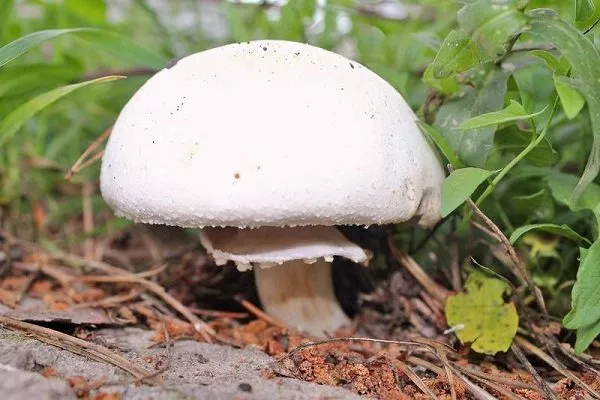
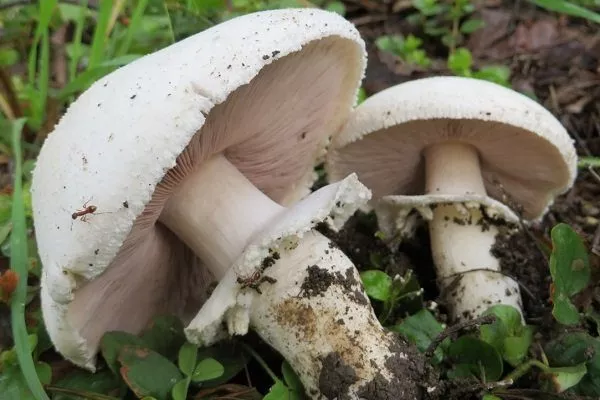
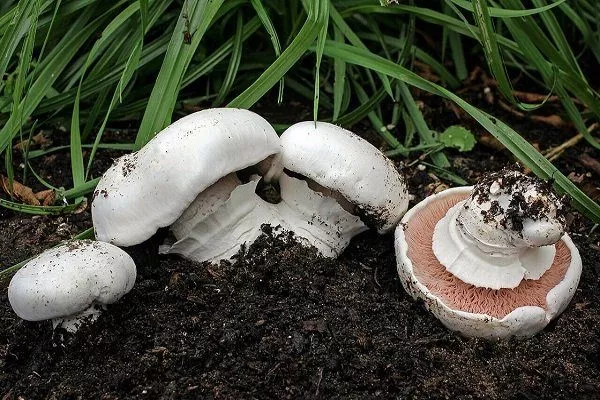
- Common champignon. The Latin name is Agaricus campestris. The cap is white, 10 to 15 cm in diameter, flattened to rounded and then spreading. The center is convex. The stem is 1–2 cm in diameter and up to 9 cm long. Like the cap, it is white.
The flesh is the same shade, but turns red when broken. When young, the gills are white, then turn pink, and then dark brown with a purple tint.

- Field champignon. The Latin name is Agaricus arvensis. The cap is initially bell-shaped, later spreading, white at first and yellowish as it matures. Its diameter varies from 5 to 20 and even 30 cm.
The stem is 6–10 cm long and cylindrical. The flesh is white and, like that of the yellow-skinned mushroom, turns yellow when pressed (though not immediately). The gills are initially white, then turn light pink, mustard, burgundy, or black.
- Two-ringed champignon. The Latin name is Agaricus bitorquis. The cap is 3 to 15 cm in diameter and is snow-white or off-white. The stem is 2 to 4 cm in diameter and 3 to 10 cm in height.
The flesh is white; when broken, the color remains almost unchanged, but may reveal a slightly pinkish tint. The gills are pink.
How to distinguish edible lookalikes from poisonous mushrooms?
According to statistics, poisoning from yellow-skinned button mushrooms occurs in almost 50 out of 100 cases. This is due to their close resemblance to edible mushrooms and mushroom pickers' unfamiliarity with the nuances of distinguishing them from toadstools.
How to identify a toxic mushroom:
- The main indicator of toxicity is the formation of a yellow tint when cut, broken, or simply rubbed on the surface (edible mushrooms have a different tint, and if there is a tendency to turn yellow, it appears no earlier than after 2–4 minutes);
- the smell is always unpleasant and reminds one of a hospital;
- The color of the stem when cut is bright yellow or orange in young specimens, brown in old ones.
To learn how to identify yellow-skinned button mushrooms, watch our video:
Medicinal properties
The yellow-skinned button mushroom is poisonous and should never be eaten. Despite this, the false button mushroom has found use in traditional and folk medicine. This is due to its unique chemical composition. It includes:
- antibiotic penicillium (from which the substance penicillin is made);
- antibacterial element campestrin;
- antibiotic psalliotin;
- agaricin;
- calvacic acid.
These components are used in medications for the treatment of typhoid, paratyphoid, tuberculosis, cancer, staphylococcal, salmonella, and other fungal and bacterial infections. Products based on the yellow-skinned champignon are used for purulent wounds, etc.
Growing
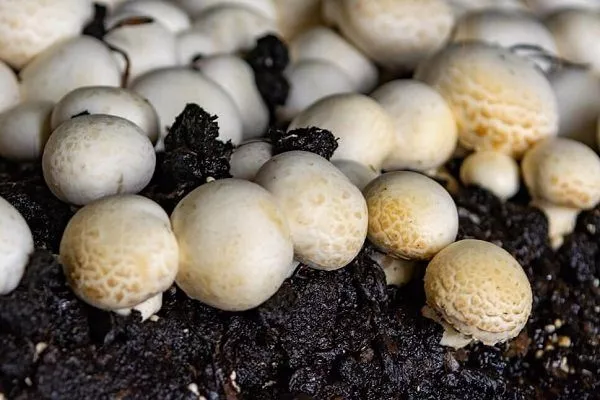
Like any champignon, the yellow-skinned variety can also be grown at home. Some farmers successfully do this, having previously entered into contracts with pharmaceutical companies for product distribution.
But there are other reasons for breeding false roaches:
- contribute to the improvement of the absorption of nutrients by trees, as they enter into symbiosis with them;
- cleaning the soil from man-made waste;
- absorption of radio emissions, pesticides;
- acceleration of growth of agricultural crops;
- increasing yields in the garden.
When planting outdoors, it's advisable to fertilize it with manure, as mushrooms don't grow in poor soil. In other situations, a basement is used. It should have concrete walls, ceilings, and a floor. A ventilation system is a must.
- ✓ Humidity control at 90-95% is critical for mycelial development.
- ✓ The temperature regime must be strictly observed: +22°C for incubation, +16°C for forcing mushrooms.
The space in the basement is zoned into 2 parts:
- for the incubation period, that is, the cultivation of mycelium, the temperature regime is + 22°C;
- for forcing mushrooms - temperature about + 16°С.
To obtain spores, simply head to the forest, collect a few false mushrooms, and place them in a nutrient medium. There are several options:
- Add 400 g of carrot extract and 15 g of agar-agar to 600 ml of water, boil for 25–30 minutes, strain;
- In 1 liter of water, mix 7 teaspoons of agar-agar, 1.5 tablespoons of oat flour, bring to a boil, mix thoroughly, strain.
Next, proceed as follows:
- Treat your hands and tweezers with antiseptic, sterilize glass jars and lids.
- Break the mushroom open and pinch off some of the biomaterial.
- Place the piece in a jar with nutrient medium and close the lid.
- Leave until mycelium (white threads) forms. This takes 10 to 15 days.
Now prepare the growing substrate. It consists of the following components:
- manure (preferably horse) - 200 kg;
- straw - 5 kg;
- urea - 0.5 kg;
- chalk - 0.75 kg;
- plaster or alabaster - 1.8 kg;
- Fertilizers - Superphosphate (0.5 kg), ammonium sulfate (0.8 kg).
Cooking instructions:
- Soak the straw in warm water and leave for 24 hours.
- Mix it with manure, adding warm water. Leave it for 96 hours.
- Add urea and fertilizer. Leave for 72 hours.
- Connect with plaster.
- Place the prepared and thoroughly mixed mixture on the floor covered with plastic film.
- Leave for 96 hours.
- Make grooves in a checkerboard pattern, spaced 20–25 cm apart and 2–3 cm deep.
Place the mycelium in the grooves. Ensure the humidity level is at least 90–95%.
Contraindications and signs of poisoning, first aid
The yellow-skinned button mushroom is contraindicated for consumption by absolutely everyone (the mushroom is considered highly toxic). It should not be eaten raw or cooked. Ingestion of the mushroom can cause intoxication. This can manifest itself with the following symptoms:
- nausea and vomiting;
- pain in the abdominal area;
- increased sweating;
- dizziness;
- diarrhea;
- fainting state.
The poisoning type falls into Group 1, as the irritating effect on the digestive system manifests itself 15 (maximum 20) minutes after ingestion. The toxin is eliminated within 3-4 days. The poisoning is not fatal.
The first thing to do in case of poisoning is to call an ambulance. While waiting for a doctor, you can alleviate the condition yourself:
- drink clean still water (1.5–2 l) or a soda solution (1 teaspoon per 200 ml of water), which will cause vomiting;
- To induce a gag reflex, press your finger on the root of the tongue;
- take any enterosorbent - Enterosgel, activated carbon, Polysorb;
- take a lying position;
- Place a heating pad on your legs and stomach.
Mushroom picking is impossible without checking them for edibility. It's important to remember that the yellow-skinned button mushroom is indistinguishable from its edible relative by appearance. It's important to learn the identification rules and use them in the forest to avoid mixing good mushrooms with poisonous ones in the same basket.