
The poisonous champignon is very similar to the edible members of this family, so inexperienced mushroom pickers run the risk of poisoning. To avoid this, you don't need to thoroughly study all the intricacies of each mushroom species; it's enough to know the characteristics of false lookalikes.
What is a false champignon?
This term refers to poisonous and inedible mushrooms that belong to the champignon family and are very similar to their edible relatives in appearance.
Consuming conditionally inedible lookalikes can lead to simple poisoning, while preparing poisonous ones can even result in death.
Description of the poisonous double
It's most difficult to distinguish a false lookalike from a genuine champignon during the early stages of growth—at this time, they are most similar. Regardless, there are some indicators that mushroom pickers and farmers should use as a guide.
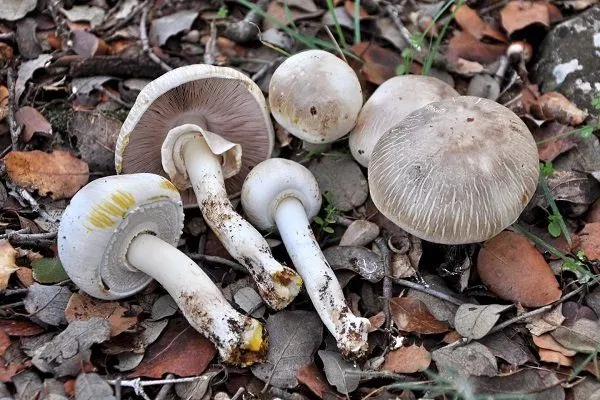
General characteristics of poisonous look-alikes that are absent or present in their edible relatives:
- Hat. The false champignon's color can vary depending on the species. However, if it was grown in a well-lit area, the predominant shade will be gray; if in a dark area, it will be orange or beige.
Almost all varieties of poisonous mushrooms have a small spot in the center of the cap – mostly brown in color. - Spore-bearing layer. Located under the cap, the gills change as the mushroom develops. False button mushrooms have light-colored gills when they first grow, and become almost black when mature. True button mushrooms typically have creamy or brown gills.
- Mushroom stem. Always located in the central part of the cap, it always has one or two rings and a tuberous swelling at the base.
- Surface. Poisonous ones are usually smooth, while edible ones are silky or slightly rough.
- Fruiting period. False champignons appear no earlier than the first days of July.
- Smell. An unpleasant aroma is always present—chemical, inky, phenolic, iodine-like, or carbolic. Normal mushrooms either have no aroma or a distinctly mushroomy one. Sometimes there are hints of almond, anise, nut, etc.
But there are exceptions, where the flesh of normal mushrooms also turns yellow. The difference here is that this happens within a few minutes, while in toxic specimens the color change is immediate.
Belonging and family characteristics
All champignons belong to the family of the same name, the genus Agaricaceae, or lamellar mushrooms. There are over 200 varieties, including poisonous ones (the latter are much fewer).
Champignons are divided into 3 groups:
- certainly edible - they are usually eaten in various forms, even raw;
- conditionally edible - can be cooked and eaten, but heat treatment must be as long as possible and at a high temperature (when boiling, frying);
- poisonous - deadly, the consumption of which causes severe intoxication with the resulting fatal consequences.
Prevalence
Like true champignons, false champignons grow almost everywhere and prefer similar locations. These are:
- deciduous or mixed forest;
- spruce and pine forest;
- forest edge and clearing;
- fertile lands in garden plots;
- steppes and deserts;
- dung heaps, etc.
But there is one peculiarity: doubles do not really like sunlight, so it is very rare to find them in well-lit areas.
Virulence
All mushrooms are toxic, but to a greater or lesser degree. False look-alikes have significantly higher levels of toxicity. This occurs for two reasons:
- toxins are inherently embedded in them by nature;
- Additionally, poisonous species absorb toxic substances from the environment – water, soil, air, etc.
They primarily contain toxoids, which, after penetrating the gastrointestinal tract, block the synthesis (production) of deoxyribonucleic acid. This neutralizes the protective barrier for the body's cells, resulting in their death.
Toxic substances cause protein breakdown, which has negative effects on the liver, heart, kidneys and other internal organs, resulting in death.
Types of false champignons and what they look like
There are a huge number of poisonous champignons worldwide, but in Russia and the CIS countries, several species are most commonly found, each with its own distinctive features that make them easily distinguishable from their edible counterparts.
| Name | Toxicity | Cap color | Smell |
|---|---|---|---|
| Reddish champignon | High | Yellowish with brown | Ink, phenolic |
| Variegated champignon | Conditionally edible | Smoky gray | Carbolic acid |
| Californian champignon | Extremely poisonous | Brown with a metallic sheen | Phenolic |
| Flat-headed champignon | The most dangerous | Whitish with gray scales | Ink, creosote, phenol |
Reddish champignon
The yellow-skinned agaricus is also known as Agaricus xanthoermusd. This is the most common and dangerous species. It grows in huge groups, like a "fairy circle." It prefers mixed and deciduous forests, as it hides in dense vegetation.
It is very similar to edible champignons, but has different characteristics:
- Hat. Diameter: 5-15 cm, bell-shaped when young, rounded and spreading when mature. Color: yellowish with brownish flecks.
- Skin. It never gets wet. Its edges become cracked at the end of the growing season.
- Leg. The height ranges from 6 to 15 cm, with a diameter of 1.5 to 3 cm. The shape is regular and straight, with a slight thickening at the base. The rings are single but double-layered, the interior is hollow, and the color is white.
- Pulp. Starting at the top of the cap, it is light brown, but as it moves down toward the base of the stem, it lightens and turns yellow. The swelling area is orange.
- Spore-bearing layer. The hymenophore is distinguished by whitish or pink, finely textured gills early in the mushroom's development. As the mushroom matures, they turn dark brown and may become covered with a grayish bloom. The spore powder is chocolate-colored.
- SmellRaw mushrooms have almost no distinctive aroma, but if you sniff them, you can detect hints of ink or phenol (a medicinal smell). This aroma intensifies significantly during cooking.
Variegated champignon
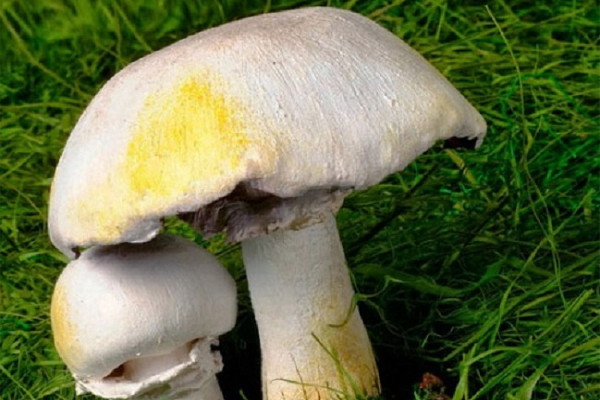
It has many names—scaly, flat-capped, and carbolic. It prefers to grow in steppes and forest-steppes, but is also found in other areas. It belongs to the conditionally edible variety of champignon, so folk healers even recommend its consumption. However, official medicine discourages this practice.
Characteristic features:
- Hat. It has a smoky gray hue throughout, but the edges are usually much lighter. When young, it is dome-shaped, but in the later stages of growth, it becomes open and develops a tubercle. The diameter ranges from 8 to 15 cm.
- Skin. Unlike its false relatives, it is covered with very small scales, which suggests that it is an edible mushroom.
- Leg. Initially, it is light-colored, but as it ripens, it turns yellow and then dark brown. Height ranges from 6 to 11 cm, diameter from 1 to 1.5 cm. The tuberous swelling is significant – about 2.5 cm.
- Pulp. It is distinguished by its snow-white cap and yellowish stem.
- Spore-bearing layer. At first, the gills are quite light and pinkish in color, later turning brown. They are densely but loosely spaced. The spore powder is chocolate brown.
- Smell. Both raw and boiled it resembles carbolic acid.
Californian champignon
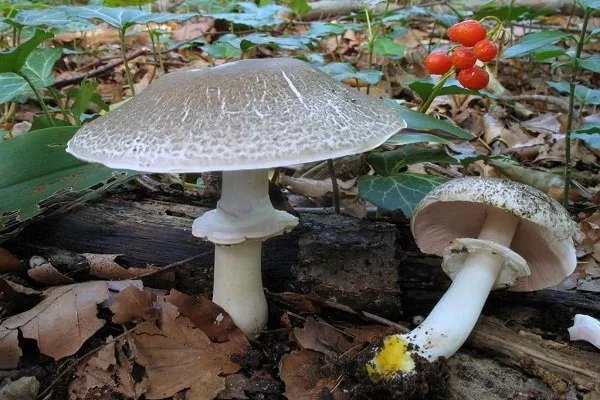
It's considered extremely poisonous and can be fatal. It grows everywhere, being undemanding of conditions. It can come in a wide variety of sizes.
Characteristic:
- Hat. At the beginning of the growing season, it is light in color, but by the end, it is brown with a darkened area in the center. A metallic sheen is visible upon close inspection. When young, the shape is rounded, with the edges very inwardly curled. In old age, it becomes spreading.
- Skin. Too dry and bare, but there are specimens with small scales that are difficult to see with the naked eye.
- Leg. Always glabrous, meaning it lacks a scaly covering. It is often curved, but most resembles a smooth cylinder. It has a single ring. The color is light.
- Pulp. Light color, dense structure.
- Spore-bearing layer. Before the spathe ruptures, the perfectly smooth plates are pure white, then acquire a pinkish tint, and at the very end of the growing season, they turn chocolate brown. The spore powder is dark chocolate in color.
- Smell. Exclusively phenolic.
Flat-headed champignon
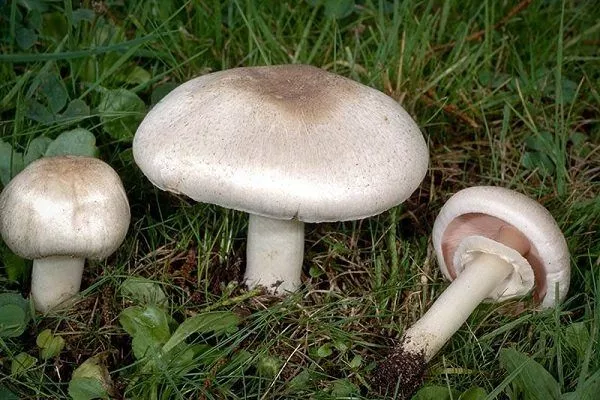
Considered the most dangerous poisonous mushroom, it turns intensely yellow when broken and then brown within minutes. It grows most often in deciduous forests and areas with dense grass.
How to recognize – signs:
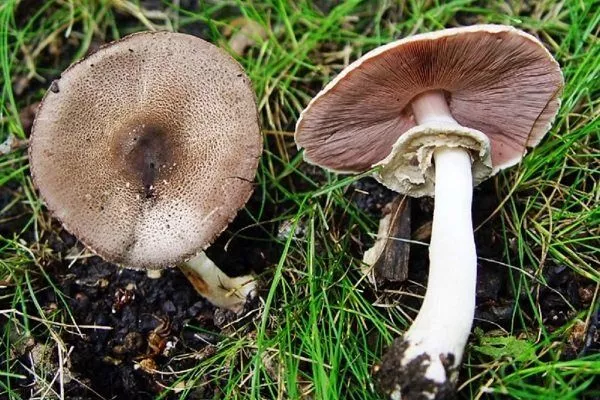
- Hat. The shape is conical in young specimens, while in adults it is wide and convex with folded edges and a flattened core. The diameter varies from 2.5 to 7.5 cm. The color is whitish, but with barely noticeable gray or smoky-brown scales. The central part is always gray-brown.
- Skin. Dry and smooth.
- Leg. Height from 3.5 to 10 cm, thickness from 0.6 to 1.3 cm. Cylindrical shape with a pronounced club-shaped thickening, often curved. The ring is membranous, light in color, but with brownish inclusions. A distinctive feature is that it cannot be torn from the edges of the cap for a very long time.
- Pulp. Snow-white hue and dense structure.
- Spore-bearing layer. The gills are frequent and loose. Initially light, they later turn dark chocolate. The spore powder is dark brown, almost black.
- Smell. Very sharp, reminiscent of ink, creosote or phenol.
Symptoms of poisoning and first aid
Initial symptoms of poisoning from false button mushrooms appear within 2-2.5 hours. They consist of two main symptoms: nausea, vomiting, and bowel upset. These symptoms are followed by:
- colic in the stomach and spastic pain;
- increase in body temperature.
After diarrhea, a person's condition may improve for 20-48 hours, but during this period, significant damage to the liver and kidneys occurs, resulting in organ failure. The intoxication then spreads throughout the body.
To prevent such complications, follow the first aid rules:
- call an ambulance;
- drink 1.5-2 liters of a light pink solution of potassium permanganate (or, in extreme cases, clean still water);
- induce vomiting;
- take an absorbent, for example, activated carbon (1 tablet per 10 kg of weight, but no more than 10 pieces);
- Place a warm heating pad on your stomach and feet to prevent blood circulation from slowing down;
- At the end, drink 200 ml of strongly brewed black tea.
If the poisoning is severe or first aid is inadequate, the doctor will prescribe a course of detoxification therapy. Treatment consists of the following:
- enema;
- oral gastric lavage;
- hemodialysis.
Restoring the patient's water and electrolyte balance is essential, especially during vomiting and diarrhea, to prevent the risk of dehydration. An IV is administered for this purpose.
Poisonous champignons are considered very dangerous, as the toxic substances cannot be neutralized even by intense heat treatment. Therefore, the only optimal solution is to carefully pick the mushrooms and be aware of all the key signs of false lookalikes.