
There are many species of champignons in the wild. All belong to the Agaricaceae family, a type of agaricaceae. Translated from French, "champignon" simply means "mushroom." In Russian latitudes, Agaricus is considered an edible product, but few people know that champignons can also be deadly poisonous.
| Name | Soil type | Fruiting period | Toxicity |
|---|---|---|---|
| Ordinary | Rich in humus | Spring-autumn | Edible |
| Yellow-skinned | Deciduous forests, gardens | July-October | Poisonous |
| Field | Pastures, meadows | May-November | Edible |
| Forest | Coniferous and deciduous forests | Summer-autumn | Edible |
| Garden | Vegetable gardens, orchards | Spring-autumn | Edible |
| Californian | Various | Summer-autumn | Poisonous |
| Fine-scaled | Deciduous and coniferous forests | Summer-autumn | Edible |
| Long-rooted | Parks, gardens | Summer-autumn | Edible |
| Crooked | Coniferous forests | Summer-autumn | Edible |
| Augustovsky | Deciduous and coniferous forests | August-October | Edible |
| Elegant | Mixed and deciduous forests | Summer-autumn | Edible |
| Large-spore | Meadows | Summer-autumn | Edible |
| Motley | Steppes and forest-steppes | Summer-autumn | Poisonous |
| Dark fibrous | Broadleaf forests | August-October | Edible |
| Möller's champignon | Parks, forests | August-October | Inedible |
| Tabular | Semi-deserts, deserts | Summer-autumn | Poisonous |
| Two-spore | Gardens, vegetable gardens | Summer-autumn | Edible |
| Porphyry | Deciduous forests | Summer-autumn | Edible |
| Pereleskovy | Deciduous and coniferous forests | Summer-autumn | Edible |
| Dark red | Deciduous forests | Summer-autumn | Edible |
| Steam | Various | Summer-autumn | Edible |
| Flat-capped | Deciduous and mixed forests | Summer-autumn | Poisonous |
| Double-ring | Broadleaf forests | May-December | Edible |
| Bernard's champignon | Steppes | Summer-autumn | Edible |
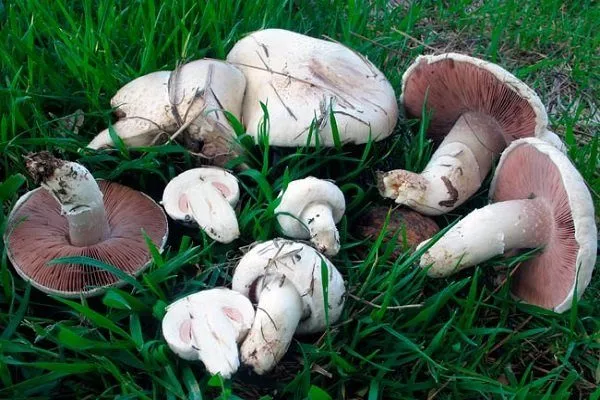
Ordinary
A completely edible and the most common mushroom, commonly known as the pecheritsa. Its distinctive feature is that it doesn't secrete juice, prefers humus-rich soil, and most often grows near livestock farms or in private backyards.
Characteristic:
- the color of the leg is whitish;
- the shade of the cap ranges from white to gray;
- the color of the plates is initially light, then dark brown and even black;
- size from 9 to 15 cm;
- pleasant mushroom smell;
- the shape of the cap at a young age is convex semicircular;
- The cap shape at maturity is flattened.
The true champignon (another name) bears fruit from early spring to late fall and has a fairly dense flesh structure in the stem and cap. When broken, the mushroom turns light pink at the break.
Yellow-skinned
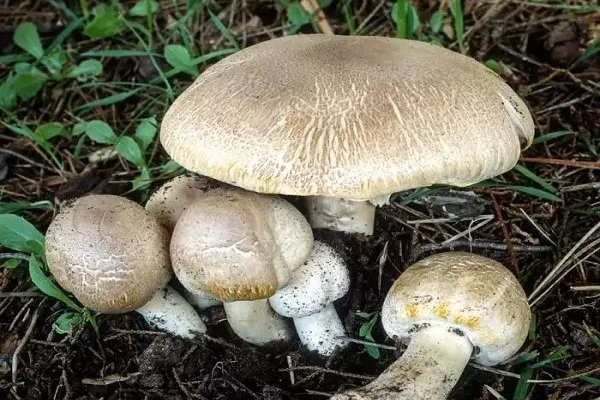
This mushroom is a poisonous variety of champignon. Its primary fruiting period is from July to early October. It can be accidentally harvested in mixed deciduous forests, gardens, parks—in other words, anywhere there's plenty of grass.
Characteristic:
- the color of the leg is light;
- the cap is yellow with a brown spot in the center;
- the color of the plates is initially white-pink, then brown-gray;
- size from 6 to 15 cm in length;
- the smell is phenolic and gouache-like, intensifying during heat treatment;
- the shape of the cap at a young age is round;
- The cap shape at maturity is bell-shaped and very large (up to 15 cm in diameter).
Unlike normal champignons, yellow-skinned The stem is hollow and has a thickened, two-layered ring. The flesh has a brownish tint.
Field
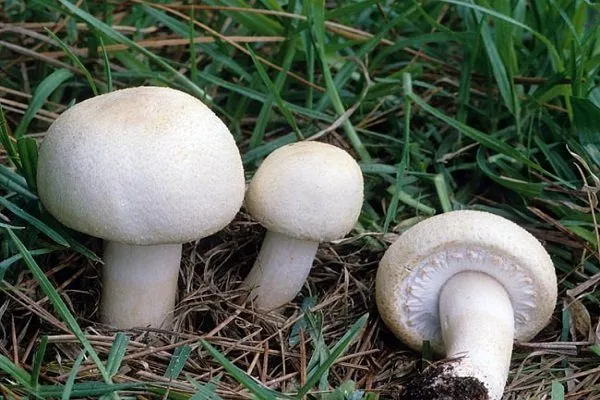
An edible and delicious mushroom that bears fruit from late May to early November. Its favorite growing area is near stables, which is why it's known in England. field mushroom It is called horse grass. It is sometimes found in meadows and clearings, but more often in pastures.
Characteristic:
- the color of the leg is white;
- the shade of the cap is light;
- size from 5 to 12 cm;
- the smell is sweetish, pleasant;
- the shape of the cap when young is bell-shaped with curved edges;
- The cap shape is spreading at maturity and drooping at the end of the growing season.
The stem is fairly dense, but with age it becomes hollow and highly fibrous. The ring, like that of poisonous champignons, is two-layered.
This champignon is sometimes confused with its poisonous relatives, as the white flesh turns yellowish when cut. However, there is one difference: the yellow-skinned mushroom's color changes instantly, while the field mushroom's takes 2–3 minutes.
Forest
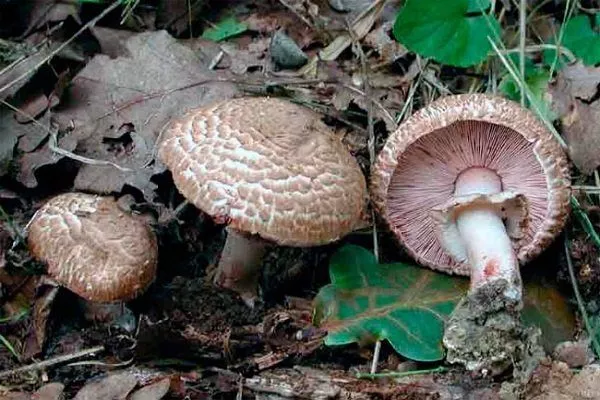
A common species of champignon mushroom, also known by three other names: cap mushroom, blaguska, and wolf mushroom. It grows everywhere in various types of forests, but especially favors pine and spruce forests. It often grows directly on anthills.
Characteristic:
- the color of the leg is dirty gray;
- the shade of the cap is light gray at first, brownish-brown at the end of the growing season;
- the color of the plates is light brown;
- size from 5 to 10 cm;
- mushroom smell;
- the shape of the cap at a young age is bell-shaped and ovoid;
- The cap shape at maturity is spreading and large (up to 10–15 cm in diameter).
The stem can be perfectly straight or curved, but it always thickens toward the bottom. As it grows, it thins and becomes hollow. At the beginning of the growing season, the stem forest champignon There is 1 ring, but then it disappears.
Garden
The garden champignon is rare in the wild, preferring to grow in vegetable gardens, compost heaps, orchards, and other areas where human cultivation occurs. For this reason, this variety is considered the most sought-after in commercial cultivation.
Characteristic:
- the color of the leg is whitish or gray;
- The color of the cap depends on the variety - garden mushrooms can be brown, white and cream;
- the color of the plates is pink at first, and as they grow they acquire a brown tint;
- size from 4 to 10 cm;
- mushroom smell with a hint of sourness;
- the shape of the cap when young is round with clearly defined inward-curved edges;
- The cap shape at maturity is slightly open with a torn cover along the edges, medium in diameter (from 4 to 8 cm).
The stem's structure varies depending on the species—it can be hollow or dense. The cap's surface is uneven—glossy in the center, slightly rough but smooth at the edges. When cut, the flesh turns pink or red.
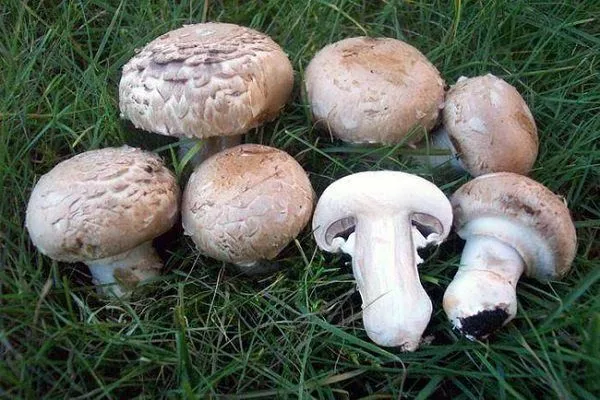
Californian
An extremely poisonous species with a very dry surface (completely bare or covered with small, multiple scales). It grows almost anywhere.
Characteristic:
- the color of the stem is light, the shape is necessarily curved;
- the cap is white or brown, often with a silvery tint and a darker center;
- the color of the plates is light brown;
- phenolic (pharmaceutical) smell;
- the shape of the cap at a young age is completely curved and round;
- The cap shape at maturity is medium-open with drooping edges.
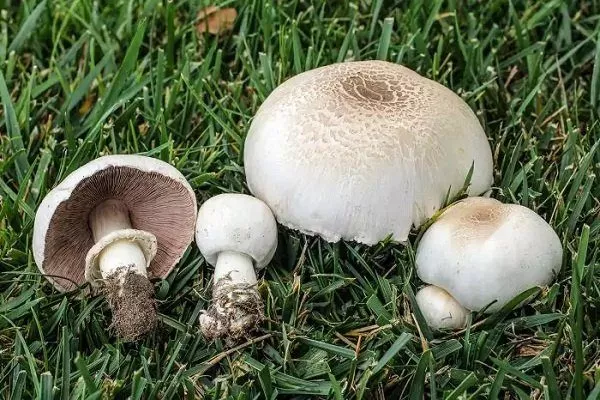
Fine-scaled
This is a rare variety of champignon. It grows in deciduous and coniferous forests (it can also be found at forest edges). It also goes by the name Benesha. The cap's surface is initially smooth, but as it matures, it cracks heavily due to the presence of microscopic scales.
Characteristic:
- the color of the stem is white, the shape is cylindrical;
- the shade of the cap is white when young, brown when old;
- the color of the plates is initially pale pink, then brown;
- size from 5 to 15 cm;
- the smell is slightly mushroomy;
- the shape of the cap at a young age is semicircular;
- The cap shape at maturity is spread out and slightly flattened.
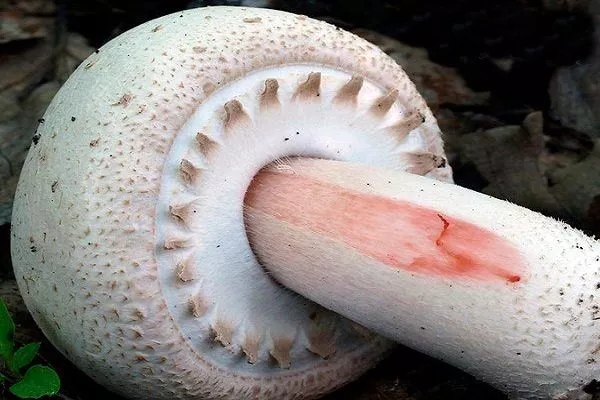
Long-rooted
Considered edible and rare, it can be harvested in parks, fields, along highways, and in gardens (especially if there are ruderal thickets). Unlike other mushrooms, it grows in small groups or singly.
Characteristic:
- the color of the leg is whitish;
- the cap is whitish or grayish-brown in color;
- the color of the plates is cream;
- size from 4 to 12 cm;
- the smell is strong with notes of walnut;
- the shape of the cap at a young age is hemispherical;
- The shape of the cap at maturity is convex-spread with a small tubercle in the center or without it (diameter - maximum 13 cm).
The flesh is usually white. If you break it, you'll notice that beneath the thin skin, it's more gray. The surface is hairy or scaly. A distinctive feature is the long root system, which turns brown when touched.
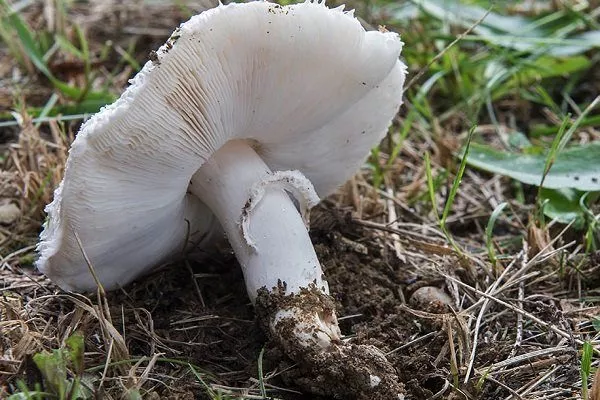
Crooked
Belongs to the nodule type of mushroom. Other names include plantain, almond, and distinctly nodule. It lives primarily in coniferous forests, especially on spruce litter. It lives solitarily, alone, or in small groups.
Characteristic:
- the shade of the cap and stem is initially snow-white, then light pink with a purple tint;
- the shape of the leg is cylindrical, expanding towards the base, where the bend occurs (after which the leg becomes hollow);
- the color of the plates is white at the beginning of the growing season, reddish-brown in the middle, and black-brown at the end;
- size from 8 to 12 cm;
- the smell is reminiscent of almonds;
- the shape of the cap at a young age is ovoid and rounded, always closed;
- The cap shape at maturity is spreading, the average diameter is from 8 to 20 cm.
The crooked button mushroom is easily confused with the death cap. After cutting, the white flesh turns yellowish (not immediately).
Augustovsky
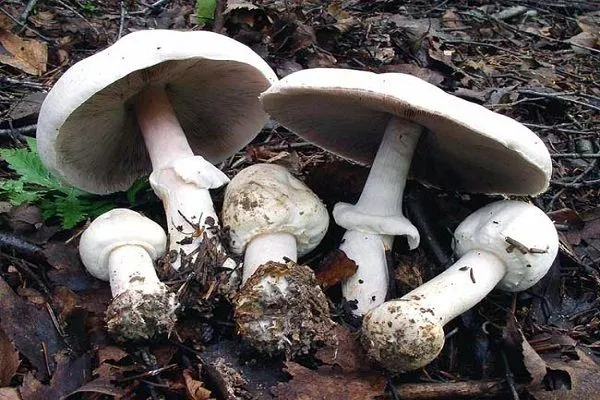
It's considered the largest champignon. It bears fruit for a short period—from August to early October (other species bear fruit from spring/summer to fall). Its favorite habitat is anthills in deciduous or coniferous forests.
Characteristic:
- the color of the stem is yellow-brown, the external structure is scaly;
- the cap is light yellow with brown scales, but the base is brownish-brown;
- the color of the plates is initially light pink, then they become brown, black;
- size from 5 to 10 cm;
- almond smell;
- the shape of the cap at a young age is hemispherical;
- The cap shape at maturity is spreading with a large hanging veil.
The pulp is August champignon Very fleshy. The stem is strong, although hollow. It has a folded ring, which is large and droops downwards.
Elegant
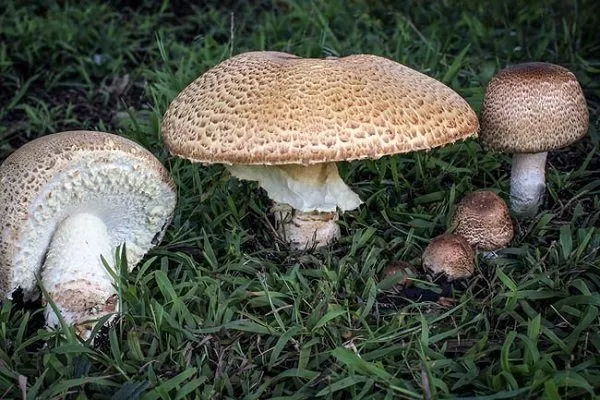
This is a small mushroom that resembles the common button mushroom in appearance. It is also known as the rose-gill. It grows in mixed and deciduous forests. It has a cap diameter of only 3–5 cm and a stem thickness of 0.2–0.5 cm, which is cylindrical.
Characteristic:
- the color of the stem and cap is whitish-yellow;
- the color of the plates is pink or cream;
- size from 3 to 5 cm;
- aniseed smell;
- the shape of the cap at a young age is bell-shaped or semicircular with a small tubercle;
- The cap shape at maturity is flattened with thin edges turned back.
Large-spore
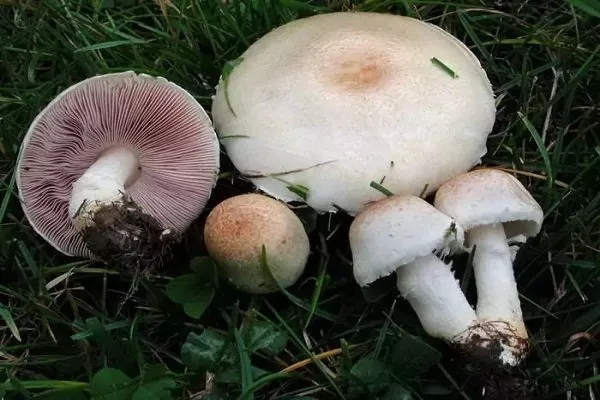
A common champignon. It grows primarily in organic soil, especially in meadows. It is distinguished by its cap, which is impressively wide compared to the stem—about 22–25 cm in diameter.
Characteristic:
- the color of the leg is dirty white or snow-white;
- the shade of the cap is white;
- the color of the plates ranges from pale pink to brown, sometimes with a grayish tint;
- size from 6 to 10 cm;
- smell - immediately after cutting it is almond-like, but turns into ammonia;
- the shape of the cap at a young age is convex;
- The cap shape at maturity is spread out with cracked scales, the edges look like velvet.
When broken, the mushroom reveals a reddish flesh. The stem is not hollow and is very dense, spindle-shaped, with a single thick ring.
Motley
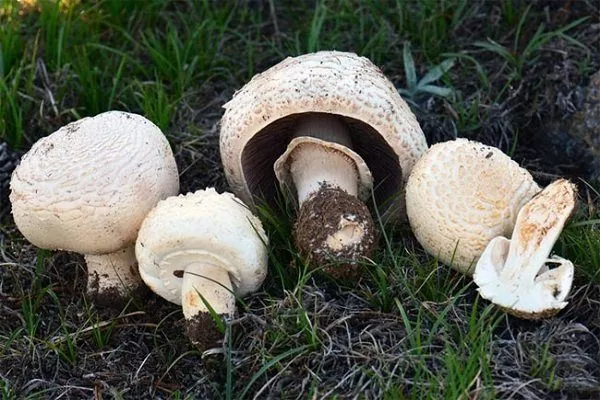
A poisonous mushroom similar in appearance to the wild champignon. Other names include the scaly, flat-cap, and carbonaceous mushroom. The latter name refers to the mushroom's distinctive odor. It grows in steppe and forest-steppe areas.
Characteristic:
- the color of the stem is initially white, then yellow and brownish;
- the cap is smoky gray, but the edges are very light;
- the color of the plates is pinkish and brown;
- size - 8-10 cm;
- the smell is reminiscent of carboxylic acid;
- the shape of the cap at a young age is dome-shaped;
- The cap shape at maturity is open with a tubercle.
The surface is covered with numerous small scales. The flesh is light-colored, but when cut, it turns brown, almost instantly. It is extremely rare in Russia; its native land is Ukraine.
Dark fibrous
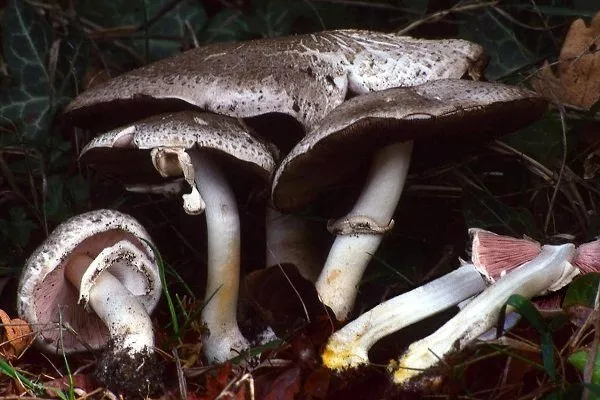
Considered a rare species of champignon, it grows in mixed and broadleaf forests. It bears fruit only between August and October. It has a smooth, hollow stem 1–1.2 cm thick. The cap is only 5–6 cm in diameter.
Characteristic:
- leg color from white to brown;
- the shade of the cap is brown;
- size from 4 to 8 cm;
- there is no smell;
- the shape of the cap at a young age is convex;
- The cap shape at maturity is flattened.
The mushroom's surface is dry and fibrous. The flesh is not fleshy and snow-white, but turns pink after cutting.
Möller's champignon
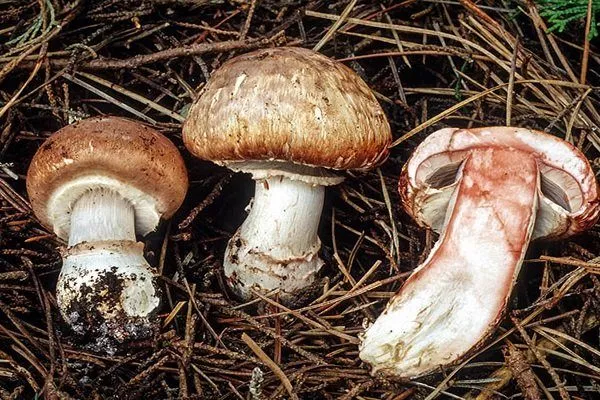
An inedible mushroom characterized by its small size—the cap ranges from 5 to 13 cm in diameter, and the stem is 1 cm thick. Fruiting season is short, from August to October. Preferred habitats include parklands and any forest with fertile soil.
Characteristic:
- the color of the leg is initially white, then yellow;
- the cap is white in color, there are scales on the surface;
- the color of the plates ranges from snow-white to brown;
- size - 5-10 cm;
- the smell is extremely unpleasant;
- the shape of the cap at a young age is round with edges strongly curved inward;
- The shape of the cap at maturity is spread out and even slightly raised upwards.
Tabular
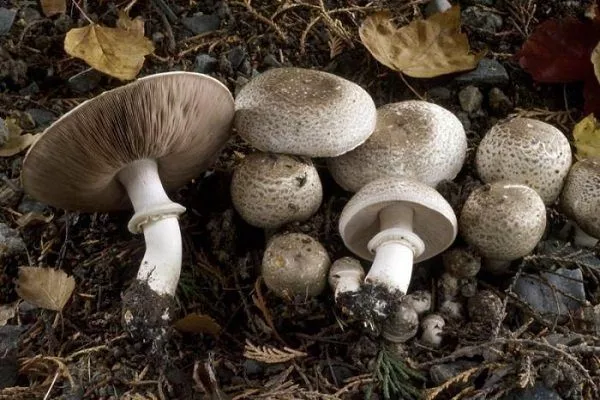
Another poisonous mushroom from the champignon family, it's rare in Russia but listed in the Red Book of Threatened Species in Ukraine. Its preferred habitat is semi-desert and desert (the Tabular Agaric can only be encountered in the southern regions).
Characteristic:
- the color of the leg is gray-white;
- the cap is whitish in color;
- the color of the plates is black-brown towards the end of the growing season;
- size up to 4 cm;
- the smell is unpleasant;
- the shape of the cap at a young age is convex;
- The cap shape at maturity is flat-convex, with a diameter of up to 10 cm.
The flesh is quite fleshy and white. When broken, it turns yellow. There is a single ring on the stem.
Features of the cap surface:
- cracked in horizontally parallel rows;
- deep pyramidal cells;
- tabular-cellular and tabular-fissured network;
- The edge is tucked in and smooth, but in maturity it becomes wavy as the veil hangs down.
Two-spore
Rarely found in the wild, it most often grows in gardens, vegetable patches, and near compost and manure heaps. It is considered edible and tasty. Other names include royal cinquefoil and brown cinquefoil.
Characteristic:
- the shade of the cap and stem ranges from light to brown, always with brown spots;
- the color of the plates ranges from gray-pink to dark brown;
- size from 3 to 8 cm;
- mushroom smell, pronounced;
- the cap shape at a young age is closed;
- The shape of the cap at maturity is hemispherical and slightly depressed, with a veil along the edges.
The cap diameter is impressive – from 5 to 33 cm. The flesh is light, but turns pink when cut.
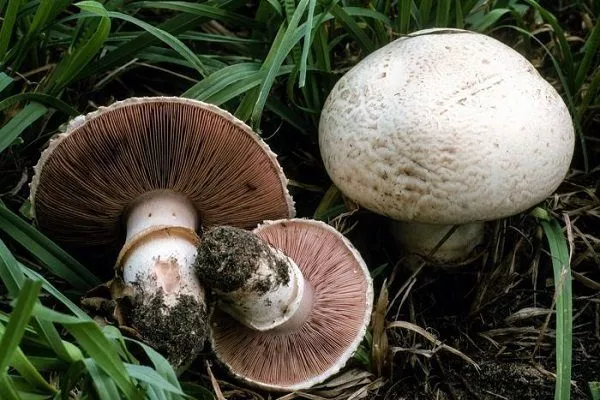
Porphyry
An edible mushroom that prefers to grow in deciduous forests. It is often found in gardens and parks. It does not tolerate crowding, growing singly or in small groups. It is rare in Russia.
Characteristic:
- the color of the leg is white;
- the cap is lilac-purple in color;
- the color of the plates ranges from gray-pink to purple-black;
- size from 4 to 7 cm;
- almond smell;
- the shape of the cap is convex.
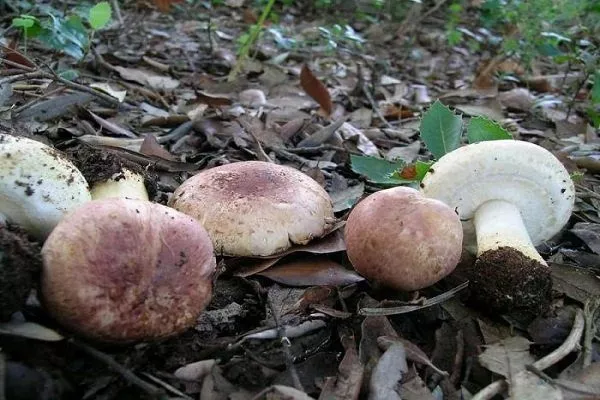
Pereleskovy
Popularly known as "thin vine," it grows in deciduous and coniferous forests with fertile soil.
Characteristic:
- the color of the leg is light;
- the cap is white or cream in color;
- the color of the plates ranges from light pink to dark brown;
- size from 8 to 12 cm;
- aniseed smell;
- the shape of the cap at a young age is ovoid;
- The shape of the cap at maturity is convex at first, flat later.
The cap's surface is slightly silky and smooth. Pressing it reveals a yellowish tint.
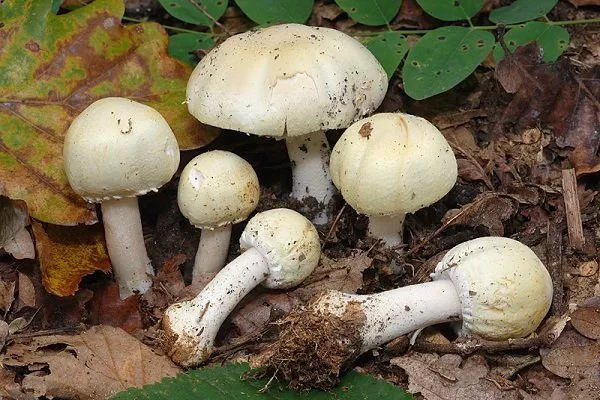
Dark red
Rarely found in Russia, it grows primarily in deciduous forests, nesting under leafy trees.
Characteristic:
- the color of the leg is dirty white;
- the cap is brownish-brown in color;
- the color of the plates ranges from light pink to brown-black;
- size from 8 to 10 cm;
- the smell is soft;
- the cap shape at a young age is bell-shaped;
- The cap shape at maturity is spreading.
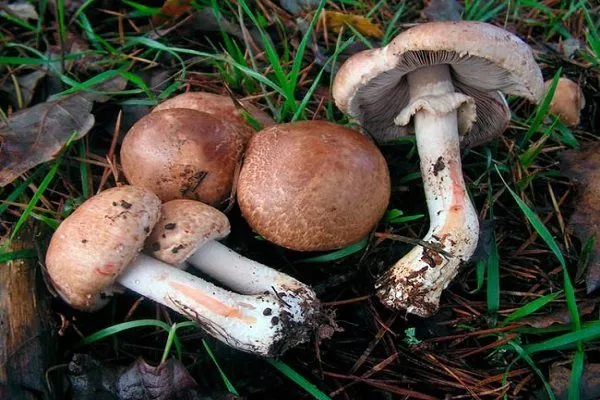
Steam
Considered a common type of champignon, it grows anywhere (as long as there are leaves or grass).
Characteristic:
- the color of the cap and stem is brownish-reddish or creamy with brown blotches;
- the color of the plates ranges from light pink to brown;
- size from 7 to 10 cm;
- the smell is reminiscent of chicory;
- the cap shape at a young age is bell-shaped;
- The cap shape at maturity is flat.
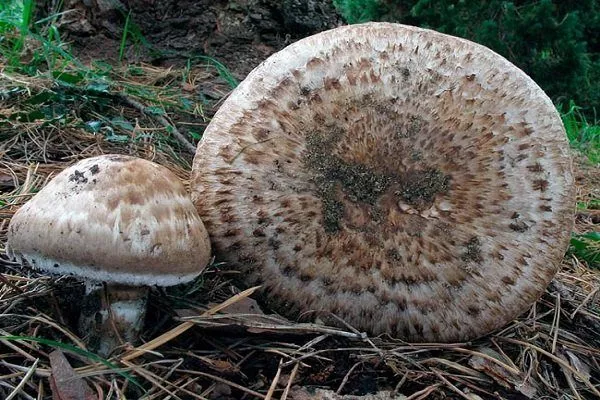
Flat-capped
The most poisonous champignon. It grows in deciduous and mixed forests. When cut, the mushroom turns yellow, and after a few minutes, it turns brown.
Characteristic:
- the color of the leg is light;
- the cap is white with brownish scales;
- the plates are colored pink, white and chocolate;
- size from 6 to 9 cm;
- chemical-pharmaceutical smell (ink, phenol, iodine);
- the shape of the cap at a young age is conical;
- The cap shape at maturity is convex-wide with curled edges.
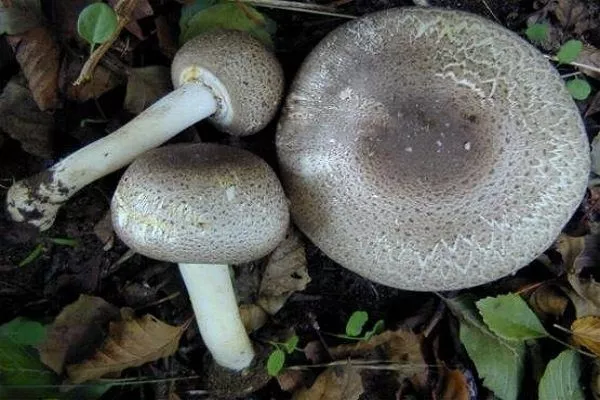
Double-ring
Other names include urban rhododendron and sidewalk rhododendron. It grows in broadleaf forests. In the city, it can be found along sidewalks, near trash bins, in vegetable gardens, etc. It is considered the easiest to grow and is cultivated everywhere.
Characteristic:
- the shade of the cap and stem ranges from white to brown and brown;
- the color of the plates ranges from dirty pink to brownish-brown;
- size from 3 to 7 cm;
- the smell is distinctly mushroomy;
- the shape of the cap at a young age is flattened-spherical with curved edges;
- The cap shape at maturity is spread out, the central part is depressed.
When cut, the white flesh turns a delicate pink. This is the longest-growing species—it can be harvested from May until November-December (when the first frosts appear).
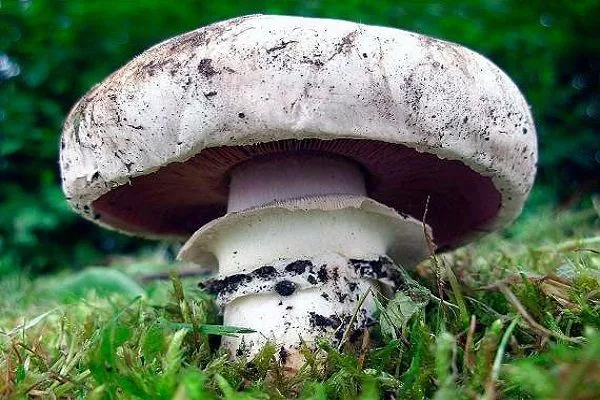
Bernard's champignon
Another name for this variety is the Steppe champignon. Its distinguishing feature is its ability to grow outside of forests and grass (even on densely crusted soil). It tolerates saline soils well. It is often confused with the common champignon.
Characteristic:
- the shade of the cap and stem ranges from white to pinkish-white or brownish;
- the color of the plates ranges from pink to dark brown;
- size from 4 to 9 cm;
- the smell is standard mushroom;
- the cap shape at a young age is closed;
- The cap shape at maturity is convex-spread.
The stem is distinguished by the presence of an unstable double ring. When cut, the white flesh turns pink.
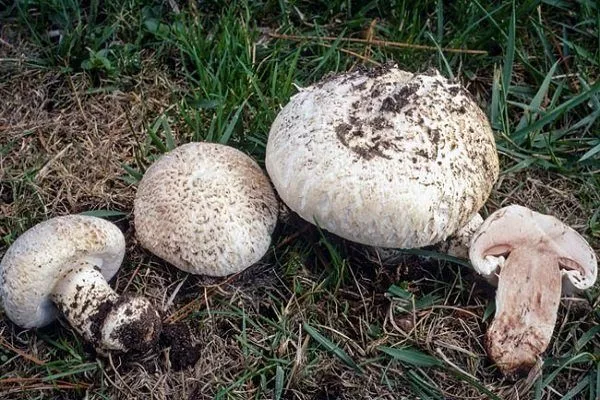
- ✓ The presence of a change in the color of the pulp when cut (pink, red, yellow) may indicate edibility, but requires further verification.
- ✓ Mushroom odor: A phenolic, chemical, or unpleasant odor is characteristic of poisonous species.
- ✓ Colour of the plates: young edible champignons have pink plates that darken to brown with age; poisonous ones may have white plates or plates that darken quickly.
Mushroom varieties are very common in forests, meadows, and gardens in temperate and southern latitudes of Russia. Hobby mushroom pickers should learn about the external characteristics of wild Agaricaceae mushrooms. This will help them avoid overlooking an edible mushroom and buying a poisonous one.