
The field mushroom is commonly known as the common or sidewalk mushroom. In Latin, it has several names: Psalliota campestris, Psalliota arvensis, Fungus arvensis, and Pratella arvensis. Translated from English, it's called the horse mushroom. This is due to the mushroom's soil preferences. It prefers soil rich in organic matter.
Description
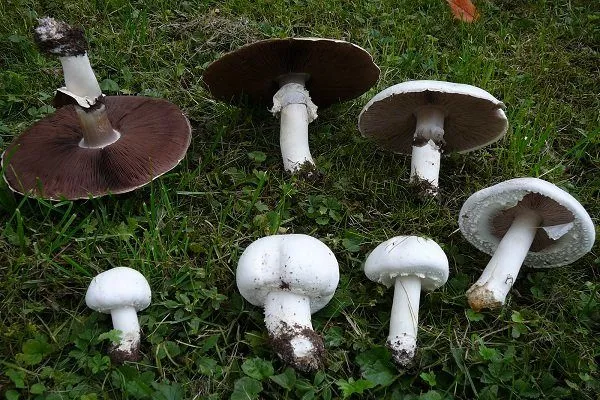
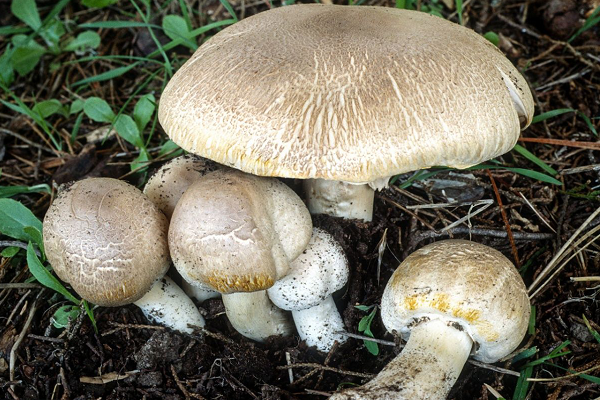
Unlike their relatives, field button mushrooms are considered large. Their caps reach up to 20 cm in diameter, with some specimens being smaller—5 cm and smaller. Size depends on growing conditions. What they look like:
Recognizing a mushroom isn't difficult if you know its distinctive features. The cap's shape changes over time:
- at the beginning of the growing season - round, bell-shaped with edges turned inward and a completely hidden hymenophore;
- in middle age it is half-open;
- At the adult stage it acquires a prostrate-convex state with a tubercle in the center (the edges are wavy or smooth).
The cap's color is initially whitish-cream. It later turns ochre, as tiny scales with a brown or tan tint appear on the surface.
Other distinguishing features:
- Ring. When fully ripe, it hangs down. It has a two-layer structure, with the upper ring longer than the lower. The edges are often jagged or wavy.
- Pulp. At first very firm, it loses its elasticity and softens over time. It's white in color. However, if you break the mushroom or press on it, the flesh turns yellow after 5-10 minutes (this is a reaction to oxygen).
- Records. Planted closely together, they are distinguished by their slight swelling. Width ranges from 8 to 12 mm. When young, they are white with a grayish tint, later turning light pink, mustard, brown, and even black.
- Leg. It ranges from 6 to 10 cm in length and is cylindrical in shape. It has a thickening at the base, where a flake-like coating is visible. Like the cap, the stem turns yellow when mechanically touched.
The field champignon has a sweet flavor. Its aroma is mushroom-like, with hints of almond or anise (more pronounced in young mushrooms).
Spreading
The field mushroom adapts to all climates and is found in all regions of Russia. Unlike other species, it dislikes being near trees, with the exception of spruce and pine.
Favorite locations (easiest to find):
- forest glades and meadows, that is, places with a large accumulation of herbaceous plants;
- roadsides;
- areas with cleared forests;
- parks, alleys and gardens;
- pastures;
- near the nettle thickets.
The mushroom grows in different ways - alone, in groups, forming ruts or arcs.
Collection period and rules
The field mushroom harvest season is long, starting in May and ending in November. The exact time depends on the climate (the warmer the weather, the earlier). Experienced mushroom pickers prefer to pick mushrooms when they're fully ripe, not overripe.
Determining the optimal growth stage is easy: the film covering is not yet fully open, but is stretched as tight as possible. The cap diameter is approximately 10 cm. At this stage, field mushrooms have:
- strong aroma;
- pronounced taste;
- fleshy pulp.
How to assemble correctly:
- do not pick or collect wilted/damaged mushrooms;
- do not pull them out of the soil roughly, otherwise the mycelium will die;
- cut with a sharp knife (ideally, twist it out holding it by the stem);
- fill the holes with soil, which will help the new crop grow faster;
- Place the collected specimens with the caps facing up (preferably in a wicker container (basket, basket)), which will allow air to penetrate between the mushrooms.
Similar species
The field mushroom has many varieties, some of which are edible. "Relatives" are similar in many ways, but have different sizes, colors, and so on. It's important to know about them, as some are poisonous.
Edible
| Name | Hat size (cm) | Cap color | Aroma |
|---|---|---|---|
| Meadow | 5-10 | White with a pink tint | Mushroom with hints of almond |
| Crooked | 3-7 | Cream | Mushroom |
| Pereleskovy | 3-8 | White | Anisic |
| False Valuy | 4-9 | Yellow-pink | Horseradish or radish |
There are many types of champignons that have a growing area identical to the field champignon, but the following species are most commonly found in Russia:
- Meadow. In appearance, it's indistinguishable from the wild variety. A lookalike can be recognized by breaking it open—the flesh turns pink, then red.

- Crooked. The cap is cream-colored, the flesh is white. It is almost half the size of its wild relative. The main difference is that when pressed, it produces very bright yellow spots.
- Pereleskovy. The cap is half the size, but the stem is identical in length to its field brother. The flesh is thin, turning ochre when cut. It has an aniseed scent. This characteristic often leads to confusion between the two mushrooms.
- False value. The cap is yellow-pink. The center of the dome is dark, and the edges are light. The stem has small white scales on the surface. The mushroom's smell is reminiscent of horseradish or radish.
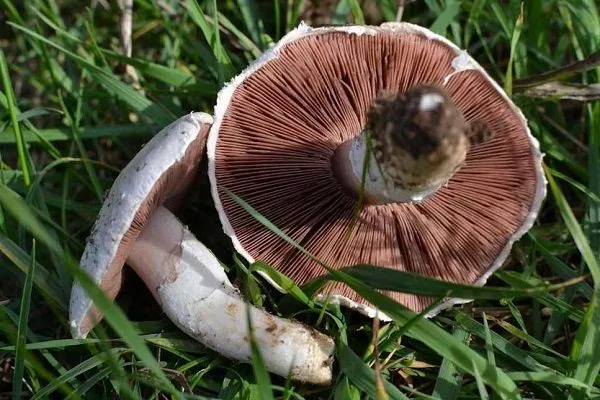
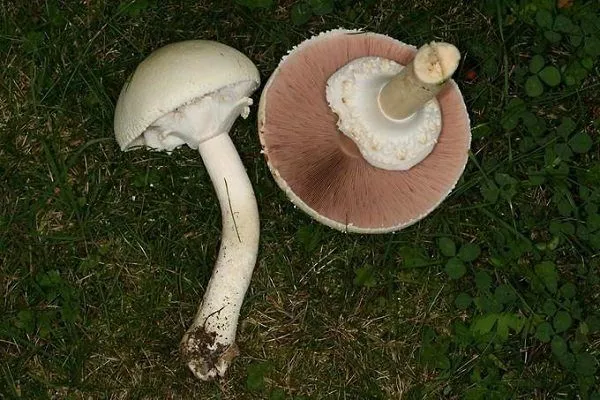
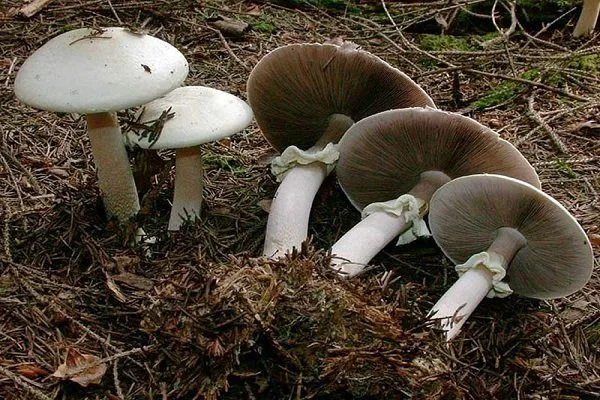
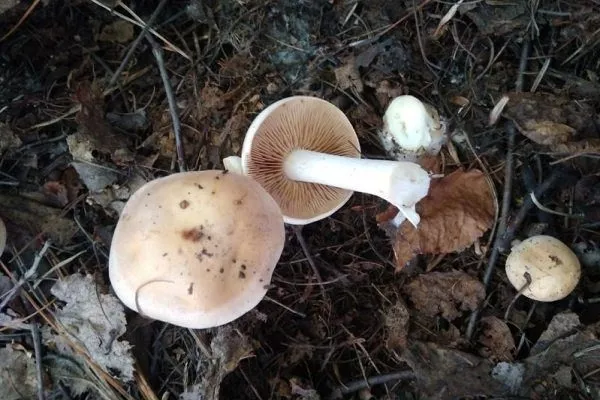
- ✓ The flesh is white and turns yellow when pressed.
- ✓ The plates change color with age from white to brown.
- ✓ The presence of a two-layer ring on the leg.
Poisonous
| Name | Toxicity | Distinguishing feature | Smell |
|---|---|---|---|
| Death cap | High | Swelling at the base of the leg | Absent |
| Red-headed | Average | Yellow, red or pink cap | Pharmacy |
Only two varieties of toxic look-alike mushrooms are found in Russia. The poisonous and edible mushrooms are identical in shape and habitat. The following characteristics distinguish these dangerous eukaryotic mushrooms from field champignons:
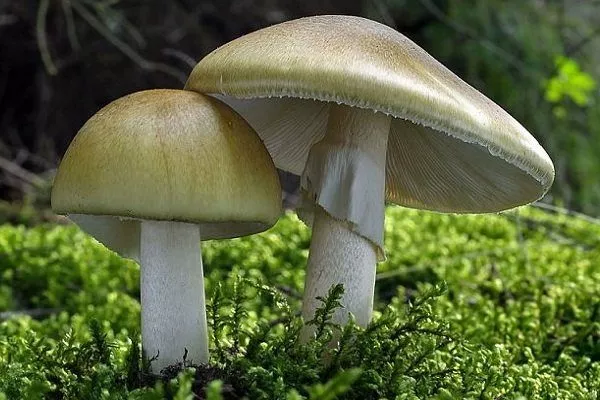
- Death cap. A highly poisonous specimen. It resembles a champignon in appearance, but has a distinct swelling at the base of the stem, covered with the remains of a veil. The ring is single-layered and located closer to the bottom.
There is no anise or nut aroma. The gills are exclusively white. They are often confused at the early stages of plant development.
- Reddish. It differs from the wild mushroom in the color of its cap. It is yellowish, reddish, or pink. The lower part of the stem has a brown swelling resembling a sac. When the fruiting body is broken, the flesh quickly turns yellow. A distinctive feature is the unpleasant odor of a pharmacy (carbolic acid).
Nutritional quality and value
The field mushroom is considered a dietary product. It contains only 27 kcal per 100 g. Nutritionists particularly note its nutritional value:
- 4.3 g protein;
- 2.6 g dietary fiber;
- 1 g fat;
- 0.1 g carbohydrates;
- 91 g of water.
The composition does not go unnoticed:
- vitamins B, A, E, C, PP, beta-carotene;
- microelements - iodine, chromium, cobalt, zinc, iron, fluorine, rubidium, molybdenum;
- macroelements - magnesium, calcium, potassium, chlorine, phosphorus, sodium;
- fatty acids.
Medicinal properties
Thanks to their rich composition, field mushrooms have medicinal properties. They are used to make medications. They are recommended for the following ailments:
- diabetes mellitus;
- obesity;
- headaches;
- problems with the kidneys, cardiovascular and nervous systems;
- tuberculosis;
- anemia;
- typhus;
- skin diseases;
- allergy;
- bronchitis.
The main properties of champignons:
- appetite suppression;
- acceleration of metabolism;
- improving visual acuity;
- normalization of unstable psyche;
- removal of cholesterol from the body;
- regeneration of damaged tissues;
- neutralization of bacteria and viruses;
- activation of the brain.
A special extract is extracted from the mushrooms. It has a beneficial effect on hair growth, strengthens hair follicles and nails, and improves the condition of facial and body skin. The extract is used to make lotions, balms, creams, serums, and other products. These products are expensive.
Harmful properties of the fungus
Based on its taxonomy, over a long growing season, mushrooms accumulate heavy metals (copper, cadmium) and other toxins, meaning substances potentially harmful to the human body. For this reason, harvesting old champignons is not recommended.
Contraindications:
- children's age - up to 5 years;
- problems with the digestive system;
- individual intolerance to mushrooms.
Storage methods
Field mushrooms are stored in various ways: frozen, dried, and canned. They are also pickled, fermented, and salted, but the most important requirement is cooking. If the fruit is harvested in ecologically clean regions, it is acceptable to eat it fresh.
Freezing
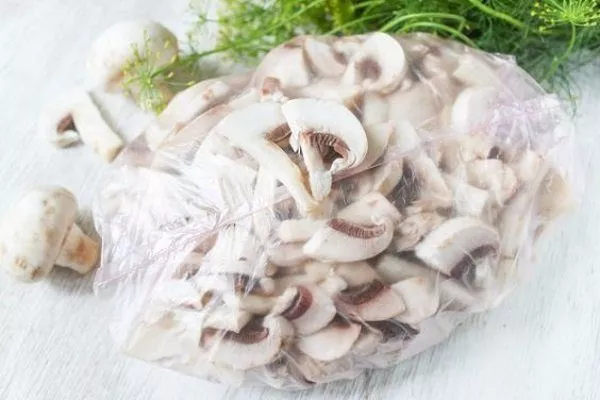
Mushrooms can be frozen either boiled or raw. If they're cooked, they're ready to eat; if they're raw, they'll need to be cooked or fried after defrosting. The shelf life when stored this way is 12 to 18 months.
Peculiarities:
- packaging - plastic container, vacuum bag, regular bag;
- The rule is that you cannot freeze the product twice, meaning that after defrosting, you should consume it immediately;
- storage method - slicing, dicing, whole;
- Mandatory pre-treatment - after boiling or washing, drying on a towel is carried out;
- An acceptable measure: it is not necessary to wash the mushrooms before freezing; it is enough to wipe them with a soft cloth and a brush (to remove dirt).
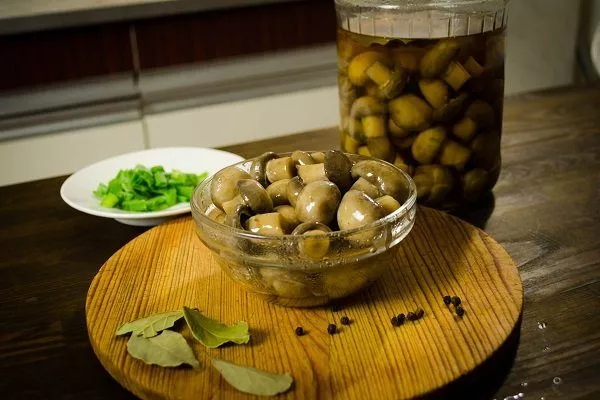
Pickling
Pickled mushrooms were considered the finest dish in Rus', so the preparation method is still used today. The champignons have a distinctive, yet pleasant, flavor.
Ingredients:
- mushrooms - 1 kg;
- salt - 75-80 g;
- sugar - 30 g.
Recipe:
- Boil the mushrooms for 10 minutes. Drain in a colander.
- Place in a saucepan, bowl, etc., add sugar and salt, mix thoroughly.
- Place a weight on top.
- Inspect the container after 24 hours—juice should have formed. If not, add a little water until all the mushrooms are covered.
Keep the basin at a temperature of at least 20°C (68°F) for 7–10 days (25–30 days is optimal). After a week, transfer the product to jars and place in a cellar, basement, or other cool place. Do not store for long periods of time. Consume within 2 weeks.
Pickling
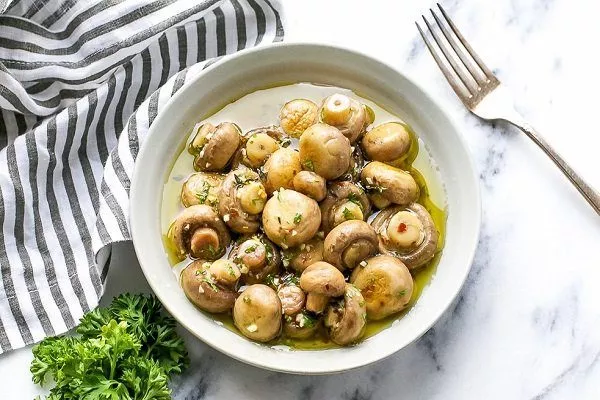
Marinated champignons are used as an appetizer. There are many recipes, but here's a quick and versatile one. You'll need the following ingredients for 1 kg of mushrooms:
- water - 250 ml;
- salt and sugar - 1 tbsp each;
- vinegar (9%) - 5 tbsp;
- garlic - 7-9 cloves;
- black peppercorns - 15-20 pcs.;
- bay leaf - 2-3 pcs.;
- vegetable oil - 2 tbsp.
Recipe:
- Place all ingredients in a saucepan.
- Place on fire.
- After boiling, simmer for 7–9 minutes.
- Place the mushrooms in sterilized glass jars, roll up, cool and put in the refrigerator.
- Use within 12 months.
Drying
Dried champignons are used in a variety of dishes. When ground into a powder, they make delicious creamy soups and sauces.
Don't wash mushrooms before drying. This will increase drying time. If the mushrooms are large, cut them into slices or cubes.
Drying methods:
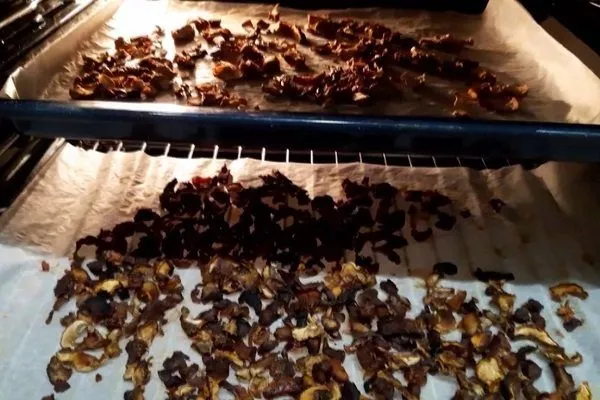
- In the oven. Spread the mushrooms in a single layer on a baking sheet. Preheat the oven to 50°C (122°F). Bake for 6–7 hours. Then increase the temperature by 30°C (86°F). Dry for another 19–20 hours. Keep the oven door slightly ajar.
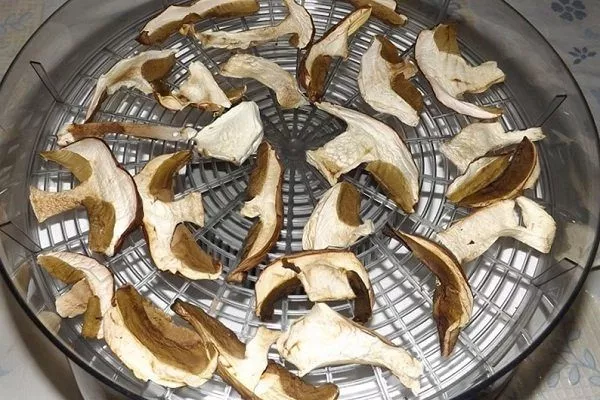
- In an electric dryer. The fastest way. Follow the instructions for your specific device.
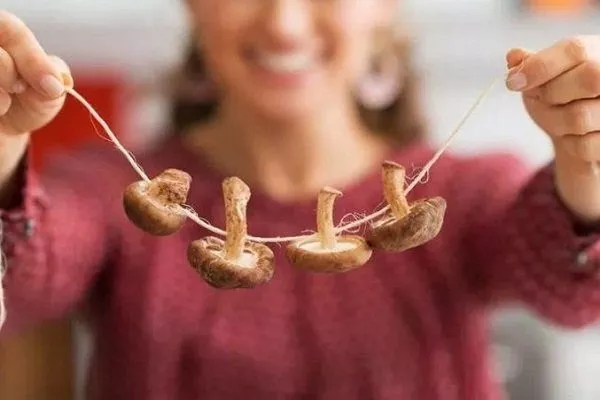
- On a thread. This is a long, natural process. Thread small mushrooms whole on a thread; chop larger ones. Hang them in a dry, ventilated area. To protect them from insects, cover them with cheesecloth. Drying takes 7 to 15 days, depending on weather conditions and their size.
Pickling
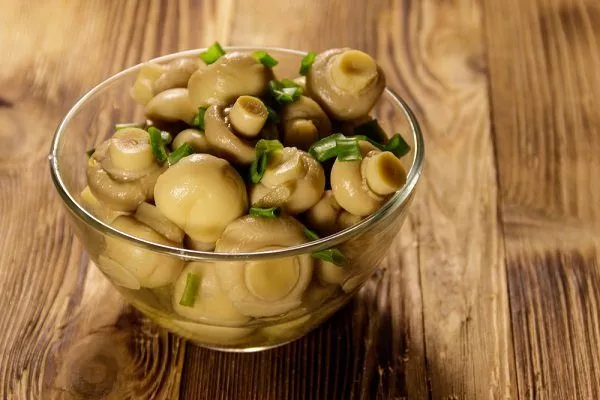
Pickled champignons are used in salads and as a standalone side dish. You will need:
- mushrooms - 1 kg;
- salt - 5 tbsp;
- sugar - 1-2 tsp;
- garlic - 8-10 cloves;
- dill umbrellas - 80-100 g.
What to do:
- Boil the mushrooms.
- Place all ingredients randomly into one container.
- Add water until it covers all ingredients.
- Cover with a lid or plate and put some weight on it.
- Keep at room temperature for 24-30 hours.
- Place in the refrigerator for 7 days.
- Place into jars and fill with the resulting brine.
- For winter use, sterilize the jars before placing them in jars. Then seal them. Store in the refrigerator for up to 2 weeks without sterilization, or up to a year in sterilized jars.
Canning
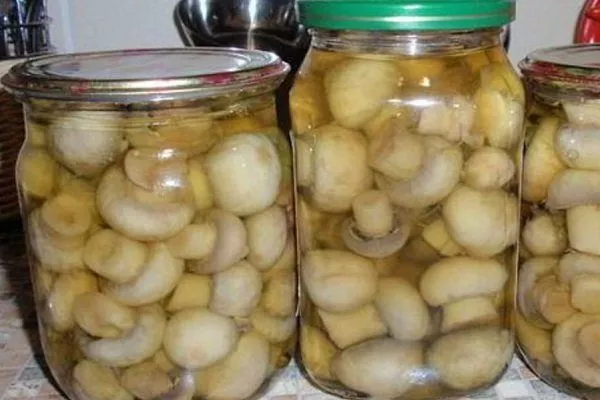
This method allows for long-term storage—up to 6–7 months. Before sealing, be sure to sterilize glass jars and lids. For 1 kg of mushrooms, use the following:
- salt - 1 tsp;
- sugar - 1 tbsp without a slide;
- water - 250 ml;
- citric acid - on the tip of a knife;
- cloves, white and allspice - 7 each;
- other spices - optional, ideally add thyme and rosemary (0.5 tsp each).
Preservation process:
- Mix water, mushrooms, salt.
- Boil until done.
- Strain. Set the mushrooms aside and place the liquid over the heat, adding all the remaining ingredients.
- Cook the brine for 5–10 minutes.
- Place the mushrooms in jars and pour boiling marinade over them.
- Roll up the lids and place them upside down under a blanket.
How to process field mushrooms?
Before storing, if drying is not planned, field mushrooms are processed. Here's what to do:
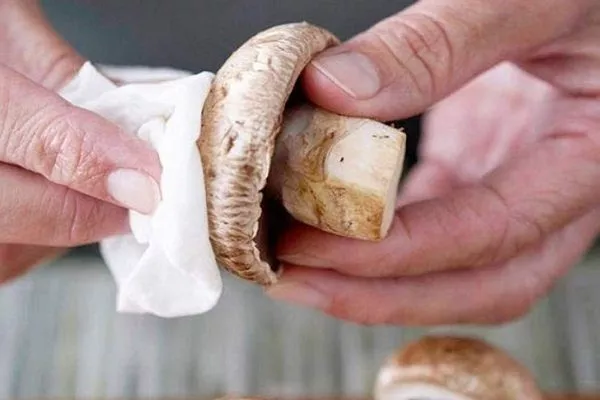
- wipe off dirt from all sides with a rag and brush;
- trim off the ends of the legs and all damaged areas;
- rinse under running water, but do not leave the mushrooms in the water (they will absorb moisture and become watery);
- Place on a paper towel in a single layer to dry.
How to cook?
Field mushrooms are easy to cook. Their delicate texture doesn't require long cooking times. Cooking methods and features:
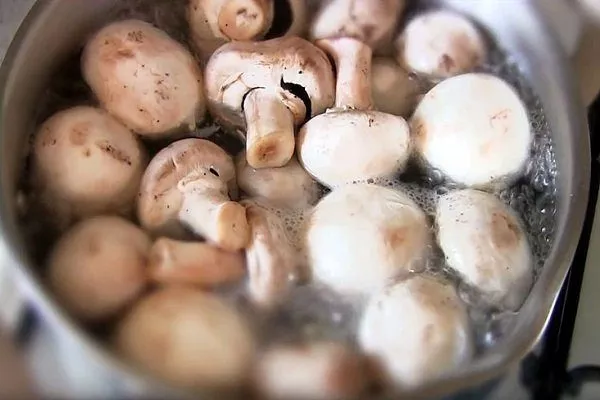
- Cooking. After initial preparation, simmer in lightly salted water for no more than 10 minutes. Once done, drain immediately in a colander to allow the water to drain completely.
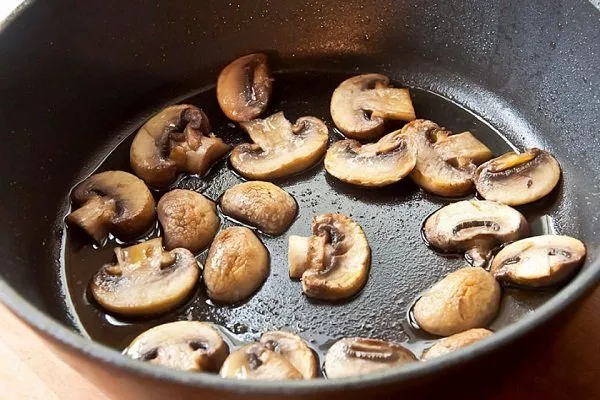
- Frying. Both boiled and raw mushrooms are suitable for frying. For the former, 5 minutes of frying is sufficient; for the latter, cook for up to 15 minutes. Note: the pan must be set on high heat.
Is it possible to grow such a champignon?
The field mushroom quickly adapts to all conditions: it is grown in garden plots, basements, bags, boxes, jars, etc. The main thing is to collect the spores.
To do this:
- Find a mushroom in the forest.
- Pinch off pieces from it.
- Place them in a nutrient medium (make a mixture of 3.5 tablespoons of agar-agar, 1.5 tablespoons of oatmeal and 1 liter of water).
How to plant in a garden bed:
- Sprinkle rotted manure or compost over the soil.
- Spread the mycelium. Don't uproot any vegetation or remove any grass.
When growing in a basement, the same steps are followed, i.e., spreading the mycelium over the soil. Just follow these guidelines:
- air humidity - 85–90%;
- temperature: during germination + 15°C, after emergence - + 20°C.
The field mushroom is a valuable product. It has excellent taste and medicinal properties. It is collected in the wild and grown at home. The key is to choose the correct species. Careful examination of its appearance and edibility will help you distinguish the field mushroom from its poisonous relatives.