
After purchasing or picking, champignons begin to spoil quickly, especially if left unrefrigerated. To ensure they can be eaten later (even over a longer period of time), various storage methods have been tried. Every homemaker can find the perfect option for their needs.
Preparatory procedures
Mushrooms are stored immediately. This rule applies to both purchased and home-picked mushrooms. The product must be prepared beforehand:
- Clean each specimen from any debris;
- trim the legs by 0.5 cm;
- carefully remove dirt from the caps;
- remove all damaged parts.
- ✓ Use only a dry cloth to clean mushrooms to avoid absorbing moisture.
- ✓ Trim the legs at a 45 degree angle to increase the moisture absorption area during subsequent storage.
Mushrooms soiled with dirt and intended for storage are not washed. This will help them stay fresh longer. Mushrooms are wiped with a clean, soft, dry cloth. Mushrooms soaked in water will quickly darken and spoil.
What are the methods for storing champignons?
There are many different ways to store mushrooms. Each method has its own subtleties. Following them will ensure the product remains in a suitable condition for cooking for a long time. Below are some popular and affordable options.
In the freezer
Freezing helps preserve mushrooms for 3–12 months. The temperature regulator should read at least -18°C. The procedure for storing fresh and processed mushrooms differs.
If it is a raw product:
- Select whole and undamaged (no cuts, dark areas, signs of rot, etc.) specimens.
- Leave whole or cut into slices.
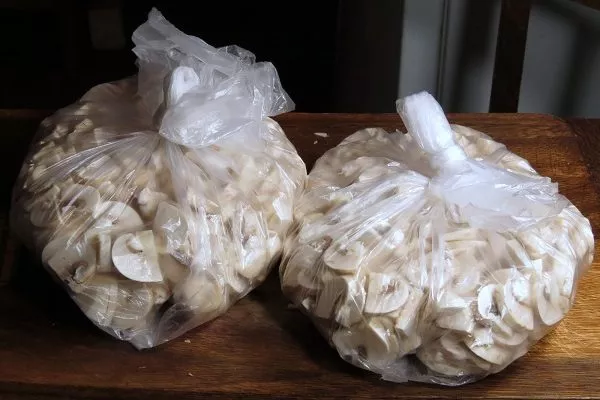
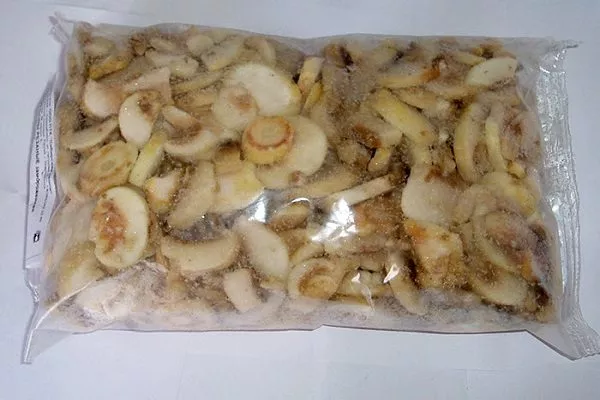
- Transfer to a plastic container or cellophane bag and place in the freezer.
The process of freezing cooked mushrooms:
- Rinse the champignons with clean water and chop.
- Pour water into a saucepan, add salt, and bring to a boil.
- Place prepared mushrooms in boiling water and cook for 10 minutes.
- Place in a colander (this will drain off excess liquid).
- Place the cooked product on paper towels and leave to dry.
- Place the prepared mushrooms in cellophane bags.
- Place in the freezer for storage.
If you need to freeze fried champignons, you need to follow the following sequence of steps:
- Wash the mushrooms.
- Cut and place in a frying pan with heated oil (sunflower).
- Continue frying until all the liquid has evaporated.
- Transfer the mushrooms to napkins or paper towels and let them cool completely. The paper will absorb any excess oil.
- Place the product into portioned bags.
- Place in the freezer for storage.
Frozen mushrooms should not be consumed after the stated expiration date. This can lead to serious poisoning. To make it easier to track the expiration date, the container (package) is marked with the date of storage.
Freezing champignons correctly is only half the battle. You need to know how to defrost the product so it retains its flavor and nutritional properties.
The defrosting procedure is performed as follows:
- Transfer the mushrooms from the freezer to the refrigerator.
- Leave for 6–20 hours. It's difficult to give an exact time, as it all depends on the number of mushrooms in the container. Watch for the moment when the mushrooms, all the way to the center, begin to separate freely from the rest of the mass.
- Remove from the refrigerator and let stand at room temperature for 20–30 minutes. If you're slicing raw mushrooms, it's best not to let them defrost completely.
In vacuum packaging
This method works well if you have a vacuum sealer at home. Purchasing a special device for small quantities of mushrooms isn't practical.
This option allows you to store raw mushrooms for up to two weeks without freezing. Dried mushrooms can be stored for the same amount of time outside the refrigerator.
If you don't have a household bagger, you can try to remove air from bags yourself using improvised means.
Please follow these steps:
- Buy some zip-lock bags and thin paper straws.
- Place the product in bags in one row.
- Close the container almost completely (leave a small gap for the tube).
- Insert the tube into the opening. Use your mouth to suck out as much air as possible.
- Quickly remove the tube and close the bag completely.
The home-grown method won't provide 100% oxygen extraction results. Therefore, store fresh mushrooms only in the freezer, and dried ones in the refrigerator.
In plastic containers
This storage method is convenient if the mushrooms will be used soon.
To keep the product fresh:
- Place the prepared mushrooms in a single layer in a plastic container.
- Cover the top with a layer of paper towel.
- Place the container in a separate compartment in the refrigerator (intended for different vegetables).
- Store fresh product in this way for 6-7 days, but no more.
Plastic containers are widely used for freezing mushrooms. This is somewhat inconvenient, as they take up a lot of freezer space.
The procedure is as follows:
- Place the prepared mushrooms in small pieces in a plastic container.
- You can add the whole product or chopped it up.
- Close the container tightly with a lid.
- Place the mushrooms in the freezer.
- Store the product in this form for no longer than six months.
In a cloth bag and a paper bag
For storage, use bags made of natural fabric or simple paper bags. Fresh or pre-dried mushrooms are transferred to containers and placed in the refrigerator's produce section.
The shelf life in a cloth bag is one week. Mushrooms stored in paper bags can be stored for no longer than 3-5 days. It is recommended to store no more than 0.5 kg of product in a single bag.
Linen or canvas bags are suitable for freezing mushrooms. They can be stored for up to 3–4 months.
In a metal container
This method is most often used for canned goods. By metal container, we mean a tin can.
Once opened, the product should be consumed within 1–2 days. If the mushrooms are transferred to a glass container along with the liquid after opening, the shelf life is extended to 4–5 days.
In cling film (cellophane)
Dried and fresh mushrooms are often stored in the refrigerator wrapped in plastic wrap or a plastic bag. They should be placed only in the vegetable compartment.
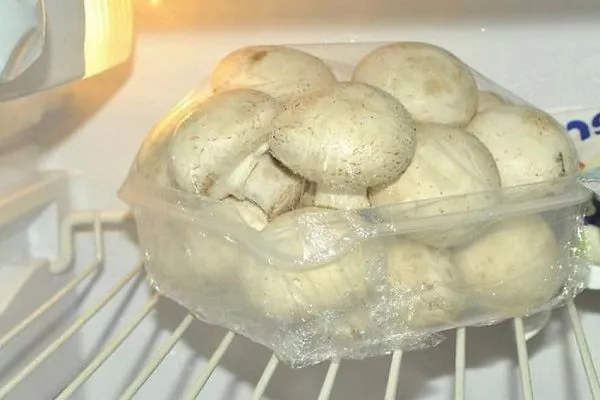
Periodically, the bag or film should be opened and aired. This will help extend the shelf life.
In a glass container
Glass containers are often used for storing mushrooms on the refrigerator shelf. The steps vary depending on the type of mushroom.
To store raw champignons:
- Sort the mushrooms and place them in a single layer in any glass container.
- Cover the top with a paper towel.
- Place the container in the vegetable compartment of the refrigerator.
The shelf life of a fresh product is 6–7 days. Remove the paper towel periodically to prevent condensation.
To store fried food in a glass container, use cling film instead of a lid. The shelf life is 3 days. If mayonnaise or sour cream was used during frying, consume the semi-finished product within 24 hours.
For canned mushrooms, a glass container with a tight-fitting lid is a good alternative to a tin. Store the canned mushrooms in a cellar, basement, or refrigerator. Store the mushrooms this way for up to 12 months.
In the cellar
Fresh mushrooms can be stored whole in the basement or pantry, both summer and winter. They are placed in metal, plastic, glass, or tin containers. Plates, boxes, and trays are also ideal.
You can store the product in simple plastic bags. In this case, open them regularly and allow for some airing.
At room temperature
Unrefrigerated, raw or cooked champignons have a shelf life of 7 hours. After just 8 hours, hazardous toxic substances begin to form in the mushrooms.
Fried mushrooms can be left at room temperature for 2–3 hours to cool. Then, they must be refrigerated.
Marinated products can be stored for a long time without refrigeration. If the product is in an airtight container, the shelf life is approximately 90 days.
The expiration date has expired: what to do?
Many home cooks face the unfortunate situation of mushrooms reaching their expiration date. In this case, the product cannot be used for cooking, as even heat treatment does not remove hazardous toxic substances.
Even if mushrooms retain their perfect appearance, it's best to discard them. The greatest danger comes from mushrooms that have begun to turn black. Such mushrooms are strictly prohibited for consumption. They already contain dangerous toxins that can cause serious food poisoning.
There are a variety of ways to store champignons. The choice of method depends on the time frame for using the semi-prepared mushrooms. If you don't plan to store the mushrooms for a long time, don't waste money on vacuum-sealed bags. It's easier to place them in a jar or plastic bag and refrigerate them. In any case, it's important to not miss the expiration date.