
Agaricus bisporus (Agaricus bisporus) belongs to the Agaricus family, lamellar type, and agaricomycetes class. Other names include Agaricus bisporus (Latin), royal, two-spore, brown, and cultivated. It grows wild and is cultivated commercially. Many farmers and gardeners grow the mushroom at home.
Briefly about the origin
Initially, the two-spore button mushroom was mistaken for the common button mushroom. Until 1906, when scientists discovered differences in the mushrooms, it received its proper name. Until 1930, it was considered a product of natural selection, but then wild specimens were discovered.
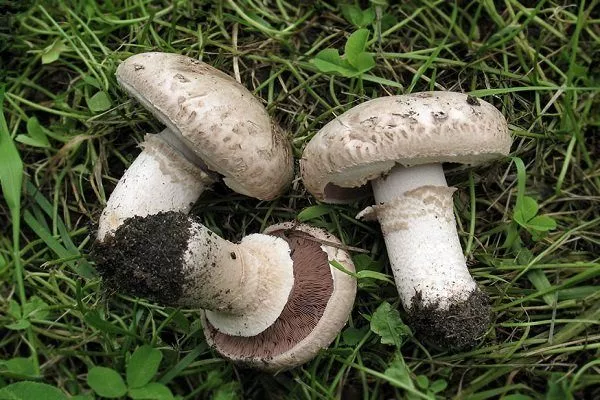
The cultivated champignon has been known to mankind since the 17th century. It is considered to have originated in Italy. It was brought to Russia in the 18th century.
Cultivated worldwide, it occupies a leading position. Almost 80% of all commercially available mushrooms are bisporous.
Description of the two-spore champignon
The royal champignon is divided into three subspecies: the first (wild) is brown, while the second and third (cultivated varieties) are creamy and white. They are similar in characteristics, with only the coloration being their distinguishing feature.
hat
At the very beginning of the growing season, the color of the cap is much lighter, but upon reaching maturity, the mushroom acquires a more saturated shade, depending on the subspecies.
Peculiarities:
- diameter from 5 to 16 cm;
- shape - spherical at the beginning of growth, hemispherical in the middle, spread out and convex at the end;
- the edge is initially folded inward, then lowered down;
- bedspread - remains present;
- the center of the cap is often slightly darker than the overall color;
- The surface of the selected ones is smooth and shiny, while that of the wild ones is silky, fibrous, covered with radial scales and cracks.
The flesh of this two-spore mushroom is dense and meaty. It has a pleasant mushroom aroma and a slightly tart flavor. It is white in color, but when cut, it takes on a delicate pink hue.
Spore-bearing layer and powder
The hymenophore is distinguished by a lamellar layer that changes color as it grows. Initially, it is pinkish-gray, later becoming dark brown, sometimes brownish with a purple tint.
Other characteristics:
- spore powder - dark brown;
- the arrangement of the plates is frequent, free and hanging;
- the edge of the plates is light.
Leg
The champignon mushroom is not considered too large. The stem length ranges from 3 to 8 cm, and the thickness from 1 to 4 cm. Other characteristics:
- the shape is cylindrical, but can be club-shaped;
- the ring is located at the top, has a whitish tint and a felt structure;
- rhizomorphs (white strands) are located at the base;
- the surface above the rings is smooth, light pink or grayish, fibrous;
- The surface under the rings is silky-fibrous, white.
Place of growth and fruiting period
The two-spore button mushroom can be harvested from early April to late September. It grows almost everywhere except in the northern regions, as it is intolerant to cold.
Prefers fertile soil. It is most often found in gardens and vegetable patches, near livestock farms, and in pastures. It requires the presence of grass or foliage.
Beneficial properties
The mushroom is considered a delicacy and is used in dietetics. It contains the following elements:
- vitamin E;
- vitamin PP;
- group B;
- iron, potassium, phosphorus, zinc;
- campesterol (natural antibiotic);
- amino acids and much more.
The calorie content of king champignons per 100 grams is only 25–27 kcal. It contains approximately 3% crude fat and 45% protein.
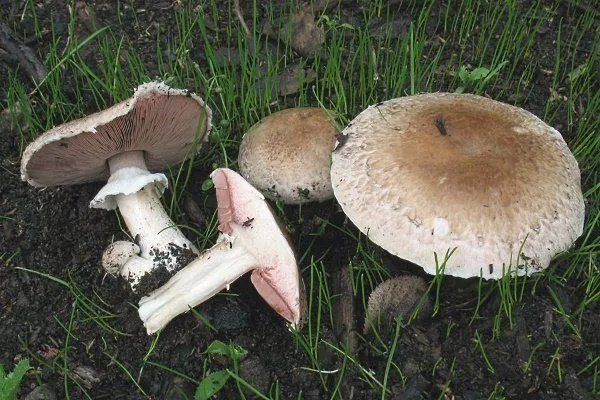
Beneficial properties:
- eliminates migraines and headaches;
- relieves fatigue;
- improves skin structure;
- promotes weight loss;
- destroys viruses and bacteria:
- suppresses cancer cells;
- disinfects;
- reduces blood sugar and cholesterol levels;
- has an immunostimulating effect;
- used for paratyphoid and typhoid fever;
- improves the digestibility of food products and nutrients;
- speeds up metabolism.
Possible harm and contraindications
All mushrooms are toxic, so consuming them in large quantities is contraindicated. Harmful mushrooms may be harvested from roadsides, industrial facilities, landfills, and other hazardous environments.
Contraindications:
- individual intolerance to mushroom products;
- age up to 5 years;
- chronic gastrointestinal diseases in the acute stage.
Preparation
The two-spore button mushroom is used for frying, boiling, stewing, pickling, and canning, but it can also be eaten raw (in very limited quantities). It belongs to food category 2 and has a pleasant flavor and aroma.
Before using mushrooms in culinary dishes, they must be properly prepared:
- Remove dirt with a brush or cloth.
- Trim 2–3 mm off the stems. If there are any damaged or rotten spots, remove them with a knife.
- Rinse under running water.
- Dry with a paper or cloth towel.
Cooking and frying rules that must be strictly followed:
- cook for about 7-10 minutes, then let the water drain, otherwise it will saturate the structure of the mushroom too much;
- You need to fry the raw product for no more than 15 minutes and 5 minutes if it is already cooked.
Growing at home and in the garden
In large industrial farms, straw mixed with horse manure is most often used for cultivation. This yields approximately 15 kg of yield per square meter. The substrate is changed after three harvests. At home, the technology is slightly different.
Breeding conditions
Growing two-spore button mushrooms requires specific conditions. These are as follows:
- the room air temperature at the time of germination is about + 15°C, then + 20°C;
- air humidity from 85 to 90%;
- Lighting - bright lamps are excluded.
- ✓ Optimum substrate temperature for mycelium: +24°C to +26°C.
- ✓ Critical pH level of the substrate: 7.0-7.5.
If you plan to grow mushrooms as a business, you need to create greenhouse-like conditions for them. This can be done in a built and shaded greenhouse or basement.
Planting material can be purchased at specialty stores, but this is expensive for a beginning mushroom farmer. The best option is to collect the spores yourself.
How to do it:
- Prepare the nutrient medium. There are two main methods:
- Mix 2 liters of water with 3 tablespoons of oatmeal and 7 tablespoons of agar-agar, bring to a boil, strain the cooled liquid;
- Combine 2 liters of water with 1 kg of carrot extract and 40 g of agar-agar, boil for 30 minutes.
- Collect the mushrooms and place the resulting mixture in a glass jar.
- Using tweezers, pinch off a small piece of the mushroom and dip it in hydrogen peroxide for a second to kill pathogenic microorganisms.
- Place in a container with substrate and close the lid.
- Leave for 12 days at a temperature of + 25°C.
- After the formation of whitish fibers, transplant to a permanent location.
Planting process and care
The first harvest after mycelium transplantation is obtained in 60–70 days. For growing, prepare a nutrient substrate:
- Soak the straw for 3 days.
- Take the same amount of manure (you can use cow manure).
- Place the straw/manure mixture in layers in the pile. Each layer is approximately 34 cm thick. There should be 4 of each.
- Add some fertilizer according to the instructions for the specific product. Superphosphate can be used.
- Moisturize daily for 7 days.
- Break up the substrate with a pitchfork.
- Repeat this 4 times with an interval of 4 days.
- During the final mixing, add 20% of the total mass of chalk or gypsum.
| Method | Preparation time (days) | Efficiency |
|---|---|---|
| Straw + horse manure | 21-28 | High |
| Straw + cow dung | 28-35 | Average |
The soil readiness is checked simply:
- there should be no ammonia smell;
- the mass does not stick to your hands;
- the mixture is loose and moist;
- straw breaks easily.
How to plant:
- Place the substrate into prepared containers (wooden boxes, bags, etc.) to a depth of 50 cm.
- Compact and water generously with warm water.
- After 3 days, spread the mycelium evenly over the surface of the created bed. Leave 16–20 cm between each piece of mycelium.
- Be sure to cover the top 3-4 cm with the same soil.
Similar species
| Name | Cap color | Cap diameter (cm) | Aroma |
|---|---|---|---|
| Asset | White | 5-16 | Mushroom |
| Crooked | Brown | 5-16 | Anisic |
| Bernard | White | 5-16 | Mushroom |
| Möller | Smoky | 5-16 | Mushroom |
| Yellow-skinned | White | 5-16 | Mushroom |
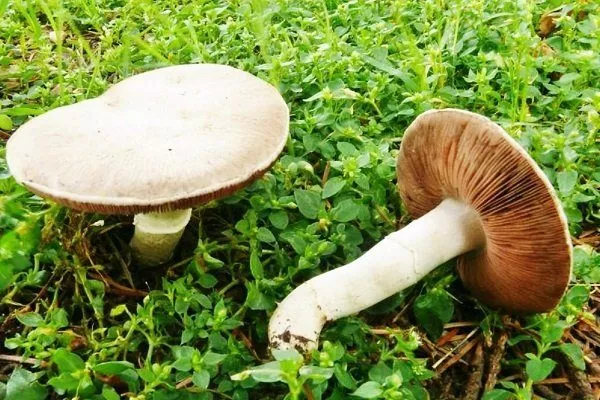
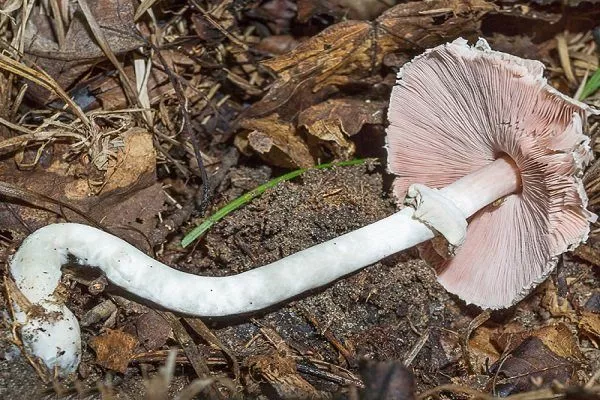
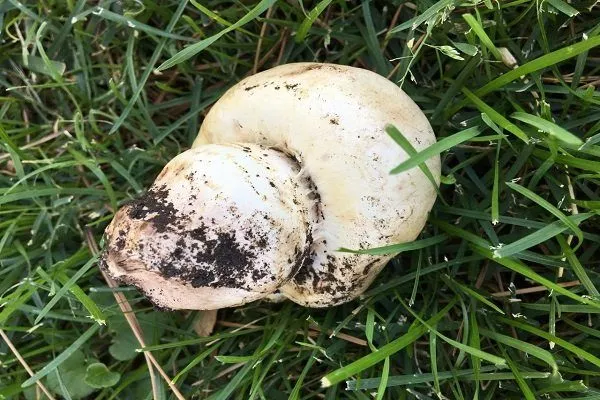
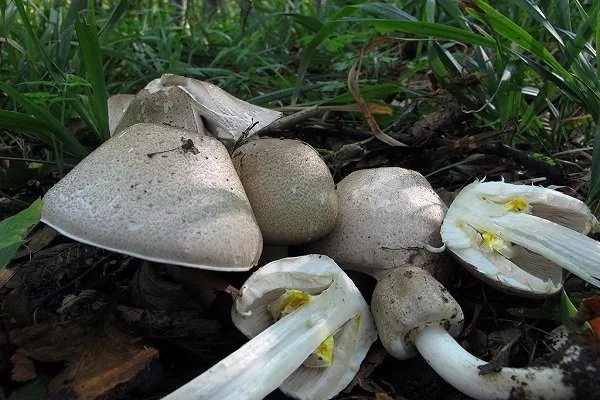
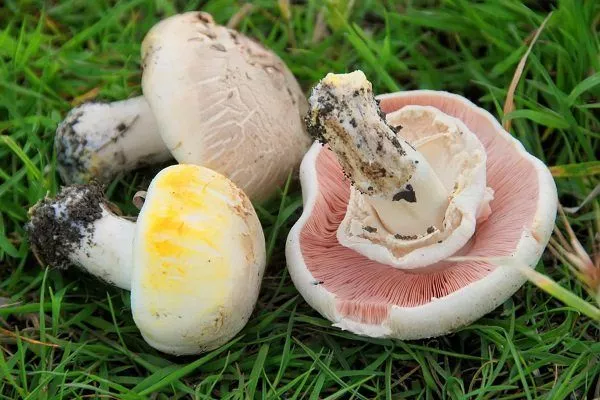
There are a number of mushrooms that resemble the Agaricus bisporus, but there are still some minor differences. Among these, some are edible, some are poisonous:
- Asset. Edible and tasty. It grows most often in coniferous forests. The fruiting body is whitish, the stem is thinner, and the ring is torn.

- Crooked. Used as food, it can be brown and also grows in spruce forests. Its distinctive feature is its aniseed aroma and flavor.
- Bernard. The fruiting body is identical to the two-spore fruit, but when cut, the flesh is more pinkish. The ring is unstable.
- Möller. A poisonous champignon with a smoky tint on its cap. Its stem is white to brown and grows in the same area as the two-spore champignon.
- Yellow-skinned. Another poisonous member of the champignon family. It's very similar to the two-spore mushroom, but if you press on the flesh, a bright yellow color immediately appears.
How to store?
Two-spore champignon stored in different waysThe most common options are:
- Frozen. To do this, mushrooms are first boiled or fried, but it is also acceptable to put them in the freezer raw.
- Fermentation and pickling. The shelf life isn't very long, but the mushrooms are delicious. There are many recipes for this.
- Canning. An excellent option if you want to make salads and appetizers from mushrooms.
- DryingThey keep for almost a year. These mushrooms can be fried, added to soups, used in sauces, etc.
The two-spore button mushroom is distinguished by its excellent taste and quality, good yield, and long fruiting period. These factors make it popular among farmers for mass cultivation for sale and among professional mushroom pickers.