
The Satan's mushroom (Latin: Boletus satanas) has earned its resonant and ominous name for a reason. Its insidiousness lies in its rare ability to mimic its edible relatives. An experienced mushroom picker would be hard-pressed to confuse the "devil's mushroom" with edible boletus, popularly known as the "white mushroom." You can distinguish this mimicry enthusiast from the "king of mushrooms" by the reddish color of its stem.
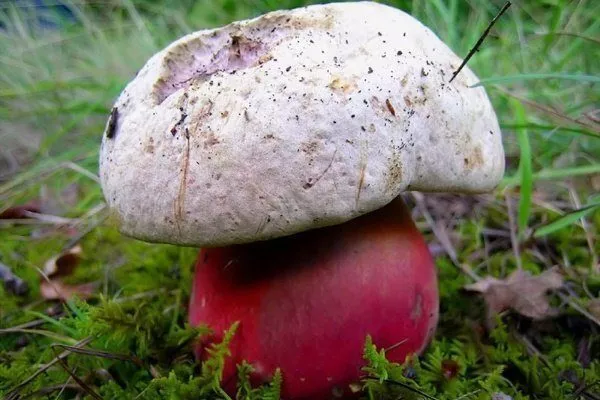
Poisonous boletus
| A type of boletus | Toxicity | Habitat | Distinguishing feature |
|---|---|---|---|
| Satanic | Deadly poisonous | Southern Europe, Caucasus | Red leg with mesh |
| Felt | Conditionally edible | Far East | Orange pores |
| Pink-skinned | Poisonous | Central Europe | Pinkish flesh |
| Beautiful | Deadly poisonous | North America | Brown hat |
| Frost | Conditionally edible | East Asia | Yellow tubes |
In appearance, this pretender doesn't look anything like a poisonous mushroom. Inexperienced mushroom pickers often mistake it for edible prey. It's large and thick, and looks like a boletus—why not add it to your basket? It belongs to a group of red-colored boletuses in the Boletaceae family. These boletuses are little studied. Besides the devil's mushroom, there are a great many others. Its equally poisonous relatives, the boletus, are:
- felt;
- pink-skinned,
- purple;
- beautiful;
- Frost;
- Burroughs and others.
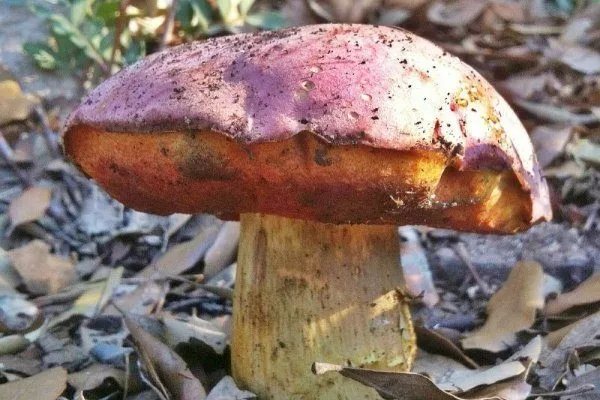
The poisonous felt mushroom boletus
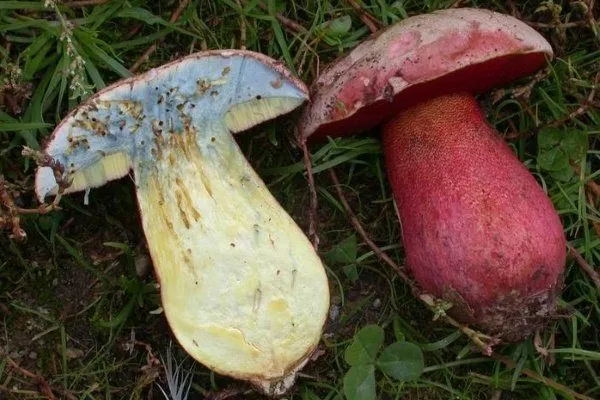
Pink-skinned poisonous mushroom
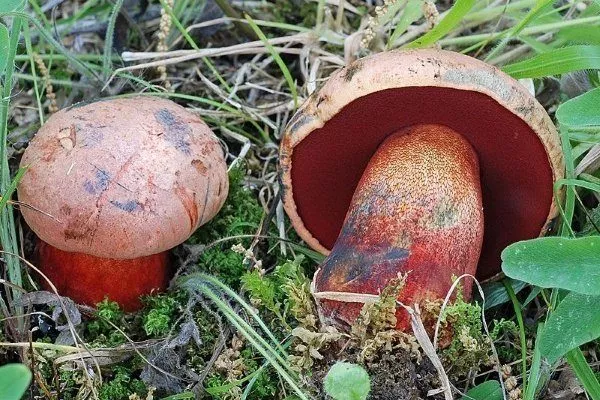
Purple poisonous boletus
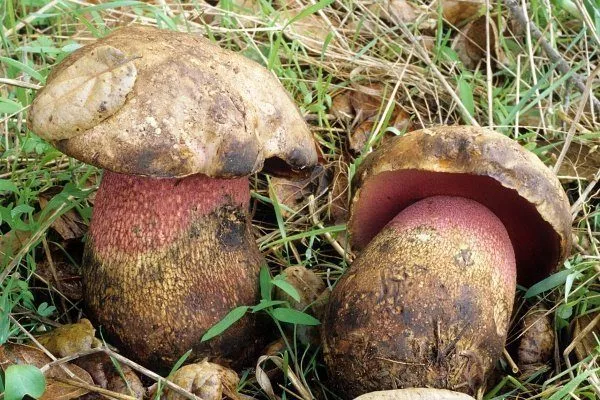
A beautiful poisonous mushroom
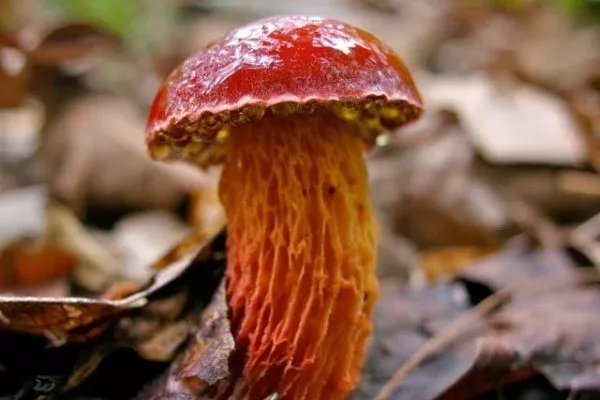
Frost's poisonous mushroom
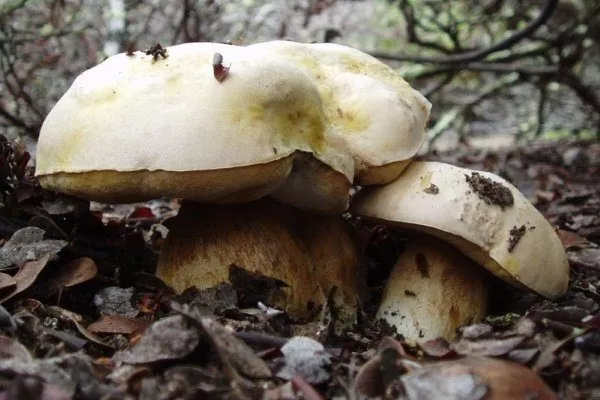
Burrows's mushroom is a poisonous species of boletus.
Characteristics of the Satanic Mushroom
A typical representative of the boletus family. Its appearance:
- Hat. It is characterized by its massive size. It reaches 20-30 cm in diameter. The cap is dull and muted in color. It is cushion-shaped. The cap may have some damage or roughness. The cap, covered with a velvety, dense skin, can be gray, olive, beige, or cream.
- Tubular partIts thickness does not exceed 2 cm. It is distinguished by a rich color scheme. The tubes begin as yellow, transition to blood-red, and then turn olive. When damaged, they turn blue.
- Disputes. The color varies from green to olive-brown. Size: 10-16 x 5-7 µm. They have a spindle-ellipsoid shape.
- Leg. Like the cap, it is quite massive. The average length of a mature specimen is 15-17 cm, and the width is 10 cm. The stem is oval or almost spherical. It has a distinctive narrowing where it joins the cap. The color can be very vibrant—red, beetroot, or orange-crimson. A distinctive feature is the reticulated pattern.
- Pulp. When broken, it has a yellow, cream, or beige color. It slowly turns blue when broken. It has a watery texture. Color depends on the growing conditions. Specimens grown in the shade tend to have dark and dull shades. Those grown in the sun have a brighter and more saturated palette.
In this video, an experienced mushroom picker will show what a satanic boletus looks like and how it differs from an edible porcini mushroom:
Distinguishing features
As this member of the boletus family ages, it develops a distinctive odor reminiscent of carrion or spoiled food. Young mushrooms, however, have a much more pleasant aroma—a blend of pleasant mushroom and spicy notes.
This variety of boletus is characterized by an astonishing ability to adapt, mutate, and mimic. It can imitate a wide variety of its relatives—both edible and semi-edible. Because this pretender is rare in our forests, poisonings from it are rare.
Where does it grow?
The mushroom prefers light deciduous forests. It thrives in hazel thickets, under hornbeams and beeches, and among lindens and chestnuts. It is common in southern Russia, the Caucasus, the Middle East, and southern Europe. It grows from early summer until October.
Periods of activity
- June-July: single specimens
- August: Massive growth
- September: peak fruiting
- October: End of the season
Favorite soil: limestone.
Fortunately, the Satan's Bolete is a rare inhabitant of Russian forests. This is confirmed by the lack of numerous names. Common species typically have dozens of popular names. Among the few names for this mushroom is the Satan's Bolete. From Latin, "bolete" translates as "porcini mushroom."
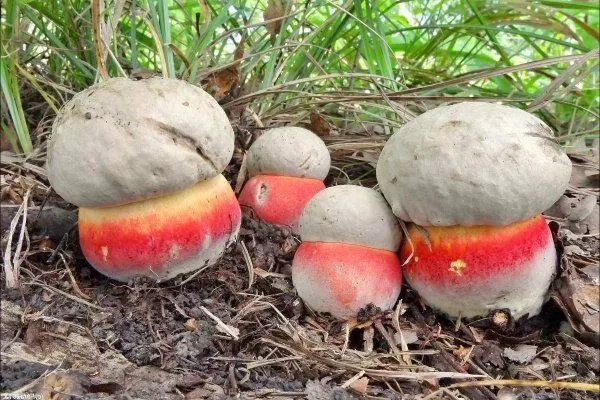
How to distinguish them from edible oak mushrooms?
| Criterion | Satanic | Dubovik |
|---|---|---|
| Speed of turning blue | Slow (5-10 min) | Instant |
| Leg color | Bright red | Yellow-brown |
| The smell of old mushrooms | Cadaveric | Mushroom |
| Mesh on a leg | Large | Thin |
Experienced mushroom pickers will never confuse the forest devil with the real edible boletus, but they can easily confuse it with its variety, the olive-brown oak mushroom.
Differences that can help you distinguish two similar mushrooms. The olive-brown oak boletus:
- hatVelvety. Color – dark olive or yellowish-brown.
- Pulp. Lemon-colored. It turns blue immediately when broken, rather than gradually, like the Satanic boletus.
The boletus is edible, but when eaten raw, it can cause dyspepsia. When combined with alcohol, it becomes poisonous.
Edible or not?
In Russia, mushroom pickers consider the "forest devil" mushroom to be unequivocally poisonous and avoid it. But in Europe, they don't shy away from it. According to the mushroom classification of the last century, it is considered conditionally edible. This means that after proper processing, it can be eaten.
To neutralize the toxins, a ten-hour soak is necessary. After such a long period of soaking, the mushroom flesh becomes tasteless. However, if it is not soaked in cold water, toxic poisoning can occur:
- liver;
- nervous system;
- spleen.

Eating the raw flesh of the Satan's mushroom is strictly prohibited, as it can cause serious poisoning. To neutralize the toxins, the mushroom must be boiled for at least 10 hours.
In a number of Central European countries, extreme gourmets consider the devil's cap mushroom not only a palatable food but also "devilishly" delicious. But it's best to listen to mycologists—scientists who study the mushroom kingdom. They claim that while this boletus-like mushroom isn't deadly, it's extremely poisonous. They're echoed by emergency room physicians, whose expertise is worth listening to.
In the Czech Republic and France, this dangerous member of the mushroom kingdom is harvested. But the debate over its toxicity continues.
Signs of poisoning
Eating the Satanic mushroom raw results in severe poisoning. Symptoms:
- confusion;
- constant urge to vomit;
- bloody diarrhea;
- paralysis;
- hepatic colic;
- spasms in the calf muscles;
- severe headache.
Along with the main symptoms, a poisoned person may also experience:
- vision will be impaired;
- drop in pressure;
- profuse lacrimation may occur;
- blush your face.

The WHO has concluded that 10 grams of raw Boletus satanas pulp is enough to cause cardiac arrest or paralysis of the nervous system, leading to respiratory arrest.
The mushroom is poorly studied, but it is known to contain muscarine and glycoprotein, which can cause toxic effects. Mycologists urge mushroom pickers, despite its relative edibility, not to eat the devil's cap. It's impossible to determine the poisonousness of a particular specimen at home. And the consequences of eating it are also unclear.
How to provide first aid?
If you take a series of simple measures in time, you can avoid serious consequences from consuming the poisonous satanic mushroom:
- Call a doctor. Don't force yourself to go to the hospital. Lie down and wait for the doctors to arrive. Relax and stay in bed.
- While the doctors are on their way, drink activated charcoal.
- Drink more cold liquids – filtered water and strong tea.
While waiting for medical attention, you can flush your stomach with a baking soda solution. Use 2 teaspoons of baking soda per liter of water.
If you follow all first aid measures and receive proper treatment, you'll be back on your feet within 24 hours. The severity of poisoning depends on the toxicity of the individual specimen—if a large amount of poison enters the body, treatment can take weeks.
Practical benefits
The Satanic boletus, growing under its "favorite" trees, forms a special tissue—a fungal root. Scientifically, this tissue is called mycorrhiza. A certain form of mycorrhiza can envelop the root system of trees, forming a sort of sheath. The poisonous boletus, entangling tree roots, penetrates the internal structures of the wood. The boletus can fuse with the tree, developing and growing within the roots.
Mycorrhiza is of economic importance. Scientists have learned to isolate microbiological inoculants from it. These are used in agriculture to increase crop yields. Thanks to mycorrhiza, plants extract maximum nutrients and moisture from the soil.
In our country, attitudes toward the satanic mushroom are unanimous: it's poisonous and therefore not suitable for collection, much less cultivation. Its use in microbiology is limited to laboratories and is not widespread.