
Mushrooms can be grown year-round, requiring minimal time and effort if you properly convert a greenhouse previously used for growing seedlings or build a greenhouse specifically designed for this crop. We'll explore the requirements for this structure and how to build one yourself.
Greenhouse requirements
Mushrooms can be grown in a greenhouse made of any material—polycarbonate, film, or glass. However, it must meet the following requirements:
- Have a heating systemIt's better to opt for a hydronic system, as it doesn't dry out the air as much as other heating methods. This setup generally ensures fresh air in the greenhouse, which is essential for mushroom growth.
- Assume high-quality sealing and insulationWithout them, it will be impossible to maintain a stable microclimate indoors, as well as optimal temperature and humidity levels.
- Have a ventilation system or supply and exhaust ventilationIt provides the mushrooms with the fresh air they need to develop quickly and properly.
- Have an irrigation systemThe mycelium requires regular watering, so it's important to ensure easy access to water. Spraying is considered optimal. If the greenhouse is small, all manipulations can be done manually, but if it's larger, it's best to consider a special spray system.
- Provide protection from direct sunlightFor these purposes, the roof of the structure can be covered with curtains made of less transparent (matte) film or whitewashed with lime.
- Have the right equipmentA greenhouse for growing mushrooms also needs to be equipped with shelves or tables for placing containers. Special stands for hanging blocks or containers can also be used for this purpose.
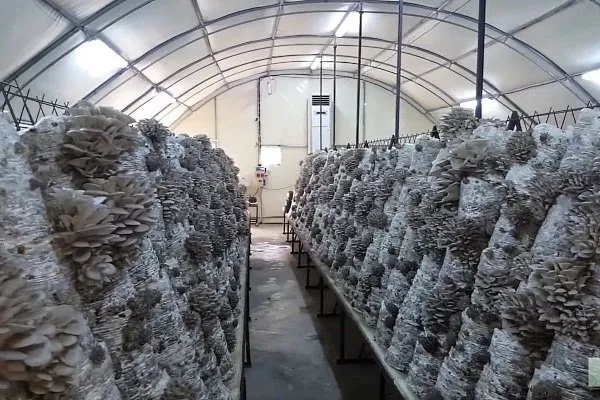
Basements of residential buildings should not be used for growing mushrooms, as excessive moisture will lead to destruction of the foundation and collapse of the building.
Organizing a greenhouse
Mushrooms are typically grown in cool weather—from October to April—so a regular plastic greenhouse, previously cleared of vegetables, is often used for this purpose. However, converting a standard polycarbonate greenhouse for mushroom cultivation requires a number of modifications to the structure. The converted greenhouse can then also be used for growing seedlings and vegetables.
Sealing and insulation
If the greenhouse structure is installed properly, there will be no gaps through which heat can escape. In this case, sealing will not be necessary. However, if installation was performed improperly or careless use has caused damage, cracks, and gaps to form in the shelter itself or between it and the frame, the greenhouse will need to be sealed. To do this, follow these steps:
- Identify all damage to the film or polycarbonate and carefully seal it with tape.
- If there are gaps between the frame and the base, they must be sealed with a high-quality sealant.
- Seal the door and vents with a rubber seal and additionally install locks.
- Cover the ground with metallized polyethylene foam to provide thermal insulation from the cold ground.
To save money on heating, it is recommended to additionally insulate the interior of the greenhouse by creating a second shelter circuit:
- Install arcs made of PVC pipe or fiberglass rebar inside the greenhouse. They should be tall enough to accommodate the mushroom racks and allow the grower to move freely.
- Stretch a thick covering material over the installed materials.
It should be noted that double greenhouse covering has many advantages:
- improves thermal insulation;
- reduces the impact of direct sunlight on mushrooms and protects against additional burns;
- helps maintain a more even and stable microclimate, even in the event of sudden changes in temperature outside the greenhouse.
A double-cover greenhouse looks like this:
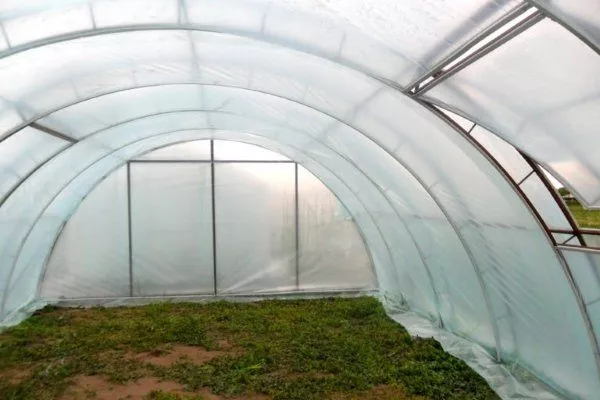
For additional insulation, you can also attach a polycarbonate frame to the inside of the greenhouse. The resulting air gap between the outer and inner sheets will provide excellent thermal insulation.
To protect mushrooms from sunburn, it is recommended to use colored or translucent polycarbonate.
Curtaining
If the greenhouse is insulated with colored polycarbonate or agrofibre, there's no need for curtains, as these materials are excellent at diffusing sunlight and reducing light levels. Otherwise, curtains are required, which can be accomplished in two ways:
- install curtains made of thick fabric under the roof of the greenhouse;
- whitewash the structure with lime mortar.
Experienced farmers recommend the second method, as whitewashing with lime not only helps protect mushrooms from solar radiation, but also effectively disinfects the walls of the structure.
Ventilation
Mushrooms require a constant supply of fresh air, especially during active growth, so the greenhouse should be equipped with a ventilation system. This can be set up as follows:
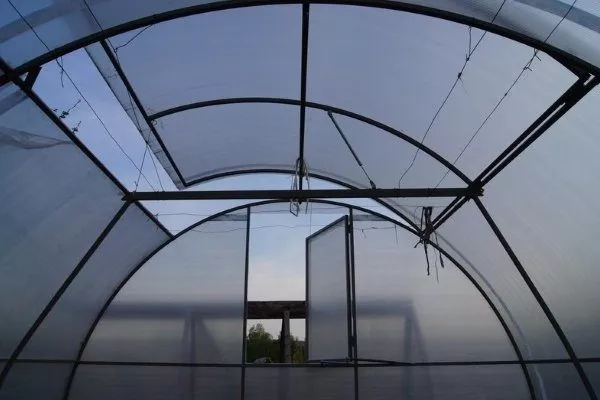
- Install a standard vent above the doors or in the roof of the greenhouse. Installing vents on the walls is not recommended, as this will allow drafts to pass through the mycelium itself.
- Install ventilation equipment, as keeping the window open isn't possible in all weather conditions. Furthermore, access to it may be difficult if double-glazed. Therefore, supply and exhaust ventilation pipes should be installed in the greenhouse, running them through the roof or end wall.
For the supply and exhaust ventilation to operate naturally, that is, according to the laws of air exchange and without ventilation, the bottom of the supply pipe should be located 15-30 cm above the floor. This way, the exhaust pipe will draw warm air from the ceiling.
- Install a fan, as airflow and outflow may become restricted. It's also important to consider that some types of mushrooms (such as oyster mushrooms) require very high airflow volumes during certain growth periods, which is virtually impossible to achieve without a forced ventilation system.
Natural ventilation of a greenhouse can be organized in the following way:
Water supply
To water the substrate and maintain the desired humidity level, a fine mist of water should be installed in the mushroom garden. For maximum water purification, a filter should also be installed. This is a must if the water is supplied from the sewer system.
- ✓ The water temperature should be between 18-22°C for optimal mycelium growth.
- ✓ The pH level of the water should be neutral (6.5-7.5) to prevent acidification of the substrate.
When choosing an irrigation system, you need to consider the dimensions of the room:
- If the greenhouse is small, manual sprayers can be used. Simply water the crop with a hand-held sprayer. Furthermore, when watering manually, experts recommend placing containers of water directly under the mycelium to maintain a sufficient supply and a suitable temperature, as well as to increase the humidity level in the mycelium.
- If the greenhouse is large or you don't want to waste time on watering, you should install a full-fledged humidification system, which will also provide automatic watering. To water the mycelium with soft, melted water, a system of tubes connected to a pump should be installed in the soil. For larger operations, you can install a tube that automatically moves along guides, creating the pressure needed to evenly spray water onto the mushroom racks. This simultaneously maintains humidity in the air and the substrate.
The best indicators of acidity (pH) and hardness (dGH) are melt, rain or river water, which should be used for spraying the substrate and mycelium.
Heating system
To maintain the optimal temperature for mushrooms in the greenhouse during winter, a heating system is necessary. This is most easily accomplished by connecting the greenhouse to the house's hot water heating system via a balancing valve, which makes it easy to regulate the temperature within the desired range.
If connecting to a hot-water heating system isn't possible, you'll need to install a separate heating device. In this case, the best option is an electric boiler equipped with an automatic and safety system. If the greenhouse is small, you can choose a low-power, affordable device. It offers the following advantages:
- allows you to easily regulate the temperature as the mushrooms develop;
- maintains the set air temperature automatically;
- requires little space;
- easy to install and connect according to the attached diagram;
- does not require installation of a chimney.
The heating system with an electric boiler looks like this:
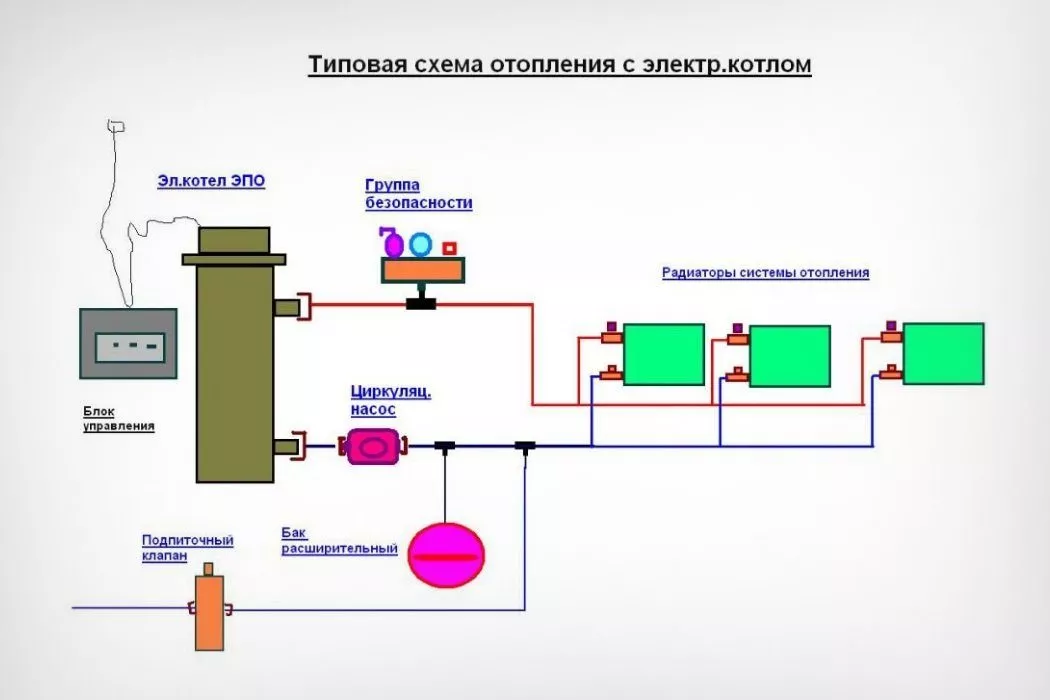
It should be noted that modern boiler models are equipped with a built-in expansion tank and circulation pump, ensuring safe operation and uniform heating of the entire greenhouse.
As for the disadvantages of electric boilers, the only one worth mentioning is their high electricity costs. To minimize these, it's necessary to properly insulate and seal the room, leaving no cracks or gaps. This will keep costs moderate, especially considering that mushrooms don't require particularly high air temperatures.
Radiators or registers made of large-diameter pipes, which are placed around the perimeter of the room at a low height, are also well suited as heating devices.
To reduce heating costs, radiators and temperature sensors should be located inside the additional shelter.
Lighting
This factor primarily depends on the mushroom variety. For example, oyster mushrooms don't require any lighting, so you can simply install lamps in the greenhouse for your own convenience. However, if you plan to grow button mushrooms and certain other types of mushrooms, this issue will require due consideration.
In the second case, it's best to install fluorescent lamps with an output of 100-180 lux/h in the greenhouse. Lamps labeled as DRL and DRLF are of higher quality, as they emit a red-blue spectrum ideal for mushrooms. These rays are invisible to the human eye, but plants are particularly sensitive to them.
The selected lamps should be evenly distributed throughout the greenhouse, preferably suspended from the ceiling. If this is not possible, the fixtures can be mounted on the walls.
It is necessary to use additional lighting on cloudy days and during the period of mushroom cap ripening.
What kind of shelving should I put in my greenhouse?
In the greenhouse, you need to install racks or stands depending on the technology mycelium cultivation and the type of mushroom. Furniture can be made of wood or metal, but the latter is preferable. Metal structures are easy to clean and disinfect, and they don't rot in high-humidity conditions. Furthermore, stands can easily be made from scrap metal, for example, using rebar trim.
Certain types of fungi can colonize wood, causing rapid deterioration, so wooden shelving is likely to have a short lifespan.
The design of the rack should be chosen based on the mushroom cultivation method. For example, if you plan to grow mushrooms on pallets, the greenhouse should be equipped with racks with several wide shelves. For ease of use, they can be installed at a slight angle.
If you plan to grow mushrooms in briquettes with substrate, it's best to install narrower racks or poles in the greenhouse to hang the briquettes from. It's worth noting that some prefer to place them directly on the greenhouse floor.
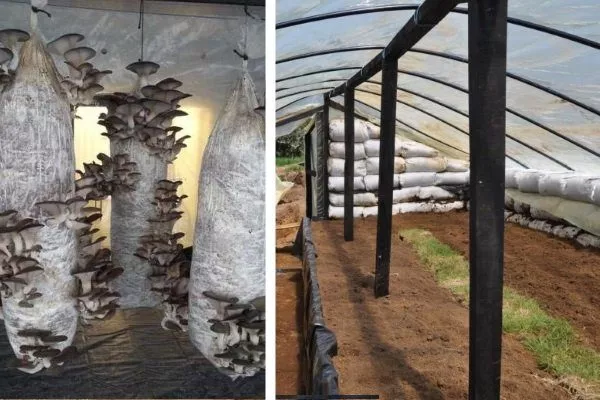
Racks for hanging bags with substrate
How to make a greenhouse for growing mushrooms all year round?
To harvest mushrooms year-round, it's advisable to install a special greenhouse, which has virtually no natural light and a high level of thermal insulation, achieved by burying the greenhouse in the ground and covering the roof with a biodegradable layer, such as manure.
Meanwhile, construction types may differ depending on the materials used to build the greenhouse—wood, film, or polycarbonate. Let's take a closer look at all three options.
Wooden structures
Wooden greenhouses are suitable for growing various types of mushrooms. They can be constructed from elements such as:
- wooden walls (board or log);
- compacted clay floor;
- garden bed;
- racks;
- roof;
- thermal insulation layer made of manure;
- choke with valve.
It's important to note that the wooden structure itself can be assembled using various designs. The following greenhouses are popular:
- Double-tier 4-flangeIt is buried 500-600 mm into the ground and insulated with a mixture of manure and clay. The length of such a structure can be from 25 to 30 meters. On average, it occupies an area of 200-230 square meters. Heating in such a greenhouse can be provided by electric, gas, or a stove. Natural light inside the greenhouse is weak or absent altogether. The appearance of such a structure can be seen in the diagram (Fig. A).
- Grachevskaya 7-flank, model 1861The Grachev greenhouse design is considered the most convenient for mycelium cultivation. It can be 4, 8, 15, or 25.2 meters long, and cover an area of 100, 200, or 300 square meters. This greenhouse is similar to a two-tiered, 4-flask design, but has been slightly modified to accelerate mushroom growth. Its appearance can be seen in the diagram (Fig. B).
- Combined two-tier 4-flangeIts length is 20 m, and the working area is 123 sq. m. This greenhouse differs from a standard 4-flange design only in its dimensions and internal components, as shown in the following diagram (Fig. B).
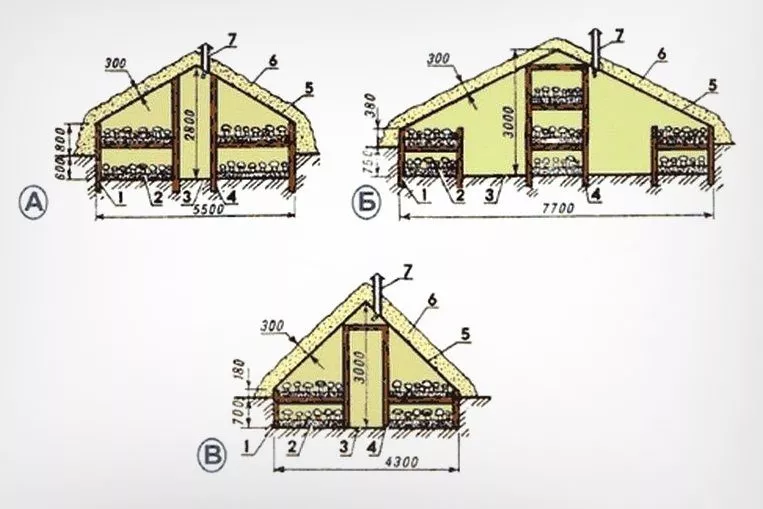
1 - wooden wall; 2 - flank or bed; 3 - compacted clay floor; 4 - wooden post with crossbars; 5 - gable wooden roof; 6 - heat insulation in the form of a layer of horse manure, which is covered with snow in winter; 7 - vent or air vent in the form of a wooden box with a felt-covered damper.
Interestingly, Moscow gardeners often use combined four-flank heated greenhouses to grow mushrooms from September to February. Once their rotation is complete, they use the hotbed to force early vegetables, replacing the wooden roof with greenhouse frames.
Film greenhouse
The base of this structure is a metal or wooden frame, which is tightly covered with thick film. This option is ideal for year-round cultivation of wild mushrooms.
To provide the greenhouse with the required level of thermal insulation and prevent excessive sunlight from reaching its walls, it is recommended to make the structure double – with an air pocket and an empty sealed space.
Polycarbonate greenhouse
Like the previous design, this greenhouse consists of a metal or wooden frame, but it is covered with translucent polycarbonate sheets instead of film. The frame can be rectangular or half-cylindrical. To grow mushrooms in this greenhouse for 12 months straight, it should also be constructed with a double wall and an air gap.
Helpful tips
To build a greenhouse and successfully grow mushrooms in it, it's worth considering a number of recommendations from experts:
- Aluminum is the best material for the structure's frame because it's lightweight and durable. Furthermore, it's corrosion-resistant and won't develop mold even in high-humidity conditions. For the same reasons, aluminum racks and stands are recommended for use in the mycelium.
- To improve thermal insulation, the floor should be covered with polyethylene foam or another material with similar properties. It's also important to carefully seal the greenhouse, as any cracks or holes in the cover will reduce heat output and, consequently, increase heating costs.
- A greenhouse intended for mushroom cultivation cannot have a translucent or transparent roof. It must be constructed or modified to dim the incoming light. Several tricks can be used to achieve this:
- paint the translucent ceiling with chalk;
- tint the roof and walls with special adhesive tape or mesh;
- curtain with synthetic translucent fabric.
- Any mycelium is always damp and humid, so to prevent mold and parasite growth, it's important to disinfect it regularly.
If additional lighting is required inside the greenhouse, fluorescent lamps can be installed.
What mushrooms to grow in a greenhouse?
| Name | Growing temperature (°C) | Humidity (%) | Ripening period (days) |
|---|---|---|---|
| Oyster mushrooms | 20-25 | 85-90 | 14-21 |
| Champignons | 15-20 | 80-85 | 35-42 |
| Shiitake | 12-18 | 80-85 | 60-90 |
| Porcini mushrooms | 18-22 | 85-90 | 90-120 |
In a properly equipped greenhouse, you can grow almost any type of mushroom, but the most popular are:
- ✓ The appearance of yellow spots on mushroom caps indicates excess light.
- ✓ Slow growth of mycelium may be caused by insufficient air humidity.
To breed them in large quantities, you should divide the greenhouse into several isolated rooms and install special equipment - a steam generator.
A well-designed greenhouse can grow mushrooms in large quantities, even in the most severe frosts. To achieve this, it's important to ensure the proper humidity and lighting levels, as well as ensure proper sealing and insulation.